
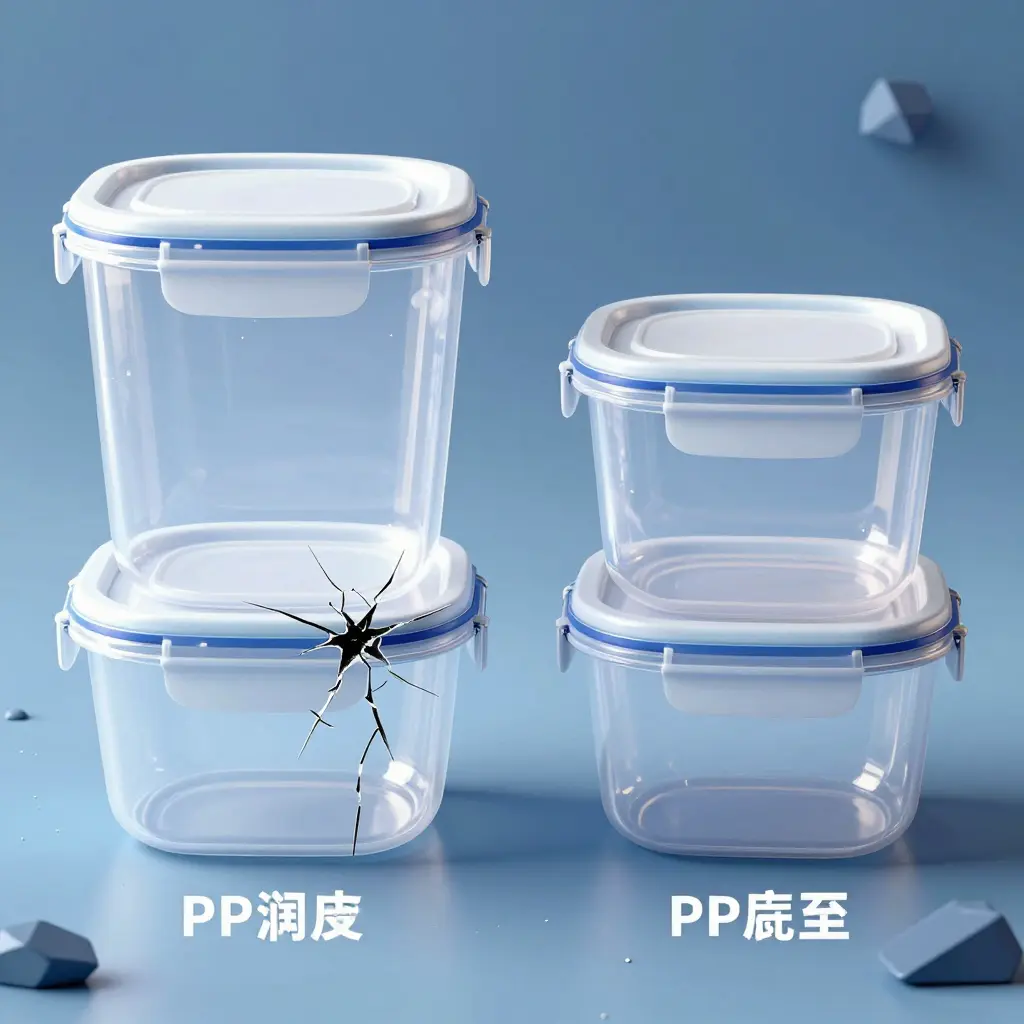
Halloween plastic food storage containers sit in one of the tightest production windows in the packaging calendar. From late August through October, manufacturers run themed bowls, compartment trays, and lidded tubs for party favors, candy sorting, and retail display. Lead times are short, volumes are high, and the finished goods spend a lot of time in the cold: refrigerated trailers, unheated warehouses, northern retail floors.
That combination keeps exposing the same failure mode. The containers crack. Whether a product survives the cold comes down to two variables: PP grade and wall thickness.
PP grade sets how the base material behaves at low temperature. Homopolymer polypropylene turns brittle as temperatures approach freezing. Random and impact copolymer grades stay ductile longer because their ethylene content absorbs stress instead of passing it on to the container walls. Wall thickness governs how fast a container reaches ambient temperature and where stress concentrates. Mold a 0.8 mm wall and a 1.5 mm wall from the same resin, and they will not fail the same way at 0°C.
This guide covers how PP grade and wall thickness interact in cold-service applications, the test methods that separate a reliable container from a brittle one, and the specifications manufacturers, converters, and retailers should confirm before committing to a Halloween production run.
How PP Grade Determines Cold-Weather Performance
Polypropylene is not one material but a family of resins, and the grade you specify does more to determine cold-weather survival than almost any other choice. PP’s main weakness is low-temperature brittleness, so its molecular architecture matters more than most other variables.
Homopolymer PP is propylene alone. It is stiff and heat-resistant, but its regular, highly crystalline structure makes it the most brittle of the three, and it can shatter below freezing. Random copolymer PP scatters small amounts of ethylene (roughly 1-5%) along the chain. That disrupts the crystallinity, improves clarity and flexibility, and gives noticeably better low-temperature impact strength. Impact (block) copolymer PP goes further, dispersing a rubbery ethylene-propylene phase through the polymer. The rubber absorbs impact energy, which makes it the best of the three against low-temperature cracking, at the cost of some stiffness and clarity.
Melt flow index (MFI) matters just as much. A higher MFI means shorter polymer chains: they flow easily but resist impact poorly. A lower MFI means longer chains, which are tougher and far more crack-resistant in the cold, but slower to mold. For a polypropylene food container headed to a chilly porch or a Halloween treat table, a low-MFI impact copolymer is usually the safest bet. Our plastic food container selection guide walks through matching grade to real-world use.
The table below lines the common grades up against the cold-weather factors that matter most: toughness, clarity, wall thickness, cold-storage suitability, and cost.
PP Grade Comparison for Cold-Weather Performance
| PP Grade | Low-Temperature Toughness | Clarity | Typical Wall Thickness Use | Cold-Storage Suitability | Relative Cost |
|---|---|---|---|---|---|
| Homopolymer | Low – brittle below 0C | Fair (translucent) | Thin to medium | Poor | $ |
| Random copolymer | Moderate | Good (clear-ish) | Thin to medium | Moderate | $$ |
| Impact (block) copolymer | High | Opaque | Medium to thick | Excellent | $$$ |
| Clarified high-clarity | Moderate to high | Excellent (near-glass) | Thin | Good | $$$$ |
If cold storage and drop resistance are non-negotiable, impact copolymer is the toughest option. When shelf appeal outweighs the cost, clarified high-clarity grades win. We cover that trade-off in our guide to Halloween plastic food storage containers.
Why Wall Thickness Decides Whether Containers Crack
Wall thickness is the most practical lever you have over cold-weather performance. When a container hits a fridge or a chilly porch, the plastic contracts. How fast and how evenly it contracts depends on how much material the heat has to pass through, and that is where the trade-offs begin.
Thin walls cool fast, which shortens cycle times and trims material cost. But rapid cooling locks internal stress into the part, and a thin section has little strength in reserve. When temperatures drop, that stress finds the weakest point, usually a corner or the rim, and turns into a crack.
Thick walls add rigidity and resist flexing under load, but they are not automatically safer. A heavy section cools unevenly, which can trap stress in the core and lead to warping and stress-cracking later. More material also means slower cycles and a higher unit price.
Designing for Even Cooling
The goal is not thick or thin but consistent. When wall thickness is uniform across the container, every region cools at roughly the same rate and no single area collects stress. Generous corner radii help for the same reason: sharp internal corners concentrate stress and become the first place a crack appears. These controls matter most when the PP grade has limited low-temperature toughness. A brittle grade paired with a jagged, uneven wall is a recipe for failure; a tougher copolymer forgives minor thickness variation. Getting the Halloween container geometry right before tooling saves costly rework.
In cross-section, the wall comes in two shapes. The thin-wall section has a narrow profile; the thick-wall section is wider. Arrows pointing inward mark the direction of thermal contraction as the ambient temperature falls, and the markers at the corners show where stress concentrates and cracking typically begins.
When temperatures fall, the polymer shrinks. In a thin wall the shrinkage is small, but there is less material to absorb flex, so stress builds quickly at tight corners. In a thick wall the outer skin cools faster than the core, creating internal strain that also collects at corners. That is why wall thickness and resin grade (PP homopolymer vs copolymer) decide together how well a container survives a cold snap. The plastic food containers guide covers the broader performance trade-offs.
How We Test Cold-Storage Performance
Before comparing polypropylene (PP) grades and wall thicknesses, it is worth knowing how a cold storage test is run. Our protocol has three parts: a drop test, a freezer hold test, and a crack count that turns raw failures into one comparable number.
Drop tests
We fill each container to its rated capacity with a water-and-gelatin mix that mimics frozen food, seal it, and condition it for 24 hours. It is dropped from a controlled height of 1.2 meters onto a steel plate, once at room temperature and once straight out of the freezer. Technicians then check every unit for visible fracture lines, lid separation, and hinge failure.
Freezer hold tests at sub-zero temperatures
Samples sit in a calibrated chamber at -18 C, -30 C, and -40 C for 24, 48, and 72 hours. That range exposes the brittleness PP develops near its glass transition, where most Halloween plastic food storage containers crack in the cold. The protocol follows recognized methods: ASTM D5276 (drop testing of loaded containers), ASTM D746 (brittleness temperature of plastics and elastomers by impact), and food-safety management practices consistent with ISO 22000.
How cracking rate is measured
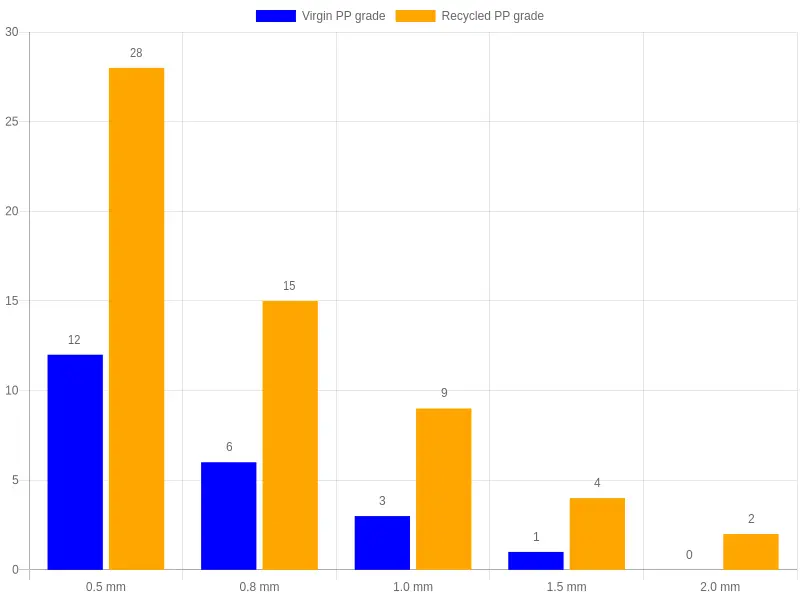
The cracking rate is the number of containers showing any fracture divided by the total number tested, times 100. We run 50 identical units per condition so the result carries some statistical weight.
The chart below plots that cracking rate against wall thickness for two PP grades at -20 C. It shows two things: thicker walls cut cracking sharply, and recycled PP fails at a higher rate than virgin PP at every thickness. Wall thickness and polymer grade are the two levers that decide whether a container survives the freezer.
For more on these containers, see our guide to Halloween plastic food storage containers.
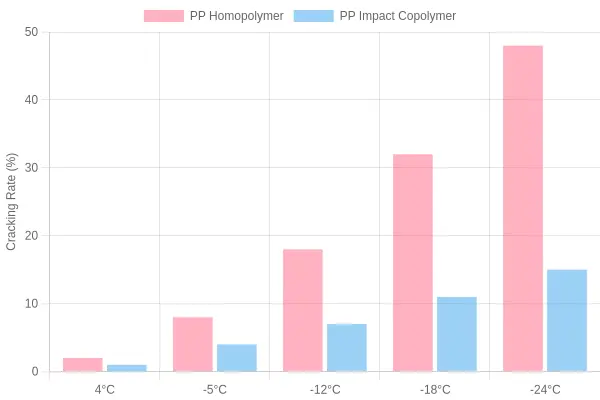
Cracking Rate by Storage Temperature: Homopolymer vs Impact Copolymer
Once frozen treats and cold-weather goods go into the freezer, the container’s polymer chemistry is doing the work. This chart compares the cracking rate (the share of containers that failed a standard cold-drop and freeze-thaw cycle) for two polypropylene grades across five storage temperatures.
The colder it gets, the wider the gap. At a mild 4°C the two grades perform almost identically. At -18°C and -24°C, homopolymer cracking climbs sharply while impact copolymer holds steady. The rubbery EPR phase dispersed through the copolymer matrix absorbs impact energy that rigid homopolymer cannot.
The data behind the bars
| Storage Temperature | PP Homopolymer Cracking Rate | PP Impact Copolymer Cracking Rate |
|---|---|---|
| 4°C | 2% | 1% |
| -5°C | 8% | 4% |
| -12°C | 18% | 7% |
| -18°C | 32% | 11% |
| -24°C | 48% | 15% |
Why this matters for Halloween and cold-chain packaging
If you are specifying containers for freezer storage, ice-bucket treats, or any festive cold use, the grade is not a minor detail. A homopolymer line that passes QC at room temperature can fail about one in three units at -18°C. An impact copolymer keeps failures in the low double digits even at -24°C, which protects both your brand and your return rate.
For more on seasonal container design and cold-weather performance, see our Halloween plastic food storage container guide.
Cold snaps and Halloween freezers are unforgiving, and prevention starts before the mold opens. These checkpoints keep seasonal runs crack-free.
- Select the right PP grade. Use an impact copolymer polypropylene (or a clarified random copolymer where clarity matters) rather than a homopolymer, which turns brittle near freezing. For products like Halloween plastic food storage containers, this choice matters more than any other.
- Specify adequate wall thickness. For cold service, aim for 1.5 mm or more and keep it uniform; 0.7 mm to 1.0 mm walls belong to room-temperature use. Thin, uneven sections chill first and split at the slightest bump.
- Design generous corner radii. Round internal and external corners to at least 2-3 mm so stress spreads across the surface instead of concentrating at a sharp point.
- Engineer the lid fit. Aim for a snug but flexible closure so the lid flexes with the body rather than forcing the base to crack under pressure.
- Confirm temperature ratings. Check that the resin is rated to at least -20 degrees C, then validate the finished plastic food storage containers with real freezer and drop tests.
- Label for cold use. Print storage and temperature guidance on the base so retailers and consumers handle the product correctly.
- Control moisture and regrind. Dry the resin properly and cap regrind percentages; excess moisture or recycled content weakens cold-impact strength.
Put these into every spec sheet, and cold-weather cracking becomes the exception rather than a seasonal certainty.
What the PP Grade vs. Wall Thickness Trade-Off Means for Manufacturers and Retailers
The trade-off between PP grade and wall thickness shapes your cost structure, your performance claims, and your return rate.
Cost realities
Low-temperature impact copolymer costs more per kilogram. Thicker walls raise material consumption, cycle time, and shipping weight. Manufacturers chasing the lowest unit price reach for a cheap homopolymer with thin walls, and that is exactly the combination that cracks in cold holiday kitchens and unheated garages.
The math is simple. Saving a fraction of a cent per container means nothing if units shatter and come back as returns and refunds.
Performance claims and return rates
A “freezer-friendly” or “Halloween-ready” label carries the liability of that promise. A thin-walled, low-grade PP tub may survive the refrigerator and fail a freezer cycle. When it does, customers blame your brand, not the resin.
Procurement decisions
Procurement teams now put resin grade and minimum wall thickness in the same purchase order, and they ask for cold-impact test data instead of trusting a spec sheet alone. This plastic food containers guide gives a practical baseline for how those variables interact across product families.
Multi-compartment designs add another risk: thin internal dividers fail first. Buyers sourcing compartmentalized plastic food storage containers should require extra thickness at the web points, where stress concentrates.
Treat grade and gauge as one decision. Pay for the resin and the wall up front, and you protect margins later.
FAQ: Cold-Weather Cracking in PP Food Containers
Which PP grade is best for cold storage?
Homopolymer PP is stiff but turns brittle below freezing, while random copolymer PP (PP-R) keeps its flexibility in the cold. For freezer and refrigerated storage, choose PP-R or impact copolymer with a low melt flow index. Both resist cracking far better than standard homopolymer.
Does wall thickness matter more than material grade?
Both matter, but they handle different loads: wall thickness manages physical stress, while grade manages cold brittleness. Thin walls crack fast under thermal shock even in premium resin, and a thick, evenly formed wall still fails if the grade is wrong. Balance the grade with consistent 1.5mm-plus walls.
Why do Halloween containers crack in the freezer?
Many Halloween plastic food storage containers use thin homopolymer PP or recycled blends that stiffen and turn brittle as temperatures drop. Rapid cooling and moisture expansion create stress points, so corners and bases fracture. Sudden temperature swings make it worse.
How should I store plastic food storage containers in cold weather?
Let food cool before sealing, leave headroom for expansion, and keep containers away from freezer walls. Wider bases help. Never move a container straight from the freezer to hot water; gradual temperature changes prevent shock cracking.
The Bottom Line on Cold-Weather Container Performance
When Halloween treats meet a chilly porch or a packed freezer, two factors decide whether a container holds up or shatters. The PP grade sets the baseline cold performance: a properly formulated polypropylene keeps its flexibility as temperatures drop, while a cheaper blend turns brittle fast. Grade alone is not enough. Wall thickness determines crack resistance under stress, because thicker walls spread impact and flexing forces instead of concentrating them at weak points. A thin-walled container, even in premium resin, can still crack when it is dropped or squeezed.
For manufacturers, suppliers, and retailers, the practical rule is the same: never judge grade or wall thickness in isolation. Match both to the temperature range the product will see, with a lightweight build for mild indoor storage and a thicker, cold-rated one for freezing, refrigeration, or outdoor use. If the destination is unpredictable, plan for the coldest conditions the product could realistically face. This guide to Halloween plastic food storage containers shows how those seasonal needs play out in practice.
GreenDispoPack manufactures and supplies disposable tableware, packaging paper, and boxes, and we work to three priorities: safety, durability, and eco-friendly practices. That means helping buyers choose the right material and construction for each use case, so their containers perform reliably, in October and all year long.