

Flat Lid vs Dome Lid: Framing the Decision
A flat lid is a low-profile paper or paperboard lid that sits close to the cup rim, so there is almost no gap between the lid and the drink surface. A dome lid is raised, creating headroom above the drink so foam, whipped cream or pearls can sit without touching the top.
For buyers of disposable paper coffee cups with lids, the choice is operational rather than cosmetic: it changes heat retention, spill control, stacking height, freight cost and which drinks a menu can serve. A flat lid traps heat in a shallow space and stacks tightly in cartons. A dome lid protects toppings and foam but takes more room on the shelf, in the case and in transit. Both profiles are stocked in our paper lids for takeaway cups range, so the comparison below applies directly to what you order.
Three questions decide most of it:
- Which lid keeps hot drinks warmer from counter to car.
- Which lid holds up to spills and jostling in real service.
- Which lid fits your drink menu, your storage space and your freight budget.
Flat Lids: Low Profile, Tight Seal, Easy Stacking
Flat paper cup lids are built around a shallow, planar top panel instead of a raised dome. A molded groove runs around the underside of the rim, and that channel is sized to press-fit over the curled lip of the cup: the lip seats into the groove, the lid flexes slightly, and the two lock together with a firm, audible snap. The sipping opening is a small pre-cut aperture or push-back tab set close to the edge, positioned so liquid flows cleanly to the lips while the flat panel around it keeps the sealing line continuous. Rim diameters and opening styles are listed in our paper cup lids range.
Because the panel sits low, the headspace above a hot drink stays shallow, which limits the air volume that would otherwise carry heat away from the surface and helps the drink hold temperature through a commute or a delivery run. The same shallow headspace reduces sloshing, since the liquid has little vertical room to build momentum, and a small vent hole equalises pressure so the lid stays seated. A cup filled to the brim needs care, though: a sharp tilt can send liquid toward the drinking aperture, so a modest fill margin keeps flat lids clean in transit.
- Stacking and packing density: flat lids nest tightly and stack almost flush, so a case holds far more units than domed lids and countertop storage stays compact.
- Size and accessory compatibility: these lids pair with paper cups in standard sizes, and their flat top lets paper cup sleeves and multi-cup holders sit level for balanced carries.
- Best operational fit: black coffee, americanos, teas and self-serve counters, where low height, tight stacking and easy tray loading matter more than topping clearance.
Both cups in the diagram use the same tapered body and the same snap-on rim engagement; the difference starts above the lip. A flat lid closes almost flush with the drink line, while a dome lifts into an arch and leaves a cushion of headroom.
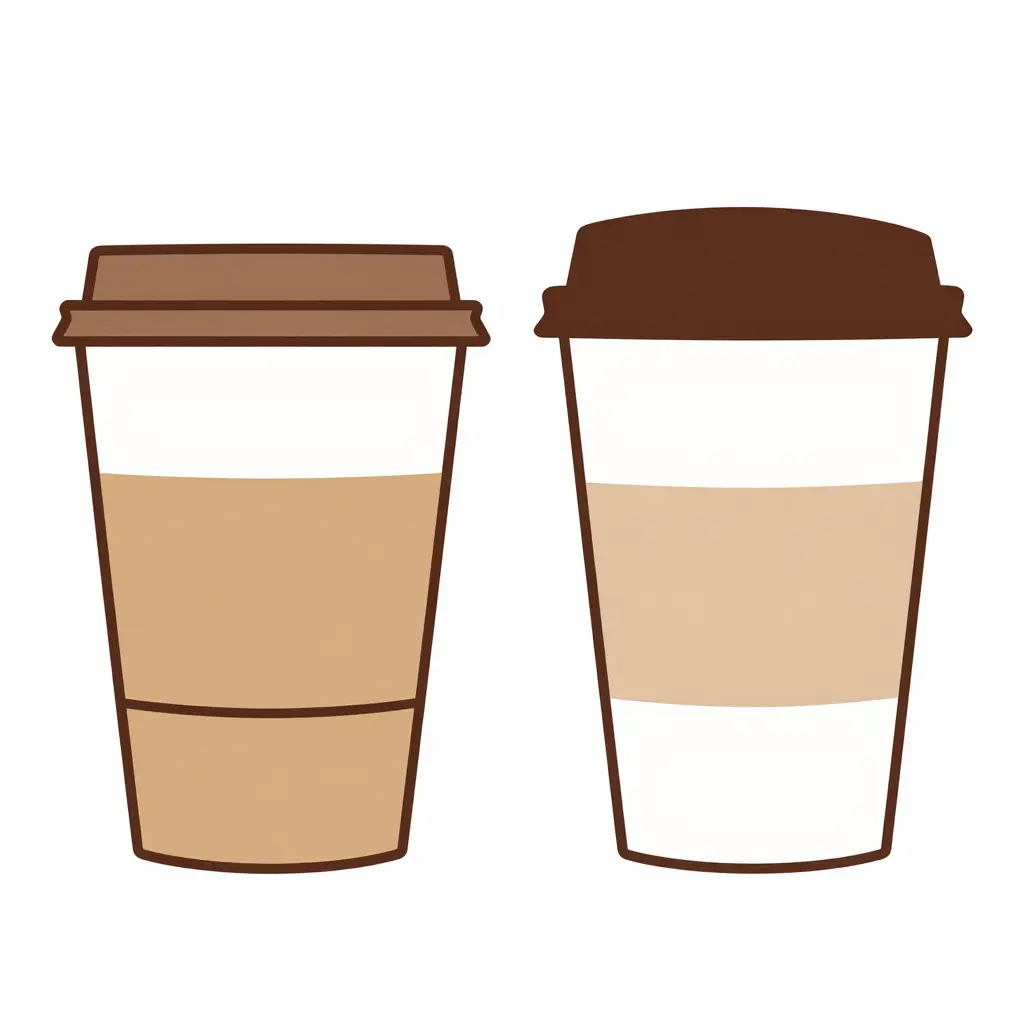
That geometry explains most of the trade-offs in the table below: spill room, foam space and stacking height all follow from it. Rim diameters for both profiles are listed in the paper lid range.
Dome lids: headroom, venting and topping-friendly design
The raised profile of a dome lid creates vertical clearance above the cup rim, so foam, whipped cream, boba pearls and toppings sit in open space instead of being pressed flat against the lid. That clearance lets a barista finish a drink with a 2 to 3 cm foam cap or a cream swirl and still close the cup cleanly. In bubble tea service the extra height keeps pearls, jelly and fruit pieces below the drinking opening, so the first sip delivers topping rather than a blocked lid. A pre-cut straw slot lets a wide straw pass through without tearing the dome.
Vent holes sit on top of the dome, usually offset from the drinking opening, and release steam so condensation does not build up and drip back into the cup. Because the dome holds its shape, it resists compression when filled cups are packed into delivery bags or carried across a catering floor, and toppings stay clear of the lid surface on short runs. Dome lids seat firmly on the rim and sit inside standard paper cup holders and sugarcane cup holders that keep multi-cup orders upright on trays. Our paper cup lids range covers both dome and flat formats so you can match lid to drink.
- Worth the extra material: topped drinks, cold foam, whipped cream and boba that travel more than a few minutes, where the headroom keeps the drink surface intact.
- Not worth it: plain black coffee or hot tea, and drinks assembled and handed over at the counter with no topping. A flat lid seals the same cup with less board, a lower stack and nothing above the fill line.
Flat lid vs dome lid for hot takeaway drinks
| Feature | Flat Lid | Dome Lid | Best Suited To |
|---|---|---|---|
| Profile height and headroom | Low, compact silhouette | Tall, generous headroom | Tight carriers and delivery bags |
| Heat retention | Close to liquid surface | Wider air gap, faster heat loss | Long delivery runs |
| Spill resistance when full | Firm rim seal, low slosh | Rim seal plus splash room | Courier and delivery runs |
| Venting for hot drinks | Small sip hole, light venting | Wide opening, strong venting | Hot drinks served immediately |
| Foam, cream and toppings | Presses down on foam | Protects tall foam peaks | Specialty drinks and frappes |
| Boba and bubble tea | Crowds wide straws | Roomy space for pearls | Bubble tea and dessert drinks |
| Stacking and carton density | High density per carton | Bulky, fewer per carton | Bulk warehouse storage |
| Freight and storage efficiency | Lower freight, slim shelves | Higher freight, more shelf space | Budget-focused large orders |
| Material usage per lid | Less material, lighter weight | More material, larger surface | Lightweight sustainability goals |
| Cup size compatibility | Matched by rim diameter to the hot cup line | Same rim matching, plus straw-slot versions | Menus spanning several cup sizes |
| Fit with sleeves and holders | Sits flush under sleeves | Sits above sleeves and carriers | Cafe sleeves and cup holders |
| Handling speed at the counter | One-press, quick seating | Slower, needs alignment | Peak-hour counter service |
Matching paper cup lids to the menu you actually run is what keeps disposable paper coffee cups with lids leak-free, quick to hand over and cheaper to ship.
Matching Lid Type to Beverage and Service Format
Lid choice follows the drink. The pairings below keep drinks sealed, textures intact and service moving across counter, drive-thru and catering work.
- Drip coffee – a flat lid. It sits flush against the rim, seals tightly on the carry and stacks neatly in cup carriers and dispensers.
- Americano and black coffee – a flat lid as well: there is no foam or cream layer to protect, and the shallow profile leaves less room for the drink to slosh.
- Latte and cappuccino – a dome lid, so the milk foam layer keeps its shape until the customer takes the first sip.
- Hot chocolate with whipped cream – a dome lid; the extra vertical clearance stops cream from pressing against the lid and smearing the rim.
- Tea – a flat lid, which holds steam better than a wide dome vent. If you want a sip hole and a tea bag tag slot, ask for both in the same cut.
- Boba drinks and multi-cup catering trays – a dome lid with a wide straw slot for bubble tea, so pearls and sealed-film piercings clear the opening; for hot takeaway drinks packed in trays, flat lids nest evenly and stay level in the carrier.
Why Menu Diversity Changes Your Lid Count
Every beverage group you add usually adds a lid SKU: another box, another footprint, another line item to count at reorder. A shop running only drip coffee might carry one or two sizes of flat lid; add lattes, hot chocolate and bubble tea and you need dome lids in several diameters plus matching straws and carriers. Standardise diameters where the cup line allows – the paper lid range lists them – and keep carry-out bags on hand for multi-cup orders so lids are not the item that runs short during a rush. Shared sizes across drinks is usually the fastest way to protect both shelf space and working capital.
Flat lid vs dome lid: performance index comparison
Choosing a lid for hot takeaway drinks usually comes down to two service realities: a cup that has to survive a 20-minute delivery ride, and a cup that has to leave the counter in eight seconds flat. This index scores both profiles on the four factors that actually decide how a paper cup performs in the wild. The paper lid range covers both formats in matching rim diameters.
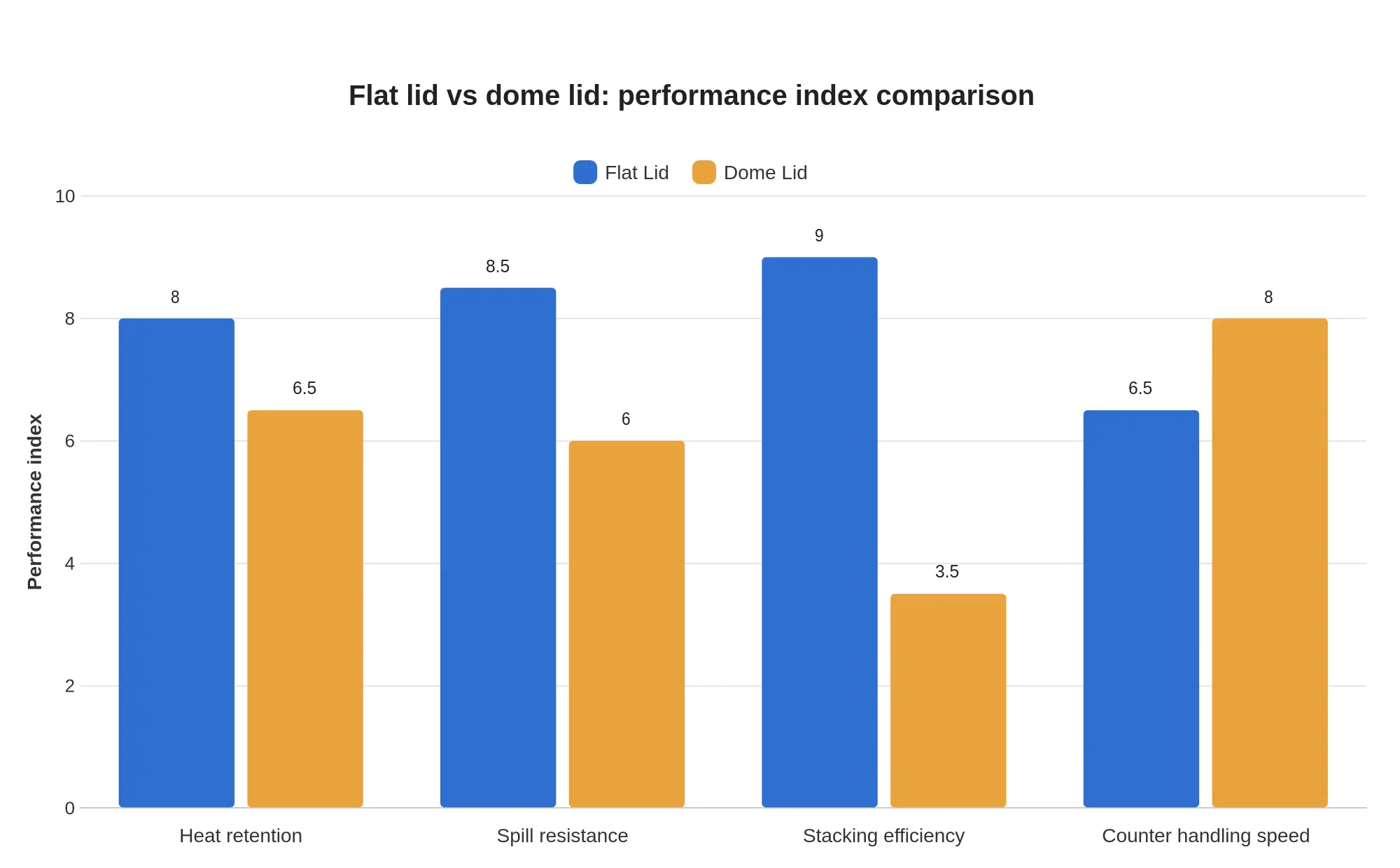
Flat lid vs dome lid: performance index comparison. Values are an index scored 0-10, derived from manufacturer testing data and published packaging guidance on lid fit, venting and stacking behaviour; they are not the result of a consumer survey.
The takeaway: the two profiles trade off against each other. Flat lids lead on heat retention, spill resistance, stacking efficiency and one-handed seating; the dome’s advantage is clearance for toppings, which this index does not score. Flat lids suit batched, transported or stacked orders, and domes suit counters selling topped or whipped drinks.
How to read the four indices
- Heat retention reflects how much headspace sits between the drink surface and the lid, plus how well the rim seal holds steam. A flatter lid closes the gap and loses less heat per minute.
- Spill resistance weighs lid-to-rim grip under tilt, vent design and how a full cup behaves when it is jostled in a carrier.
- Stacking efficiency measures how many filled cups can be nested or carried without crushing the lid below – the one category where the two designs are furthest apart.
- Counter handling speed accounts for how quickly a lid can be seated one-handed during a rush, including rejection and re-seat rates.
None of these numbers exist in isolation. A heavier lid board typically improves rim grip but adds stacking load, which is why the gap on stacking efficiency is the widest of the four. Pair the lid profile with the right cup body weight and you get the benefit without the penalty.
Cost, Storage and Logistics: Where Lid Choice Really Lands
The per-unit gap looks small on a quote, but it compounds across a year. At the same 90 mm rim diameter, a flat lid typically prices 20-30% below a dome lid because it uses roughly 30-40% less board and forms in a single stamping pass. Carton economics stretch that gap further: flat lids commonly ship 1,000 per carton against 500 for domes of the same size, so a standard pallet carries twice the units and 1,000 lids need roughly 1.5 cu ft of shelf instead of 3.2 cu ft, measured across nested, banded cartons. Buyers ordering in steady volume get the most out of that density by specifying nested bulk packaging for the SKUs that move fastest, which reduces both pallet count and the labour of breaking down mixed cartons.
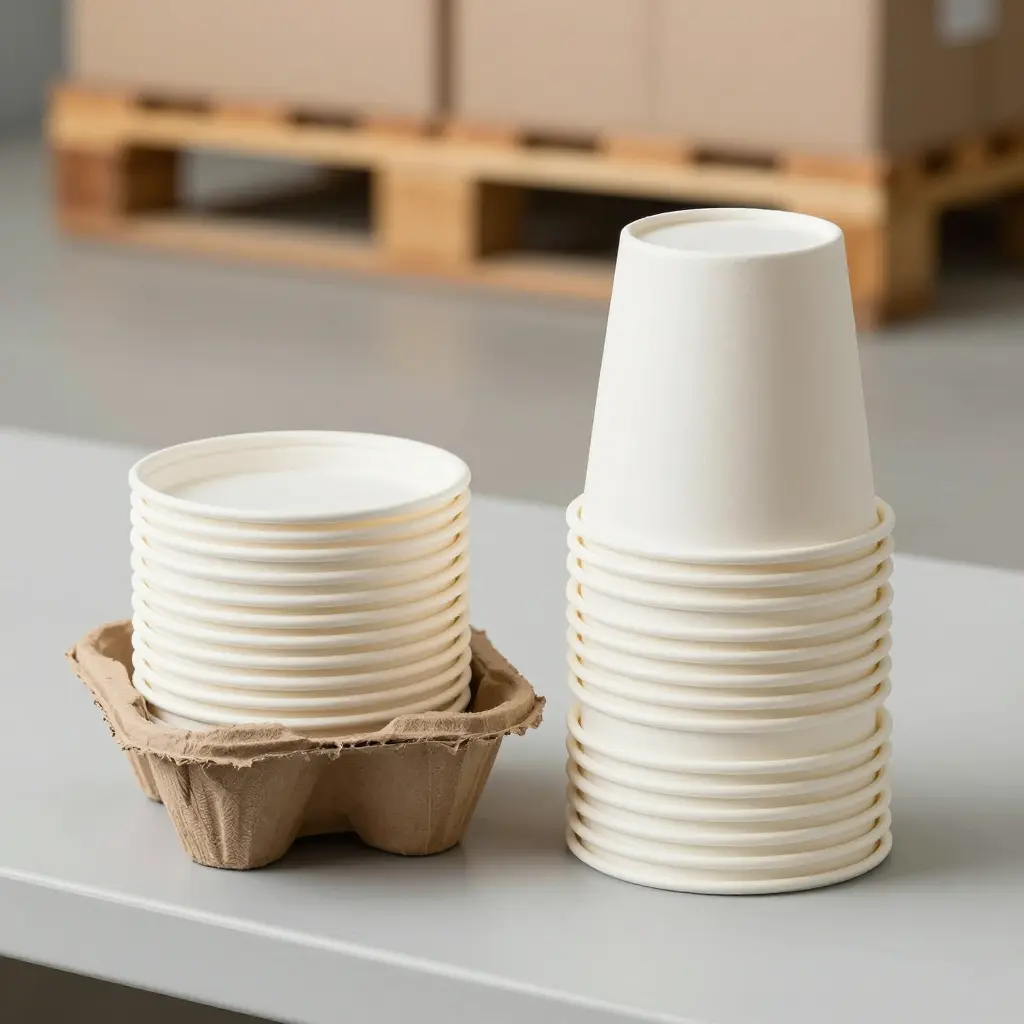
Dome lids are also the more fragile part at the rim and shoulder. Expect 1-2% cracked or deformed domes in a 100-carton shipment against well under 0.5% for flat lids, and ask your supplier for their incoming inspection figures so the number on the quote matches what arrives. Every damaged unit costs a sorting step and a re-packing pass before the carton goes back on the shelf. Handling time is the quieter cost: a flat lid seats in about 0.5 seconds one-handed, a dome in 1.0-1.2 seconds with a visual alignment check. Across a 120-drink peak hour that difference is 1-1.5 minutes of counter time, which is why high-volume counters pair flat-lidded cups with multi-cup carriers built for the shorter profile and keep domes for whipped or topped drinks.
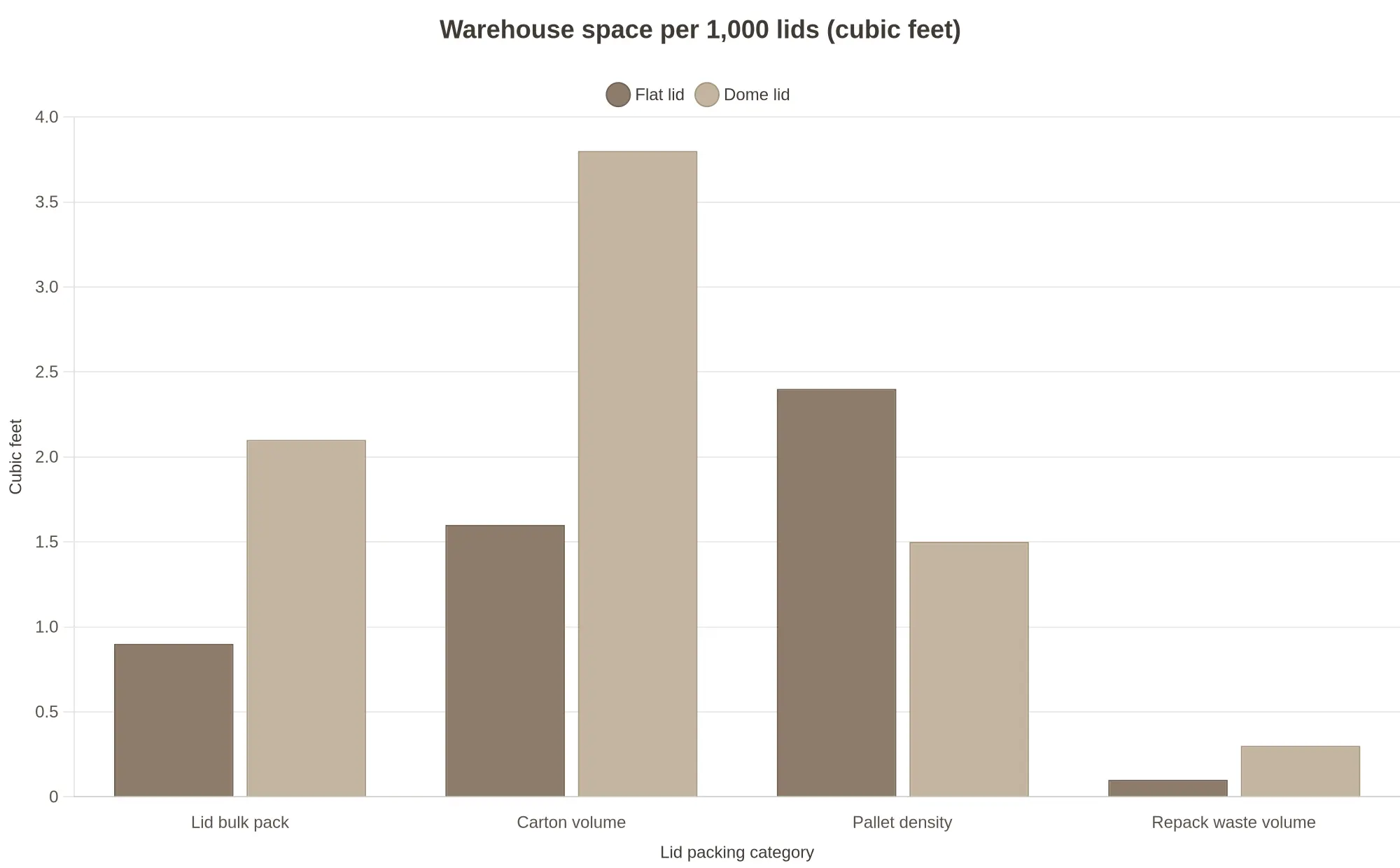
- Landed cost per 1,000 lids: flat lids need about half the storage footprint and half the pallet positions, so freight and warehousing cost per lid drop even when the unit price is identical.
- Seconds at the counter: saving 0.5 seconds per lid across 1,200 takeaway packaging lids in a ten-hour day returns roughly 10 minutes of service capacity at peak.
- Breakage and re-packing: a 1-2% dome breakage rate means 10-20 lost paper cup lids plus a re-packing step for every 1,000 units received, and that waste is rarely captured in the purchase price.
Your lid decision, mapped in one glance
The flow below runs the three questions in order: does the drink carry foam, cream or toppings; does it travel in a multi-cup tray or on a long delivery route; and do carton space and freight cost decide the order. Three questions, two outcomes.

Treat the flow as a prompt rather than an answer key, because every menu answers those three questions differently. Walk your own drinks through it one at a time. If it points you toward the low-profile option, our paper lid collection lists sizes and finishes that match your cups.
Sustainability and Material Considerations
More than the colour of the label, the board and the coating decide what a lid can do. Paperboard lids are generally uncoated or lightly coated and print well, while coated paper lids trade a little recyclability for moisture resistance on hot drinks. Lining and coating choices (PE, water-based dispersion, or PLA) determine both heat tolerance and which waste stream a lid belongs to. Ask for the board’s basis weight in gsm, the coating type and coat weight, and any food-contact or compostability certificates, because those are the numbers worth repeating to customers. Our eco-friendly paper cups are specified the same way, so you can compare lid and cup data side by side.
Lid weight and material usage per unit set your total packaging footprint at scale. Moving from a heavy dome to a lighter flat lid saves grams per unit, and at 50,000 units a week that adds up quickly. A correctly sized paper cup lid, matched to the rim diameter and cup wall, seals tightly, so fewer drinks are remade, fewer lids are dropped, and less stock is spoiled by loose-fit returns. Less material per unit plus less waste per order is progress you can measure and defend in a tender or an audit. Disposable paper coffee cups with lids simply work best when cup and lid are specified as one system.
- Confirm with your supplier whether the lid coating is PE, water-based or PLA, and whether local paper recycling or commercial composting accepts it.
- Keep coated lids out of plain mixed-paper collection unless your hauler explicitly accepts them, and verify local rules before promoting recyclability.
- Pair hot lids with paper sleeves, list both in staff disposal guidance, and separate streams correctly at the bin. Confirm coating and compliance details with your supplier before publishing a sustainability claim.
Heat Retention: Flat Lid vs Dome Lid
Temperature is usually the first thing a customer notices, and the lid is the last thing you close before the cup leaves the counter. The chart below tracks one hot drink under the two lid formats, holding everything else constant.
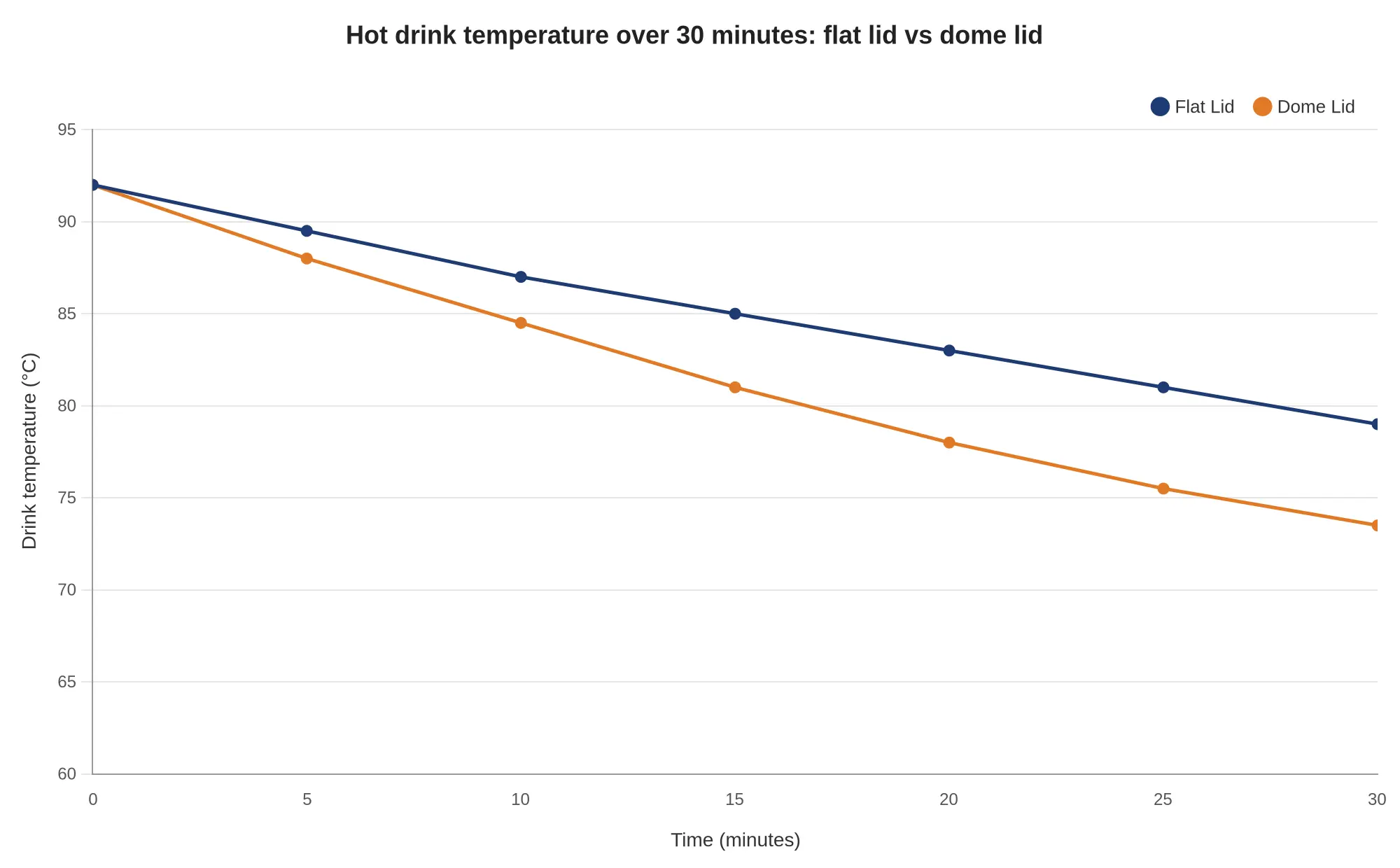
Chart: Hot drink temperature over 30 minutes – flat lid vs dome lid. The curves are representative trend lines built from supplier data and general industry hot-holding guidance, not lab measurements; actual results will vary with cup size, fill level, lid fit and ambient conditions.
What the Curves Tell You
Both lids start at the same serving temperature, around 92 °C, so the difference is purely about how quickly heat escapes. A dome holds roughly 2-3 cm of trapped air above the drink surface, and warm air rises into that space, circulates and keeps pulling heat off the liquid. A flat lid sits close to the surface, leaving little room for that cycle to build, so the drink cools more slowly.
| Time (minutes) | Flat Lid (°C) | Dome Lid (°C) | Gap (°C) |
|---|---|---|---|
| 0 | 92.0 | 92.0 | 0.0 |
| 5 | 89.5 | 88.0 | 1.5 |
| 10 | 87.0 | 84.5 | 2.5 |
| 15 | 85.0 | 81.0 | 4.0 |
| 20 | 83.0 | 78.0 | 5.0 |
| 25 | 81.0 | 75.5 | 5.5 |
| 30 | 79.0 | 73.5 | 5.5 |
The Takeaway
The flat lid stays warmer through the whole window: about 79 °C at the half-hour mark against 73.5 °C under a dome. The gap widens through the first 25 minutes and then holds near 5.5 °C. Neither cup is at sipping temperature after 30 minutes, so the flat lid is buying margin on a longer run rather than a drink that arrives ready to drink. The dome still earns its place for whipped toppings, boba and cold foam, at the cost of faster cooling.
If you are deciding which format to standardise on, pair each lid with a matching cup rather than mixing sizes – browse our paper cups and lids to check fit across your hot line.
Procurement Checklist for Paper Cup Lids
Most lid failures are decided before the purchase order goes out. A lid that fits loosely or vents poorly turns hot takeaway drinks into leaking, soggy cups by the time they reach the customer, and inconsistent carton counts or missing paperwork slow your receiving team down. Work through the checklist below against our paper lids range before you lock a specification.
- Confirm the cup rim diameter and lid fit tolerance in writing, then check both figures against the cups you actually stock.
- Verify vent hole size and placement so steam from hot takeaway drinks escapes without softening the lid seal.
- Request lid-cup fit samples before the bulk order and test them with the real drinks, fill levels and temperatures you serve.
- Check carton count, pack size and pallet configuration so each pallet matches your storage space and unloading equipment.
- Confirm coating and food-contact documentation, including declarations for the lid lining, adhesive and any printed inks.
- Run a leak and tilt test, and measure lid removal force, so staff can close cups quickly without lids popping open.
- Confirm diameter consistency across sizes, so one lid spec does not have to cover three different cup sizes.
- Review printing and embossing quality, colour accuracy and ink coverage on the finished paper cup lids.
- Confirm lead times, minimum order quantities and replenishment support for repeat and seasonal orders.
- Agree on inspection criteria and a simple claim process for damaged or out-of-spec cartons.
Once the lids are approved, keep cup and lid specifications in one document so every reorder stays consistent. Browse the matching paper cup range to align rim sizes, capacities and coatings across your menu, and give the approved samples to your receiving team so each delivery is checked against the same standard.
Frequently Asked Questions: Flat Lid vs Dome Lid
These are the questions buyers ask most, from boba shops to procurement teams. The answer usually depends on the drink, the delivery route and your volume.
Can a flat lid be used for drinks with foam or toppings?
Generally no. A flat lid sits close to the cup rim, so foam, whipped cream, boba pearls or cold foam press against it and spill. For drinks with toppings or tall foam heads, choose a dome lid with extra headroom, and keep disposable paper coffee cups with lids matched to the drink build.
Do dome lids keep hot drinks hotter than flat lids?
No – flat lids come out ahead. A dome holds more air above the drink, and warm air moving in that headspace keeps drawing heat off the surface; in the 30-minute comparison above, the flat-lidded cup finishes about 5.5 °C hotter. The gap is small in the first five minutes and widens over a longer run. Sleeves, cup wall thickness and preheated cups move the number too.
Are paper cup lids leak-safe for delivery and catering transport?
Yes, provided the lid matches the cup and is pressed down fully. Tight-fitting paper cup lids resist splashing on delivery runs, although they are splash-resistant rather than fully spill-proof. For catering transport, seat each lid firmly, keep cups upright and use lids sized to your cup line.
Do all lids fit every paper cup size?
No. Flat and dome lids are sized by rim diameter and rim style, and a lid made for one cup line will not grip another. Cups from different suppliers often look similar but differ by a millimetre or two. Always pair lids with cups from the same manufacturer and confirm the size code.
Which lid type is more cost-effective for high-volume takeaway service?
Flat lids usually cost less per unit and stack more compactly, which lowers storage and freight costs. For standard black coffee and tea, they are the economical choice. Reserve dome lids for foam, boba and iced layered drinks, where the extra headroom prevents spills and remakes.
The answer is not one lid for every menu but one lid per order type. For standard hot drinks – black coffee, americano, plain tea – the flat lid is the practical default: it stacks tightly, ships at high freight density and uses less material per unit, which keeps both landed cost and storage footprint down. Foam, whipped toppings, boba pearls and long delivery routes make the case for the dome, because headroom is what protects the surface of the drink and keeps toppings from collapsing on the way to the customer. When the menu genuinely needs both formats, stock both rather than forcing one compromise.
- Flat lid: standard hot takeaway drinks, high-volume counter service and any account where stacking, freight density and material efficiency matter most.
- Dome lid: foam-topped drinks, boba, loaded toppings and delivery routes long enough that headspace is what protects the drink.
- Both formats: menus that split between simple coffee and specialty drinks, stocked in proportions that match your real order mix.
For buyers, a short sequence beats a long evaluation. First, define your cup sizes and rim diameters. Then request samples of both lid types in those exact sizes and run a fit check on filled cups, including a light squeeze and a short carry test. Follow with a heat-retention and transport check over the delivery distance you actually run. Only then lock specifications – material, thickness, rim tolerance and print – and set reorder quantities against a few weeks of real usage data. Review paper lids and paper cup holders together, since holders are what keep multi-cup orders stable in transit. greendispopack.com supplies disposable tableware, packaging paper and boxes, and answers specification and reorder questions.