
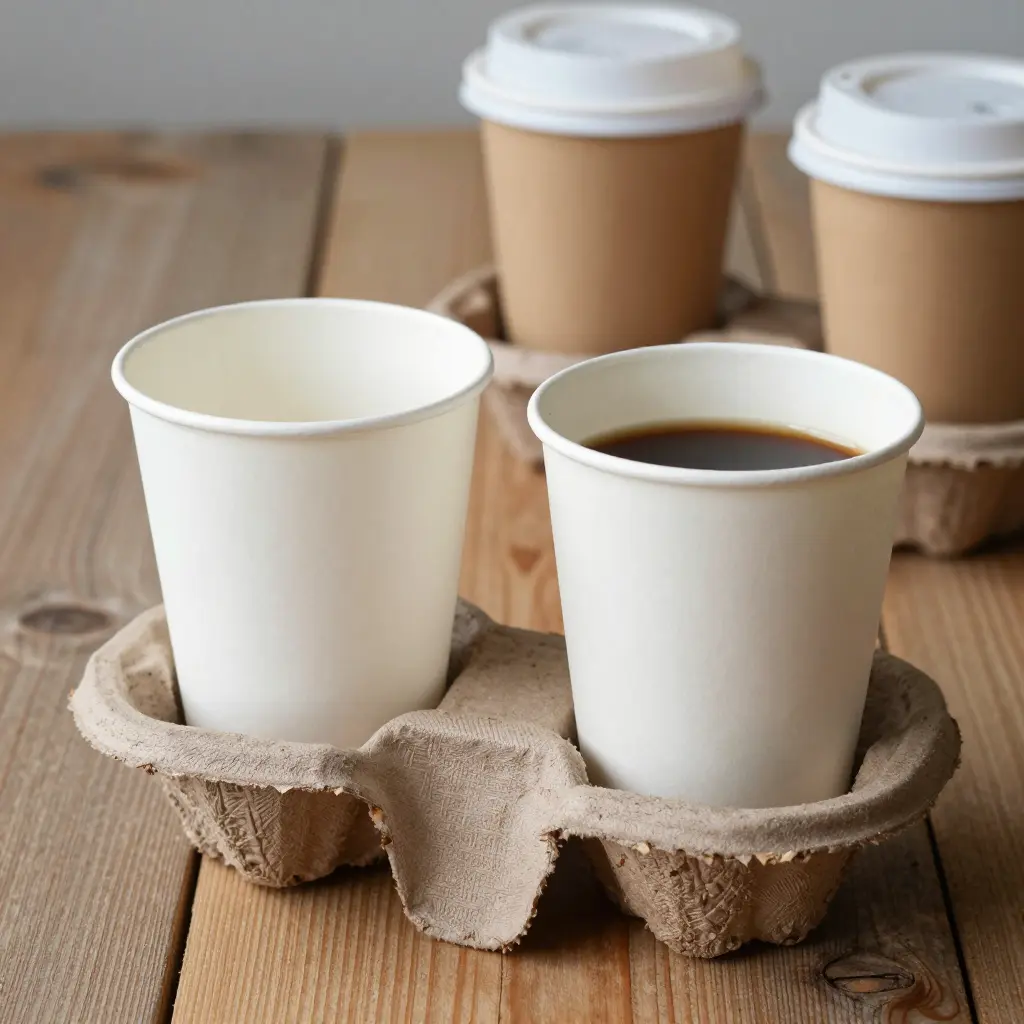
A compostable paper cup is certified paperboard sealed with a lining that breaks down under industrial composting instead of lingering as plastic waste. China makes a large share of the world’s supply, which is why so many buyers start their sourcing research with compostable paper cups made in China and the supply chain behind them. That lining decides how the cup performs in service and how it can be disposed of.
Two lining technologies dominate the hot-drink market in China. A PLA lining is a thin film of polylactic acid, a plant-derived polymer usually made from corn starch, that forms a smooth, leak-resistant barrier for coffee and tea at moderate serving temperatures. A water-based coating is a dispersion applied directly onto the paper with no polyethylene film, so the finished cup can pass through standard repulping and composting streams.
Why This Single Specification Carries So Much Weight
The choice shapes cost, minimum order quantities, tooling, and the environmental claims a brand can legally make. For a business owner it changes unit price, shipping weight, and how well a “compostable” label survives customer scrutiny. For a consumer it decides whether the cup actually breaks down in a real facility or ends up in a landfill.
For anyone running a cafe or food-service operation, the lining governs heat resistance, seam strength, leak risk, stacking stability, and lid fit across thousands of servings a day. A cup that sags or transfers flavor during the morning rush costs more in lost trust than it saves on price, and those failures are usually lining problems, not paper problems.
This article compares PLA-lined and water-based coated compostable paper cups made in China on performance, cost, certification, and end-of-life disposal, so you can match the right option to your hot-drink program.
How a Compostable Paper Cup Is Built: The Layer Structure
Whatever the coating, a compostable paper cup is the same three-part sandwich:
- Paperboard body – the structural shell that gives the cup its shape, strength, and heat resistance. It is the thickest layer and the one that carries the branding.
- Inner lining layer – a thin barrier bonded to the inside of the board. This is where PLA and water-based coatings differ, and it is what keeps hot liquid from soaking through the paper.
- Rolled rim – the curled top edge. It stiffens the opening, gives lids and sipping a clean surface, and hides the raw edge of the paperboard so it does not fray or wick moisture.
The differences between the two materials live almost entirely in that middle layer. If you want the full background on how these cups are sourced and produced overseas, the compostable paper cups made in China guide covers the complete picture.
What Is a Water-Based Coating?
A water-based coating (also called an aqueous coating) is a thin, food-safe barrier brushed or sprayed onto paperboard so it holds liquid without a plastic film. Instead of a layer of polyethylene (PE) or a PLA film, the barrier is a water-borne polymer dispersion that cures into a smooth, sealed surface. In compostable paper cups, that coating supplies the leak resistance drinkers expect while still letting the cup break down in industrial composting.
How it is applied
Manufacturers usually apply the aqueous coating as a liquid during the cup-forming process, then dry it with heat so the water evaporates and the polymer fuses into a continuous film. The result is a uniform seal on the inside wall, with no glue-heavy laminated sheet to peel apart.
Heat behavior with hot drinks
Because the coating is thin and moisture-tight, it handles the steam and heat of coffee or tea without softening or delaminating the way some wax coatings can. It also lets the paper breathe slightly, which cuts the slipperiness and condensation that plasticky linings often create.
Repulpability and the plastic-style difference
Unlike a PE or PLA lining that must be separated before recycling, an aqueous coating is designed to disperse during repulping, so the paper fiber can be recovered more cleanly. That same property makes it fit the compostable stream, where the cup can be processed alongside organic waste.
If you are comparing linings for your next order, our guide to the best compostable paper cups gives a practical breakdown.
The table below compares PLA lining and water-based coating on the criteria that matter most for hot-drink paper cups:
| Criterion | PLA Lining (Polylactic Acid) | Water-Based Coating |
|---|---|---|
| Material origin | Plant-based bioplastic derived from renewable crops such as corn starch or sugarcane | Synthetic polymer (often acrylic) dispersed in water; some bio-based grades exist |
| Heat resistance for hot drinks | Moderate: softens around 55-60°C; best for warm drinks, may deform with near-boiling liquids unless heat-crystallized | Good: handles hot drinks up to roughly 95-100°C depending on the formulation |
| Compostability conditions | Industrially compostable only, requiring high-temperature (58-70°C) facilities; not home compostable | Varies by grade: some are industrially compostable, many are not; always verify certification |
| Recyclability / repulpability | Not repulpable; the film must be separated and can contaminate standard paper recycling streams | Designed for repulpability; generally compatible with standard paper recycling |
| Moisture barrier | Good water and moisture barrier | Good moisture barrier when properly applied |
| Grease barrier | Good grease and oil resistance | Good grease barrier; performance is formulation-dependent |
| Typical cost positioning | Higher cost; premium eco positioning | Moderate cost, increasingly cost-competitive at scale |
Neither choice is universally better. The right pick depends on your market’s disposal infrastructure, your heat specifications, and the claims you can legally make, so read up on choosing the best compostable paper cups before you commit.
Fast Checklist: What to Weigh Before You Buy
Before you sign off on a supplier, use this checklist to confirm that your compostable paper cups made in China hold up for hot drinks in real conditions.
- Beverage temperature. Check that the lining is rated for your actual serving temperature. If you pour near boiling, that usually points to a water-based coating, since PLA begins to soften around 60°C.
- Serving duration. Match the lining to how long the drink sits. An espresso to go needs far less heat resistance than a slow-sipped large latte that stays hot for 30 minutes or more.
- Disposal infrastructure. Confirm that your local commercial composting stream accepts the cup. A good product still fails if no nearby facility can process it.
- Certification. Ask for recognized compostability certificates (such as BPI, OK Compost, or EN 13432) plus food-contact safety reports, so the claim holds up with regulators and eco-conscious customers.
- Branding and print compatibility. Check that the coating takes food-safe flexo or offset inks cleanly, so your logo stays crisp without undermining recyclability claims. You can review print-ready options like these custom printed paper cup solutions before finalizing artwork.
- Order volume. Balance minimum order quantities against your storage and cash flow, and confirm that lead times from overseas factories will not outrun your busiest season.
Work through these before you order, and you avoid the expensive mismatch between what a supplier promises and what your operation actually needs.
PLA Lining vs. Water-Based Coating: The Numbers Side by Side
Before you commit to a supplier, it helps to see how the two most common compostable options score on the metrics that matter during hot-drink service. The chart below rates each material from 0 to 10 across four dimensions: heat resistance, moisture barrier, compostability speed, and repulpability.
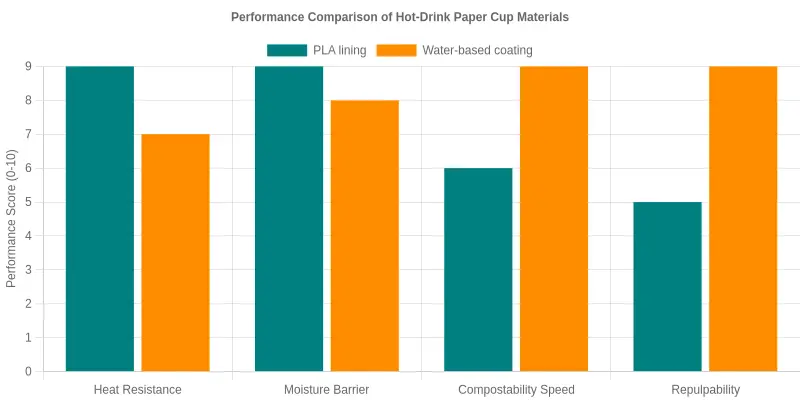
Figure 1. Grouped bar chart comparing PLA lining (teal) and water-based coating (orange) on a 0-10 performance scale for four hot-drink service metrics.
The takeaway: water-based coating scores highest on heat resistance, compostability speed, and repulpability, while PLA stays competitive on moisture barrier. Each material is the stronger choice depending on whether your priority is barrier performance or end-of-life processing.
For teams weighing how these trade-offs play out across a whole product line, it is worth reviewing the broader comparison of compostable paper cups made in China to align material choice with your sustainability goals.
Hot-Drink Performance Analysis
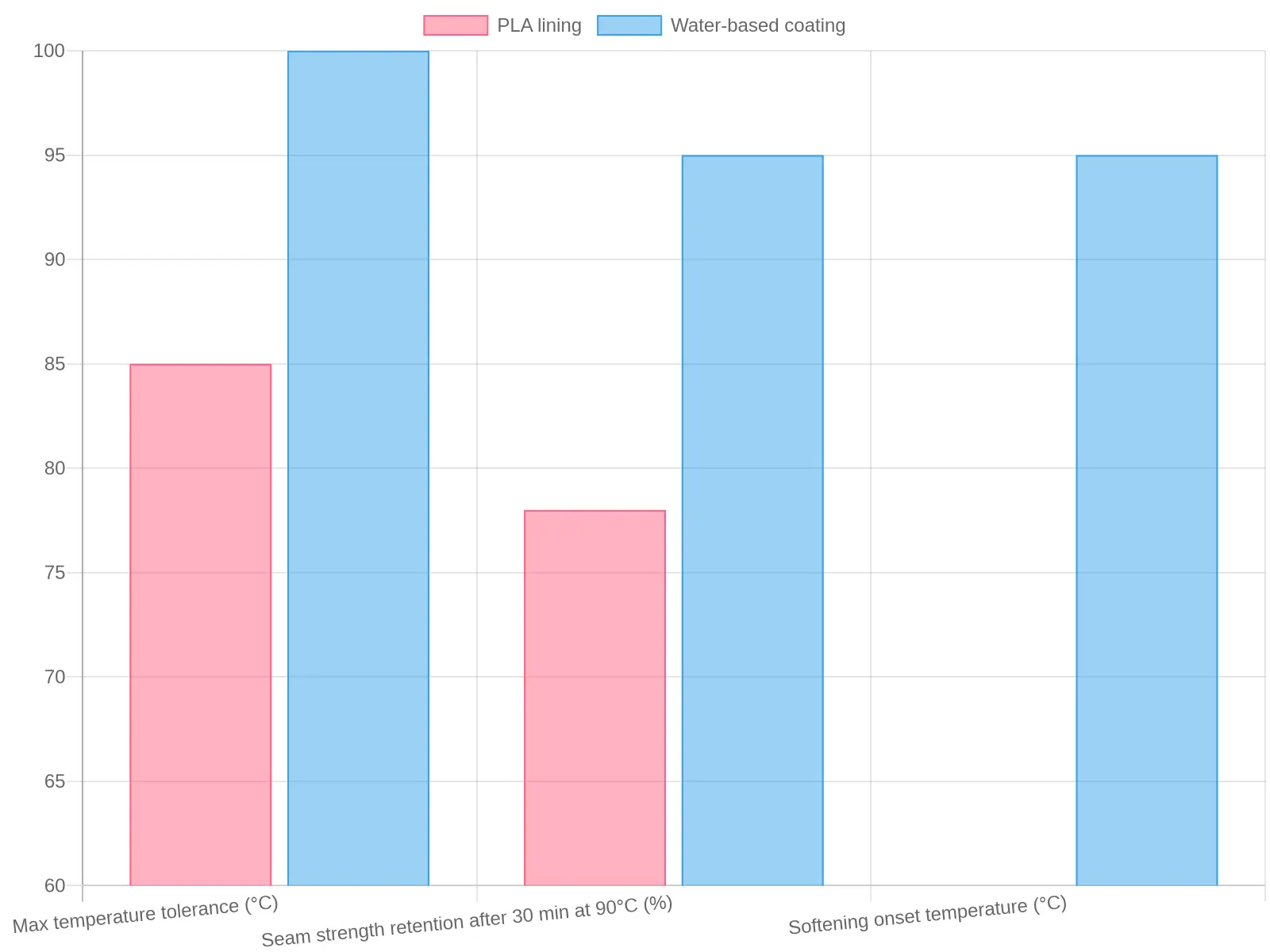
The chart above measures both systems on the same three behaviors: how much heat the barrier absorbs, how firmly the side seam holds, and when the material starts to soften.
Temperature tolerance
The water-based coating tops out near 100°C, which covers a full pour of boiling water. The PLA lining holds steady to roughly 85°C. In practice, that gap matters most at the moment of filling, not while drinking. A tea bag steeped in freshly boiled water hits the cup wall at close to 95°C before the drink cools.
Softening and seam behavior
The softening point tells the clearer story. The water-based coating begins to soften around 95°C, so it stays rigid through a normal pour. The PLA lining starts to yield near 60°C, well below the fill temperature. After 30 minutes at 90°C, the water-based coating retains about 95% of its seam strength, while the PLA lining retains roughly 78%.
| Metric | PLA lining | Water-based coating |
|---|---|---|
| Max temperature tolerance | ~85°C | ~100°C |
| Softening onset | ~60°C | ~95°C |
| Seam strength after 30 min at 90°C | ~78% | ~95% |
What this means for coffee and tea
For hot black coffee, espresso drinks, and steeped tea, the water-based coating holds its shape and seam integrity with more margin. The PLA lining works reliably for warm and moderately hot drinks and stays fully compostable, but it rewards faster service and shorter hold times. If your menu leans on near-boiling pours, the higher-tolerance coating lowers the risk of a softened seam and a leaking cup; if most of your volume is warm drinks consumed quickly, PLA remains a sound, compostable choice. Either way, the spec on the cup should follow the temperature on the menu.
Buyers comparing suppliers across both formats can review disposable paper cup options for wholesale programs to align lining choice with typical serving temperatures.
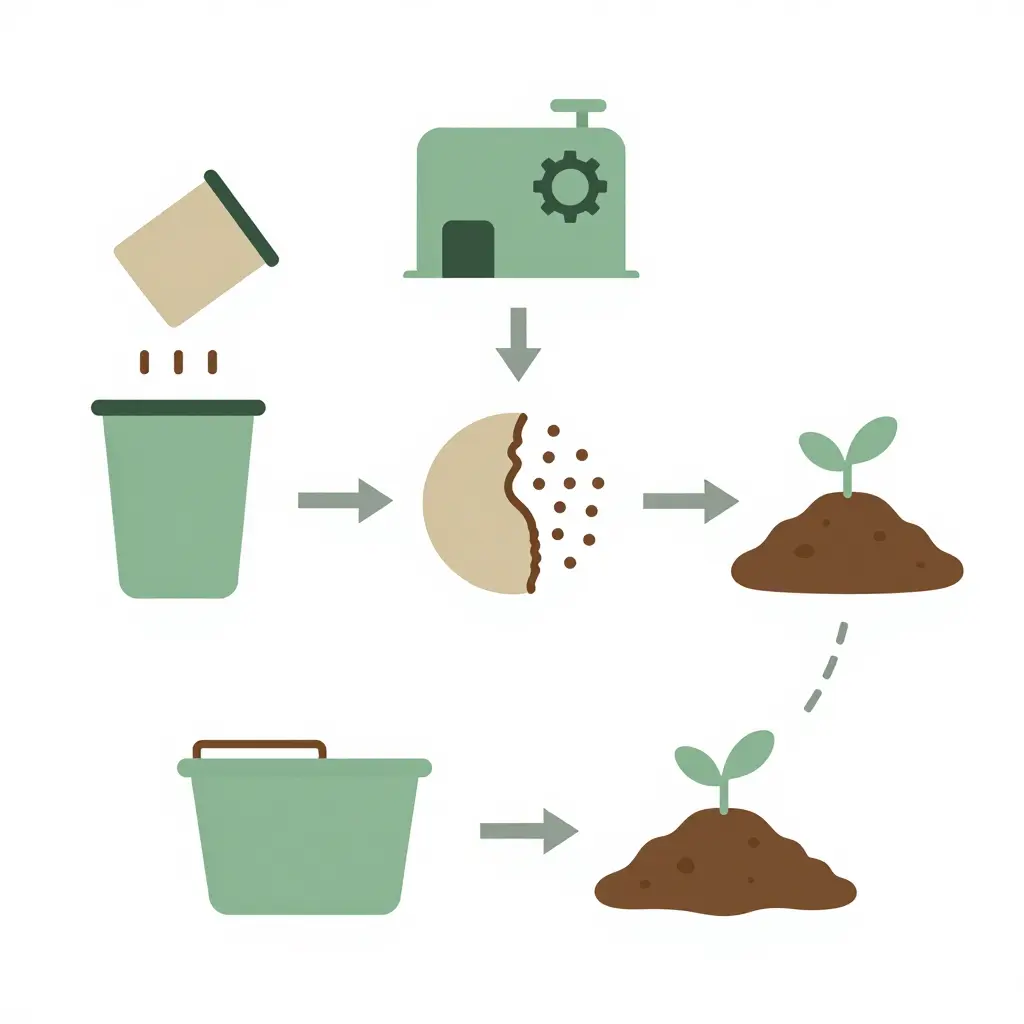
Reading the End-of-Life Pathway
The diagram traces what usually happens to a compostable paper cup after a customer drops it in the bin. Four stages, left to right:
- Collection – the used cup lands in a dedicated collection bin rather than general waste.
- Composting environment – contents move into a controlled facility where heat, moisture, and microbes do the heavy lifting.
- Breakdown of the lining or coating – the inner barrier (whether a PLA film or a water-based layer) separates and disintegrates.
- Return to soil – the remaining paper fiber and coating residues finish as usable compost.
Where PLA and Water-Based Cups Diverge
The two barrier technologies share the same journey but differ in their disposal requirements. PLA-lined cups generally rely on the sustained high temperatures of an industrial composting environment to break down their film, which is the dashed branch in the diagram. Water-based coated cups are often designed for a broader range of conditions, including some home-compost setups, which is why you see a simpler second path.
If you are comparing suppliers, our overview of compostable paper cups made in China walks through how each lining type is specified and labeled.
Practical tip: always match the printed disposal instructions to the local waste infrastructure. A cup that clearly states “industrial composting only” prevents well-meaning customers from contaminating a home compost pile.
Compostability & Certification: Reading the Labels
For compostable paper cups made in China, “compostable” is a testable claim, not a slogan. Most certified cups pair a paper body with either a PLA lining or a water-based coating, and each breaks down only under the right conditions.
Industrial vs. Home Composting
The most common misunderstanding is where composting happens. Most “compostable” certifications assume industrial composting, where facilities hold temperatures around 55-60 C with controlled moisture and active microbes for weeks. A PLA lining needs that heat to fully disintegrate. A backyard pile rarely gets there, so a cup certified for industrial composting can look virtually untouched after months at home. Genuine home-compostable products carry separate, stricter certifications, so do not assume the two are interchangeable.
Standards Worth Trusting
| Standard | Region | Setting |
|---|---|---|
| EN 13432 | Europe | Industrial |
| ASTM D6400 | USA | Industrial |
| AS 4736 | Australia | Industrial |
| ISO 17088 | International | Industrial |
| TUV OK Compost HOME | Europe | Home |
| AS 5810 | Australia | Home |
How to Verify a Chinese Supplier
- Request the certificate and the underlying lab test report, not just a logo image.
- Check the license number on the certifying body’s own website.
- Confirm the lining type in writing. A PLA lining and a water-based coating behave differently at end of life.
- Ask for batch-level declarations, and be wary of vague terms like “eco-friendly” instead of a named standard.
- Compare a supplier’s full range against other eco takeaway food boxes to see which certifications appear consistently.
When a supplier names a standard, shows a valid certificate, and matches it to the real disposal stream, the claim holds up. When they only say “green,” it probably does not.
Cost, Supply Chain & Sourcing
Sourcing compostable paper cups made in China gives you mature, high-volume manufacturing. Your real cost and how fast you can restock depend less on the cup itself than on the lining you choose.
Cost positioning
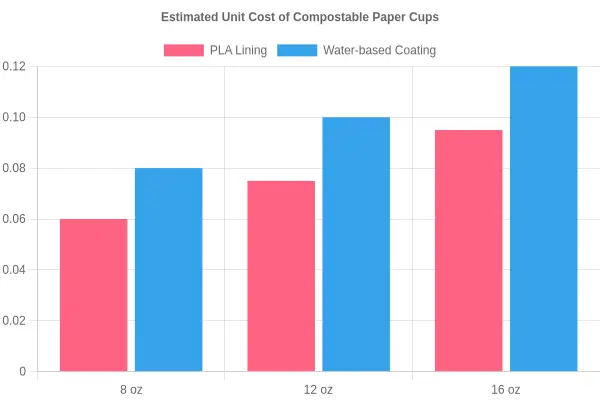
A standard 12 oz cup usually wholesales between US$0.07 and US$0.13 per unit before printing and freight. PLA film is the volume workhorse: mass-produced, widely available, and typically the cheaper route, adding roughly 10-15% over a conventional PE-lined cup. Water-based coatings carry a small premium, often one to three extra cents, for cleaner and more complete composting.
| Factor | PLA lining | Water-based coating |
|---|---|---|
| Typical unit cost (12 oz) | $0.075 | $0.10 |
| Typical MOQ (custom print) | 50,000 – 100,000 | 30,000 – 60,000 |
| Production lead time | 20 – 30 days | 25 – 40 days |
| Compostability | Mainly industrial | Home and industrial |
| Supply availability | Broad | Narrower |
MOQs and lead times
Custom-printed runs usually begin near 30,000-60,000 units for water-based coatings and 50,000-100,000 for PLA, while stock blanks ship in far smaller lots. Budget 20-30 days of production for PLA and 25-40 days for water-based, then add 25-40 days of sea freight. Chinese New Year reliably slows factories for two to three weeks each winter.
Supply chain considerations
Resin prices, port congestion, and compliance paperwork all move your landed cost. Confirm that your supplier holds BPI, TUV OK Compost, or EN 13432 certification, and remember that water-based capacity is narrower, so delays and single-source risk run higher.
Guidance for buyers
Test demand with a stock size first, then negotiate tiered pricing as volumes climb. Consolidate cups, lids, and sleeves into one container, lock pricing on a quarterly basis, and always request physical samples plus test certificates. Qualify both linings so a resin shortage never interrupts your hot-drinks service, and pair your cups with complementary low-impact materials such as recycled kraft paper packaging for a fully circular takeaway setup.
Market and Adoption Trends: Compostable Hot-Drink Cups on the Rise
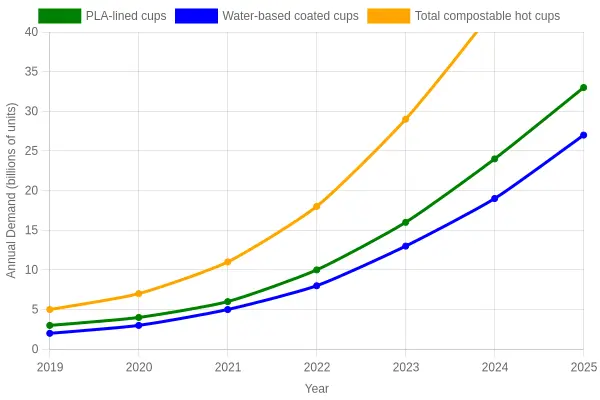
Figure 2. Global demand for compostable hot-drink paper cups, 2019-2025, split by lining technology.
Interpretation: Demand for compostable hot cups has grown roughly twelvefold since 2019, with PLA-lined cups holding a consistent lead over water-based coated cups, signaling strong buyer confidence in both technologies.
What the Chart Tells Buyers
Three signals stand out across the series:
- PLA-lined cups lead the pack. Starting from a base of 3 billion units in 2019, demand climbs to roughly 33 billion by 2025, a pace that reflects growing familiarity with plant-based linings and their reliable barrier performance.
- Water-based coated cups are growing fast, but not closing the gap. Rising from 2 billion to about 27 billion units, they grew at a faster percentage rate, yet PLA’s absolute lead widened from 1 billion to 6 billion units.
- The overall pie keeps expanding. Total compostable hot-cup demand moves from 5 billion to 60 billion units, which points to a structural shift rather than a passing trend.
For food and beverage operators, the practical read is that sourcing now, rather than waiting for prices to “settle,” means locking in supply and building brand equity while the category is still climbing. A dependable supply chain matters more than ever, which is why working with an experienced partner on compostable paper cups made in China can give you volume, consistency, and cost control in one move.
The two lining technologies are still competing for share, and the years ahead will likely reward buyers who keep both PLA and water-based options in their lineup so they can pivot as regulations, pricing, and consumer sentiment change.
Frequently Asked Questions: Compostable Paper Cups for Hot Drinks
Which lining is better for hot drinks – PLA lining or water-based coating?
It depends on your serving temperature and your end-of-life goals. A water-based coating tends to hold up better against near-boiling drinks because it resists heat without softening, whereas PLA lining can begin to lose rigidity around 60 degrees Celsius. PLA still delivers excellent grease and moisture resistance and is certified compostable in industrial facilities. For cafes pouring coffee at 75 to 85 degrees Celsius, a well-specified water-based coating is often the safer pick, while PLA performs well for warm or moderately hot drinks.
Are compostable paper cups recyclable?
It depends on the lining. PLA-lined cups are not repulpable, and the film has to be separated out, so they belong in compost rather than standard paper recycling. Water-based coated cups are designed to disperse during repulping and are generally compatible with standard paper recycling. In both cases, follow the cup’s printed disposal instructions instead of assuming it can go in the blue bin.
Do compostable paper cups require industrial composting?
In most cases, yes. Both PLA lining and many water-based coatings break down reliably only under industrial composting conditions that reach sustained high temperatures. A backyard compost pile rarely gets hot enough to break down PLA, so always check for certifications like EN 13432 or BPI before claiming a cup is home compostable.
How do I choose a supplier for compostable paper cups made in China?
Start with documentation: request EN 13432, BPI, or FDA food-contact certificates, and confirm the exact lining type in writing. Then ask for samples and test them with your real hot drinks to check for leaks, softening, and flavor transfer. A reliable partner will also offer customization and consistent batch quality, which matters a great deal once you scale up.
PLA lining vs water-based coating at a glance
| Feature | PLA lining | Water-based coating |
|---|---|---|
| Heat resistance | Moderate (softens near 60C) | Higher, better for hot drinks |
| Grease resistance | Excellent | Good |
| Compostability | Industrial only | Industrial (some home) |
| Recyclability | Not recyclable | Repulpable |
| Best for | Warm and cold drinks | Hot drinks |
Still weighing your options? Explore our complete guide to compostable paper cups made in China to compare specifications, certifications, and sourcing tips before you place your next order.
Conclusion: Choosing the Right Lining for Compostable Paper Cups
Both PLA lining and water-based coating deliver the core promise of hot drinks packaging: a paper cup that holds up without leaking and avoids the plastic waste problem of traditional polyethylene. The difference is where each performs best.
PLA lining gives you a smooth, moisture- and grease-resistant barrier and usually a lower unit cost. It is industrially compostable and works well for hot drinks in the warm-to-moderate range, served quickly; its limit is heat, since it starts to soften around 60°C. Water-based coating takes near-boiling pours in stride, holds its seam through a long serve, repulps cleanly, and composts more readily in the grades that carry certification. It usually costs more per unit.
The trade-offs split three ways:
- Performance: water-based coating holds up better at high temperatures, while PLA stays competitive on moisture and grease resistance.
- Compostability: water-based coating repulps and composts more easily; PLA needs industrial composting to break down.
- Cost: PLA usually lands at a lower unit price; water-based coating carries a small premium.
For business owners, match the lining to your menu and disposal infrastructure. Cafes that hold hot drinks for a long time should lean toward water-based coating; brands prioritizing a lower unit cost and a strong barrier can stay with PLA.
For eco-conscious consumers, ask suppliers which certification backs the compostability claim rather than trusting the label alone.
For food and beverage industry professionals, align your choice with local waste systems, then lock in consistent quality from a vetted compostable paper cups made in China partner. If you import at volume, the customs classification for disposable paper cups is worth understanding too.
Neither lining is universally superior. Choose on performance needs, disposal reality, and budget, and you will land on a hot drinks cup that satisfies customers and holds up in service.