
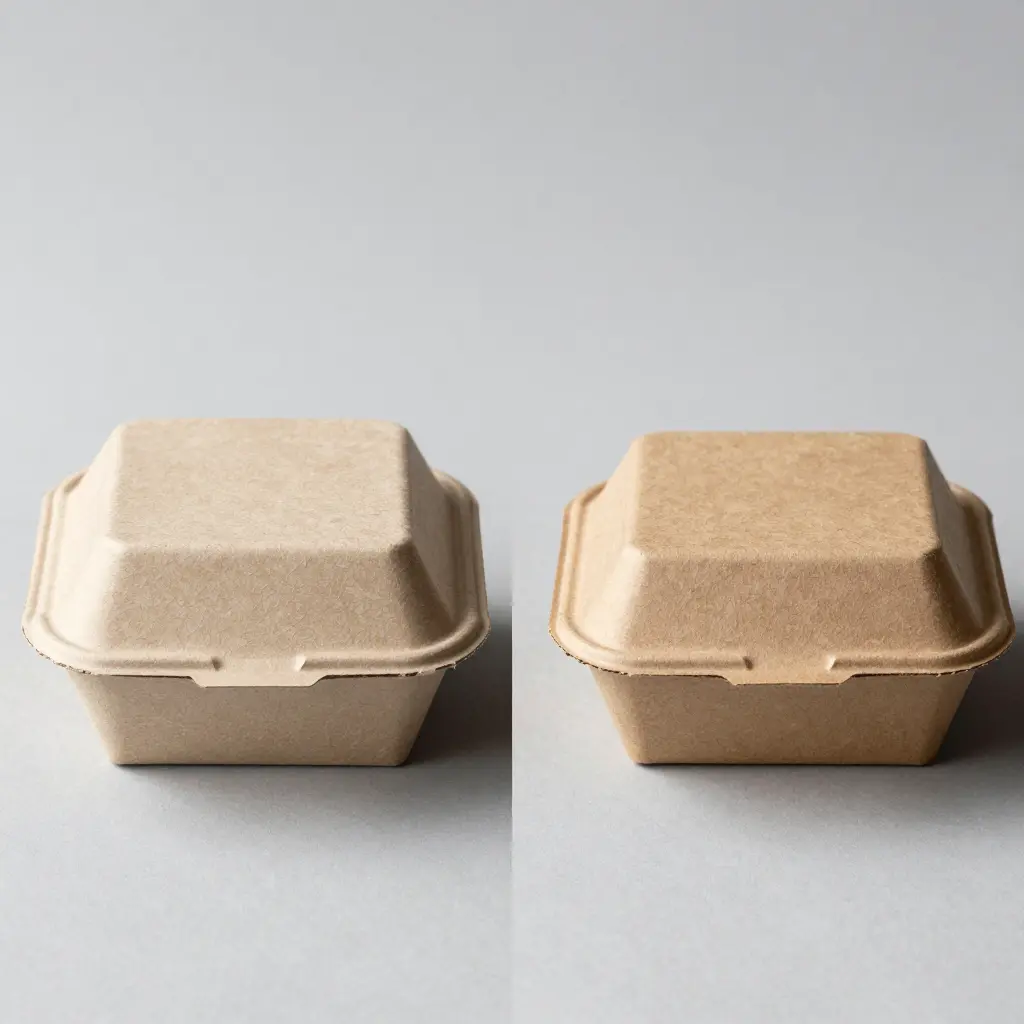
Choosing the Right Eco Takeaway Food Box: Bagasse vs Paperboard
Most food businesses that switch to compostable packaging end up choosing between two materials. Bagasse is the moulded fibre left after sugarcane is crushed; paperboard is built up from laminated fibre layers. Both are food-safe and easy to source, so availability rarely decides it. Compostability is not automatic for either one, since it depends on the coating rather than the fibre alone.
What settles the order is how the box behaves in a microwave, and whether it holds oil. A box that softens or wicks grease after ninety seconds of reheating costs more in complaints than it saves on unit price.
These notes are for the people placing volume orders: bubble tea and beverage chains, restaurants, food trucks, caterers, event planners and corporate procurement teams. They cover how each material is built, heat and oil performance, a procurement checklist, and the questions buyers ask most.
If you are still deciding on a format rather than a material, our sugarcane food containers range is a place to start on sizing and lid options.
Bagasse vs Paperboard: How Each Material Is Built
Two eco takeaway food box families can look almost identical on a shelf and be built in completely different ways. One is pressed from plant residue, the other laminated in layers. That difference predicts how a box behaves during microwave reheating and what happens when something oily sits in it for half an hour.
Bagasse: pressed sugarcane fibre
Bagasse is the fibrous pulp left behind after sugarcane is crushed for juice. Producers mix it with water, press it into shape in heated moulds and dry it into rigid tableware with a soft, matte finish. The shapes and depths available are shown in our sugarcane food containers range.
Paperboard: layered fibre with a coating
Paperboard is one or more layers of virgin or recycled fibre laminated together for stiffness and print quality. Food-grade boards usually add a barrier on top: PE film, PLA film or a water-based aqueous coating. Our kraft paper boxes show how that layered board performs as a foldable, printable format.
Fibre density and wall thickness
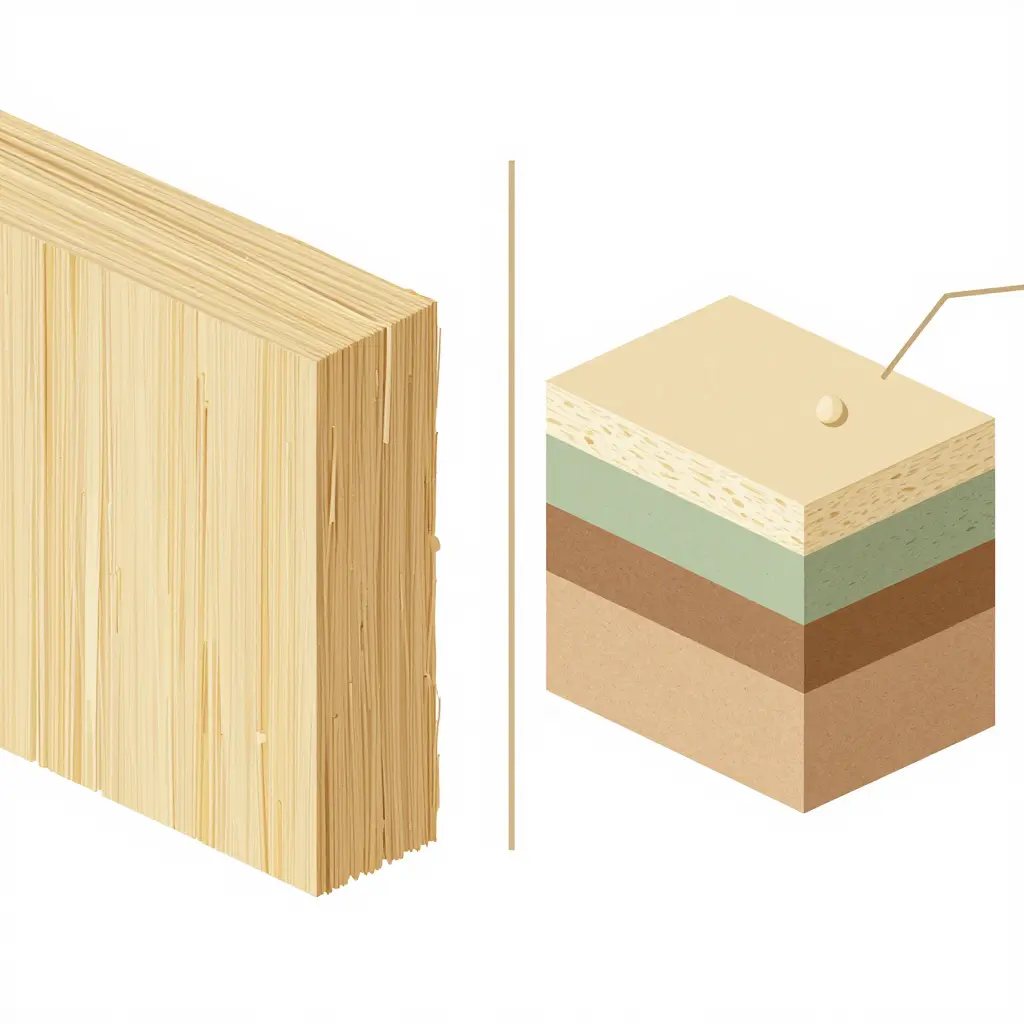
Bagasse walls are generally thicker and denser, because the pulp is pressed as a solid mass rather than laminated. A dense wall takes heat in slowly and spreads it evenly, which suits microwave reheating. Paperboard is thinner and stiffer for its weight, so heat crosses it faster and the corners dry out first.
Surface coating and finish
Bagasse is usually uncoated or lightly coated, and the surface stays slightly porous. Paperboard often carries a film coating that blocks liquid: good for oil, less good for steam, which gets trapped underneath. Plain uncoated paperboard soaks grease quickly, so the coating choice matters most on saucy, fatty menus.
Moisture content
Freshly moulded bagasse still holds some natural moisture, so steam does not collapse it. Paperboard starts drier and can soften or warp when a hot, wet dish releases vapour. A snug lid and short bursts of reheating keep both materials looking presentable.
| Trait | Bagasse | Paperboard |
|---|---|---|
| Build | Pulp pressed in heated moulds | Fibre layers laminated together |
| Wall feel | Thick, dense, matte | Thin, stiff, smooth |
| Heat behaviour in microwave reheating | Slow, even heat spread | Fast transfer, dry edges |
| Coating options | Little or none | PE, PLA or aqueous |
| Oil bleed resistance | Good, absorbs gradually | Strong with film, weak without |
| Moisture content | Holds natural moisture | Starts drier, warps with steam |
Bagasse wins on heat tolerance and heft; coated paperboard wins on stiffness and grease control. Neither is ahead in the abstract, because the dish decides.
The table below compares the two on the eight criteria that come up most often behind the counter, from microwave reheating to oil bleed. Which column you need depends on what you already stock, whether that means matching new boxes to existing sugarcane food containers or building a menu around a new format.
| Criterion | Bagasse | Paperboard |
|---|---|---|
| Microwave reheating tolerance | Handles 2-3 minute reheats well with no metallic arcing | Safe for short reheats, but watch edges for scorching |
| Heat distortion at high fat content | Stiff fibres resist sagging under hot, fatty sauces | Softer board may bow when saturated with hot fat |
| Oil bleed resistance | Natural fibres absorb surface grease, reducing visible oil bleed | Uncoated grades often show grease marks within 20-30 minutes |
| Moisture and sogginess behaviour | Holds shape well; absorbs moisture without going limp | Soggier base under steam; needs barrier or liner |
| Coating options | PFAS-free water-based or PLA coatings available on request | PE, PLA or clay coatings for grease and moisture barriers |
| Available lid and closure formats | Matching sugarcane lids, hinged clamshells, and slot-fit covers | Kraft lids, windowed tops, tuck-front and sleeve closures |
| Cost positioning | Higher unit price, often offset by premium brand value | Lower entry cost, widely stocked and easy to source |
| End-of-life handling | Compostable in industrial facilities; home-compostable grades exist but are less common | Recyclable when clean; coated versions often landfilled |
When reheating and greasy sauces decide the order, bagasse is the lower-risk buy. When budget and print coverage lead, paperboard is.
Microwave Reheating: What Actually Happens to the Box
A microwave heats water rather than packaging. What it heats inside an eco takeaway food box is the water in the food, in the sauce and in the fibre wall itself. What happens to that water over the next two minutes decides whether the box comes out looking the way it went in.
Heat transfer starts at the surface, then works inward
Microwaves reach a couple of centimetres into food, so the outer layer warms first and passes heat inward by conduction. Water held in the fibre wall absorbs energy directly, turns to steam and pushes outward. Cellulose fibres are held together by hydrogen bonds, and steam plus heat is very good at loosening them.
Why moisture and fat push surface temperature past the safe limit
Oil absorbs microwave energy poorly next to water, but it behaves badly once hot: its heat capacity is roughly half water’s, and it does not evaporate, so it keeps climbing well past 100 °C while the food around it still feels mild. In an oily dish that means local board temperatures high enough to soften coatings and stress adhesive seams. Steam adds a second load, because vapour that cannot escape builds pressure just under the surface.
Coated paperboard: blistering and delamination
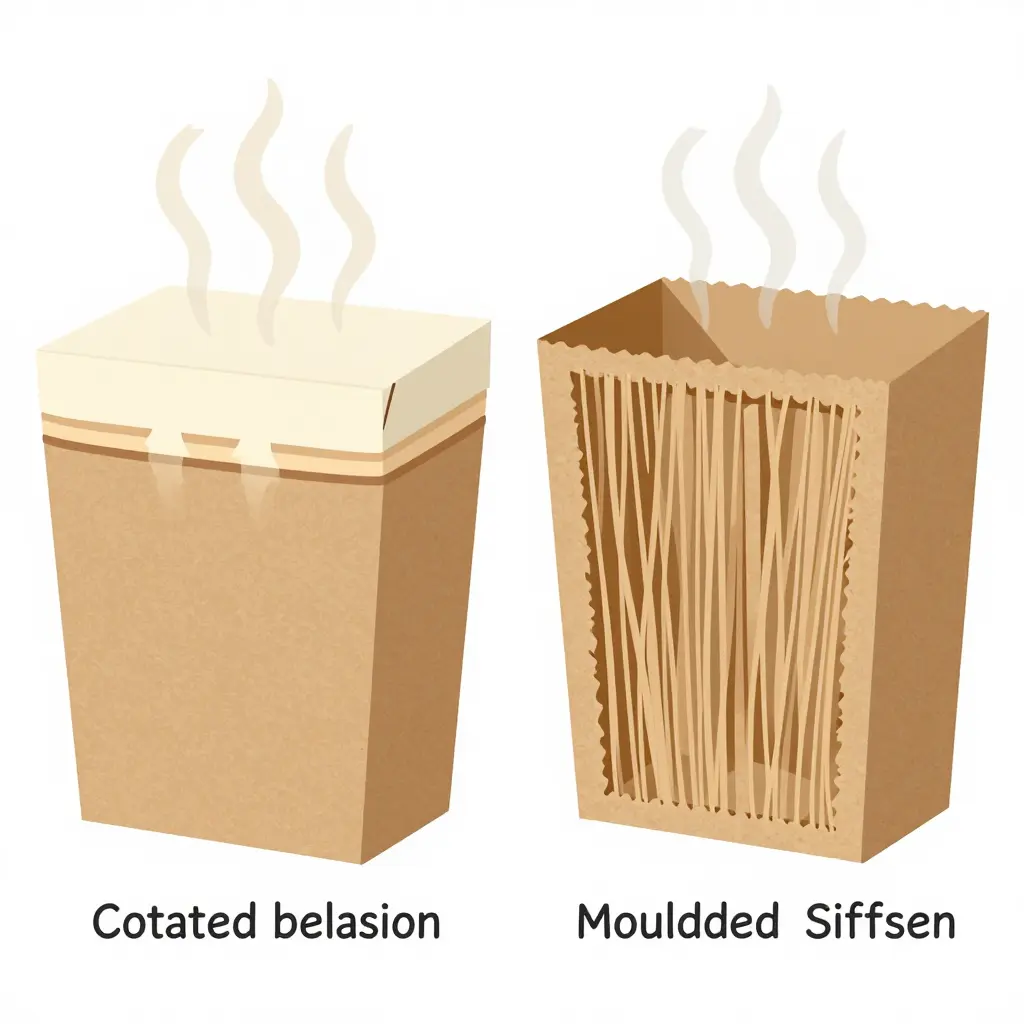
A coated paperboard box looks better on the pass, but the coating that keeps grease out also keeps steam in. Coating and base board expand at different rates, so the layers bubble, blister and eventually separate. Once a seam lifts, oil has a route through.
Uncoated bagasse: stable in shape, but it dries out
Moulded bagasse has no coating and no laminated layer to peel apart, so steam escapes through the fibre and the box keeps its shape and stackability. The cost is moisture loss: long or repeated reheating pulls water out of the fibre until the walls stiffen, feel brittle and crack at the corners. For wet, saucy dishes that get reheated often, a bagasse-friendly bowl format handles that moisture cycle better than a shallow box.
Practical reheating rules that work across the menu
- Time windows: reheat in short bursts of 60 to 90 seconds, check, then continue. Most single portions are done within two to three minutes total; anything longer usually means the power setting is too high.
- Power settings: use medium or roughly 70% power rather than full blast. Slower heating gives steam a chance to escape instead of inflating the board.
- Lid removal: lift the lid, or vent it with a gap, before switching the microwave on. Never send a metallised film, foil-laminated lid or foil-lined sleeve into a microwave, even for a few seconds. Metal reflects energy, which arcs, scorches and is a genuine fire risk. If you are sourcing lids, look for clearly microwave-safe paper lid options and rest them loosely on top rather than sealing them.
Treat these as starting points rather than a fixed script, since portion size, oil content and wattage all move the numbers. Reheated sensibly, an eco takeaway food box comes out fine. It needs short bursts and a lid that comes off first.
Quick comparison at a glance
| Behaviour when reheated | Coated paperboard | Uncoated bagasse |
|---|---|---|
| Steam escape | Trapped under coating | Passes through fibre |
| Shape retention | Good until seams fail | Very good |
| Main risk | Blistering, delamination | Drying, stiffening, cracking |
| Best practice | Lower power, vented lid | Short bursts, add a splash of water |
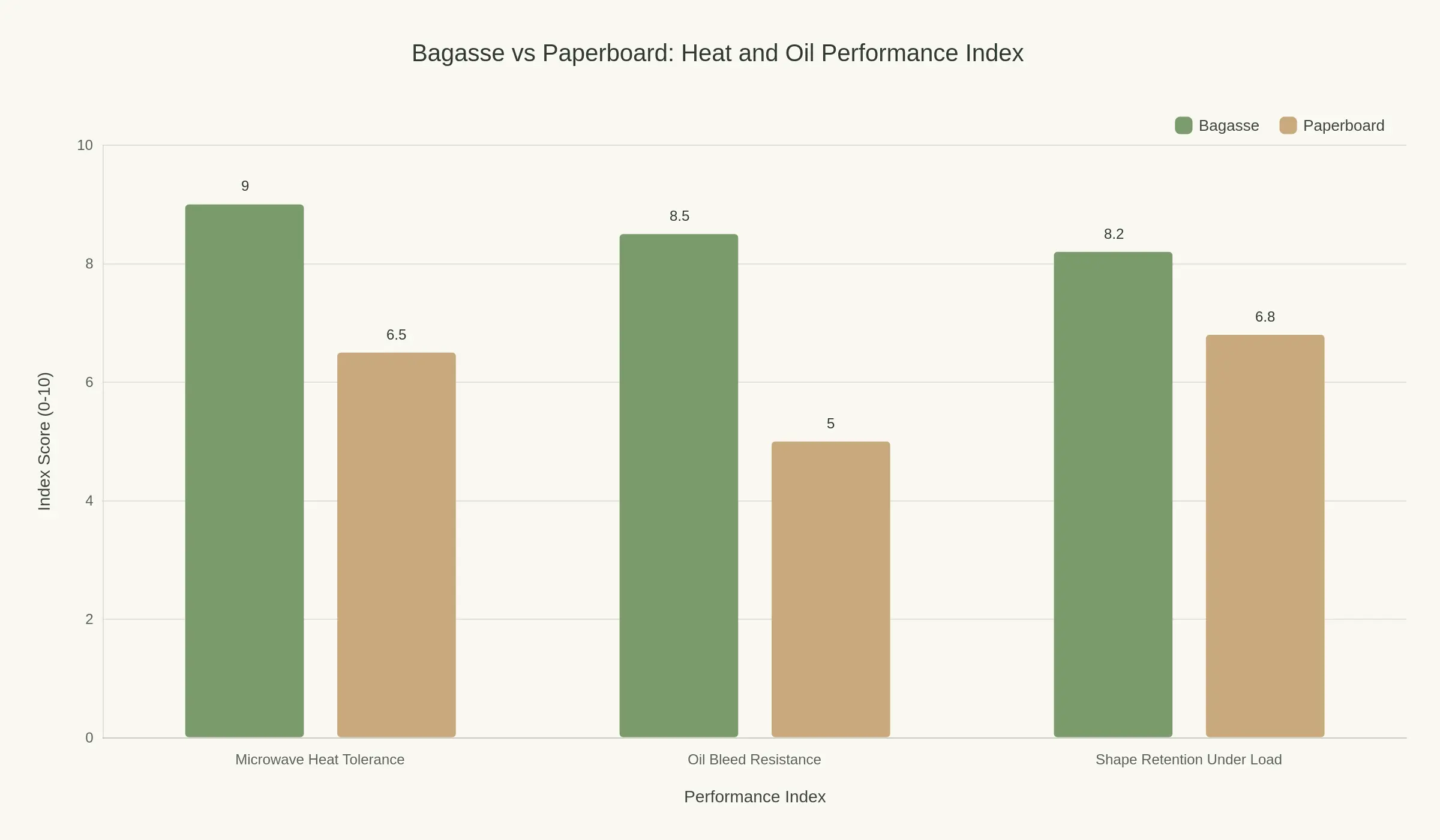
What the bars show: bagasse scores above paperboard on all three measures, at 9.0 against 6.5 for microwave heat tolerance, 8.5 against 5.0 for oil bleed resistance and 8.2 against 6.8 for shape retention under load, with the widest gap on oil bleed. The scores are a relative ranking of our own samples rather than lab results, so confirm them against your menu. Read that way, bagasse is the lower-risk choice when reheating, greasy sauces or stacked delivery loads are routine, while paperboard is fine for short, dry, room-temperature holds. The bagasse side of that comparison sits in our sugarcane food container range.
Oil Bleed: Why It Happens and Which Material Holds Up
A dark glossy patch creeps up the side of a box minutes after packing. It looks like a cosmetic annoyance, but it shows what is happening inside the wall of your eco takeaway food box, and it usually means the material does not match the menu.
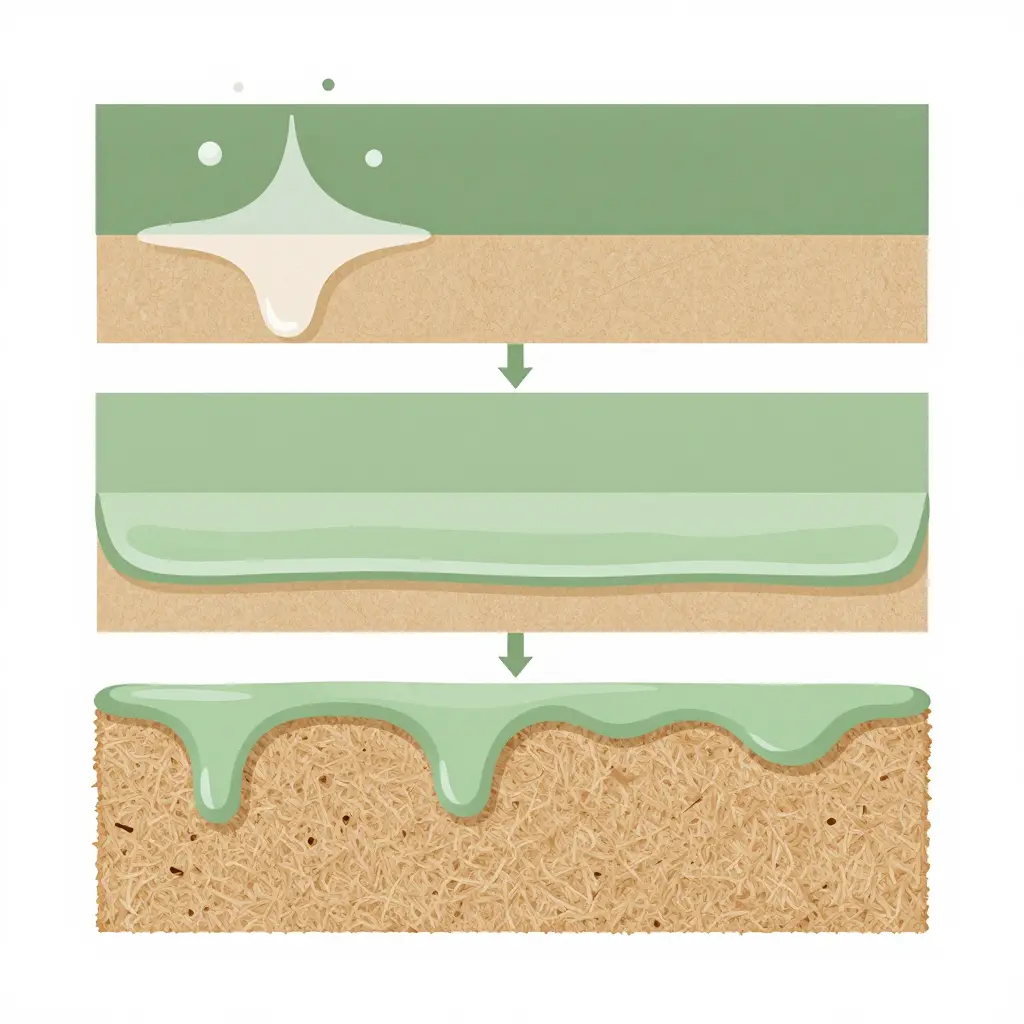
The wicking mechanism, in plain terms
Paper and moulded fibre are not solid sheets. They are webs of cellulose fibres with countless pores trapped between them. When liquid fat sits on the surface, capillary action pulls it into those pores, the same effect that drags a spill along a paper towel. Once the fat is inside the sheet it travels sideways and upward through the fibre network, so a small splash at the base can resurface as a wide dark ring an hour later.
Why thin, uncoated board struggles
A thin, uncoated paperboard wall has very little material to absorb or slow that movement. The oil fills the air spaces, changes how light passes through the sheet, and shows up as translucent patches that read as damp and greasy to your customer. Saturated fibre also loses stiffness: the wall softens, the base sags, and a box that felt rigid when packed starts to buckle. Stack a few and the sag compounds down the pile.
How grease-resistant coatings stop the flow
A grease-resistant coating closes the surface. The barrier seals the pore openings, so liquid fat stays on top as a film instead of being drawn inside. Fluorine-free water-based barriers are now common and are easier for mills to repulp than PE, though whether a barrier-coated box is accepted still depends on your local facility. Continuity is the catch: the barrier only works where it is unbroken, so creases, folded corners and cut edges remain the weak points.
Where bagasse behaves differently
Bagasse is moulded rather than laminated. Wet pulp is pressed under heat and pressure into a dense, closed surface skin, so far fewer open pores remain for oil to enter. That compaction is why moulded bagasse copes with curries and other high-fat sauces: the sauce pools on the surface, oil bleed stays out of sight, and the container keeps its shape through a full delivery run. The thicker wall insulates a little as well. One honest caveat: thin, water-heavy gravies held for a long time still creep at cut edges, so portion size and hold time matter.
Practical selection thresholds
| Menu fat level | Typical items | What to specify |
|---|---|---|
| High fat / sauce-heavy | Curry, chilli-oil noodles, fried chicken, braised pork | Moulded bagasse or grease-resistant coated board |
| Medium | Stir-fries, rice bowls, pasta, loaded fries | Coated board or bagasse; avoid thin uncoated walls |
| Low fat | Salads, sandwiches, pastries, plain rice | Lighter uncoated paperboard is fine |
Match the wall and coating to the fattiest item on the menu, not the average one. Curry, chilli oil and fried chicken call for moulded bagasse. Our sugarcane clamshell boxes are pressed with that dense surface and suit saucy menus, and a coated kraft option from our noodle paper box range covers broth-and-noodle service. Salads, sandwiches and bakery items are fine in lighter uncoated board, which costs less.
Procurement Checklist Before You Commit to a Box Specification
Packaging decisions look tidy on a spreadsheet and feel different at 7pm on a Friday. Run these checks with your team before you lock a specification.
- Confirm fibre or pulp grade, whether bagasse, bamboo or virgin paperboard, against your heaviest menu item.
- Verify coating type and food-contact compliance, and request current certificates before you sign off.
- Check the microwave reheating label printed on the eco takeaway food box you plan to buy.
- Run an oil bleed test with the actual menu items instead of generic sample proxies.
- Test lid and closure fit with gloved hands during a busy-service simulation.
- Validate stacking strength for delivery by loading full cases and checking bottom-box crush.
- Review custom print and kraft paper box options, including minimum order quantities and artwork lead times.
- Audit carton and shipping case efficiency to cut freight and storage cost per unit.
- Gauge supplier support by timing replies to technical and reorder questions.
Nine answers in writing, and your eco takeaway food box choice holds up in service rather than only in the showroom.
Barrier Layer Principle: Where Oil and Moisture Are Stopped
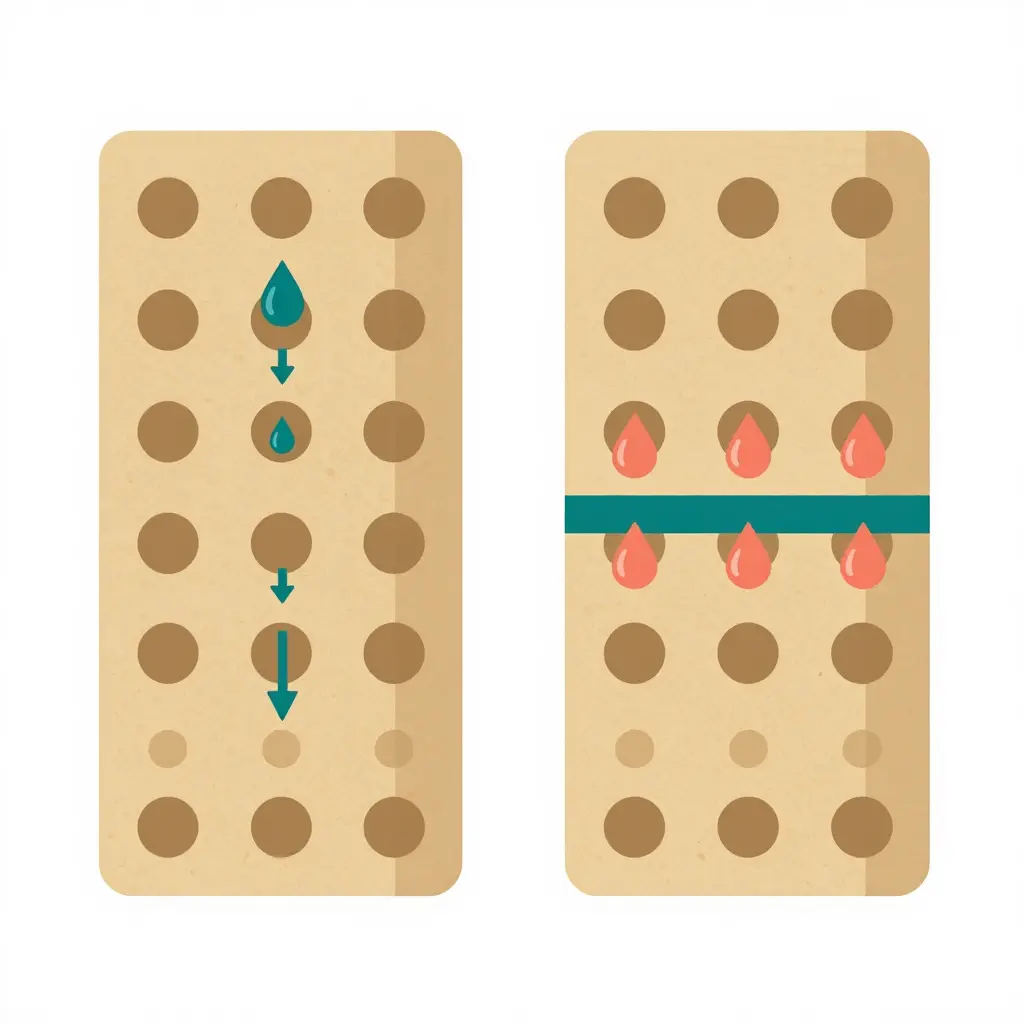
Caption: On a plain fibre wall, oil and moisture travel through the open pores into the board, while a thin barrier layer closes those gaps so droplets simply stay on the food side of the wall.
Cost, Lead Time and Supply Planning
Buyers usually open with the question of which option is cheaper per box. Fair question, and not the whole one: cost, lead time and the reliability behind both decide whether your eco takeaway food box works on the counter every week.
Unit cost positioning at similar volume tiers
At comparable order tiers, coated paperboard usually starts at a friendlier unit price. Sheet-fed and high-speed converting lines are widely available, many suppliers compete for the same orders and the raw board market is deep, so competition keeps pricing tight.
Bagasse typically sits a step above paperboard at the same tier. Moulded fibre uses more energy, the tooling is dedicated to each shape and fewer factories have both the capacity and the export experience. The gap cuts both ways, because bagasse pricing is driven by fixed costs: once volume climbs and moulds are paid off, the gap narrows, and on very large runs it can close.
| Factor | Bagasse | Coated paperboard |
|---|---|---|
| Typical unit cost position at mid volume | Higher | Lower |
| Behaviour as volume grows | Improves faster (fixed-cost driven) | Improves gradually |
| Tooling investment | Moulds per shape and size | Die-cut plates and cutting dies |
| Custom printing flexibility | Limited (often labelling or mould texture) | High (multi-colour, full wrap) |
| Supplier depth in most regions | Thinner | Deep |
What actually moves the price and the clock
Three levers do most of the work.
- Coating type. Polyethylene linings are the cheapest and most familiar. Water-based and bio-based coatings sit in a different bracket and take longer to schedule, because fewer lines run them. Where microwave reheating matters, an aqueous coating is usually the compromise that works. Our paper cup, bowl and bucket ranges show how coatings are applied across formats.
- Custom printing. New artwork means plates, proofing and a press run-up. Adding a logo to a stock box is a modest setup fee; six colours plus a coated lid finish adds days before dispatch, not just cents per unit.
- Tooling or mould changes. A new bagasse mould or a new cutting die for paperboard is a one-time cost spread across the order. Change the shape, whether a deeper box, a rounded corner or a window, and the clock restarts. Where possible, fit your menu into an existing tool rather than inventing a new one.
Total landed cost beats sticker price
Spoilage and re-order frequency usually outweigh the unit price. A box that bleeds oil through the base damages the order, the bag and the customer relationship; a lid that fits loosely causes returns. Compare the spoilage rate you see in a real service week, not the quote.
Re-order frequency matters as much. Frequent small top-ups mean more freight, more handling and more exposure to stock-outs. Consolidating into fewer, fuller shipments usually saves more than a marginal unit-price discount ever will, and it applies across our wider paper packaging lineup.
Storage counts too. Bagasse nests tightly and stacks well. Paperboard boxes arrive flat but take up more room once erected. Warehouse space is a cost line even when it is not on the invoice.
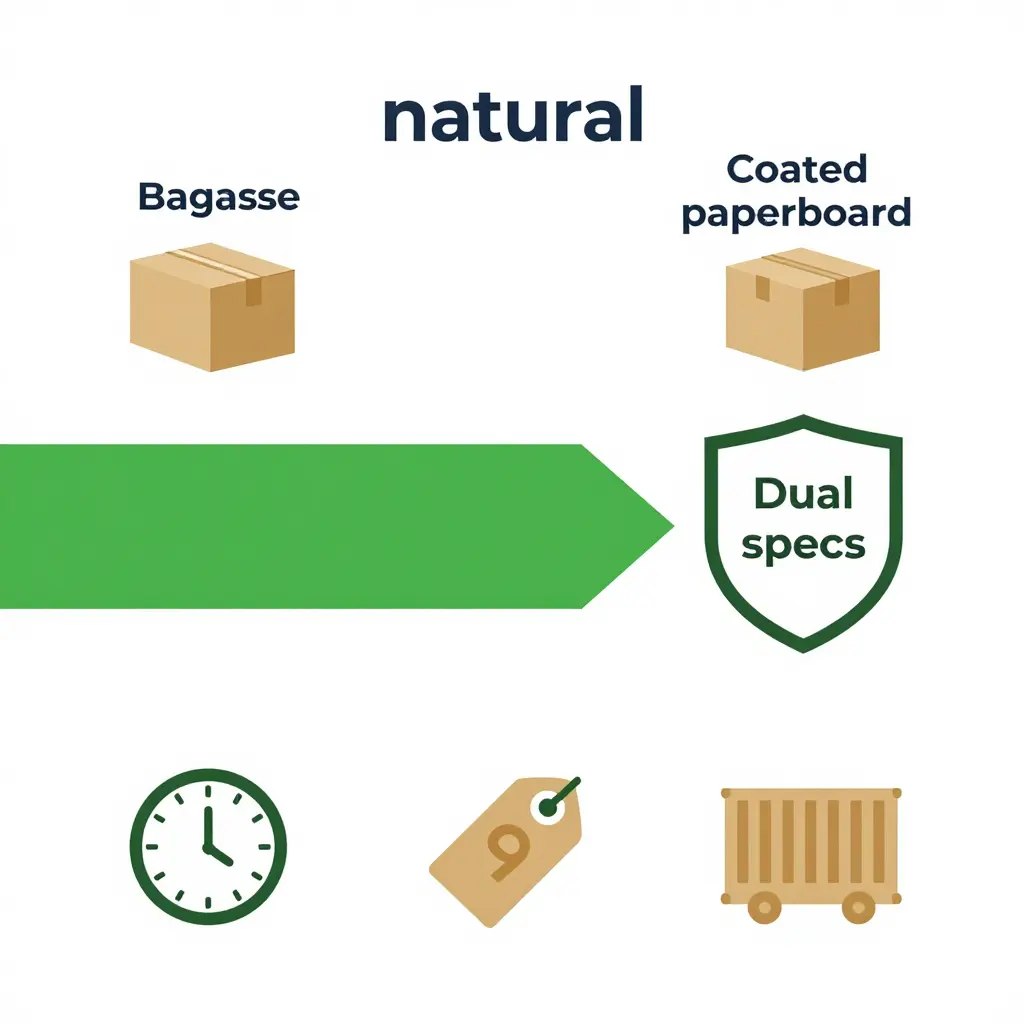
Always keep two approved specifications
The most useful habit in eco takeaway food box procurement is to approve two specifications instead of one. Qualify a bagasse box and a coated paperboard box for the same dish, with the same footprint and accepted oil resistance, and sign off both artwork versions in advance.
When a mill goes down, a coating is delayed or a container is rolled, you switch to the approved alternate and keep serving. Your team already knows the box, the lid and the packing rhythm. Dual approval costs some diligence once and saves scrambling every service day after that.
Matching the Box to Heat Load, Fat Load and Service Format
Start with three variables rather than a material: how hot the food goes in, how much fat it releases, and how long it sits before someone opens it. Treat what follows as filters, not fixed categories.
- High heat plus high fat: coated paperboard or dense moulded bagasse. A coating slows oil penetration and keeps the surface clean through microwave reheating, and a denser bagasse wall resists softening when sauces pool against the base.
- Long holding times: thicker walls and lids that seat firmly. Wall thickness is insulation and rigidity at once, and a lid that closes properly traps steam where you want it while keeping spills out of the bag.
- Cold items and delivery-heavy work: lighter board for chilled desserts and drinks, since they rarely need heavy walls, and compression strength plus seam quality first for anything that rides in a bag all evening.
Most decisions come down to reading the menu honestly. Curries, glazed wings and fried sides are where oil bleed appears first, and it is usually a coating and seam problem rather than a thickness problem, so specify the barrier before you specify the grammage. If a box has to survive a microwave pass and then a twenty-minute car journey, the denser wall with the tighter lid earns its price over the lighter option.
Closures follow the same logic. A paper sleeve gives a hot drink a grippable, condensation-resistant surface, paper cup holders keep multi-drink orders upright in transit, and a box with a clear lid lets cold or garnished items stay visible without breaking the seal. Match the carry format to the journey and the box becomes the easy part of the order.
FAQ
Can bagasse boxes go in the microwave?
Yes. Moulded bagasse contains no metal, and the fibre tolerates short reheating bursts of two to three minutes. What limits it is drying rather than melting, so remove lids, metal clips and sauce cups first and stir halfway through.
Is paperboard safe for microwave reheating?
Plain uncoated paperboard is fine for short reheats of low-fat foods at medium power. Foil-laminated and metallised board must stay out, and waxed board softens. PE-coated board is often sold as microwave-safe for short bursts, but it will soften and can blister. Look for a microwave-safe symbol on the base and keep heating under three minutes.
How do I stop oil bleed in an eco takeaway food box?
Oil bleed happens when hot fat seeps into uncoated fibre. Use a box with a grease-resistant lining, keep sauces in separate cups, and let fried food drain for 30 seconds before packing. A lined kraft paper box is the simplest fix.
Which material is better for hot, oily foods?
Bagasse holds heat and grease better than standard paperboard, because its moulded fibre is denser and stays rigid when saturated. Coated paperboard suits medium-fat dishes. For curries, fried rice and saucy noodles, bagasse is the safer option.
Are these boxes recyclable or compostable?
Uncoated bagasse and plain paperboard both compost in industrial facilities, typically within 60 to 90 days; home compostability depends on the grade and should not be assumed. Moulded fibre is rarely taken in kerbside paper recycling, while clean uncoated paperboard usually is. Coated versions depend on the coating and on local facilities: PLA needs industrial composting, and PE coatings generally go to general waste.
The Practical Takeaway
Across the measures that matter in daily service, the split is consistent. Bagasse tolerates heat and holds oil, which makes it the safer choice for dense, saucy, reheated menus such as curries, braises and rice bowls that see the inside of a microwave before they are eaten. Coated paperboard leads on cost efficiency and print flexibility, so it fits lower-fat menus where branding space and unit price carry more weight than thermal endurance.
The right eco takeaway food box is not the one that wins a general comparison. It is the one validated against your actual menu, portion size, holding time and reheating routine, and a sample test with your own dishes tells you more than any specification sheet.
If it helps, you are welcome to browse our paper packaging range or look more closely at rectangular sugarcane food containers. Our team can arrange samples or specification support whenever your review reaches that stage.