
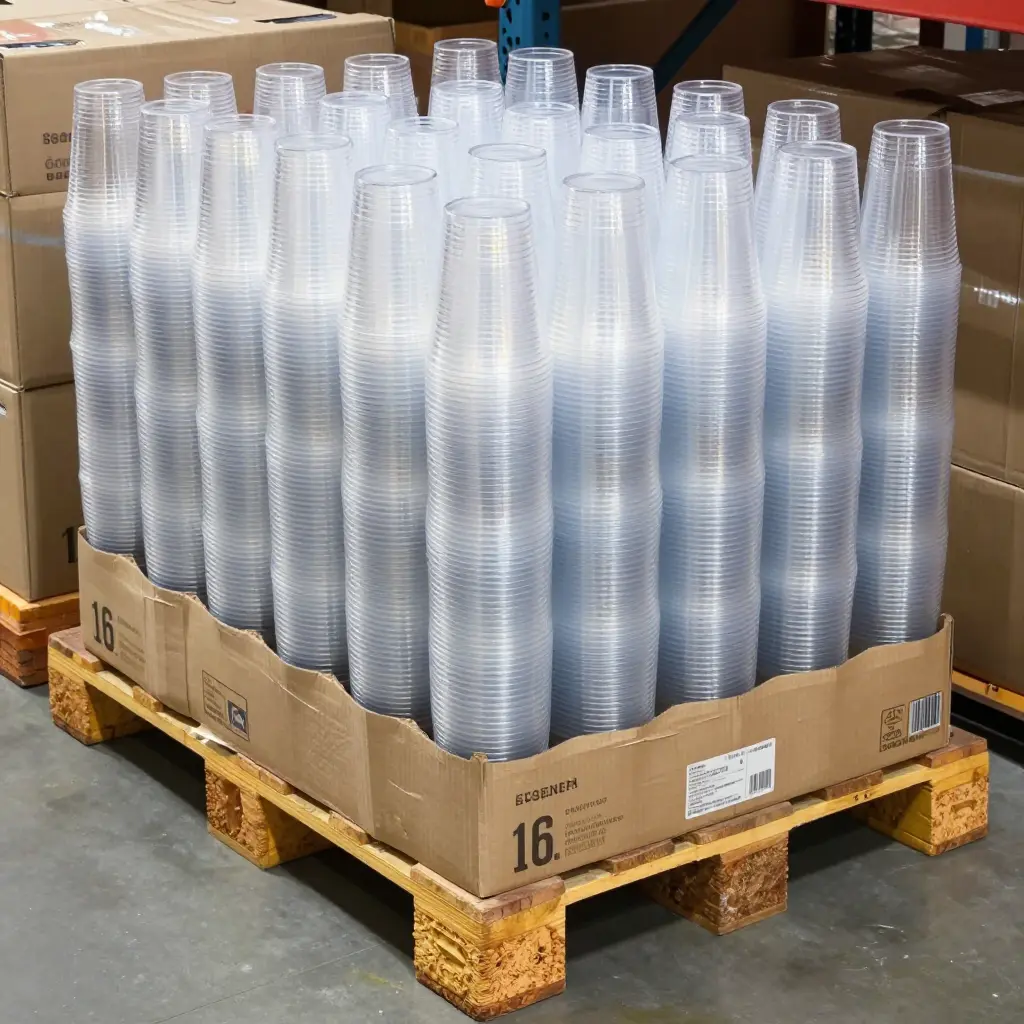
Why PET Cup Weight Decides How High You Can Stack Bulk 16oz Clear Plastic Cups
Two numbers set the safe stacking height of bulk 16oz clear plastic cups: the gram weight of each PET cup and the compression strength of the carton it ships in. Get either one wrong and the bottom layer of a pallet fails, often before the load reaches the truck.
Weight compounds quickly. At 1,000 cups per carton, moving from a 9 g cup to a 14 g cup adds 5 kg to every case and about 80 kg to a 16-carton pallet. The bottom carton in a four-layer build absorbs an extra 15 kg of that, with no change to the board grade underneath it.
Mass is what the lower cartons actually have to hold. Carton compression is the vertical force a case takes before its walls buckle, and the bottom tier carries everything stacked above it. So set pallet height from the smaller of the two limits: what the cups can pass down and what the carton can carry. Beverage chains that stock paper cup ranges for hot menus alongside PET run the same arithmetic, because mixed inventory on one rack shares the floor space and the crush risk.
What Drives PET Cup Weight in a 16oz Clear Cup
The gram weight on a 16oz PET spec sheet comes from four design decisions, and each one changes how the cup feels, how it nests and how many units fit on a pallet.
Wall thickness
Wall thickness accounts for most of the difference. A 16oz body has roughly 320 cm² of surface, so every extra 0.1 mm of average wall adds about 4 g of PET. That alone separates a 9 g cup from a 15 g cup built to the same shape and capacity. The thicker wall also resists flexing when a cup is gripped hard or packed with ice.
Rim design
A rolled rim puts extra material at the top edge, where the cup meets the lid or sealing film. A tight, thin roll saves weight but can feel sharp against the mouth. A wider, rounded rim adds a gram or two, seals more reliably, and holds up when lids are pressed on in a busy queue.
Base cup height
Cups nest, so base height sets both stability and stack height. A taller base lifts the cup off the counter and stiffens the lower wall, at a cost in material. A shallower base saves grams and leans on wall thickness for support instead.
Thin-wall, standard and heavy-duty formats
Most suppliers quote 16oz clear cups in weight bands rather than exact grams:
| Format | Typical weight per 16oz cup | Cups per carton | Cartons per pallet | Typical use |
|---|---|---|---|---|
| Thin-wall | 9-11 g | 1,000 | 12-16 | High-volume cold drinks, fast turnover |
| Standard | 12-14 g | 1,000 | 12-16 | Bubble tea, iced coffee, daily service |
| Heavy-duty | 15-18 g | 500 | 16-20 | Thick toppings, events, longer holding |
| Reinforced rim | 17-20 g | 500 | 16-20 | Lidded delivery, transit-heavy orders |
Lighter versus heavier: the trade-off in real numbers
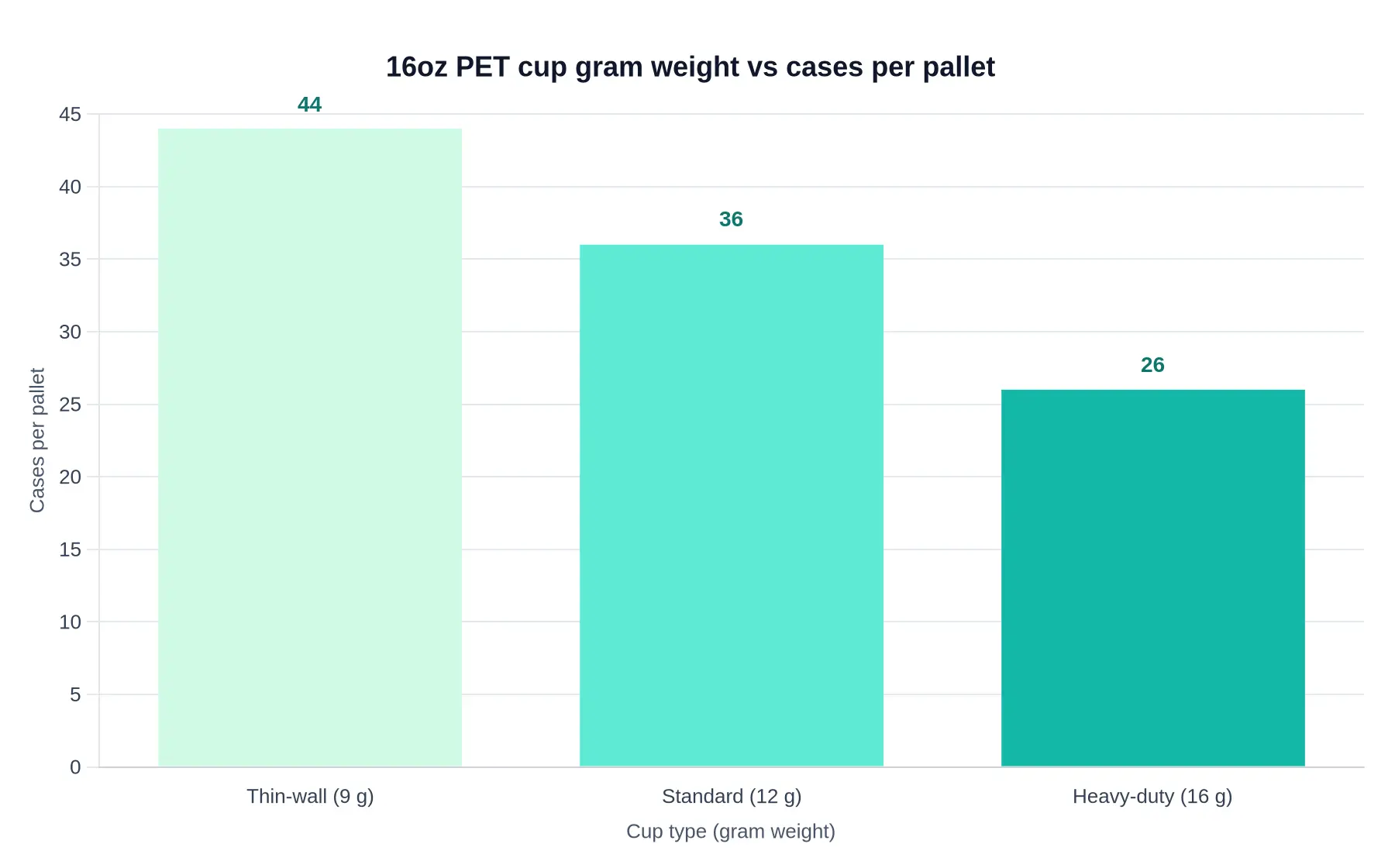
Lighter cups fit more product into the same footprint. A 1,000-count carton of 12-14 g cups weighs 13-15 kg gross, while a 500-count heavy-duty carton lands nearer 9-10 kg. Per case, the lighter carton is the heavier one to lift and the harder one to stack high.
Plastic cup weight per case is where the trade shows up on a freight invoice. A pallet built from 1,000-count standard cartons carries 12-16 cases, or 12,000-16,000 cups. The same footprint in 500-count heavy-duty cartons carries 16-20 cases, or 8,000-10,000 cups. What the heavier cup buys is rigidity, lid grip and a firmer hand-feel, not extra pallet capacity.
Comparing formats across materials is worth the same exercise. Beverage programmes that need a sturdier, more premium feel often look at paper cup and bowl formats alongside PET, because the weight-to-case-count maths does not change with the substrate.
Here is how cup weight tracks with carton build across our cup options:
| Cup Format (16oz PET) | Approx. Cup Weight (g) | Cups per Carton | Carton Gross Weight | Max Cartons High on the Floor | Best Use Case |
|---|---|---|---|---|---|
| Thin-wall | 9 – 11 | 1,000 | 12 kg (26 lb) | 8 | High-volume iced drinks, fast-turn events |
| Standard | 12 – 14 | 1,000 | 15 kg (33 lb) | 6 | Daily bubble tea and smoothie service |
| Heavy-duty | 15 – 18 | 500 | 10 kg (22 lb) | 7 | Catering, thick shakes, sturdier hand-feel |
| Reinforced rim | 17 – 20 | 500 | 11 kg (24 lb) | 6 | Lidded delivery and transit-heavy orders |
| Standard bulk pack | 12 – 14 | 2,000 | 29 kg (64 lb) | 4 | Central warehouses feeding multiple stores |
Read that last column against carton gross weight, not cup weight. A 500-count heavy-duty carton stacks higher than a 1,000-count standard carton because it weighs 5 kg less, even though each cup is heavier. Takeaway: match the tier to the load the board can take, and never go past the tested height for the carton in front of you.
Carton Compression: The Real Limit on Pallet Stacking
A corrugated case full of nested cups is, structurally, a short column. Vertical load travels down the box walls and funnels into the four corners, while the fluted medium acts as a row of small arches holding the liners apart. Lined up properly, a case carries hundreds of kilos. Out of line, the walls bow and the stack leans.
Why compression strength drops over time and in damp air
Humidity. Paper fibres take up moisture from the air, the hydrogen bonds between them loosen, and the board softens. Moving a pallet from a dry, air-conditioned aisle to a humid loading dock can cost a third or more of a carton’s compression strength, with no damage visible from outside. Cartons stored near dishwashing areas, cold-room doors or open bays behave very differently from the same cartons in a dry back room.
Time. Corrugated board creeps. Under sustained load it deforms slowly, so a pallet that looks square on delivery day can show bulging sidewalls by week three. Forklift vibration and the small impacts of restacking add their own losses.
The three conditions that quietly reduce compression strength
- Moisture pickup from humid air, wet floors, or condensation on cases moved between cold and warm zones.
- Long dwell time under load, plus vibration and repeated handling that fatigue the board.
- Pallet overhang and misaligned corners: a case hanging a few centimetres past the pallet edge loses much of the corner support carrying the load.
How the air space inside a case changes rigidity
A carton of tightly nested cups behaves almost like a solid block. Cup walls and bases butt against each other, the stack props up the top panel from underneath, and the load path runs straight down. Loose packing leaves air gaps: the top flaps dish inward, the sidewalls carry load in bending rather than compression, and the box fails at a much lower weight.
Tight nesting in a case sized to the cup protects stacking height more than extra board thickness does, and it also stops rims and lids from shifting and scuffing in transit.
The practical takeaway
Do not size a stack from cup crush resistance alone. Cups can be tough while the case around them bulges first. What sets the ceiling is the box compression value, discounted for humidity, dwell time and handling. Build in a safety factor, keep pallets square and flush, store cases off the floor and away from damp, and pair well-built cases with tidy cup holders and carriers so the front of house handles as smoothly as the back.
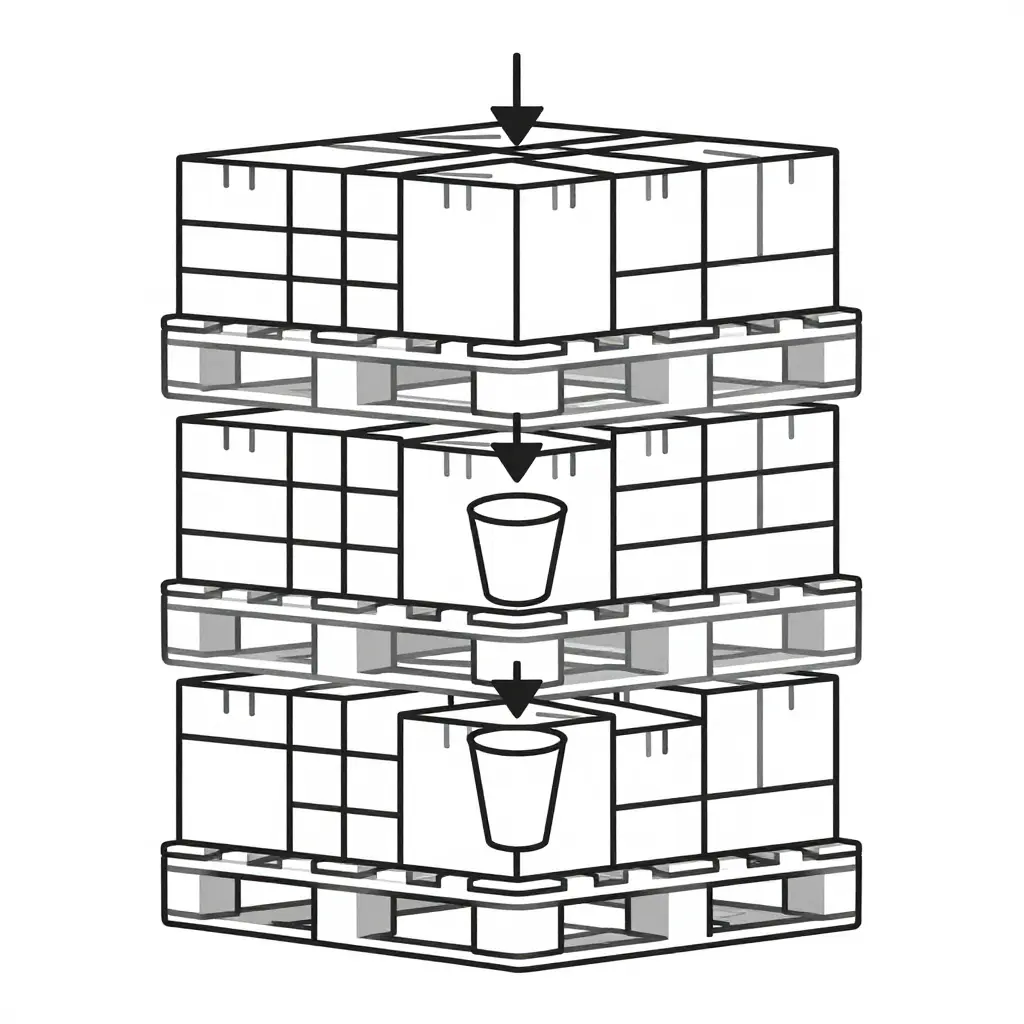
Balancing Cup Weight Against Carton Compression: A Practical Decision List
Every bulk buyer meets the same trade. A thicker wall makes 16oz clear PET cups more forgiving on a busy dock and adds resin cost to every unit sold. Go lighter and yield per pallet climbs, but the packed carton now depends on stronger board and a conservative stack height to arrive intact. Neither answer is right in isolation, so treat PET cup weight and carton compression as two dials to tune together rather than a single pass-or-fail spec.
- Cost per delivered cup. Landed cost is resin plus the cartons, stretch wrap and pallet footprint needed to protect it. A lighter cup that forces heavier board or extra wrap can eat its own saving, so compare cost per undamaged cup delivered, not cost per case.
- Board grade against the real load. Match the board to the weight the bottom box actually carries. If the bottom row bulges or feels soft after settling, cup weight and box strength are out of balance: step up the board or drop a tier before shipping.
- Warehouse stack height. Every extra tier multiplies the load on the bottom carton. Set a ceiling where cases still look square after a 24-hour settling window, and keep it through humid months, when board softens.
- Handling and delivery conditions. Forklift jostling, multi-drop routes and long hours in a warm van punish thin walls harder than a controlled distribution centre does. Food trucks and event crews should sit at the sturdier end of the range.
- Presentation in service. Rigid cups hold a crisp shape when customers squeeze them, which matters for branded drink programmes. Lids sized to the cup keep packed cartons stable, with less pop-off and sleeve slip in transit.
Choose the lightest cup your cartons, stack heights and delivery routes can genuinely protect. Real handling conditions, not unit price alone, should make the call.
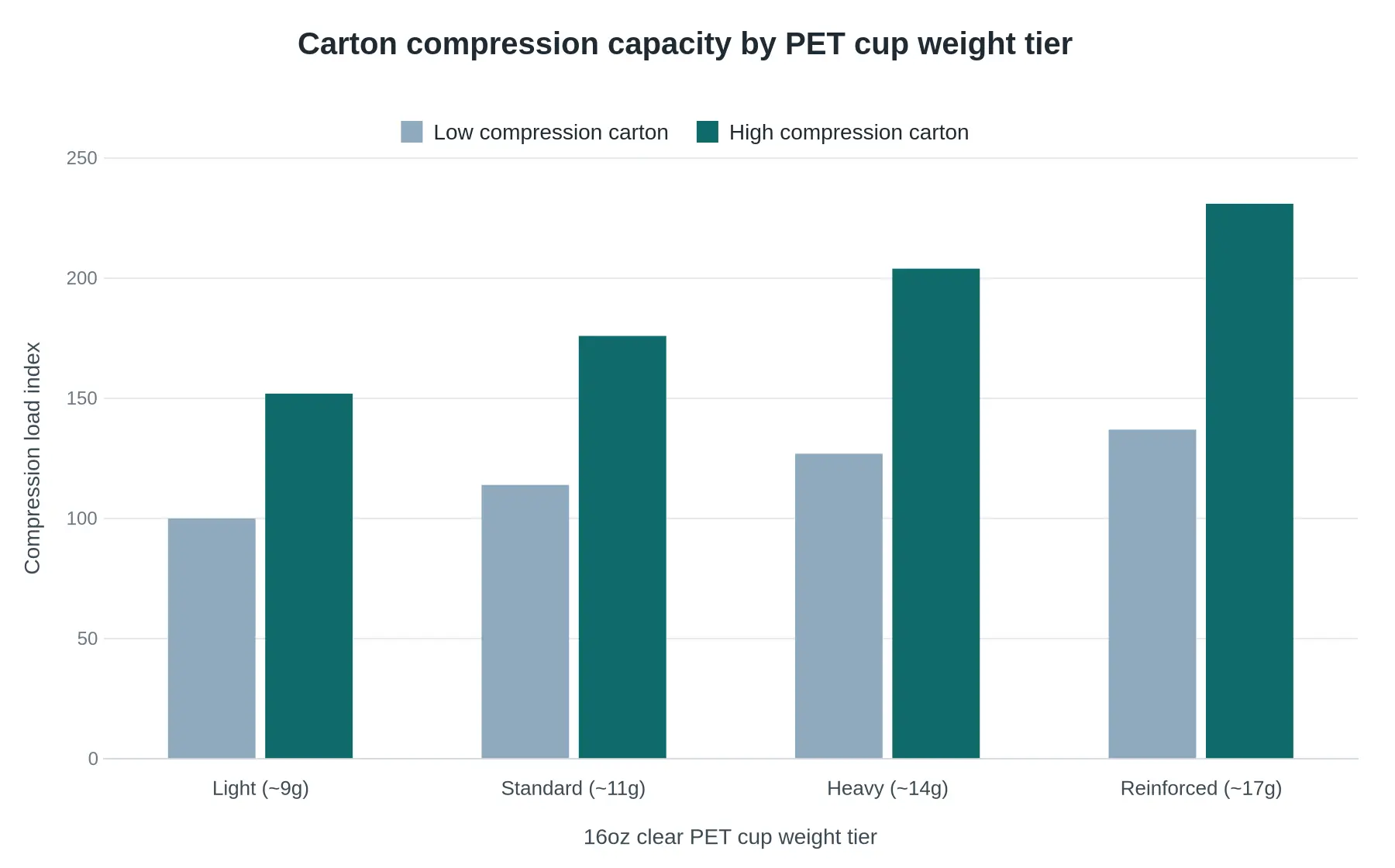
Carton compression capacity by PET cup weight tier
A thicker wall changes how high a carton can go, not because the cup gets taller, but because the cup passes load down into the case below instead of deforming under it. The chart below compares that effect across four cup tiers and two carton grades.
How to read the chart
Values are a compression load index built for this comparison, with light cups in a light carton set at 100. It is a relative scale, not a laboratory BCT figure, so use it to rank configurations rather than to quote absolute loads.
| Cup weight tier (16oz PET) | Low compression carton | High compression carton |
|---|---|---|
| Light (~9g) | 100 | 152 |
| Standard (~11g) | 114 | 176 |
| Heavy (~14g) | 127 | 204 |
| Reinforced (~17g) | 137 | 231 |
Three patterns stand out.
- Both columns climb. Moving from light to reinforced cups lifts the index about 37% in the light carton and 52% in the heavy one. Thicker walls resist crushing better.
- The gap widens with cup weight. The two cartons sit 52 index points apart at the light tier and 94 apart at the reinforced tier. Cup strength and carton strength multiply each other rather than add.
- The weakest pairing is the common one. Light cups in a light carton sit at the bottom of the chart, which is exactly where cost-driven bubble tea programmes tend to start.
Why the two variables are not interchangeable
Carton strength comes from board grade, flute profile and how the flaps and corners are glued. A cup’s contribution comes from wall thickness and rim rigidity. In a stack, load travels down through the cups into the case, then through the case to the pallet, and the softest link in that chain sets the limit. That is why a stronger carton delivers less than its top row suggests while the cups stay light, and why stiffer cups without a stronger carton leave performance unused. The heavy carton reaches 231 only because the reinforced cup spreads load across the top panel instead of dimpling under each base.
Turning index points into a safe stacking ceiling
Index units compare options; a warehouse team needs a number for the rack post. Take the carton’s lab box compression value, discount it for humidity, dwell time and handling, then divide by carton gross weight.
A worked example: a 1,000-count carton at 14 kg gross with a 260 kg lab BCT, derated to 60% for a damp season and divided by a 1.6 safety factor, allows about 98 kg on the bottom box. Divide by 14 kg and you get seven cartons, so a four-layer pallet build leaves margin while a seven-high floor stack uses all of it. Put the same board under 18 kg cartons and the ceiling drops to five.
Practical takeaways for buyers
- Match the tier to the trip. Local routes with two-week turnover suit light cups in a mid-grade carton. Cross-country freight and third-party warehouses justify the premium for heavier board.
- Audit the stack, not just the spec sheet. Lab compression values assume even, centred loads. A rushed pallet build can erase a 30-point advantage in an afternoon.
- Standardise where volume is highest. Putting the best-selling 16oz SKU on one cup tier and one carton grade makes reordering simpler and stack height predictable across sites.
- Protect the corners. Corner posts and edge protectors preserve more capacity than most buyers expect, especially on the top cartons where failure usually begins.
Weight tier and carton grade are two halves of one decision, and the chart is the quickest way to see what is gained when both are chosen together. If you are planning storage for a new menu launch, browsing a complete packaging range shows which cup and carrier combinations were designed to work as a system.
Warehouse Stacking Procedure for Bulk 16oz Clear PET Cups
Good warehouse stacking keeps every carton intact until it reaches the counter. Run this routine on every inbound load of bulk 16oz clear plastic cups, and post it at the receiving bay so each shift stacks the same way.
- Verify carton compression before receiving. Check the edge crush test (ECT) rating printed on each carton label and match it to the load the stack will put on the bottom box. Reject soft, dented or moisture-marked cartons on the spot.
- Check cup weight consistency between lots. Weigh one sample carton from each lot on a floor scale and record the reading next to the lot number. A sudden drop in PET cup weight means thinner walls and weaker support in the tier below.
- Align cartons flush to the pallet footprint. Square each carton against the pallet edge, keep corners tight, and allow zero overhang. Restack any load that shifts by more than a finger width.
- Limit height by tier count, not by eye. Set a fixed tier cap per SKU, such as four or five layers for 16oz cups, tape the number to the rack post, and count tiers on every walk-through.
- Control humidity and storage time. Hold the stacking area at 40-60% relative humidity, run dehumidifiers after rain or floor washing, cap storage at 30 days, and date every pallet on arrival.
- Rotate stock so older cartons sit lower. Load new pallets above dated ones and move older cartons to the bottom tiers and the pick face. Stage outbound orders in sugarcane cup holders to keep packed orders and counts organised.
Checking carton compression and PET cup weight together is what prevents crushed rims and leaked lids. Fixed tier caps and steady humidity keep the line safe through the season.
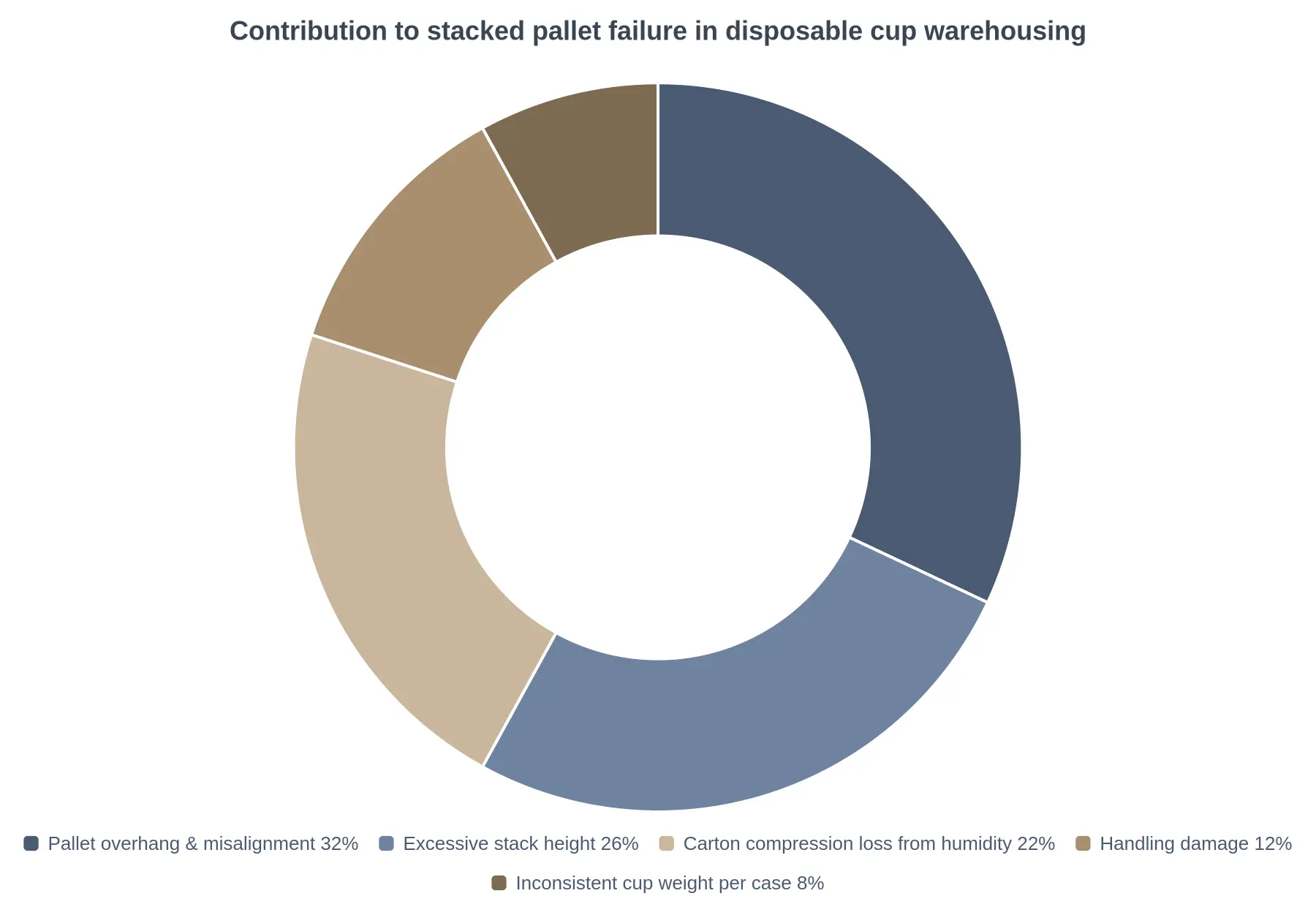
Contribution to stacked pallet failure in disposable cup warehousing
How to read it
The ring ranks five drivers behind collapsed cup pallets. The percentages are an indicative split used for auditing, not a published survey, so treat them as a priority order: the ranking is the useful part, the exact shares less so. Each legend entry carries its own figure, so nobody has to estimate slice size by eye.
| Failure driver | Indicative share | What it looks like in the warehouse |
|---|---|---|
| Pallet overhang & misalignment | ~32% | Cartons hanging past the pallet edge, corners drifting out of column |
| Excessive stack height | ~26% | Tall builds that lean, then shear in the top third |
| Carton compression loss from humidity | ~22% | Soft, bulging cartons after a damp week; walls no longer square |
| Handling damage | ~12% | Forklift clips, torn corners, crushed bottom layers |
| Inconsistent cup weight per case | ~8% | One heavy case hidden in the middle of an otherwise even layer |
The takeaway for daily operations
Geometry leads, not strength. Pallet overhang and misalignment is the largest single contributor, and it is also the cheapest problem to fix: five minutes of checking that every carton sits flush inside the pallet footprint, plus lining up the column edges before wrapping, removes the biggest slice of risk before anyone touches a forklift.
Stack height comes second, which is why so many cup programmes settle on a build that stays below the point where cartons start to bow. Humidity-driven compression loss is third, and that share grows quickly where storage air is damp; tighter case-weight control keeps layers predictable as carton walls soften. Teams weighing a format switch often compare our paper cup range against PET for the same reason, since the case weight has to suit the racking either way.
Fix alignment first, cap the height second, control moisture third. Those three cover about four fifths of the risk.
Bulk Procurement Checklist: Turn Weight and Compression Data into Order Terms
Once the relationship between PET cup weight and carton compression is clear, the next step is to move those numbers into the purchase order. Whether you run a bubble tea chain, a restaurant, a food truck route or a corporate buying desk, the same checks protect your warehouse, your margin and your service standards. Send this list to every supplier quoting on bulk 16oz clear plastic cups and compare answers side by side before you sign.
- Confirm gram weight tolerance per cup. Ask for the target weight and the allowable range on the spec sheet, for example 13 g ± 0.5 g, then verify it with a scale check on incoming cartons. A thin cup saves pennies and costs you cracked rims and leaks.
- Request carton compression test data. Ask for the box compression (BCT) value, the test standard used, and the humidity at which the figure was measured. Stacking strength in a humid warehouse is not the same as a lab result.
- Verify cups per carton and cartons per pallet. Reconcile unit counts at every level, including inner bags, so landed cost per cup matches the quote and your inventory system stays accurate.
- Confirm stack height limits in writing. Get the maximum cartons high, the maximum pallets stacked, and the maximum rack level stated on the order confirmation, not just mentioned in a phone call.
- Check lid and sleeve fit on the same format. A strong carton still fails if lids do not snap tight or sleeves slip, so test both together with your compatible cup and lid formats and confirm matching paper sleeves before the first bulk run.
- Agree the delivery pallet configuration. Settle pallet footprint, load height, stretch wrap, corner boards, unloading responsibility and delivery windows, then write it into the contract.
Two optional checks pay for themselves quickly: run a trial stack in your own warehouse for two weeks, and add a claims clause covering crushed cartons and out-of-tolerance cup weights.
Get these answers at quotation stage and your receiving team will not end up arguing with a supplier over who crushed what.
FAQ: PET Cup Weight and Carton Compression
What is a typical gram weight for a 16oz clear PET cup?
Thin-wall 16oz clear PET cups usually run 9 to 11 grams, standard formats 12 to 14 grams, and heavy-duty or reinforced-rim versions 15 to 20 grams. Ask your supplier for two numbers before you order: grams per cup and cups per shipping carton. Multiply one by the other to confirm carton weight, because that figure drives both freight cost and the load your bottom layer carries.
Does a heavier cup always allow higher pallet stacking?
No. Height is limited by carton compression strength against carton gross weight, and heavier cups add kilos to every case. A heavier cup does resist rim crush and nesting deformation, which helps the cup survive handling, but it also loads the bottom box harder. Set the tier cap from the carton’s box compression test (BCT) value, then confirm it with a 48-hour loaded test stack in your own bay.
How does humidity affect carton compression?
A common rule of thumb for paper packaging is roughly 1% loss of compression strength for every 1% rise in relative humidity above 50%. A case with a 250 kg lab BCT can fall toward 150 kg in a damp back room, which is enough to make the bottom layer bow. Keep storage between 40% and 60% RH, at the drier end in humid months, set pallets on 4 to 6 inches of dunnage rather than bare concrete, and specify a moisture-resistant liner for coastal or rainy-season deliveries.
How many cartons of 16oz cups fit on a standard pallet?
A standard 48 x 40 inch pallet usually takes 12 to 16 cartons of 1,000 bulk 16oz clear plastic cups, four to a layer and three to four layers high. That is 12,000 to 16,000 cups at a finished height near 60 inches. Confirm carton dimensions with your supplier first, and stack pallets no more than two high unless the carton compression rating supports a third.
Should cup weight be specified in a bulk purchase contract?
Yes. Write the gram weight into the contract with a tolerance of plus or minus 0.5 grams, along with the resin grade (virgin food-grade PET) and a minimum carton compression rating such as ECT 32. Add the pack configuration, carton dimensions and maximum stack height so quotes stay comparable across suppliers. Round out the order with lidded paper cup options for hot drinks, and one delivery covers both menus.
The Bottom Line: Stacking Is a Shared Decision
Safe stacking is not one specification’s job. Gram weight and carton compression work on each other: the cups pass load into the case, the case passes it to the pallet, and the weaker of the two sets how high anything goes. Warehouses that record both numbers and check them against real stack heights avoid crushed cups, collapsed pallets and the replacement costs that follow.
In practice that means three habits. Put gram weight on every purchase order, with a tolerance, so rigidity is a known quantity rather than a guess. Confirm carton grade and BCT before the first pallet leaves the dock, because a box built for 12 kg of cups and one built for 18 kg look identical from the outside. Cap stack height on the floor at the weaker of those two figures, and revisit the cap when the season turns humid.
Coordinated disposables then round out the order. Teams pair a cup programme with our paper packaging range for lids, sleeves and carriers, and with sugarcane cup options when a compostable alternative has to sit in the same stack heights and storage footprint. Keep that consistent from order to order and supply stays steady through the year.