
PP vs CPET: Choosing Microwave Safe Containers for Repeated Reheating
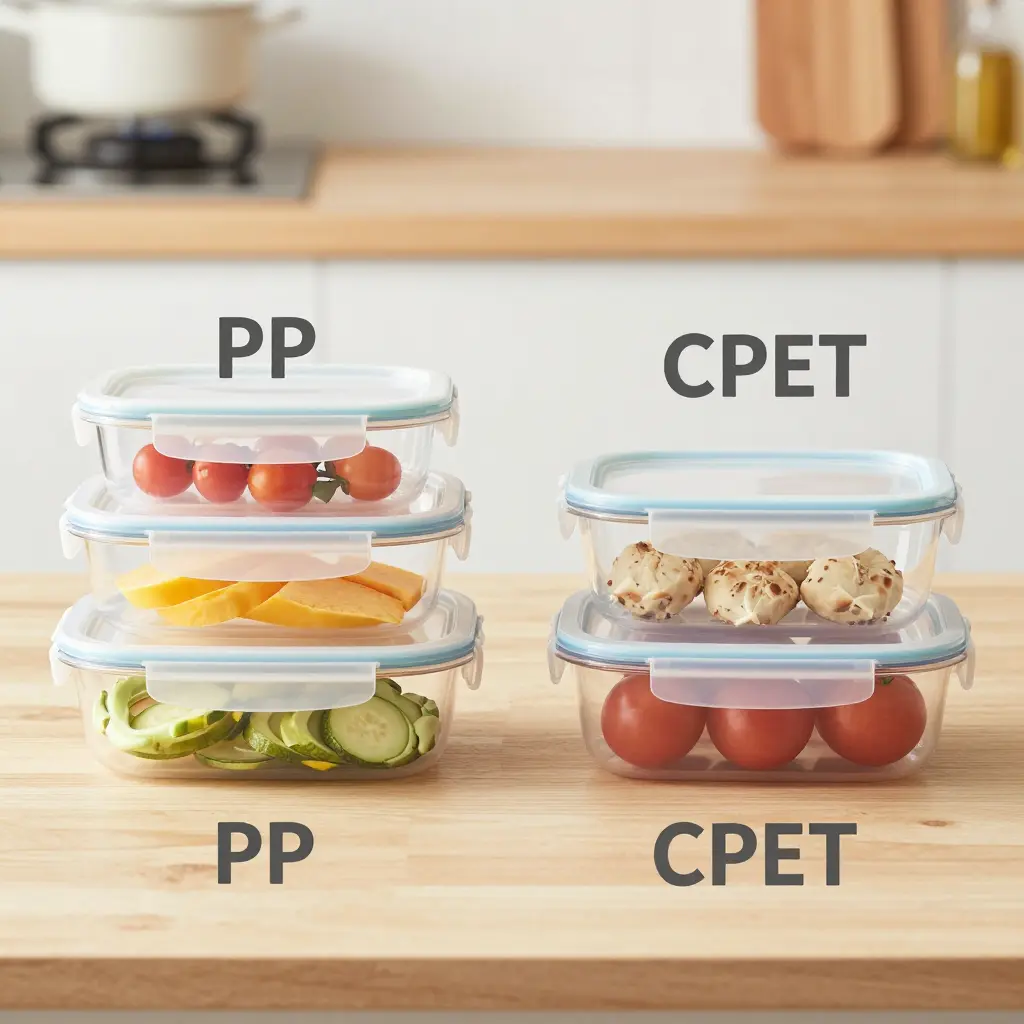
PP (polypropylene) and CPET (crystallized PET) are behind most of the microwave safe containers sold for food prep. Both hold food, survive delivery, and can go into a microwave. The difference that matters is the reheating workflow each material fits: microwave only, oven finishing, or freezer to oven.
The requirements are usually the same: high-volume food prep, packaging that gets through transport without leaking or buckling, and reheating that works as well on the tenth cycle as on the first. Under repeated reheating, small differences in heat resistance, wall rigidity, and lid fit decide whether a container lasts or gets retired early.
This guide compares the two materials on heat resistance, durability across reheat cycles, and the procurement details that drive cost, then sets out how to test a container before committing to a full order. Our food container collections show the formats both materials are sold in.
Polypropylene (PP): The Everyday Workhorse for Microwave Reheating
Polypropylene melts at roughly 160°C to 170°C, which leaves enough headroom above boiling water for microwave reheating and hot-fill. Most food-grade PP grades are quoted for service from about -20°C to 100-120°C, and heat-stabilized grades reach 130°C to 140°C. That range is why PP turns up in kitchen and takeout operations almost everywhere.
Those numbers move with the resin grade, the additives, and the wall thickness. A 0.6 mm bowl softens and warps sooner than a 1.2 mm container made from the same resin, so test the actual SKU you plan to stock rather than trusting a data sheet alone.
Natural PP is translucent rather than glass-clear, and clarified grades come close to clear. That translucency helps at the counter: customers can see sauce layers, grain bowls, and dessert parfaits without the pack looking thin. PP also bends before it breaks, so living hinges on clamshells survive repeated opening and snap-fit rims hold without chipping.
Lids are the other reason operators keep buying PP. Rigid PP lids seat with an audible snap, and film seals bond reliably, which keeps leak risk low on saucy or brothy dishes. PP holds its dimensions, so full containers stack and empties nest, which matters in a compact walk-in or a cramped food truck galley.
PP is also the usual choice for compartmented formats. Two-, three-, and four-section trays keep rice, protein, pickles, and sides separated through reheating, so textures stay intact. If you are building a compartmented meal prep program, pairing your PP trays with multi-compartment food containers made from sugarcane gives you a plant-fiber option with the same grid layout, which keeps packing lines and menu photos consistent.
PP carries resin code 5. Whether kerbside collection accepts rigid PP depends on your municipality, so verify locally before printing a recycling claim; supply itself is broad and pricing steady because so many converters run the material.
PP is not the highest-performing polymer on the shelf. It handles everyday microwave reheating, hot fills, and busy service at the lowest cost of the two, which is why it remains the default for microwave-only programs.
CPET: Dual-Ovenable Strength for Demanding Reheating Cycles
CPET is crystallized polyethylene terephthalate: the same polyester as clear PET, processed so the polymer chains pack into a crystalline structure. The crystallinity raises the softening point well above standard PET, so a CPET tray holds its shape where an APET tray would sag.
That structure gives CPET a wider working range. Depending on the grade, trays are rated for microwave and conventional oven use, commonly up to about 220°C (428°F) for short oven exposures such as 30 minutes, and they are built to go from freezer to oven without thawing first. Continuous service temperatures sit below that peak, so ask for the rating tied to your oven time and temperature rather than a single headline number.
CPET is opaque, usually white or black, with a matte to satin surface that hides sauce splashes. It is stiff enough that a loaded tray does not buckle when a server carries four at once, and polyester provides a good moisture and oxygen barrier. Lidding options include heat-sealed film for high-volume lines, snap-on rigid lids for vented reheating, and board lids for premium presentation. Most formats nest for storage.
CPET is not the same as clear APET, and the two are often confused. APET is amorphous and transparent, made for cold display, and it softens around 70-80°C, so it has no place in a hot well or an oven.
| Property | CPET | Clear APET |
|---|---|---|
| Appearance | Opaque, white or black | Transparent |
| Heat resistance | Oven rated, commonly up to about 220 C for short exposures | Softens near 70-80 C |
| Reheating | Microwave and conventional oven | Cold service only |
| Typical use | Ready meals, catering, bakery | Cold deli, salads, fruit |
If you are building a CPET lineup and need an adjacent format for hot holds and delivery, our rigid rectangular food containers use the same straight-sided, stackable footprint your racks already accept.
Choosing CPET over PP usually comes down to oven capability rather than the microwave. If your workflow stops at the microwave, polypropylene is lighter and cheaper. If trays pass through a convection oven or a high-heat holding cabinet, CPET is the safer specification.
The table below compares the specifications that drive cost and performance; it can double as a supplier comparison sheet. If you want to pair either material with matching paper lid options for cold or ambient lines, that range is listed separately.
PP vs CPET at a Glance
| Feature | PP | CPET |
|---|---|---|
| Heat source compatibility | Microwave safe; conventional oven only if explicitly labeled ovenable | Microwave and conventional oven safe, within the stated rating |
| Temperature rating | About 100 to 120 C (212 to 248 F) continuous; melting point about 160 to 170 C | Short-term oven exposure about 200 to 220 C (392 to 428 F), typically 30 minutes; continuous rating is lower |
| Freezer-to-oven transition suitability | Not recommended; warps, crazes, or cracks under oven heat | Designed for direct freezer-to-oven |
| Appearance and clarity | Translucent to clear; lets the food show | Crystalline and opaque; white or black, matte to satin finish |
| Rigidity and stack strength | Flexible walls; moderate stack strength | High rigidity; strong stacking and pallet stability |
| Lid and seal options | Snap-fit lids, dome lids, film seal | Rigid lids, film seal, board lids |
| Grease and moisture barrier | Good; needs thicker walls for hot, fatty foods | Excellent; inherent barrier at thin gauges |
| Recyclability stream | Resin code 5 (PP); kerbside acceptance varies by municipality | Resin code 1 (PET) family; CPET tray takeback is limited |
| Relative unit cost | Lower upfront cost | Higher upfront cost; the gap depends on format and order volume |
| Best-fit food prep use cases | Cold and ambient preps, sauces, boba toppings, portioning | Bake-and-reheat meals, catering trays, sealed meal prep |
How to use this sheet: keep the rows as your evaluation criteria and score each supplier 1 to 5, then weight the rows that matter most to your operation. For most chains, heat ceiling and barrier performance outweigh unit cost once waste and remakes are counted.
Container Spec Checks Before You Commit
Treat the supplier datasheet as a checklist, not a brochure. Whether you are comparing PP and CPET food prep containers or adding a complementary material such as these sugarcane food containers, these eight lines tell you whether a container will hold up in a busy kitchen.
- Stated service temperature range: Confirm the minimum and maximum continuous-use temperatures, not just a peak tolerance measured for a few seconds.
- Microwave and oven compatibility wording: Look for explicit “microwave safe” and oven-safe claims, together with the rated duration and power level they were tested at.
- Resin grade and food-contact compliance: Check the named resin (PP homopolymer, CPET) plus FDA or EU food-contact declarations and migration test reports.
- Wall thickness and base rigidity: Ask for nominal wall thickness in millimeters and how much the base deflects under a full load.
- Lid material and closure type: Verify whether the lid uses the same resin as the body and how it locks, whether by snap, friction or tamper-evident rim.
- Seal and leak performance: Request leak and lid-retention data measured after repeated reheating, so sauces do not escape in a delivery bag.
- Freezer performance: Confirm the container handles blast freezing and freezer-to-microwave transitions without stress cracking.
- Per-unit cost at volume: Get tiered pricing at your real order quantity with lids included, then calculate true cost per use rather than cost per carton.
Two suppliers that answer all eight in writing are easier to compare than two brochures.
Seeing the Difference: Amorphous vs. Crystalline Walls
The performance gap starts at the molecular level. A PP wall is made of long, tangled polymer chains with no fixed order, so it softens earlier as heat builds up. A CPET wall is locked into a tight, repeating crystalline lattice, which holds its shape longer under the same microwave load.

Warp temperature, oil resistance, lid stability, and service life all trace back to that structural difference.
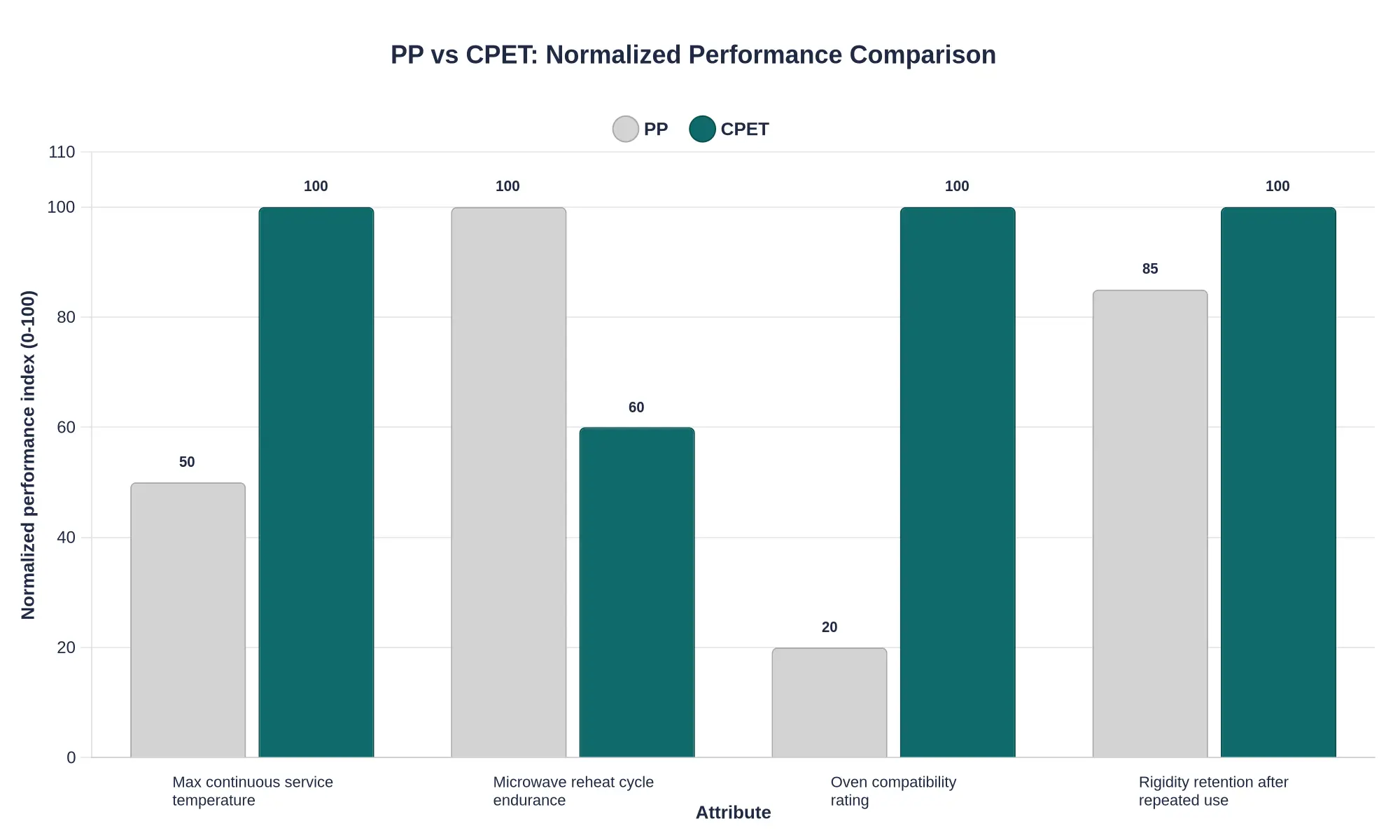
Figure 1: Normalized PP vs CPET performance index (0-100) across four measurable attributes, with actual values labeled on each bar.
Takeaway: The two materials trade wins. CPET reaches a much higher heat ceiling and is the only one of the two rated for conventional ovens; PP is cheaper, lighter, and more forgiving in microwave-only service. For a high-volume reheat line, PP usually wins on cost per cycle, while any menu item that needs oven finishing justifies the CPET premium. Grade, formulation, and wall thickness shift real-world results, so validate with your own lid-and-fill test before a full production run.
What Happens After the Fifth Reheat? Durability and Food-Contact Safety
By the fifth reheat, wear shows on PP: a slight lift at the rim, a faint haze where the polymer has been stressed, a lid that no longer clicks down cleanly. These are signs of wear at the edge of the rated range, not a defective batch.
Crazing is the first visible stage, a network of hairline surface cracks that appears when you tilt the container toward the light. Warping follows, usually at corners and thin walls. Once a base has bowed it stops sitting flat, heats unevenly, and loses lid fit. A lid that no longer seals is an operational problem, not a cosmetic one: leaks in transport, condensation on the outside, and faster heat loss during delivery.
Sauces and oils leave their own marks. Tomato, curry, turmeric, and chili oils carry pigments that migrate into the polymer surface, so a container that was clear in week one can look amber by week four. The staining is cosmetic in most cases, but a surface porous enough to hold pigment is also harder to clean, and heavy staining tends to come with the scratching and cloudiness that do affect performance.
Food-contact compliance rests on using the container inside its rated temperature range and time limits. Within those limits, migration stays within the standard the material was tested against; repeated excursions narrow that margin. Discoloration, deformation, or a smell that survives washing are grounds to retire a container rather than scrub it and put it back into service.
Know which tier you bought. Thin single-use food prep containers are realistically good for one service and perhaps a second reheat. Reusable microwave safe containers in rigid PP or CPET are built for repeated cycles, provided you rotate stock and retire warped units. Molded fiber formats, including our rigid sugarcane food containers, are microwave safe for a single service but are not designed for repeated reheat cycles. Match the tier to your reheat count and the rest follows.
A Six-Step Evaluation Protocol for PP and CPET Containers
Validating microwave safe containers for repeated reheating doesn’t require a laboratory, but it does require a process anyone on your team can repeat. Work through the six steps in order, and pair each reusable container program with a disposable line such as these paper cups, bowls and buckets so you always have a compliant backup on hand.
-
Gather supplier documentation first. Before any sample touches a test kitchen, request the resin grade (PP homopolymer vs. CPET), food-contact declarations, migration test reports, and written temperature ratings. Save these in your vendor file; they become the baseline you compare real-world performance against later.
-
Confirm rated temperature against your actual reheat method. A container rated to 100°C may still warp if your staff routinely run a 3-minute high-power cycle with oily sauces. Document the wattage, cycle length, and food load your kitchens actually use, then verify the supplier’s rating covers that exact scenario, not an idealized one.
-
Run an internal trial with representative foods and oils. Fill containers with the products you actually sell, such as curry bases, tomato sauces, chili oil toppings, or tapioca pearls, and reheat them on your own equipment. Use at least three containers per product so a single outlier doesn’t skew your read.
-
Inspect for deformation and seal failure after each cycle. Check every container after each reheat for warping, panel flexing, stress whitening at the corners, and lid pop-off. Log the cycle number at which the first defect appears; that number, not the marketing claim, becomes your practical reuse ceiling.
-
Review unit cost against observed reuse life. Divide purchase price by the number of defect-free cycles you actually logged to get a true cost-per-use figure. Compare PP and CPET side by side: a pricier CPET container that survives five cycles often beats a cheaper PP option that fails after two.
-
Lock specifications into the purchasing agreement. Once you have a winner, write the resin grade, minimum wall thickness, rated temperature, lid fit tolerance, and approved food categories into the contract, and require written notice before any material change.
Results from your own kitchen are more useful than any supplier claim, and they protect both margin and food safety.
Follow the Reheating Path to the Right Material
Before you order another pallet, walk your actual workflow. The list below turns the PP-versus-CPET question into a checklist your kitchen lead can run in under two minutes. If you want a fiber-based backup for cold and ambient items, our sugarcane food containers are worth reviewing alongside your plastic specs.
- Map every reheating method used on-site. Note each station: countertop microwave only, combi oven only, or blast chiller followed by oven regeneration.
- Keep PP at microwave-only stations. PP handles microwave reheating, but it warps when oven temperatures climb past its rating.
- Assign CPET to any oven-plus-microwave path. Dual-ovenable CPET holds its shape from freezer to short oven exposures up to about 220°C, so one container covers both steps.
- Assign CPET to freezer-to-oven paths too. Skipping the thaw stage is where PP lids crack and seams fail.
- Confirm the lid and seal match the base material. A CPET base with a PP lid still limits you at the oven door.
- Test a full cycle ten times before committing. Warping, staining, and seal fatigue usually show up between cycles four and eight.
- Lock the choice into your purchasing spec sheet. Write the material, temperature ceiling, and reheat method next to each SKU so nobody re-guesses.
Reading the Flowchart
The diagram shows the same logic visually, top to bottom: a single container node branching into a microwave-only path, an oven-plus-microwave path, and a freezer-to-oven path. The two outcome boxes are color-coded, so you can see where PP stops being the safe answer and CPET takes over.
[Image: A minimalist flat 2D decision flowchart with no text, showing a container node at the top branching by thin arrows into three paths – a microwave symbol, an oven symbol, and a snowflake symbol – and resolving into two color-differentiated outcome boxes, one teal for the microwave-only route and one coral for the freezer-to-oven and oven-plus-microwave routes.]
The short version: microwave only, keep PP. Anything that touches an oven, specify CPET. Tape the chart inside the prep cooler door and the choice stops being a recurring argument.
Cost Per Use Beats Sticker Price
Unit price appears on the invoice; cost per use appears in your P&L. A thinner container that looks cheaper per case can cost more once you count replacements, double wrapping, leaked lids, and the labor spent re-plating food that arrived looking tired. That is why we talk about cost per use instead of price per piece: it answers the question an operations team actually asks, which is what the container costs each time it does its job.
The calculation is straightforward: landed price plus lid, freight share, and storage space, divided by the number of reuse cycles you can realistically expect. A lightweight single-use PP tub comes out at one use. A thicker rigid PP or CPET container that survives ten or fifteen wash-and-reheat rounds drops to a fraction of that per use, even at two or three times the shelf price.
Where that trade-off falls depends on your menu. For high-volume beverage chains and food trucks doing one-pass delivery, thin single-use PP for food prep plastic portions is the efficient choice, because the container never comes back and durability is money wasted. For restaurants, catering services, and corporate event teams reheating the same dishes repeatedly, thicker rigid PP and CPET usually win. Rigid walls are what make the difference: microwave safe containers with thicker walls keep their shape and lid fit through repeated heat cycles, where thin walls fail.
Operational fit decides whether those savings survive contact with your team. Check stacking density before you commit, since a taller profile can swallow shelf or cold-rail space faster than the per-unit cost suggests. Confirm lid interchangeability across sizes so staff are not hunting for a matching lid under pressure. Labeling matters too: a container that takes a marker, a sticker, or a printed sleeve without smearing saves seconds on every order. And not every item needs to reheat at all, so pair your reheat line with kraft paper boxes for non-reheat items and keep the durable PP for the dishes that earn it.
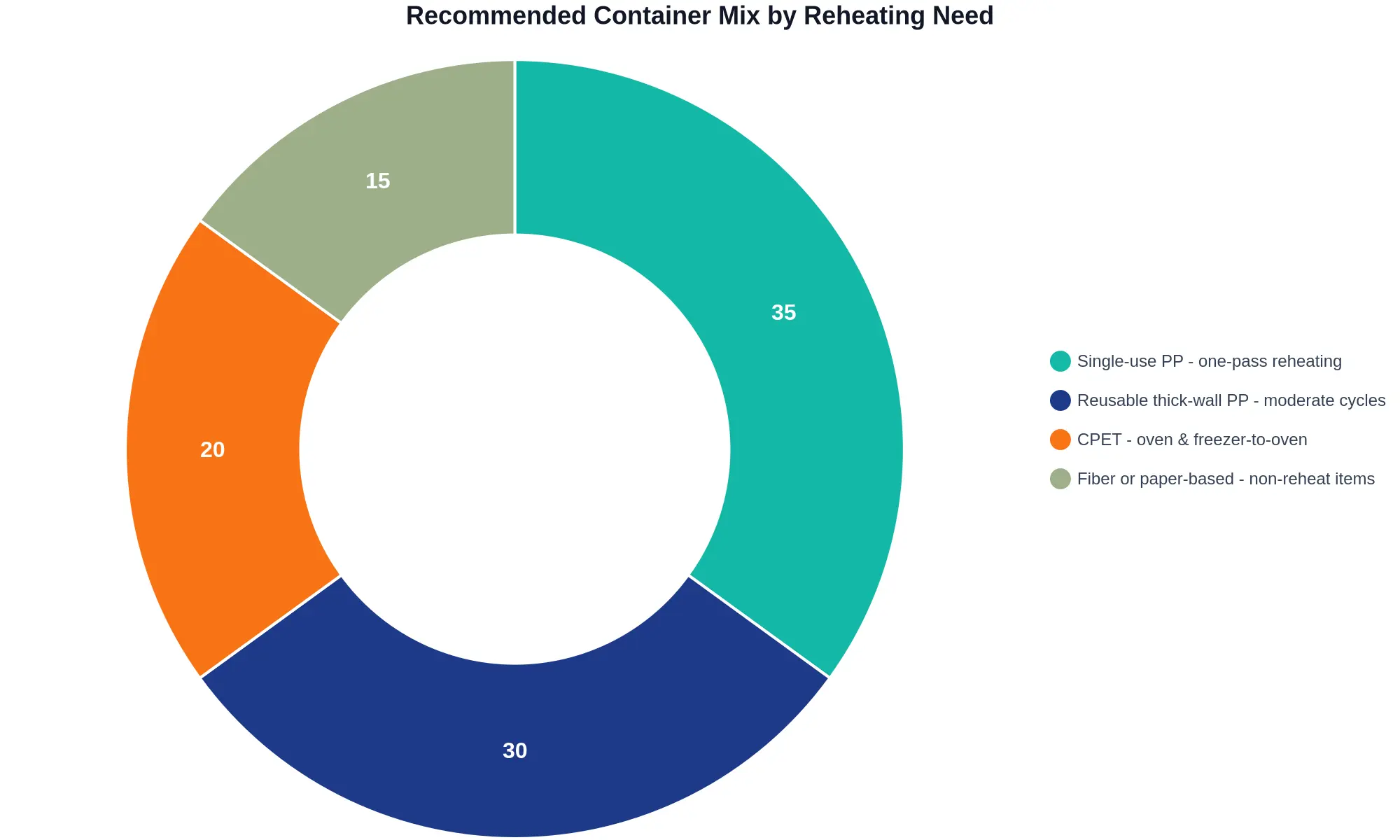
Example container mix by reheating need: single-use PP 35%, reusable thick-wall PP 30%, CPET 20%, fiber or paper-based 15%.
Takeaway: Build your container mix around how each item is reheated rather than around one default material. Pairing one-pass PP, thick-wall reusable PP, CPET, and fiber-based options covers most service scenarios without over-specifying.
FAQ: Getting the Most Out of Microwave Safe Containers
Is PP (polypropylene) microwave safe?
Yes, when the pack is labeled microwave safe. Resin code 5 identifies the plastic as PP; it does not by itself certify microwave use, so check the marking. Vent or loosen the lid so steam can escape, and keep very fatty or sugary foods to shorter cycles, since those reach higher surface temperatures.
Can CPET containers go in the microwave?
Yes, where the manufacturer rates them for it. CPET is crystallized PET engineered for heat, commonly rated to about 220°C (428°F) for short oven exposures, with microwave ratings that are usually time-limited as well. That heat resistance is why CPET dominates ready-meal trays and catering programs that go from chilled storage to the microwave. Check the stated ceiling and duration before pushing a tray to the limit.
How many reheat cycles does a container realistically last?
It depends on the tier. Thin single-use trays are good for one to three reheats. Rigid reusable PP and CPET containers commonly last a dozen or more cycles, and careful handling can push that past 30. The only reliable number comes from logging your own cycles. Staining, scratching, and cloudiness are the signals to retire a container, because a compromised surface is harder to clean and more likely to hold odors.
Can I microwave clear PET takeout lids together with the container?
Usually not. Standard clear PET lids are amorphous rather than crystallized, so they soften and distort well below the temperature the base can handle. Take the lid off, or swap in a vented PP or CPET lid designed for reheating. If a lid carries no microwave marking, keep it out of the microwave and use it for transport and display only.
How do I read packaging temperature ratings correctly?
Look for three separate numbers, not one: the maximum continuous service temperature, the short-term peak temperature, and the method it was tested under (microwave, oven, or hot-fill). A tray rated to 200°C for 30 minutes of oven use is not automatically approved for 30 minutes at the same temperature in a microwave. When a spec sheet is vague, ask the supplier for the test method in writing, and run a trial batch before committing to a large order.
What eco-friendly options work alongside PP and CPET?
If you need fiber-based formats, molded pulp, sugarcane bagasse, and coated paper work alongside plastic trays, and their grease and moisture coatings have improved considerably. Our fiber-based paper packaging range covers bowls, boxes, cups, and sleeves that pair with a plastic hot-food program. Many operators run a hybrid menu: CPET or PP for the microwave-heavy dishes, fiber for cold, dry, or grab-and-go items.
Matching the Material to the Reheating Routine
If reheating happens mostly in the microwave and you want one container that moves from prep to display to customer, PP is the practical choice: it handles repeated microwave cycles, tolerates high-fat sauces within its rating, and costs less than CPET. If your program includes oven finishing or freezer-to-oven service, CPET is the material that qualifies, because it is rated for both microwave and conventional oven exposure along with cold storage. Many operators run both, assigning PP to cold and microwave-only lines and CPET to bake-and-serve items. Whichever way you split it, compare the two on cost per use rather than unit price.
As a manufacturer and supplier of disposable tableware, packaging paper, and boxes, we build our range around food-contact safety, durability in real service conditions, and material choices we can document. In practice that means consistent specifications, dependable lead times, and support when a menu shifts or a program needs adjusting. You are welcome to review the range and see which formats fit your reheating routine.
- Paper bowls for hot, saucy, and soup-based menu items
- Sugarcane food containers for sturdy, plant-based service and takeaway
- Paper lids to pair with compatible bowls and keep transport secure