
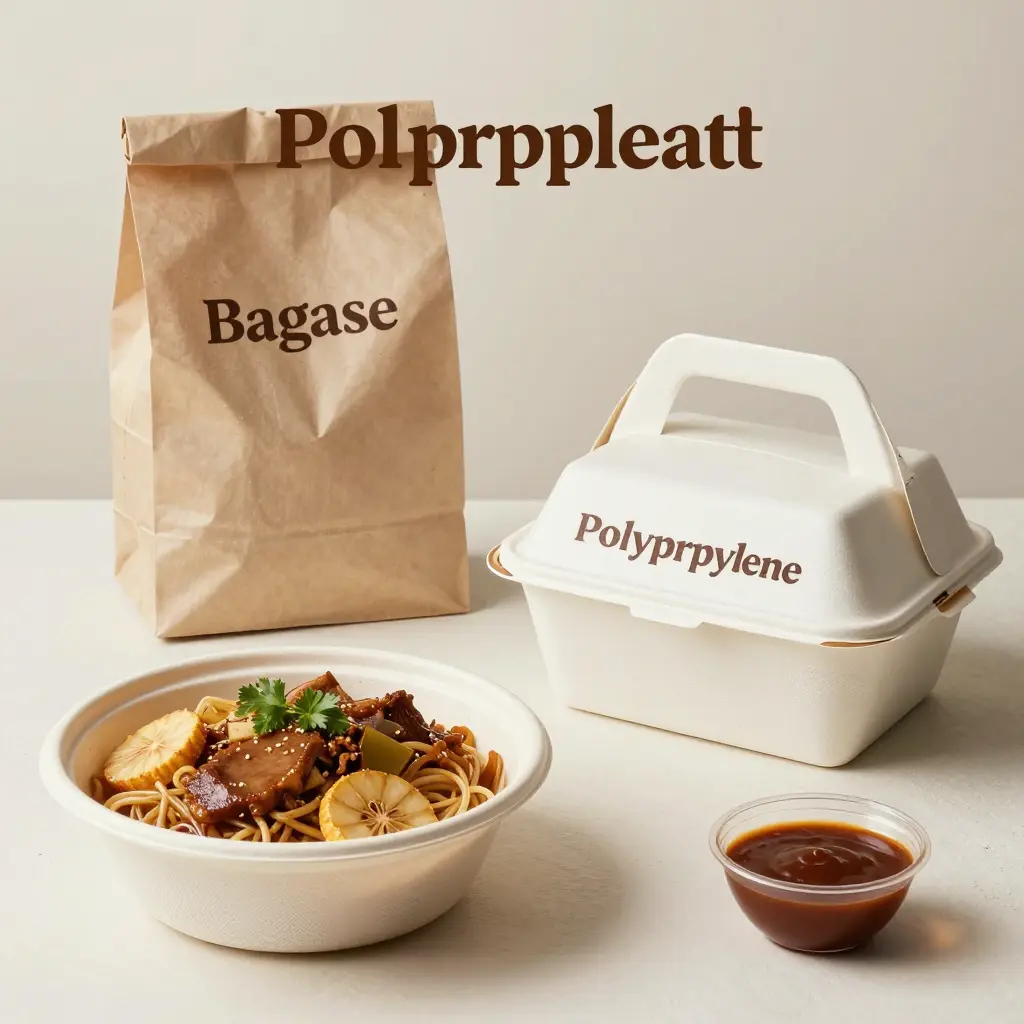
3 Compartment Takeaway Food Boxes: Choosing the Right Material
A three-compartment takeaway box only works when the material suits what goes in it. This comparison sets molded sugarcane pulp against PP for the people who buy packaging for bubble tea shops, beverage chains, restaurants, food trucks, catering operations and corporate procurement.
A 3 compartment takeaway food box is one container divided into three sections, so a main, a side and a sauce or garnish travel without mixing. The two candidates here are bagasse, molded sugarcane pulp, and PP, polypropylene.
Both get weighed on the same four points: hot holding, cold holding, landed cost per unit, and end-of-life handling. The sections below keep to that framework, so you can take the comparison into a packaging review as it stands. If you want to see the format first, our multi-compartment sugarcane containers show it up close.
How the Three-Compartment Format Constrains Material Choice
A three-compartment box asks more of its material than a single-well tray. The dividers carry load, and every wall has to stay flat while hot curry sits beside a cool salad. Four demands matter most:
- Divider rigidity: thin dividers sag or tear at the hinge, so bagasse needs adequate wall thickness and molded ribs, while PP stays stiff at a lower gauge.
- Base stiffness under load: a heavy rice portion bows a thin base, so bagasse requires a deeper draft and denser fiber, whereas PP resists bending with a flatter, thinner bottom.
- Lid fit and stack stability: repeated stacking crushes soft rims, so PP holds tight tolerances easily while bagasse depends on matched tooling for consistent rim nesting.
- Grease and moisture barrier at the seams: sauces wick through any gap, so PP is inherently barrier-proof while bagasse relies on a well-formed seam and a PFAS-free coating.
The format, not just the menu, drives the choice. When you spec a multi-compartment food container for eco-friendly takeaway packaging, size the material to your heaviest portion and your stack height first. Then compare rectangular sugarcane food containers against PP on the requirement you cannot trade away.
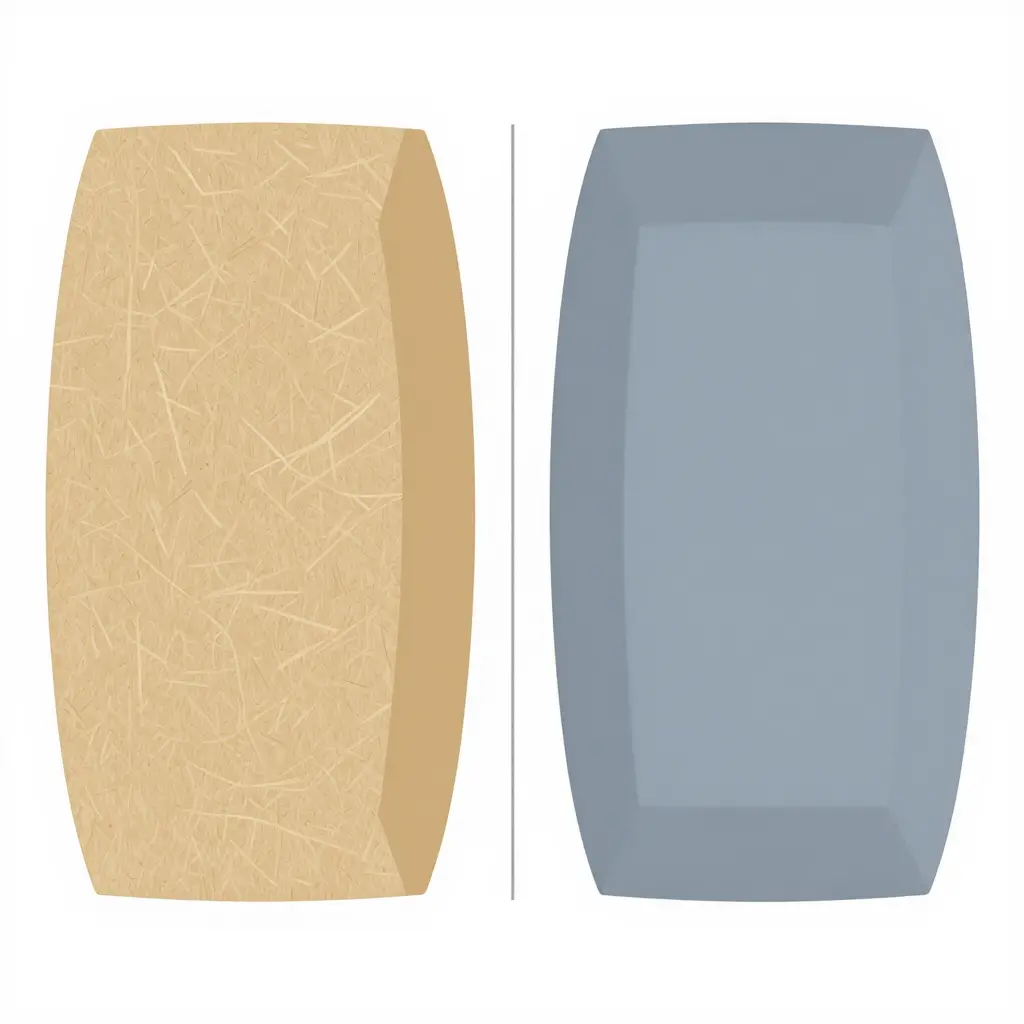
Bagasse walls are thick and fibrous; PP walls are thin and uniform. The numbers come next.
Bagasse: The Molded Sugarcane Pulp Profile
Bagasse is the fiber left behind after sugarcane is pressed for juice. Molded into pulp, it gives bagasse food containers a stiff, matte surface closer to uncoated paper than to foam: warm to the touch, with the speckled tone of an unbleached fiber finish.
Heat is where bagasse holds its own. It takes hot menu items and short microwave reheats without warping, so rice bowls, curries and grilled proteins still look right at the counter. A light grease resistance handles oily sides, and because the fiber absorbs some of the moisture vapor, less of it ends up condensing on the lid, which is the sweating that turns fried food soggy. As compostable food containers, bagasse boxes break down in industrial composting; home composting depends on the grade and its certification.
The limits are real. Bagasse wicks moisture over long holds and soaks through faster than plastic in prolonged wet contact, so sauce-heavy deliveries that run for hours need a liner.
This profile favors hot, moderately saucy menus served inside a normal service window: rice plates, noodles, and grilled or fried mains in sugarcane food containers.
Molded pulp against polypropylene comes down to a handful of hard specs rather than marketing language. Eleven of them follow, each one the kind of thing that decides whether the curry or the chilled dessert arrives in the state you sent it out in. If you are already leaning toward fiber, the full range of multi-compartment sugarcane food containers is worth a look while you read.
Bagasse vs PP 3 compartment takeaway food boxes: at a glance
| Attribute | Bagasse (molded sugarcane pulp) | PP (polypropylene) | Best fit |
|---|---|---|---|
| Heat tolerance | Stable near 100°C, brief peaks slightly higher | Holds shape to roughly 120°C | PP for very hot curries |
| Cold and freezer performance | Fine chilled, softens with heavy frost buildup | Rigid at freezer temperatures; check the grade below -20°C | PP for freezer programs |
| Microwave reheating | Microwave-safe for short reheats, food may dry out | Microwave-safe, but trays can warp above 100°C | Bagasse for quick customer reheats |
| Oil and grease resistance | Good natural barrier, heavy oil can wick through | Complete grease barrier, virtually no staining | PP for fried and oily dishes |
| Leak resistance for saucy items | Reliable with lined lids, seams need snug fitting | Excellent, molded rims seal tightly | PP for curry, soup, gravy |
| Rigidity and stackability | Stiff, but tall stacks can compress lower trays | Very rigid, stacks squarely and high | PP for tall delivery stacks |
| Condensation and lid fogging | Breathes slightly, less fogging on pulp lids | Fogs up, anti-fog clear lids cost extra | Bagasse for hot, humid menus |
| Compostability and recyclability | Industrially compostable; home composting only with certified grades, PFAS-free options | Recyclable where resin code #5 is accepted, rarely compostable | Bagasse for green brand goals |
| Unit cost trend at volume | Higher per unit, falls steadily with volume | Lowest per unit, very price-stable | PP for tight food-cost budgets |
| Storage space required | Bulky nested stacks, needs dry storage | Compact thin walls, saves shelf space | PP for small kitchens |
| Custom branding options | Deboss and print on pulp lids and sleeves | Sharp multicolor print, molded-in logos | PP for detailed brand artwork |
Bagasse comes out ahead on composting claims and condensation control. PP comes out ahead on cost, freezer durability and leak-tight performance with saucy items. Take the row that fits your menu, then check it against the items that will actually travel in the box.
PP (Polypropylene): The Heavy-Duty Performer
Polypropylene molds into rigid containers that keep their shape when stacked, and the smooth, non-porous surface wipes clean in seconds. The lid seal is the real advantage: it holds sauce in, so the bag stays dry on the drive over. For liquid-heavy and high-moisture menu items that means consistent performance from kitchen to counter, plus freezer stability that keeps portions neat through cold storage and reheating. Bodies can be molded clear so guests see the food, or in custom colors with high-definition printing on the lid and sides. Where collection infrastructure exists, PP is recyclable under resin code 5.
The trade-offs are petroleum feedstock, no compostability, and a plastic look that some buyers read before they read the menu. If you want a paper-forward presentation instead, consider paper boxes with clear lids. PP food boxes and microwave-safe takeaway containers suit saucy curries, noodle dishes, soups, rice bowls, and hot-and-cold combo menus where leak protection matters most.
Internal Food Temperature Over a 60-Minute Hold
The chart below is the basis for the hot-menu recommendation further down. Both boxes start at 78 °C, so the material is the only variable.
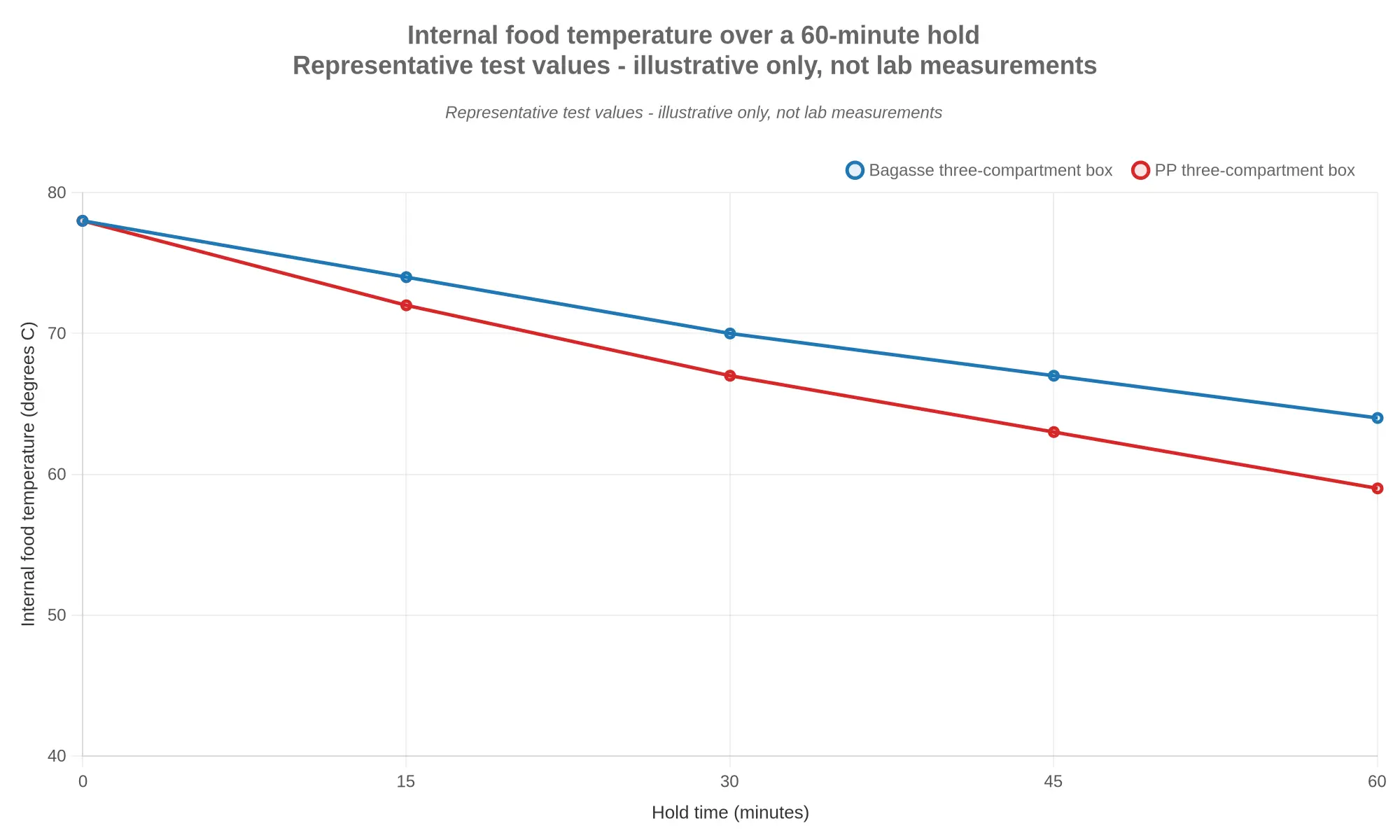
Caption: The bagasse box loses roughly 14 °C over the hour and the PP box about 19 °C, so bagasse stays above the 63 °C hot-holding threshold longer, though these are representative test values chosen for illustration, not measured lab results.
The gap widens at each 15-minute interval, which is the window catering deliveries, food-truck queues and long event services tend to occupy. Past the 30-minute mark, PP’s faster heat loss is what decides whether a dish still steams on arrival. On this model the bagasse box stays above 63 °C for the full hour; the PP box crosses that line around the 47th minute. Want to see the shapes and configurations the data refers to? Browse our three-compartment sugarcane food containers.
Data source: illustrative model values for two otherwise identical 78 °C meals held in uninsulated, lidded three-compartment boxes at room temperature (22 °C). Treat them as a directional comparison only and run your own probe tests for compliance reporting.
How each material handles hot builds
Rice dishes and noodle plates hold up in both materials, but creamy curries show the difference fast. PP 3 compartment takeaway food boxes keep sauce where you put it, and the dividers stay dry, while bagasse seams can let thin gravy creep across and leave a damp ring. Fried sides and stir-fries reverse it: bagasse wicks surface grease and limits lid fogging, whereas PP traps steam that drips back onto crisp edges.
At the customer end, PP takes microwave reheat better, so gravy-heavy plates arrive intact. Bagasse is happier in stacked delivery bags when builds are dry or sauce-on-the-side, since it resists grease strike-through without going limp.
For high-liquid curries and gravy-heavy plates, choose PP. For fried, dry or sauce-on-the-side builds, choose bagasse, and add a liner when the sauce is especially oily. Wet noodle plates travel better in our noodle paper boxes, and paper bowls suit saucy sides. Seals matter too: hot food packaging lives or dies on a tight lid.
Rule of thumb: pick the box by the sauce, not by the dish name.
Cold & Chilled Applications: Where the Materials Really Diverge
Cold service is harder on packaging. Pudding cups and topping tubs sweat, cold noodle and salad builds slump against wet walls, cut fruit weeps, and grab-and-go deli sets get stacked, tilted and refrigerated for hours. Three things decide whether the box holds up: condensation, since water pooling in the corners softens fiber fast; lid fogging that hides the contents customers are paying to see; and structural strength once chilled, because cold fiber loses rigidity sooner than molded plastic. Freezer stability matters too if you pre-assemble chilled desserts.
PP does best here: a tight seal and a clear body keep chilled desserts, cut fruit and deli builds visible at the counter and leak-resistant in a delivery bag. Bagasse wins a different argument. Its breathability limits sogginess in cold, dry or semi-moist items, and its composting claim backs up the sustainability message your cups already carry. Pair cold food packaging with sugarcane cup holders for stable multi-cup carries, and keep hot lines on paper cup holders, so drinks and food tell one consistent story across your takeaway packaging for beverage chains.
An eight-step checklist for choosing between bagasse and PP three-compartment boxes
A sequence that keeps restaurants, food trucks, catering crews and procurement teams from guessing:
- Classify every menu item by moisture, oil and serving temperature before shortlisting any material.
- Decide whether reheating is required, since PP tolerates microwaves better while bagasse suits brief reheats.
- Test lid seal and divider integrity under load using stacked, sauce-heavy samples.
- Confirm freezer or chilled-display needs, because fiber can soften during long, condensation-heavy cold holds.
- Estimate units shipped per week and storage space per case to compare freight and shelf footprint.
- Check compostability claims and how your local waste handler actually treats fiber packaging.
- Request samples and run a trial week across your busiest service before committing.
- Confirm lead times, MOQ and support responsiveness against your seasonal peaks.
Step seven is easier with samples in hand: the sugarcane multi-compartment containers range lists sizes you can line up against a trial menu.
Cost, Sustainability and Procurement: The Commercial Reality
On paper, PP usually lands at a lower unit price than bagasse, but unit price is only the first line of the spreadsheet. Build a total cost of ownership model instead: add leak claims and remake costs for hot, saucy dishes, storage volume (bagasse stacks bulkier, so you rent more space), and freight weight, since heavier cases raise the delivered cost per unit. Volume and customization move the gap in both directions: large standardized runs shrink it, while custom printing, unusual compartment layouts or small minimum order quantities widen it.
Both materials can support an eco-friendly takeaway packaging story, but each needs different evidence. Bagasse’s compostability and residue-based origin should be backed by certifications and recognized test standards; PP’s recyclability claim depends on local collection infrastructure and on containers going into the stream clean. Neither wins outright, so match each claim to your market’s actual waste stream.
Before committing, confirm food-contact compliance documentation, batch-to-batch consistency in color and wall thickness, and realistic lead times. A reliable supplier should speak to safety, durability and support without overpromising. Matching paper cups, bowls and buckets and printed paper sleeves keep the whole set consistent.
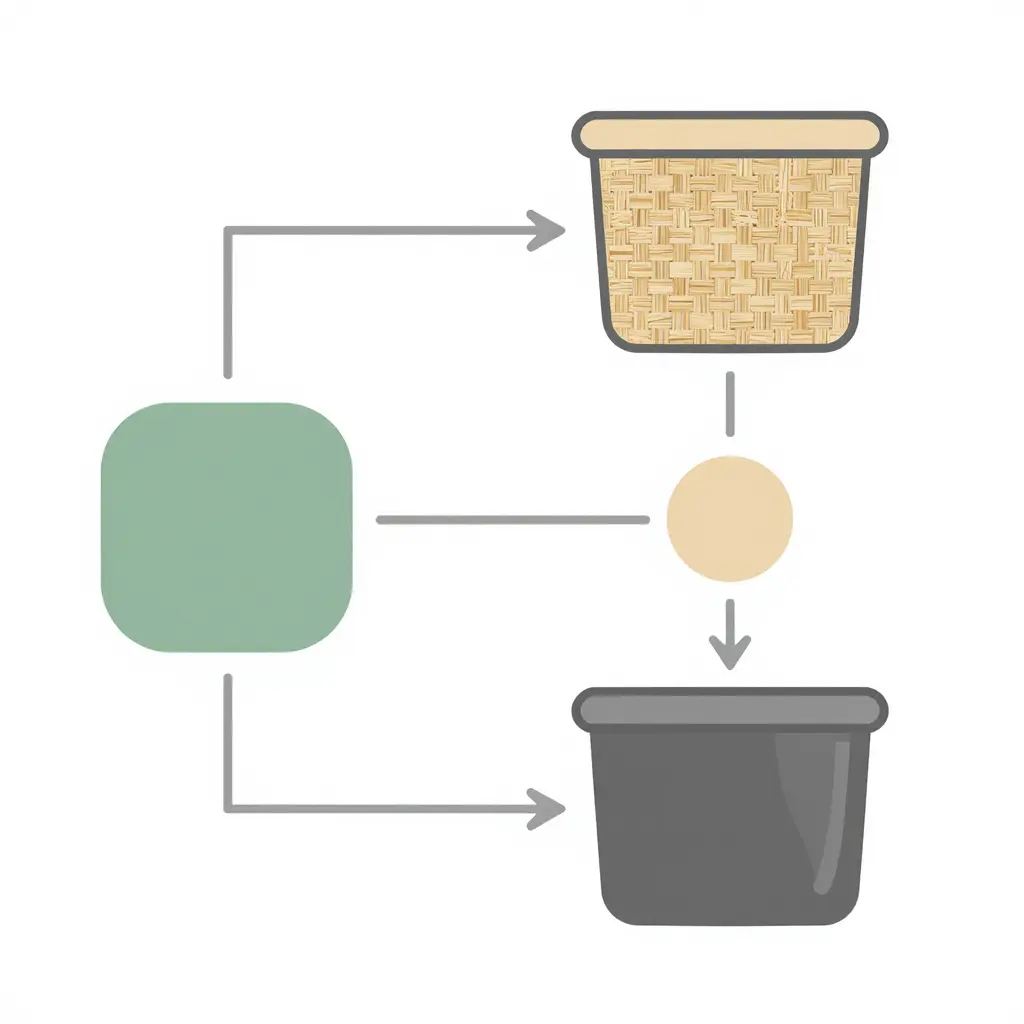
Figure: a routing map for three-compartment boxes. Moisture, oil and holding temperature push the decision along one of three branches. The fiber-textured outline is molded bagasse, the smooth rigid outline is PP, and the short middle branch is the hybrid approach: bagasse for the hot, saucy compartment and a rigid PP insert for the chilled or liquid-heavy side.
If you take the hybrid route, keep the base and the divider system on the same footprint with a matching multi-compartment sugarcane food container.
Buyers tend to ask the same things before they commit.
Frequently Asked Questions
Are bagasse three-compartment boxes microwave safe?
Yes, most bagasse boxes tolerate short microwave reheating. Bagasse handles temperatures up to roughly 100°C (212°F) for a few minutes without deforming. Avoid long cycles and dry, oil-heavy foods that can scorch the fiber, and check the supplier’s stated heat limit.
Can PP three-compartment boxes go straight into the freezer?
Yes, with a check on the grade. Polypropylene food containers are routinely frozen, and most stay serviceable at -20°C (-4°F). Homopolymer grades get brittle in deep freeze, so confirm the resin with your supplier, leave headspace for expansion, and check that the lid still seals cold.
Which material costs less at high volume?
PP is usually cheaper at high volume. Once tooling costs amortize across large orders, PP units generally price below molded fiber, whose raw material and drying steps carry more cost. Real quotes vary with wall thickness, lid type and freight, so compare landed cost per unit.
Do bagasse boxes leak when used with curry or gravy?
Uncoated bagasse can wick moisture, so lined grades are safer. Thin sauces and gravies can work through the base in 20 to 30 minutes if the fiber has no water-based barrier lining. Choose a lined box, or use a multi-compartment sugarcane food container for drier items.
Are both materials recyclable or compostable, and what should buyers verify?
PP is widely recyclable; bagasse composts under industrial conditions, and home composting needs a certified grade. The bagasse vs PP decision therefore hinges on local waste infrastructure, not material origin alone. Verify certification numbers, coating type, and whether your processor accepts lined fiber before committing.
The Bottom Line: Match the Material to the Menu
Match the material to moisture, oil and temperature, then check the choice against handling, storage and end-of-life requirements. Once those signals line up, the decision is usually obvious.
The advantage is simple: a single box that keeps saucy, crisp and dry items apart means fewer leaks, less sogginess, and less time spent fixing plates at the pass.
Neither material wins outright. Bagasse suits hot, moderately saucy menus; PP handles cold, wet or long-hold items. Both can be the right answer for different menus, which is why it pays to compare options such as multi-compartment sugarcane containers against your own serving pattern.
The supplier manufactures disposable tableware and packaging, and works with buyers on food-contact safety, durability and eco-friendly options.