
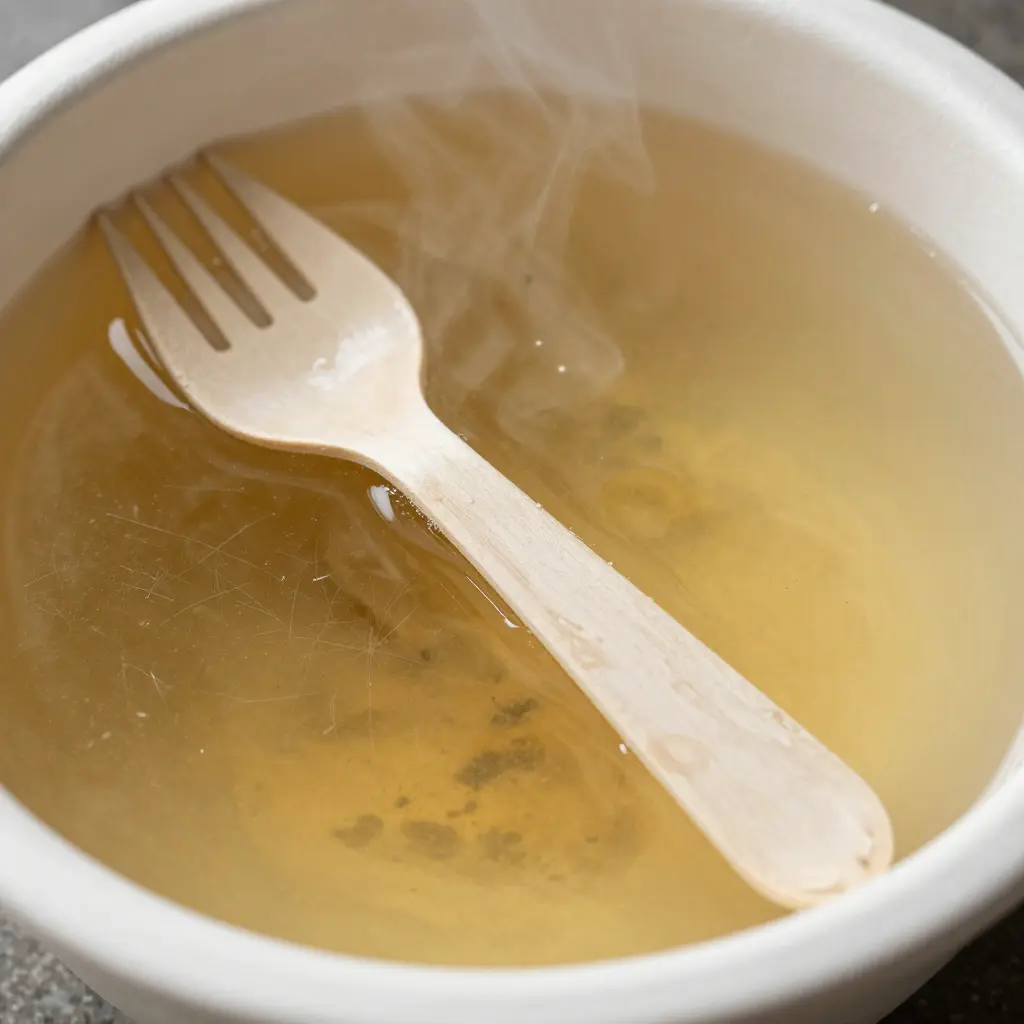
Why Compostable Cutlery Warps in Hot Liquid
Compostable cutlery warps in hot soup because heat and water attack the material at the same time. Heat softens the plant-based polymer above its glass transition temperature; water migrates into the structure and swells it from the inside. Either factor alone is usually survivable. Together they break down heat resistance faster than most food service operators expect.
The supporting mechanism
Polylactic acid (PLA) has a glass transition temperature near 55–60 °C, close to the temperature of a freshly poured soup or a cup of hot coffee. Once the material crosses that threshold, its polymer chains gain mobility, the rigid network loosens, and stiffness drops sharply.
At the same time, the material starts to take on water. Starches, bamboo fibers, and many biopolymer blends are hygroscopic, so moisture absorption acts like an internal lubricant. Water molecules slip between the polymer chains, push the effective glass transition temperature lower, and force the structure to swell. After a few minutes of soaking, hydrolysis begins snipping the ester bonds that hold the chains together. A fork sags, curls, and loses its grip right when a customer needs it. For hot-soup menus, the practical fix is usually a higher-grade biodegradable utensil with better crystallinity, or a foodware line matched to the meal such as the best compostable paper cups.
Key terms, defined
- Glass transition temperature: The temperature at which a polymer shifts from a hard, glassy state to a soft, rubbery one. Above it, the material bends under its own weight.
- Hygroscopic: A material’s tendency to absorb and hold water vapor or liquid from its surroundings, which drives swelling and dimensional change.
- Hydrolysis: A chemical reaction in which water breaks the bonds holding polymer chains together, weakening the structure over time.
Compostable cutlery fails in hot liquid because heat softens the polymer while moisture swells and chemically erodes it, so grade selection and soak time matter as much as the material claim on the label.
Material-Grade Breakdown: How Each Compostable Cutlery Grade Handles Heat
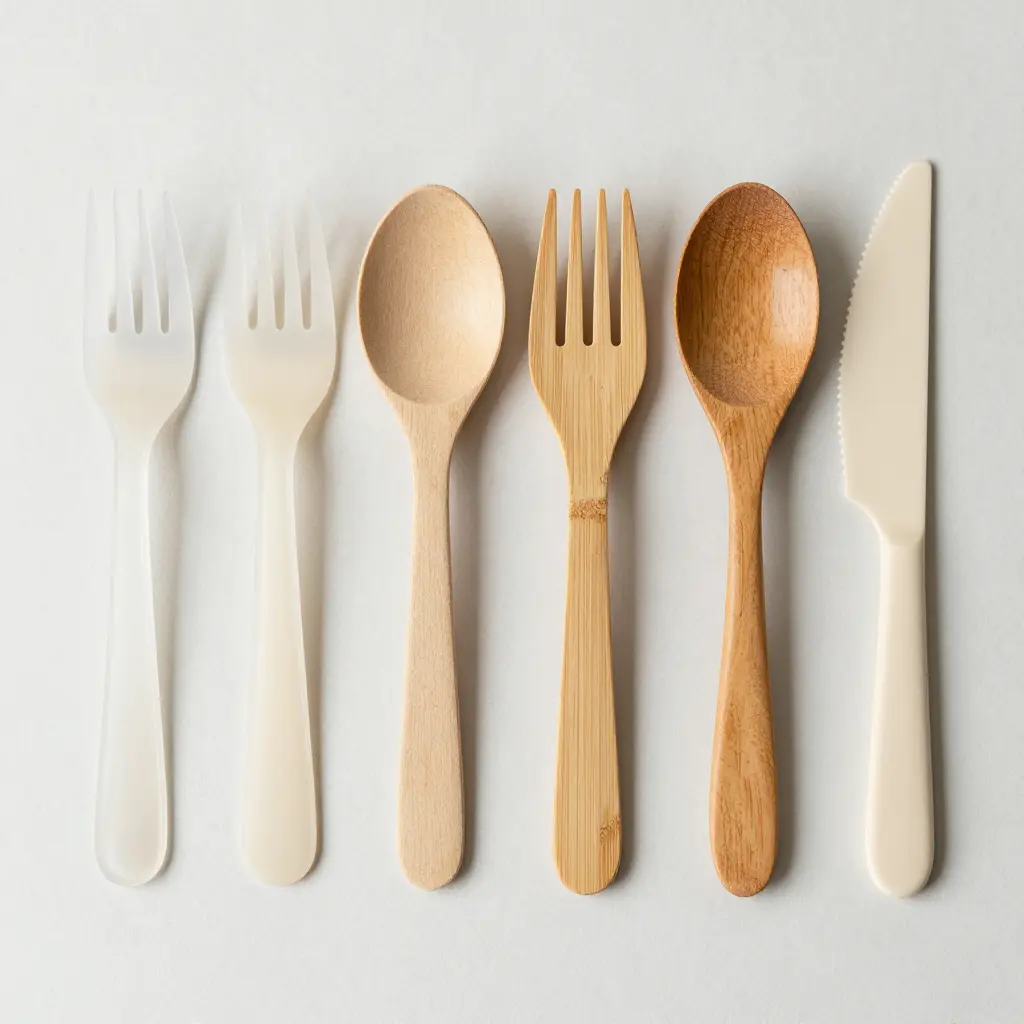
Not all eco-cutlery is built the same. When a fork disappears into a steaming bowl, the deciding factor is the material grade — the specific polymer or fiber formulation the utensil is molded from. That grade sets the heat tolerance, which in turn governs how quickly a utensil softens, flexes, or warps under hot, wet conditions. The profiles below cover the six grades most common in biodegradable cutlery and the wider sustainable tableware market.
PLA (Polylactic Acid)
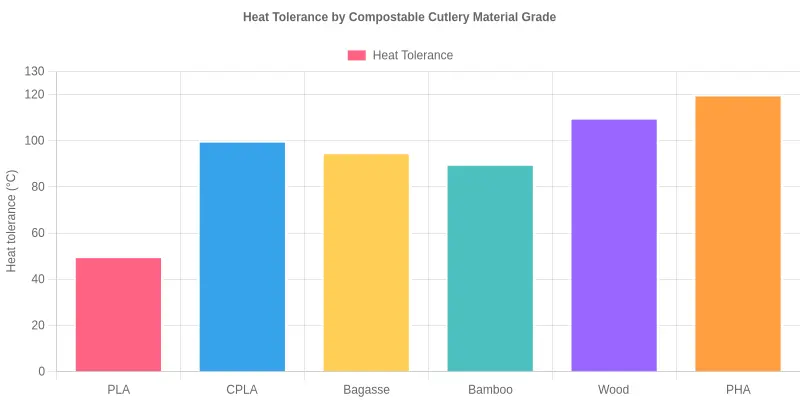
The baseline plant-based polymer. Standard PLA softens at roughly 55–60 °C, so it holds up against cold and lukewarm dishes but gives way quickly in hot, wet environments. Its structure relaxes and the tines or bowl begin to droop as soon as sustained heat is applied.
CPLA (Crystallized PLA)
Crystallizing PLA reorganizes its molecular structure and raises heat tolerance to roughly 80–90 °C. This grade resists the immediate softening that plagues standard PLA and keeps its shape in hot food for longer, though repeated or prolonged soaking still drives moisture into the matrix and slowly weakens rigidity.
Bagasse
A molded sugarcane-fiber pulp. Bagasse tolerates roughly 95–100 °C and behaves like dense paperboard: sturdy when dry, but it absorbs liquid over time. Under hot, wet conditions the fibers swell, the surface feels softer, and edges lose their crisp profile.
Bamboo
Bamboo utensils handle about 110–120 °C and stay relatively stiff thanks to their dense, fibrous grain. The weakness is moisture rather than heat — prolonged exposure lets water migrate between fibers, gradually reducing stiffness and allowing thin sections to flex.
Wood
A naturally heat-resistant grade, wood tolerates around 120–130 °C. It holds its shape well even in hot dishes, but the porous surface wicks liquid. Soaking raises fiber moisture content, which can soften the structure over extended contact.
PHA (Polyhydroxyalkanoates)
A microbially produced polyester. PHA’s heat tolerance is moderate, roughly 85–95 °C, but it keeps its structure well in wet conditions and holds up better than standard PLA over a long soak.
Deformation vs Soak Time by Material Grade
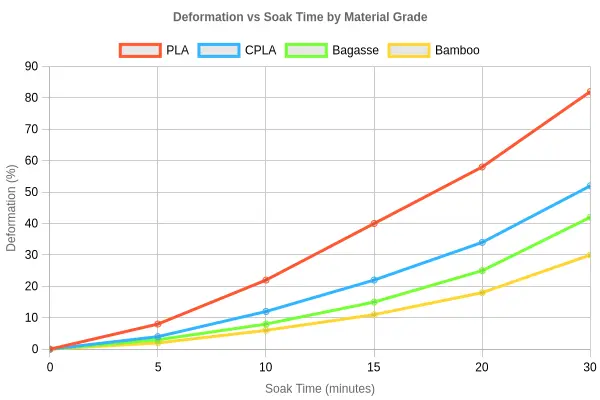
X-axis: soak time in minutes (0, 5, 10, 15, 20, 30). Y-axis: deformation percentage (0-100%). One line each for PLA, CPLA, bagasse, and bamboo at a fixed hot-soup temperature.
At a fixed hot-soup temperature, PLA warps the fastest and most severely, reaching roughly 82% deformation by 30 minutes, while bamboo stays the most dimensionally stable at about 30%. CPLA and bagasse fall in between, in that order.
Material Grade vs Soak Time Performance
The table below compares how the most common compostable cutlery grades hold up when submerged in hot soup. As a rule, higher heat tolerance and lower water absorption mean the utensil keeps its shape longer before it starts to soften or warp.
| Material grade | Heat tolerance (°C) | Estimated time-to-warp in hot soup (minutes) | Water absorption rate (low/medium/high) | Recommended maximum soak time |
|---|---|---|---|---|
| PLA | 55-60 | 5-10 | Low | Up to 15 minutes |
| CPLA | 80-90 | 20-30 | Low | Up to 45 minutes |
| Bagasse | 95-100 | 30-45 | Medium | Up to 60 minutes |
| Bamboo | 110-120 | 45-60 | Medium | Up to 90 minutes |
| Wood | 120-130 | 60-90 | High | Up to 120 minutes |
| PHA | 85-95 | 25-40 | Medium | Up to 60 minutes |
Note: These figures are representative benchmarks based on typical serving temperatures (75-95 °C) and standard wall thicknesses. Real-world performance shifts with soup fat content, utensil thickness, and repeated hot-and-cold cycling, so always confirm specs with your supplier before finalizing a food service order.
For manufacturers and buyers, the material grade predicts performance before soak time even enters the picture. Choosing grades suited to their intended use — and understanding how they behave once wet — is central to dependable sustainable tableware. Teams comparing compostable formats more broadly may also want to see how top compostable paper cups handle similar heat-and-moisture trade-offs.
Interpreting the Table: Grade Sets the Baseline, Soak Time Sets the Clock
Your material grade sets the baseline for heat tolerance; soak time determines how quickly that baseline is breached. No single ingredient in a bowl of hot soup makes a compostable spoon fail on its own — the clock working against the grade you chose does.
Read the table above as a set of soak windows rather than a ranking of materials. A PLA utensil that softens within 10 minutes may still be fine for a dish eaten at the counter, while a wood or bamboo piece rated for an hour will lose stiffness if it sits in broth that long. The grade tells you where the ceiling is; the serving clock tells you whether you will hit it.
Rule of thumb: match your material grade to your longest expected soak time, not your shortest. If a dish can sit for 15 minutes or more, choose a grade rated for at least that long; anything lower invites compostable cutlery warping. The same logic applies to storage and transport — understanding how container materials handle heat and moisture (plastic food containers guide) is a useful next step.
Inside the fiber: what hot soup does over time
Below is a simplified cross-section of a compostable utensil’s plant-fiber matrix. On the left is the intact, dry structure, with tightly packed fibers holding their shape. On the right is the same structure after prolonged moisture exposure, where water has slipped between the fibers and forced them to swell, spread, and lose the tight interlock that keeps a fork or spoon rigid. This happens well before the bend becomes visible.
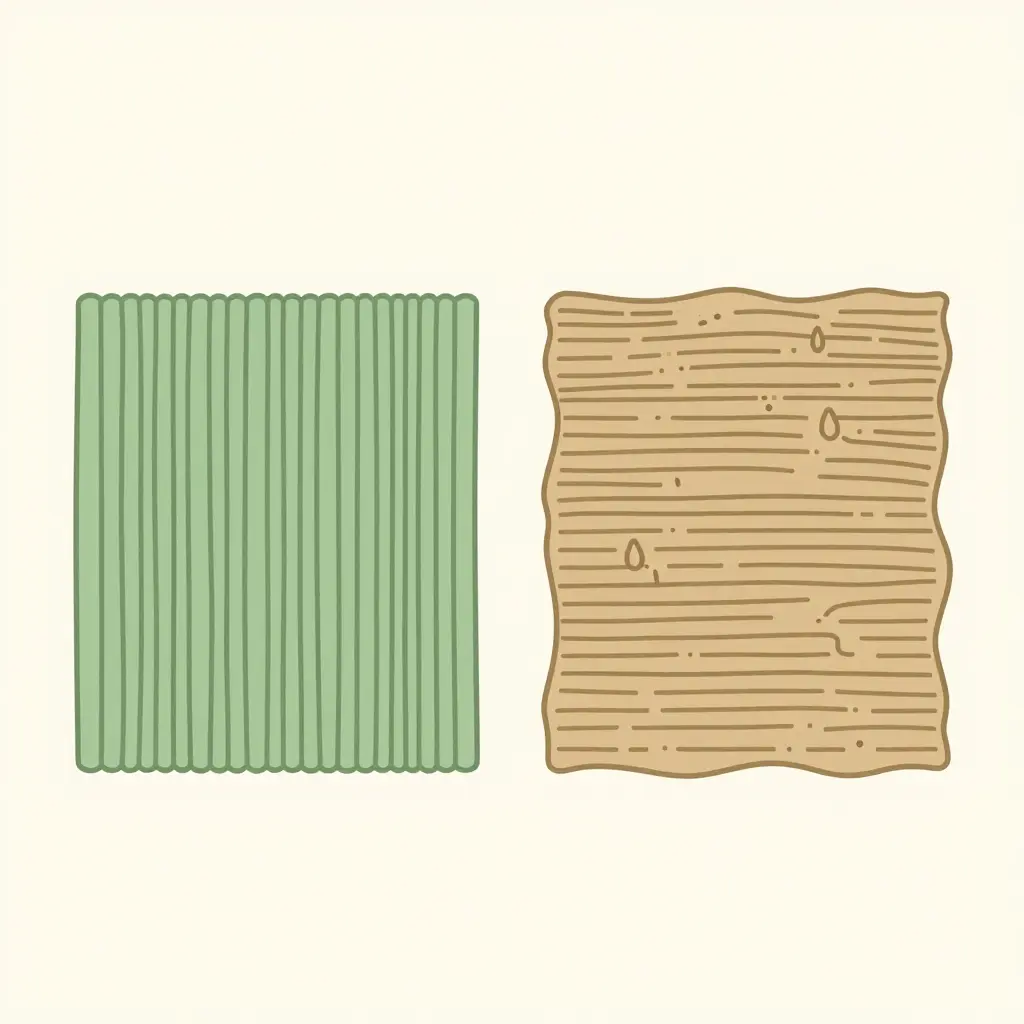
Illustrative cross-section only – a schematic of structural change, not a literal diagram. Understanding how plant-fiber materials behave in real-world use is exactly what these compostable paper cup insights explore.
- Choose a high-grade material. Opt for CPLA (crystallized PLA) or heat-tolerant molded fiber instead of standard PLA. The material’s heat resistance rating is the single biggest predictor of whether your compostable cutlery will bend in a steaming bowl of soup.
- Match the utensil to the serving temperature. Use standard PLA only for dishes below 45 °C, and reserve CPLA or wood for soups above 60 °C. Serving a 75 °C ramen in basic PLA guarantees a saggy fork within minutes.
- Shorten the serving window and limit soak time. The longer a utensil sits in hot liquid, the more moisture it absorbs and the faster it softens. Train staff to pair cutlery with food at the counter rather than burying it in the dish, and keep soak time under 15-20 minutes for hot meals. Pairing sturdy utensils with well-drained containers, like a 3-division takeaway food box, keeps sauces away from the handles.
- Add a barrier coating. A thin PLA, beeswax, or food-safe starch coating slows moisture uptake and helps the utensil hold its stiffness just long enough to finish the meal.
- Increase thickness and gram weight. Heavier utensils (3.5g and up for forks) resist softening better than flimsy, thin-molded pieces. A little extra material buys a lot of structural integrity.
- Store cool, dry, and flat. Keep compostable cutlery out of humid kitchens and hot storage areas, and never stack it under heavy boxes. Moisture and pressure deform utensils before they ever reach a customer.
- Manage lids and steam. Vented lids let steam escape instead of condensing onto cutlery. Choosing an eco takeaway food box with a vented or loose-fit lid reduces the trapped moisture that warps handles.
- Provide a dry resting spot. Include a small napkin or a raised ledge so diners can set utensils down without leaving them parked in hot broth.

The diagram maps the two inputs behind compostable cutlery material choice. Read it left to right: the starting node represents the serving scenario, the first diamond tests soup serving temperature, and the second tests expected serving duration. Each branch ends in an outcome node, giving you a quick visual shortcut for matching a material grade to the soak conditions it will actually face.
FAQ: Compostable Cutlery, Hot Soup, and Warping
Does compostable cutlery really warp in hot soup?
Yes, but not inevitably. Warping usually happens when low-grade compostable cutlery meets liquid above roughly 60 °C (140 °F), softening the handle or bending the tines. A higher material grade combined with a short soak time keeps most utensils rigid through an ordinary meal.
What is the difference between PLA and CPLA?
PLA (polylactic acid) is a bio-based polymer fermented from plant starches such as corn. CPLA is “crystallized” PLA, produced by heat-treating the polymer so its internal structure becomes more ordered and heat-resistant. That single processing step is why CPLA holds its shape in hot soup far better than standard PLA.
How long can compostable cutlery stay in hot soup?
For CPLA and other heat-tolerant grades, keep the soak time under about 30 to 45 minutes for dependable rigidity. Thin PLA utensils may start to soften in as little as 5 to 10 minutes. The longer the soak, the more heat and moisture the polymer takes on, and the sooner it loses strength.
Do thicker utensils resist warping better?
Generally, yes. Thicker walls add mechanical strength and slow heat penetration, so a heavy-gauge utensil tolerates hot soup longer than a flimsy one. Thickness alone cannot rescue a poor material grade, though, so buy both gauge and grade with care, much as you would with an eco takeaway food box.
Does bagasse outperform plastic-based compostables?
For hot soup, bagasse (sugarcane fiber) offers strong heat resistance and a naturally rigid feel. Yet it can absorb liquid and slowly lose stiffness during a long soak, and its tines are often bulkier. For cutlery specifically, CPLA usually beats bagasse on precision and durability, while bagasse wins on a fully fiber-based, home-compostable profile.
Conclusion and Recommendations
The evidence points to one reliable conclusion: matching material grade to expected soak time is the single most effective way to prevent compostable cutlery warping. Even the sturdiest CPLA, bamboo, or wooden utensils have a thermal and moisture ceiling, and pushing past it in a bowl of hot soup will soften, bend, or sag them.
For buyers, start with your real-world soak time, not the ideal one. If a soup is typically eaten within 15-20 minutes, a mid-grade CPLA fork handles it comfortably. For longer stews, chowders, or delivery orders that sit in broth for 30 minutes or more, choose a higher-heat grade or a thicker-gauge option.
For manufacturers, test and label accordingly. Publish a clear recommended soak time for each SKU so operators can match the product to the meal. Small design tweaks — reinforced handles, denser tines, or moisture-resistant coatings — can extend tolerance without sacrificing compostability.
A quick checklist to act on:
- Buyers: measure actual soak time, then select the matching grade.
- Manufacturers: validate heat and moisture limits for every product line.
- Both: favor certification-backed materials for consistent performance.
For a broader view of pairing compostable materials with real-world serving conditions, explore our guide to compostable foodservice supplies.
At greendispopack.com, we supply durable, eco-friendly tableware engineered to hold up in hot foodservice while staying fully compostable, so your sustainability goals never have to cost you performance.