
Why Soup Takeout Bowls Leak at the Rim
A leaking soup bowl usually isn’t the product of one broken part. At the sealing edge, two dimensions decide whether the lid holds: how much the lid can vary and still grip (lid fit tolerance), and how thick the rolled paper rim actually is. When those two drift apart, the lid stops seating fully, and liquid escapes through whatever gap is left once the bowl is moved, heated, or pressurized from the inside.
Lid fit tolerance is the range of variation a lid can absorb and still grip the bowl opening. Paper rim thickness is the gauge of the rolled edge the lid has to close around. A lid molded for a thin rim won’t seal a thick one; a thick rim can stop a tight lid from snapping down at all. Both parts can be in spec and still leak, because the failure lives in the mismatch between their specifications, not in either part.
The cost lands on everyone in the chain. Restaurants absorb the complaints, refunds, and cleanup. Delivery services eat the damaged orders and the reviews that follow. Suppliers take the returns and the reputational hit when a batch behaves differently from the last one.
The rest of this article defines both variables, compares published lid and rim specifications, and gives measurement-based guidance for matching components before a shipment leaves the warehouse. For how lids and bodies are paired in practice, see these lid-to-cup fit specifications.
What Lid Fit Tolerance Means
Lid fit tolerance is the dimensional range in which a lid can engage a bowl rim and still seal. It is the amount of give the design allows before a lid either won’t snap on or sits loose enough for soup to slip past the rim. Every lid-and-bowl pairing has a target size and an acceptable window of variation around it. When a shipment starts leaking, the two parts have usually drifted to opposite ends of that window.
Nominal Dimensions: The Design Target
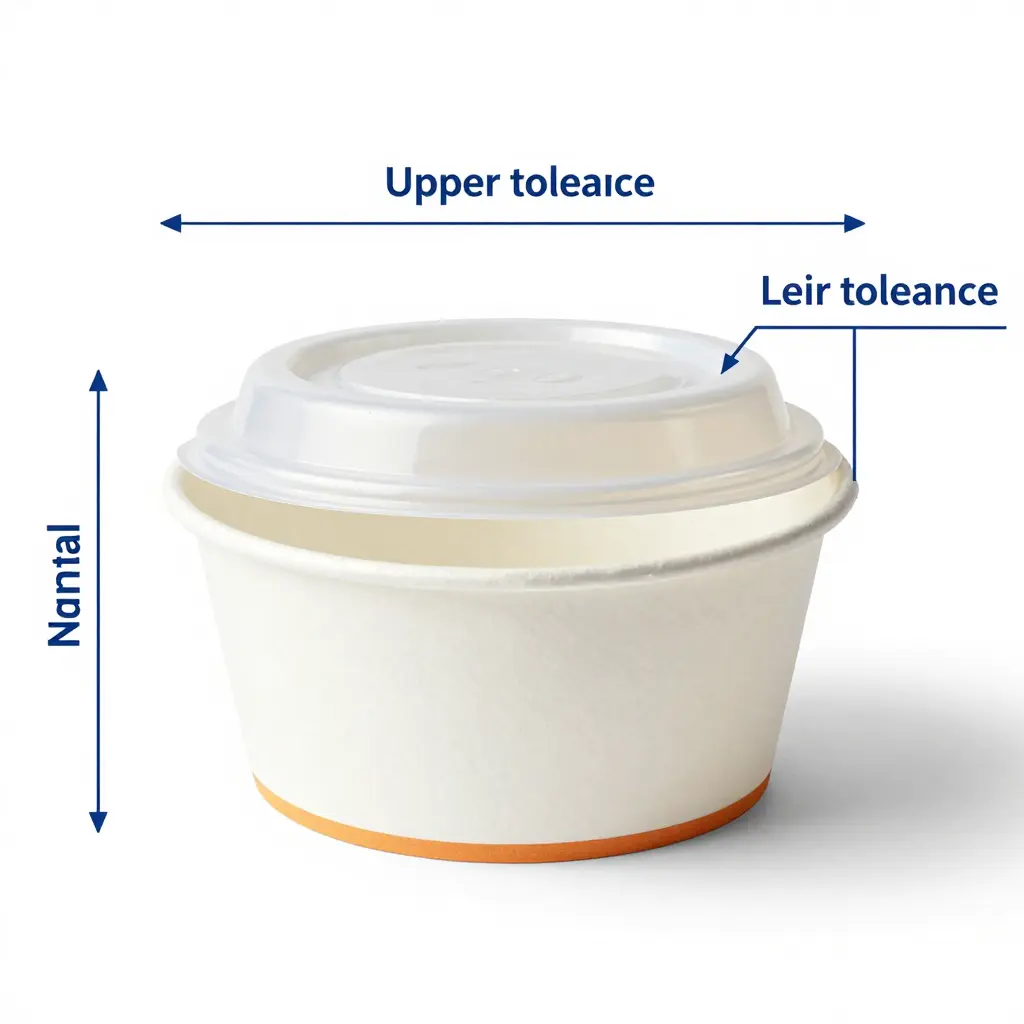
The nominal dimension is the ideal, “as-designed” size – for example, a bowl rim engineered at 118.0 mm. It is the reference number engineers agree on before any tolerance is added. Real parts never hit it exactly, so fit is governed by a range, not a single figure.
Upper and Lower Tolerance Bands
Around the nominal dimension sit two boundaries. The upper tolerance band sets the largest acceptable size (say, 118.3 mm), and the lower tolerance band sets the smallest acceptable size (117.7 mm). Any lid or rim inside that band counts as in spec, even though a 117.7 mm rim and a 118.3 mm rim behave very differently under the same lid.
Two Parts, Two Tolerances
Injection-molded lids and paper bowls each carry their own tolerance. Plastic lids can be molded tightly, often within a few tenths of a millimeter, because the mold is rigid. Paper bowls vary more, because pulp thickness, moisture, and forming pressure all shift the final rim diameter. Stacked tolerances then compound at the rim: a lid at its lower limit meeting a bowl at its upper limit may not close at all, while the reverse pairing fits too loosely to seal. For this reason, well-run lidded cup and bowl systems are specified as a matched set, not as two parts ordered independently.
Three Tolerances That Matter Most
| Term | Plain-language definition | What it controls |
|---|---|---|
| Diameter tolerance | How much the circle’s width can vary around the rim | Whether the lid can start to engage |
| Rim radius tolerance | How much the rolled or curled edge’s curvature can vary | Whether the lid grips the edge smoothly |
| Snap / press depth | How far the lid’s inner lip travels down over the rim | Whether it actually locks and seals |
Together, these three tolerances describe how a container behaves better than any single diameter figure.
How the Lid Groove Meets the Paper Rim
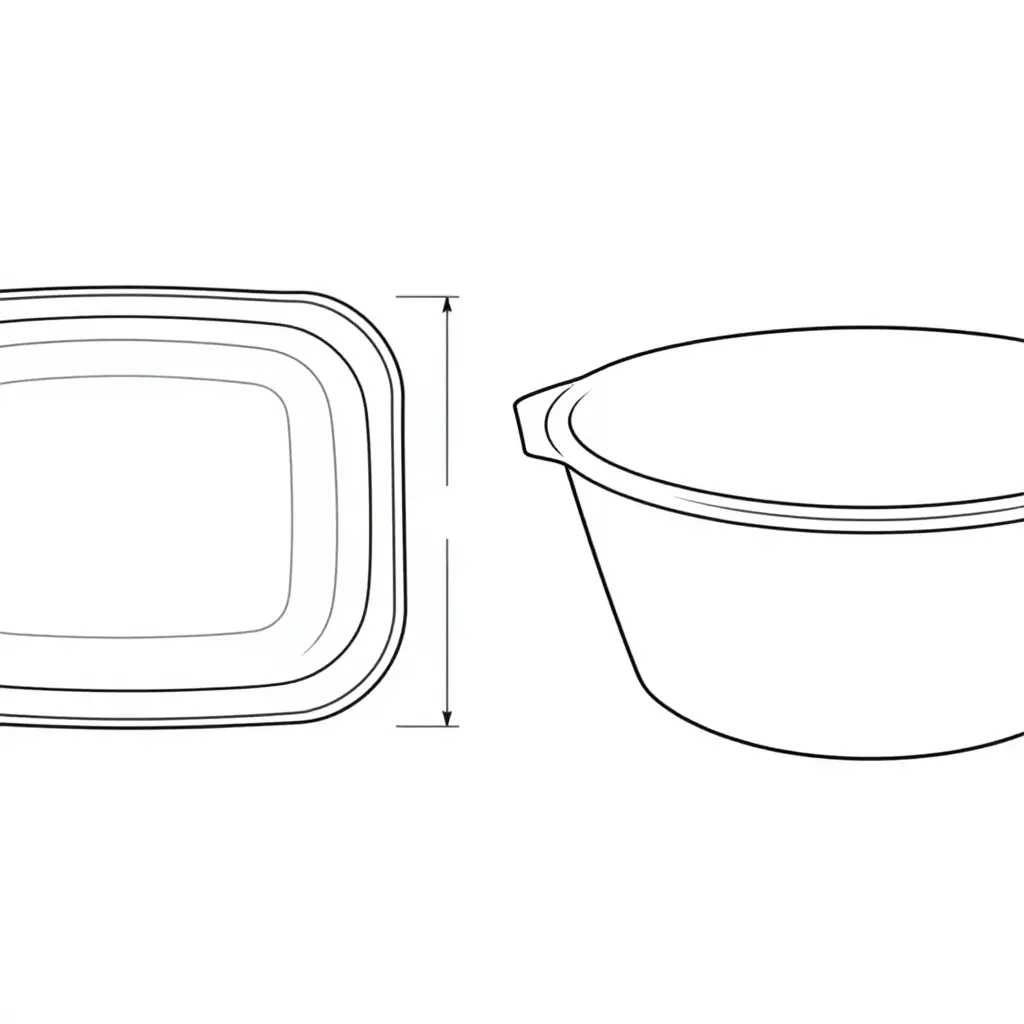
The diagram reduces the seal to its two parts: the lid edge, drawn as a U-shaped inner groove, and the paper bowl rim, drawn as a rolled curl. When the lid snaps down, the curl nests inside the groove, and the seal is only as good as the fit between the two.
The two sets of arrows tell the real story. The narrow pair marks the working gap – the small clearance that lets the curl slide in without tearing the paper. The wider pair marks the tolerance band: the acceptable range the gap is allowed to drift within across thousands of manufactured units. If the paper rim curl falls outside that band, or the groove is molded too wide, the lid can seat without actually clamping down, and soup finds the smallest path out.
How Paper Rim Thickness Shapes the Seal
The rim of a paper soup bowl is the rolled lip the lid snaps onto, and it is where many leaks begin. When paper is formed into a bowl, the top edge folds back on itself into a tight roll, creating a reinforced band. That finished band, the paper rim thickness, does more to decide whether a container arrives leak-proof than most buyers assume.
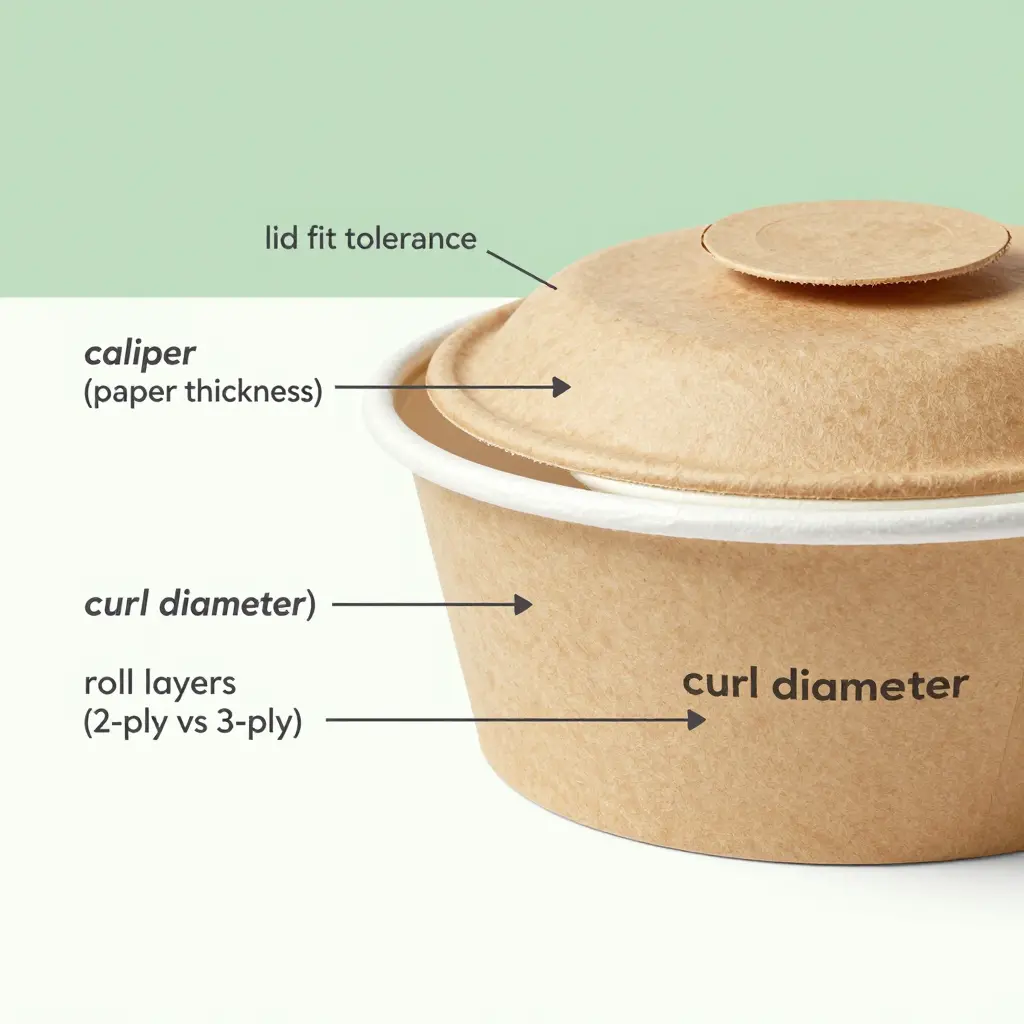
Three design factors decide how that rim behaves:
Caliper: the paper’s starting thickness
Caliper is the thickness of the raw paperboard before it is rolled. Heavier caliper gives the rim more substance and a stiffer surface for a lid to grip, while lighter caliper keeps the bowl flexible and light.
Roll layers: how many folds make the rim
A single-layer curl is thin and springy. Two- or three-ply rims stack multiple folds of paper, adding rigidity and a more consistent sealing surface. More layers generally mean a stronger rim, but also a bulkier one.
Curl diameter: the size of the finished roll
Curl diameter is the outer dimension of the completed roll. A larger curl creates a wider landing area for the lid, while a smaller, tighter curl fits slimmer lid channels.
Why thicker and thinner rims both cause trouble
A thick, multi-layer rim resists deformation well, so it holds its shape under handling, but it can clash with lids molded for thinner rims, leaving gaps or forcing the lid to sit too high. A thin rim is the opposite: it seats easily, but it can flex and open up under heat and moisture, exactly the conditions inside a soup bowl.
Matching paper rim thickness to lid tolerance is what keeps takeout packaging leak-proof. Get the caliper, layer count, and curl diameter in line with the lid, and the seal stays tight from kitchen to doorstep.
The table below matches paper rim thickness ranges to lid fit tolerances.
| Rim Thickness Range | Corresponding Lid Fit Tolerance | Seal Type | Deformation Risk Under Hot Liquid | Leak Risk Level |
|---|---|---|---|---|
| Thin rim (0.5-0.7 mm) | Tight (plus or minus 0.15 mm) | Snap-fit with inner plug | High – rim flexes and curls | Moderate |
| Thin rim (0.5-0.7 mm) | Standard (plus or minus 0.30 mm) | Friction-fit | High | High |
| Standard rim (0.8-1.1 mm) | Tight (plus or minus 0.15 mm) | Snap-fit with inner plug | Low to Moderate | Low |
| Standard rim (0.8-1.1 mm) | Standard (plus or minus 0.30 mm) | Friction-fit | Moderate | Moderate |
| Standard rim (0.8-1.1 mm) | Loose (plus or minus 0.50 mm) | Overlap / resting lid | Moderate | High |
| Heavy-duty rim (1.2-1.6 mm) | Standard (plus or minus 0.30 mm) | Double-seal snap-fit | Low | Low |
| Heavy-duty rim (1.2-1.6 mm) | Loose (plus or minus 0.50 mm) | Overlap / resting lid | Low | Moderate |
For hot soup, the safest combinations pair standard or heavy-duty rims with tight or standard snap-fit tolerances: the thicker wall resists the softening and warping that hot liquid causes, and the tighter grip keeps the seal continuous. Thin rims flex and deform under sustained heat even with tight tolerances, opening small gaps that turn into full leaks. Before you source new paper soup bowls in bulk, measure actual rim thickness with calipers instead of trusting the nominal spec printed on the carton.
Where Tolerance Meets Rim Thickness: The Leak Zone
A soup bowl’s seal comes from two variables that move independently in production: the lid’s fit tolerance and the paper rim thickness. Matched correctly, the lid compresses the rim just enough to hold back hot broth. Mismatched, you ship leaks.
When the Lid Is Too Loose
If the lid’s inner dimension is too loose for a given paper rim thickness, the lid never actually compresses anything. The rim behaves like a rigid ring rather than a compressible gasket, so there is no sealing force at the interface. Broth creeps under the lid, wicks along the paper edge, and escapes once the bowl tilts in a delivery bag. Thin rims make this worse – less material means less compression to work with, so even a small gap leaks.
When the Lid Is Too Tight
An over-tight lid fails too. When the lid’s inner dimension is far smaller than the paper rim, the snap force cracks or deforms the rim itself. Paper rims are composite structures; over-compression delaminates the layers, collapses the rolled edge, and permanently flattens the sealing surface. Once the rim deforms, the lid can pop loose as the bowl flexes under load.
The Good Fit Window
The reliable answer is a good fit window – a range where the lid’s inner dimension overlaps the rim’s outer dimension across the full tolerance band of both parts. That means designing the lid to sit slightly smaller than the largest expected rim, so every real lid compresses every real rim by a controlled amount. Sourcing lids and rims with coordinated lid fit specifications keeps that overlap predictable instead of accidental.
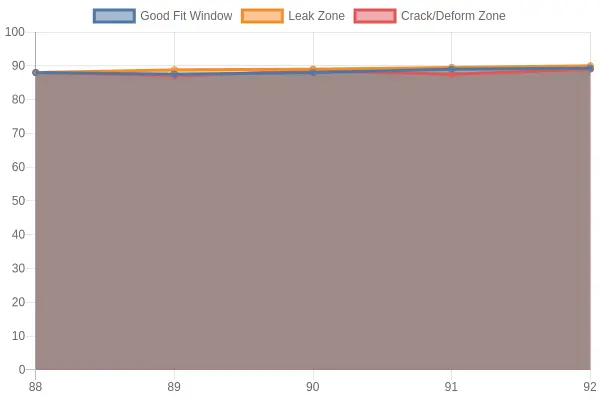
The window shifts once the bowl leaves the plant. In delivery, three forces move it:
| Delivery Factor | What It Does to the Rim | Net Effect on the Fit Window |
|---|---|---|
| Heat | Softens the material and expands trapped air | Window narrows – grip weakens |
| Moisture | Condensation coats the rim | Window narrows – friction drops |
| Stacking pressure | Pushes lids downward and induces creep | Window shifts – seal loosens over time |
Heat, moisture, and stacking rarely act alone. A hot, steamy bowl at the bottom of a full carrier meets all three, which is why some leaks only show up twenty minutes into a route. Treat lid fit tolerance and paper rim thickness as one coupled system: test the overlap across the full tolerance range and validate it under delivery conditions, not on a lab bench.
Leak Rate vs. Tolerance Deviation
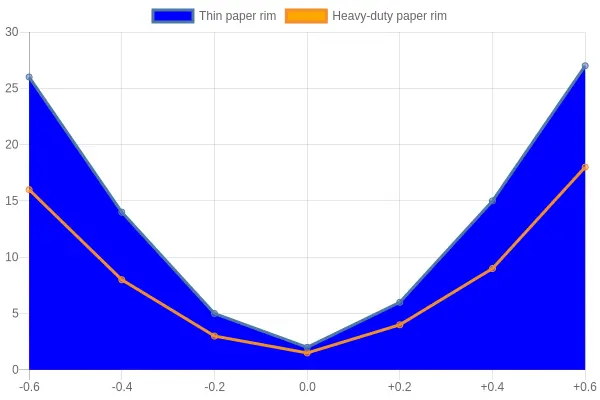
Leak incidents do not rise in a straight line with tolerance deviation. They follow a U-shaped curve, with the lowest point at the nominal fit. The figures below are illustrative, showing the shape of that curve for thin and heavy-duty paper rims rather than results from a single controlled study.
Reading the Two Curves
The horizontal axis is tolerance deviation from the nominal fit in millimeters; the vertical axis is the leak incident rate as a percentage of bowls tested.
| Tolerance deviation | Thin paper rim leak rate | Heavy-duty paper rim leak rate |
|---|---|---|
| -0.6 mm | 26% | 16% |
| -0.4 mm | 14% | 8% |
| -0.2 mm | 5% | 3% |
| 0.0 mm (nominal) | 2% | 1.5% |
| +0.2 mm | 6% | 4% |
| +0.4 mm | 15% | 9% |
| +0.6 mm | 27% | 18% |
Why Both Extremes Fail
Under-tolerance (negative deviation): the lid is too tight. The rim gets compressed beyond its elastic limit, paper fibers crush, and the seal deforms permanently. Broth finds micro-channels along the crushed edge.
Over-tolerance (positive deviation): the lid is too loose. There isn’t enough interference between lid lip and rim to create a seal. Hot soup sloshes, pressure builds, and it weeps right past the gap.
The nominal fit (0.0 mm) gives the lowest leak rate for both materials, and the heavy-duty rim stays lower than the thin rim at every point, by roughly a quarter to a bit over 40%. That gap is what thinner paper stock buys when it is chosen to save a fraction of a cent per unit.
What This Means for Your Operation
- Tighten your spec tolerance to roughly ±0.2 mm. The curve is relatively flat there, so minor manufacturing drift won’t spike your leak complaints.
- Invest in heavier paper rims if you ship hot, liquid-heavy soups. The curve shows the seal holds better across the whole range.
- Audit incoming batches with a simple go/no-go gauge. A bowl sitting at ±0.6 mm is a guaranteed callback waiting to happen.
To compare lid-and-rim combinations before committing to a spec, browse tested cup and lid formats.
Common Causes of Rim Leaks at a Glance
Rim leaks rarely have a single culprit; small tolerances stack up until the seal gives way. For a kitchen or a delivery fleet, the list below covers the most common causes.
- Out-of-spec lid diameter. When a lid runs even slightly larger or smaller than the bowl’s design, the rim never seats fully, leaving a hairline gap that soup finds instantly.
- Thin or inconsistent paper rim curl. Paper rims that vary in thickness or curl poorly around the mouth fail to create even pressure against the lid, so the seal breaks at the weakest point.
- Excessive fill level. Overfilling pushes liquid right up to the rim, so any tilt or minor jostle sends soup straight past the closure.
- Thermal expansion of hot soup. Hot contents warm the rim and the trapped air, raising internal pressure that forces liquid outward as the bowl flexes. The same paired-component mechanics show up in clear plastic cups with lids.
- Stacking pressure in delivery bags. Piling bowls on top of each other compresses the rims, distorting their shape and breaking the seal before the bag is even zipped.
- Moisture softening of the rim. Steam and condensation soak into paper rims, softening the fibers so they lose the stiffness needed to hold a firm seal.
- Vibration during transport. Constant jostling on scooters, bikes, and cars works liquid toward the rim and gradually loosens an otherwise decent fit.
- Improper lid seating. A lid pressed on at an angle, rather than snapped down evenly, creates a tilted seal that leaks on one side only.
Testing Lid Fit and Rim Thickness Before You Buy
Before committing to a full order, run a short, repeatable test on a small sample. It tells you more than a spec sheet, and the whole routine takes under an hour.
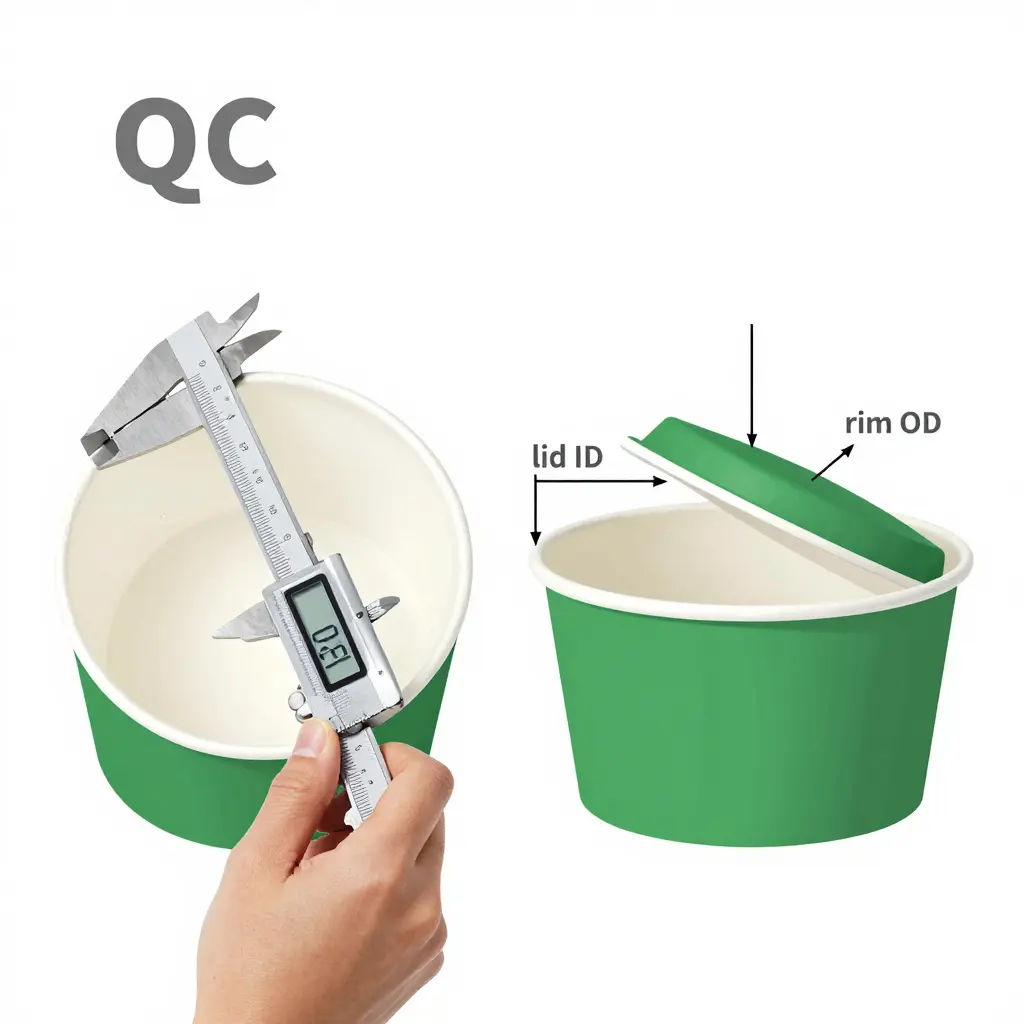
Measure paper rim thickness with calipers
Using a digital caliper, take readings at four points around the rim (front, back, left, right) on at least five bowls, then note the minimum and maximum. Consistent thickness is what makes a seal predictable. A rim that swings by more than a couple of hundredths of a millimeter will snap tight on some lids and float over others.
Verify lid inner diameter against rim outer diameter
Next, confirm the geometry. The lid inner diameter must sit just inside the rim outer diameter so it grips without crushing the bowl. If the lid ID is too large, steam lifts it off; if it is too small, the rim deforms and splits. This relationship is the core of lid fit tolerance and the number to compare against the good fit window defined earlier. For more on matching cups and lids for a reliable seal, see the linked guide.
Run a tip-and-shake test
Fill a bowl to its working level with water, snap on the lid, then tip it 45 degrees and shake it firmly over a tray. Any weeping at the seam is a fail. Repeat three times, rotating the bowl each round so you test the full circumference.
Run a hot-liquid hold test
Heat and steam soften paper and can swell the rim, so this test matters most. Fill a bowl with hot liquid (around 90°C), lid it, and let it stand for 15 minutes. Then tip and shake again. Marginal fits often pass cold and fail here, which makes it the more demanding test of lid fit tolerance.
Sample across batches and catch drift
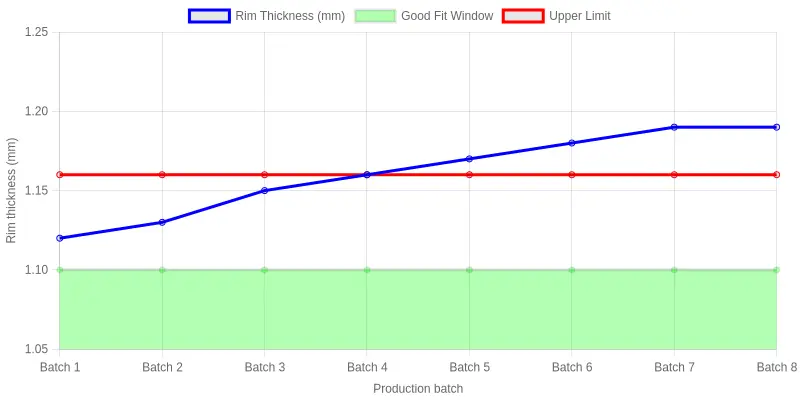
Never judge a supplier on the first batch alone. Pull five bowls from every production run and log each measurement on a simple log sheet. Over time, a slow upward trend in rim thickness signals tooling wear or moisture changes, drift that pushes bowls out of the good fit window before anyone notices leaks on the line. Plotting the readings makes that slide visible.
Set acceptance criteria
Base every pass/fail decision on the good fit window, and keep a one-page check sheet so operators and suppliers stay aligned:
| Test | Method | Pass criteria |
|---|---|---|
| Rim thickness | Calipers, 4 points x 5 bowls | Inside good fit window, spread under 0.03 mm |
| Lid ID vs rim OD | Compare measured diameters | Lid snaps with a firm click, no rocking |
| Tip-and-shake | 45 degree tip plus shake, 3 rounds | No visible leaking at the rim |
| Hot hold | 90°C for 15 minutes, then shake | No leaking, lid stays seated |
Run these four checks every batch, and rim leaks stop being a mystery; they become a measurement you can track and act on before a customer opens a bag.
Related Packaging Resources
Rim leaks are one case of a broader pattern. Lid fit, container selection, and material choice all rest on the same sealing principles: rim geometry, the tolerance between lid and body, and how the material responds to heat and moisture together.
The breakdown of clear plastic cups with lid covers how lid design meets rim contact. The plastic food containers guide compares formats for hot and cold takeout, including how container shape, wall thickness, and closure type affect performance. For paper-based options, the overview of compostable paper cups explains how rim thickness and coating choices influence lid compatibility. Together they cover the tolerance, selection, and material questions behind most rim-leak complaints.
Frequently Asked Questions About Soup Bowl Leaks
-
What is a good lid fit tolerance for paper soup bowls? For most soup takeout bowls, aim for a lid fit tolerance in the tight-to-standard range – plus or minus 0.15 to 0.30 mm on each part – which keeps roughly 0.5 to 1.0 mm of total clearance between the lid’s inner wall and the bowl’s outer rim. Tighter tolerances reduce play but demand consistency, while looser ones seat easily yet leak more readily.
-
Does a thicker paper rim always prevent leaks? No. A thicker paper rim thickness adds stiffness and gives the lid more material to grip, but it does not guarantee a tight seal on its own. If the lid’s channel is wider than the rim, the lid still sits loose, and bowl-to-bowl variation creates gaps. Consistent dimensions matter more than raw thickness.
-
Can hot soup change rim thickness? Yes. Heat and steam can soften and slightly swell the paper rim, altering both its paper rim thickness and its shape over time. That swelling may tighten a loose lid or distort it enough to break the seal entirely, which is why moisture-resistant coatings and stable rim dimensions matter for hot soup takeout bowls.
-
How do I test lid fit quickly? Run a simple fill-and-tilt test. Fill a soup takeout bowl to its normal serving level, snap on the lid, and tilt it about 45 degrees while watching the rim for drips. Repeat with hot water to see how heat affects the seal. It takes seconds and exposes a poor lid fit tolerance before it ever reaches your customers.
-
Does stacking cause rim leaks? It can. When soup takeout bowls are stacked, the weight presses down on the lid and rim, which may flex a loose-fitting lid and open small gaps. Choosing bowls with reinforced rims and limiting stack height helps prevent this compression-driven leaking.
-
Can I improve the seal with better tooling? Often, yes. Precision equipment matters, and the way disposable bowls are shaped on custom plastic forming machines directly affects rim uniformity and lid fit. Pairing tight lid fit tolerance with a controlled paper rim thickness is what ultimately keeps soup takeout bowls leak-free.
Getting the Rim Fit Right
The leak-rate pattern and the test methods point to the same conclusion: a leak-proof soup bowl is not the product of a better lid or a thicker rim by itself. It depends on alignment. Lid fit tolerance, the range in which the closure still grips, and paper rim thickness, how consistently the rolled edge holds across a production run, have to fall inside the same good-fit window. When they do, the seal holds against heat, steam, and the jostling of delivery. When they drift apart, a well-engineered lid still leaks and a sturdy rim still fails.
The practical actions are the same for restaurant owners, delivery services, and packaging suppliers:
- Measure both variables. Confirm the actual rim thickness of incoming bowls and the grip range of each lid rather than relying on label claims or a single sample.
- Specify tolerance ranges. Write acceptable ranges for rim thickness and lid fit, and tie them to real production limits instead of ideal numbers.
- Test across batches. Run fit and leak checks on multiple batches, not just the first, because paper stock and molding conditions shift over time.
Treating lid fit tolerance and rim thickness as one specification turns rim leaking from a recurring complaint into a measurable target. Teams standardizing a full container lineup can use a practical guide to food container selection to connect these fit decisions to the rest of the packaging choices.