
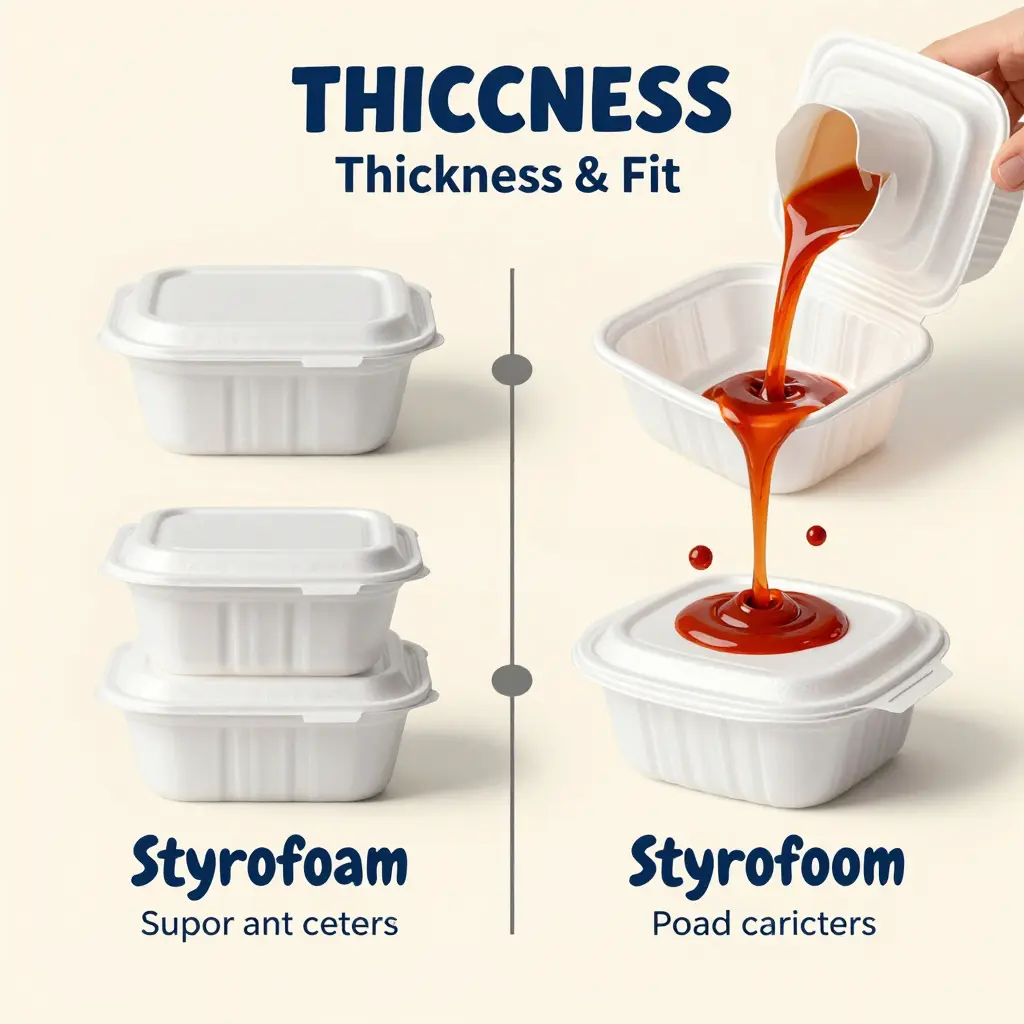
Wall Thickness vs Lid Fit: What Really Decides a Saucy Takeout Order
Ask three wholesalers to quote the same foam takeout container and the answer comes back as a single number: pesos per piece. That number says almost nothing about whether the container survives a ride with curry in it. Wall thickness and lid fit decide that, and neither one appears on the quote sheet. Two suppliers can price an identical tray the same way and produce very different results at the customer’s door.
This guide is for the people who place the orders rather than the ones who write the menu: bubble tea and beverage chains, restaurants, food trucks, caterers, event planners, and procurement teams buying in volume. It compares four things that matter once hot, wet food has been sitting in the box for twenty minutes: wall thickness grades, rim geometry, lid skirt depth, and condensation. Each section is written to be carried into a supplier meeting or a sample review.
The method has three steps, and each one ends with something you can hold a supplier to:
- Step 1 – Grade the wall. Compare millimeter thickness at the body and the base, then match each grade to the load it actually carries.
- Step 2 – Check the rim and skirt. Rim geometry and skirt depth decide how the two parts lock against a heavy, sauce-heavy fill. Compare real lid and rim options before you shortlist anyone.
- Step 3 – Test condensation and load. Run a fill test that mimics a warm delivery ride, then look for softening, seepage, and lid lift.
What Wall Thickness Actually Does in a Saucy Takeout Container
Wall thickness is the number buyers most often misread. Diameters and compartment counts get compared first, the cheapest quote wins, and a month later the lids are popping open in the delivery bag. Thickness does three separate jobs, and only one of them is about strength.
One note on the wording, since it comes up in every tender: food-service foam is expanded polystyrene, or EPS. Styrofoam is a Dow trademark for extruded polystyrene insulation board, not a takeout tray, but it is the name Filipino buyers use, so it is the name used here.
Three jobs, one dimension
Rigidity under a filled load. Curry, adobo, braised pork: heavy, and always moving. A thicker wall resists side-panel bulge and flex, so the body keeps its footprint when it is stacked in a thermal bag or carried four at a time.
Insulation. Foam holds still air between the sauce and the room, and a thicker wall holds more of it. That buys minutes of serving temperature across a 20 to 40 minute ride.
Resistance to rim softening. Hot, oily, high-moisture food resting against the rim for 20 to 40 minutes softens thin foam. The rim loses its edge, droops, and the lid seat quietly lets go.
Light, standard and heavy-duty grades
- Light grade: fine for fast hand-offs, low-moisture items and short trips. Cheapest per piece, and rims give up quickly under wet, hot loads.
- Standard grade: the everyday grade for most restaurant and catering menus with moderate sauce.
- Heavy-duty grade: holds rim shape noticeably better, which means a more secure lid seat and far fewer pop-offs on long or stacked deliveries.
Rigidity is not free. A heavier wall costs more per piece and takes more storage volume per carton, so a pallet holds fewer units and the warehouse bill grows. On a bulk order those two costs add up fast, which is the argument for choosing a grade per menu item rather than per supplier.
Sauce beats portion size
Portion size is a poor guide on its own. Viscosity and free liquid change the requirement more. A 12 oz serving of thick rendang puts less stress on the rim than an 8 oz pool of thin, oily broth. Thin, free-flowing liquid plus sustained heat is the hardest combination any wall grade will meet.
If wet menus are pushing you toward other materials, the sugarcane food container range is worth putting through the same tests as your foam options.
Match wall grade to sauce load and transport time. The cheapest quote is not a specification.
Put Table 1 next to whatever quote sheet you are holding. Published grades are indicative, so confirm thickness and lid fit on a physical sample before committing volume to a Styrofoam food containers wholesale Philippines order.
Table 1: Wall thickness vs lid fit reference for saucy takeout containers
| Wall grade | Typical thickness range (mm) | Best suited sauce load | Rim rigidity under load | Recommended lid type and skirt depth | Lid fit risk level | Relative cost per piece | Storage volume per carton |
|---|---|---|---|---|---|---|---|
| Light-duty wall | 1.5 – 2.0 mm | Dry or low-moisture only | Flexes easily when lifted | Flat lid, 5 mm skirt | High | $ (lowest) | Highest units per carton |
| Standard wall | 2.0 – 2.8 mm | Medium gravy | Firm, slight flex at rim | Snap lid, 8 mm skirt | Moderate | $$ (mid) | Medium units per carton |
| Heavy-duty wall | 2.8 – 3.5 mm | High-liquid or oily | Rigid, holds shape | Deep snap lid, 12 mm skirt | Low | $$$ (highest plain wall) | Lowest units per carton |
| Ribbed or reinforced rim | 2.5 – 3.5 mm plus rib | High-liquid or oily | Very rigid, resists bowing | Deep snap lid, 12 – 15 mm skirt | Low | $$$+ (above heavy-duty) | Medium-low units per carton |
Read the risk column as a cost-of-failure signal, not a quality badge. When two wholesalers quote the same price, compare their risk grade against the thickness they list, then ask both for the same test: load the bowl with your heaviest sauce, stack three high, and check the skirt for lifting after 30 minutes. A quote that pairs a thin wall with a tall skirt and still claims low risk is a question to raise, not a bargain. Ask for matching lid options and sample lots, and weigh delivered cost per usable piece rather than headline price before you commit a season’s volume.
Lid Fit: Rim Geometry, Skirt Depth and Snap Behavior
A bag tips over on the car seat and the sauce stays inside. Nobody thanks the lid; it simply worked. But lid fit is not luck, and it is not one measurement either. It is what happens where two molded parts meet, and on a saucy menu it deserves the attention wall thickness already gets.
How a lid actually stays on
Most foam containers hold their lid by interference: the inside of the lid skirt is molded slightly smaller than the outside of the rim, so the two press against each other, and that contact is the seal. A deeper skirt puts more surface into that contact and resists sideways lift. A shallow skirt grips on tension alone. A locking snap works differently, engaging a bead or lip on the rim and clicking into place for a mechanical hold rather than a friction one. Neither closure is better in the abstract; what matters is that lid and rim were designed around each other.
Rim land area is the other half. That flat band where lid and rim meet is where the seal lives, and a lid that barely overlaps it has little margin once the container is full and warm.
Why a “standard” lid fails elsewhere
A lid tuned for a standard-wall body will not reliably seal a heavy-duty body. The extra thickness pushes the rim outward and the skirt can no longer seat all the way down. Ribbed and reinforced rims add a second problem: the ribs create high and low points, so contact becomes a series of pressure spots instead of a continuous band. The classic wholesale mismatch is a lid from one supplier on a body from another. Each factory works inside its own tolerance window, and two acceptable variances can stack into a lid that is too loose to trust or too tight to close comfortably.
Heat, steam and saucy fill lines
Steam is the quiet enemy. It builds pressure under the lid and pushes a shallow skirt upward, lifting the seal just enough to weep. Sauce does something similar from the other direction: fill it high and displacement coats the land area, which is the surface the seal depends on. Leave headspace, and specify enough skirt depth to resist the push.
Four lid fit checkpoints
- Skirt depth that reaches past the rim bead instead of resting on top of it.
- Closure type matched to the dish: friction press for light service, locking snap for heavy or hot loads.
- Rim land coverage that stays continuous through corners and rib transitions.
- Paired tolerances from one source, so body and lid were tested together rather than separately.
If you are building a saucy takeout program, the matching paper lid range is worth comparing against whatever is on your shelf now, before any volume commitment.
Treat lid fit as one specification for a container-and-lid system, not two independent SKUs. Order them as a pair, test them with your hottest, wettest dish, and the lid stops being something your staff think about.
Three Rim-and-Skirt Profiles, Side by Side

The diagram reads left to right across three wall profiles and shows what a lid skirt does against each one:
- Thin wall, shallow overlap – the skirt barely travels past the rim, so very little contact area stands in the way of a leak. Adequate for dry goods, risky for gravy.
- Standard wall, full rim land – the skirt sits flat across the whole land, which gives sauce a longer, tighter path before it escapes.
- Heavy-duty wall, ribbed rim, deep locking skirt – the rib acts as a physical stop and the deep skirt adds mechanical grip, which is what broth-heavy or high-fat takeout needs.
The useful question is not how thick the wall is but how much rim the lid actually touches, and how that contact holds when the bag is set down and sauce pushes outward. If you are matching lids to cups and bowls you already own, the paper lid range lists skirt depths you can compare before ordering.
Wholesale Ordering Checklist for Saucy Takeout Programs
Saucy menus punish loose lids within weeks of a supplier switch, and Styrofoam food containers wholesale Philippines buyers tend to learn that the hard way. Treat the quote as a test rather than a promise.
- Confirm each container SKU is matched to its exact lid SKU in writing, not from memory.
- Ask for wall thickness in millimeters for every size, and reject an unstated “heavy duty”.
- Verify rim diameter and skirt depth tolerances so fit stays repeatable batch to batch.
- Test with your own sauce at serving temperature: tilt, shake, and hold for 30 minutes.
- Check carton quantity, units per carton and per-piece landed cost, including duties into the Philippines.
- Measure storage volume and stacking strength before you reserve warehouse space.
- Review production lead time plus the reorder buffer that covers your peak sauce season.
- Get written replacement terms for lids that fail to seat, warp or split at the skirt.
- Ask how stock is stored; humid Philippine conditions soften foam rims in a warehouse that is not climate-controlled.
- Compare paper lid specifications against foam options if you plan to blend materials.
Score every shortlisted supplier on the same list. The comparison stops being a conversation about price, which is usually where an honest one starts.
What Actually Goes Wrong at the Rim
Wall thickness gets the attention, and it earns most of it, but it is not the only thing standing between a saucy order and a 30-minute delivery ride. The chart below compares three commonly reported failure modes across four wall thickness grades, using illustrative percentages rather than surveyed results.
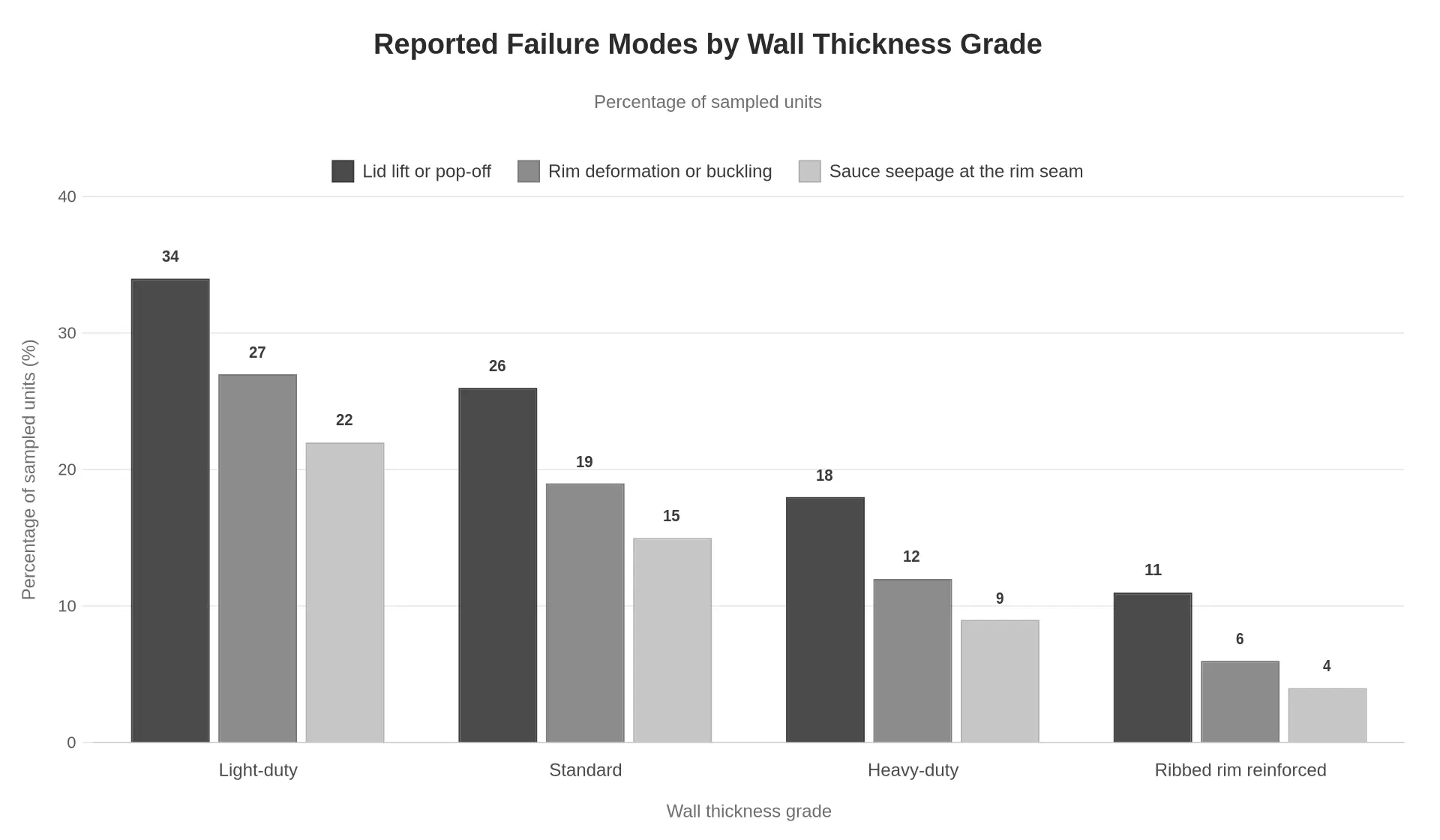
Takeaway: lid lift outranks seepage at every wall grade, which is why lid fit has to be specified separately from wall thickness.
For a sauce-heavy menu, that one finding reframes the whole specification conversation. A thicker body buys rigidity; a properly matched lid is what keeps gravy, laksa broth and brown sugar syrup inside the box. If the packaging set is still being assembled, the paper lids page lists the dimensions to compare against your containers, so the two get chosen as one system instead of two line items.
Heat, Steam and Delivery Time: Why Lid Fit Fails After Packing
A lid that clicks down perfectly at the packing station can be seeping by the time the rider reaches the gate, and the lid is usually not the reason. The cause is what starts happening the moment hot food is sealed in.
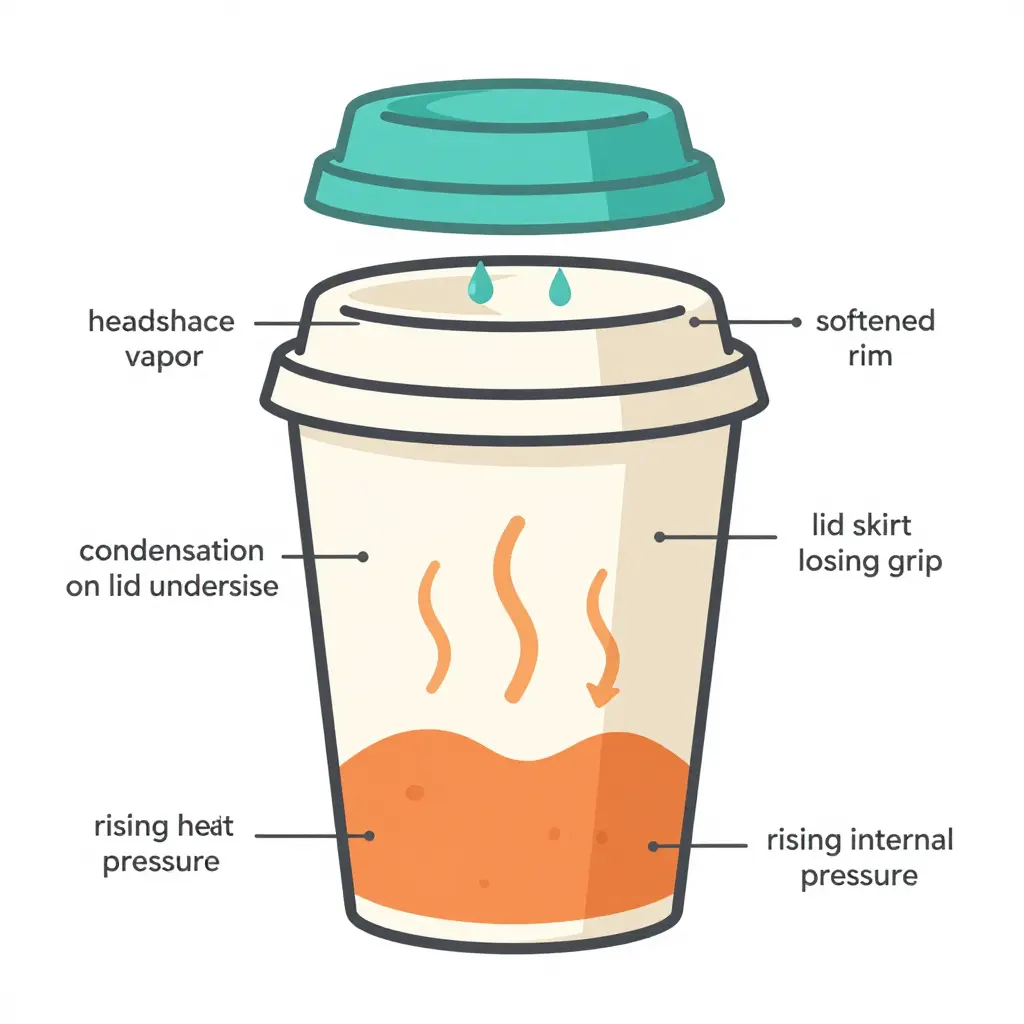
The sequence, step by step
- Vapor rises. Hot, saucy food keeps releasing steam. A thick, rich sauce loses heat more slowly than a thin broth because there is less movement inside the container, so vapor keeps forming for many minutes after packing.
- Condensation collects. That vapor meets the cooler underside of the lid, condenses there, and forms a film of water that creeps down toward the rim.
- The rim softens slightly. Food close to boiling point softens the polymer at the rim. Cell walls of closed-cell foam do not soak up water the way paper does; the condensed film mostly sits on the surface. Nothing melts, and the rim simply gives a little.
- Grip pressure drops. A lid skirt holds on through radial tension against the body wall. Once heat has softened the rim and a water film sits between the two surfaces, that tension falls and the seal becomes noticeably less leak-resistant.
- Internal pressure pushes up. Sealed hot food keeps generating vapor, so pressure inside climbs, in the one direction the skirt has least resistance to.
Ambient heat, humidity and the insulated bag
Tropical conditions speed up step three. In the Philippines the lid never really cools down, and its outer surface may already be wet before the bag is zipped.
Stacking makes it worse. Two or three loaded containers in an insulated bag trap heat between them, so a lower container’s lid sits in a warm, humid pocket while its internal pressure climbs, and the weight above presses the skirt outward at the moment it is weakest. The lid lifts a millimeter or two, sauce escapes, and delivery arrives with a stained bag.
Practical countermeasures
| Countermeasure | Why it works |
|---|---|
| Leave headspace below the rim | Gives vapor room to expand and condense without reaching the seal |
| Choose a deeper lid skirt for high-moisture items | More contact height means more grip even after slight softening |
| Use vented or paper lids where appropriate | A controlled escape path relieves internal pressure so the skirt stays seated |
| Limit pack-to-handoff time | Less time at peak heat means less condensation collecting at the seal |
| Avoid overstacking | Fewer trapped heat pockets and no mechanical load pressing on the skirt |
A deeper skirt and a breathable lid are the two cheapest changes available. Browse the leak-resistant paper lids against your current cup sizes, and check the full paper cup systems so lid and cup get chosen as one pair instead of two separate parts.
Get those two details right and a saucy order arrives the way it left the kitchen.
Where the Cost of One Leaked Saucy Order Goes
A leak never costs one container. Before comparing per-piece quotes, it helps to see where the money actually goes when a sauce-heavy order arrives soggy at the customer’s door. The doughnut chart breaks one incident into its five cost buckets.
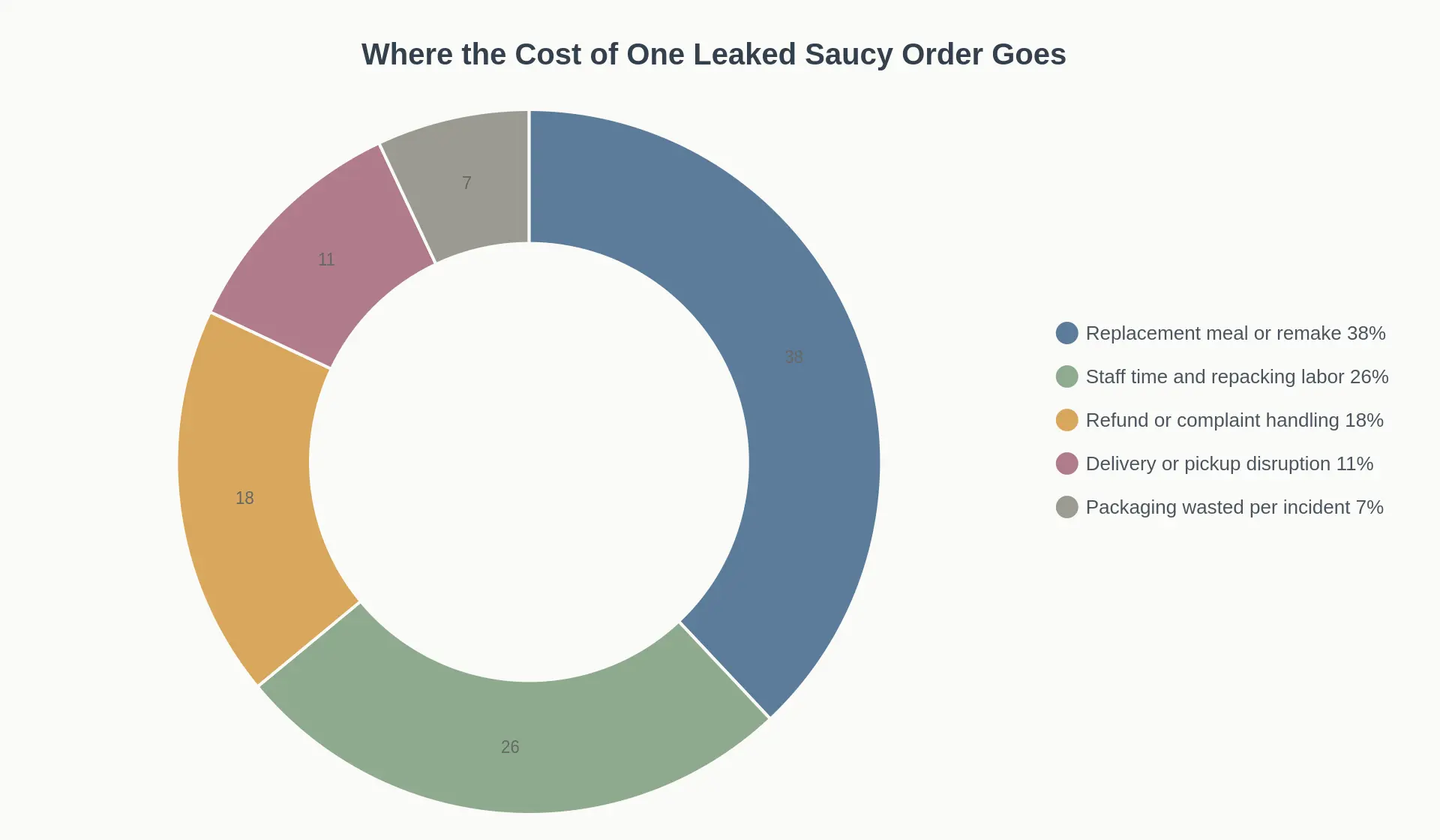
Packaging is the smallest slice at 7%, which is a fair reason to distrust per-piece price as the basis for choosing a wholesaler. A lid that seats badly on your saucy noodle boxes can quietly multiply the other four slices, and those are the ones your staff absorb at 8 pm and your reviews absorb the week after.
Price Per Piece vs Total Cost Per Order
A headline price of PHP 5.10 looks unbeatable next to PHP 7.00 until you count what happens after the food leaves the counter. When you shortlist Styrofoam food containers wholesale Philippines suppliers, compare landed cost per serving instead of price per piece, then let the arithmetic decide.
Build the landed cost per serving
Start with one container plus its lid, delivered, then add the lines that never appear on a quotation:
- Failure rate. Leaks, split rims and lids that pop under a heavy sauce. Ask for the defect rate, then verify it yourself.
- Remakes. Every failed order is a second serving of protein, sauce and labour given away free.
- Refunds and credits. A leaked delivery costs the food, and it costs the goodwill of a repeat customer.
- Staff time. Repacking, wiping, apologising and re-sealing at peak hour is paid labour, and it is the line buyers forget.
Put a number on each one. The gap between two quotes narrows fast, and sometimes it reverses. The table below runs that comparison across 1,000 orders on assumed inputs; replace the assumptions with your own defect rate, wage and remake cost.
| Cost line per 1,000 orders | Low-bid supplier | Vetted supplier |
|---|---|---|
| Container + lid at unit price | PHP 5,100 | PHP 7,000 |
| Leak-related remakes (3% vs 0.5%) | PHP 900 | PHP 150 |
| Refunds and service credits | PHP 600 | PHP 100 |
| Staff time on repacks (6 hrs vs 1 hr) | PHP 1,200 | PHP 200 |
| Total per 1,000 orders | PHP 7,800 | PHP 7,450 |
A PHP 1.90 unit-price saving can quietly become a PHP 350 loss per thousand orders. That is the whole argument for landed cost in one row of arithmetic.
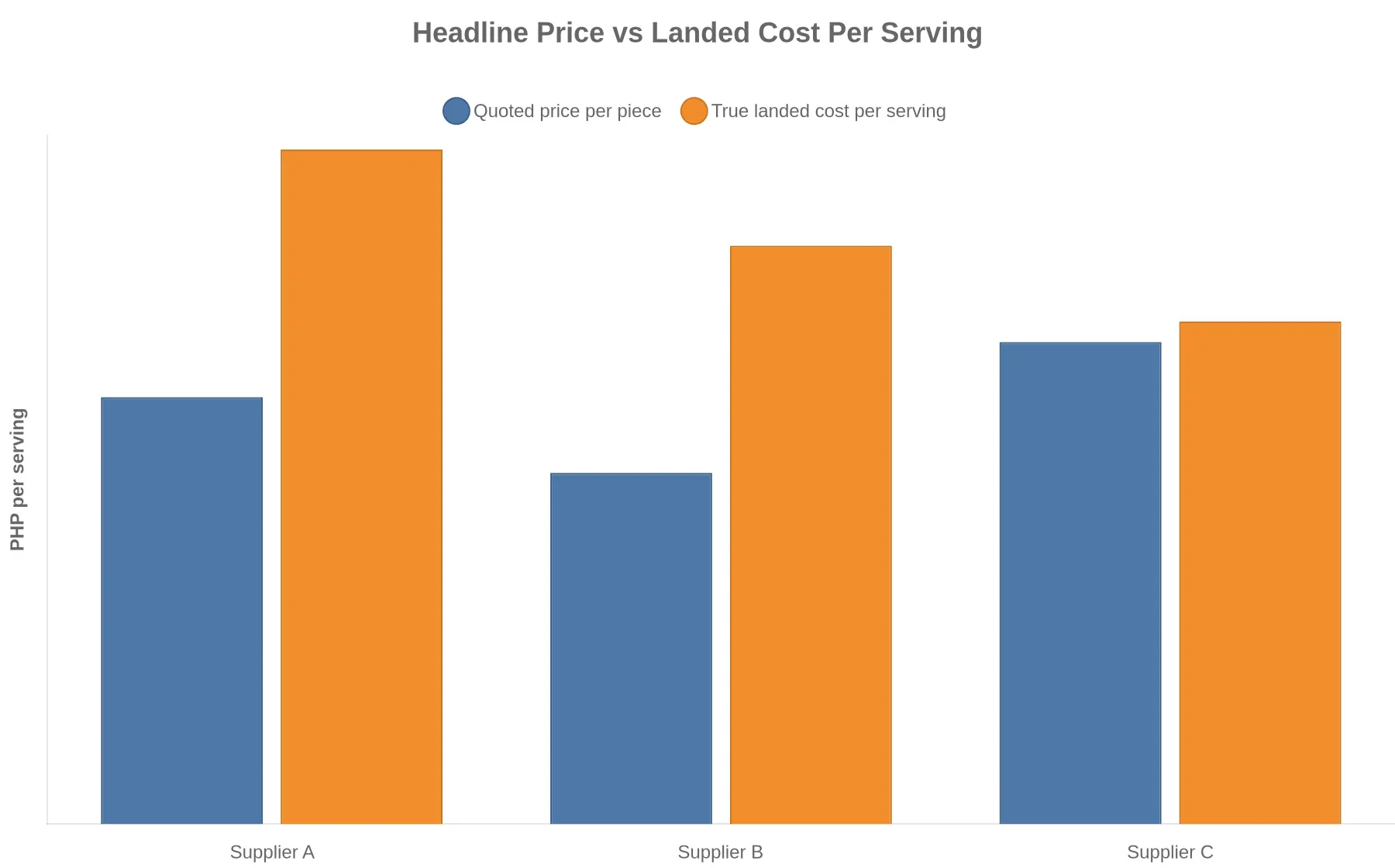
Run the same arithmetic on your own numbers before you sign, and the lowest quote stops being the obvious answer.
A supplier vetting process you can run in two weeks
Choosing a supplier for a high-volume sauce programme is a testing exercise, not a negotiation exercise. The five steps stay the same every time:
- Request matched samples. A body and a lid from the same mould family, in the exact size you will buy, so fit is judged as a system.
- Test with your actual sauce at service temperature. Fill to your real portion weight, seal, tilt to 45 degrees, and hold for 30 minutes. Saucy takeout fails at the rim, not in a catalogue.
- Check consistency across two production batches. Batch A should match Batch B in wall thickness, rim diameter and lid click. Variation between batches is the leading cause of mid-programme leaks.
- Confirm stated thickness and rim tolerance in writing. Numbers on the quotation or specification sheet, with a tolerance range, so a conversation about 2.0 mm versus 2.8 mm becomes a documented claim rather than a memory.
- Verify reorder lead time for your monthly bulk volume, plus the buffer the supplier holds. A great sample means nothing if restock takes three weeks.
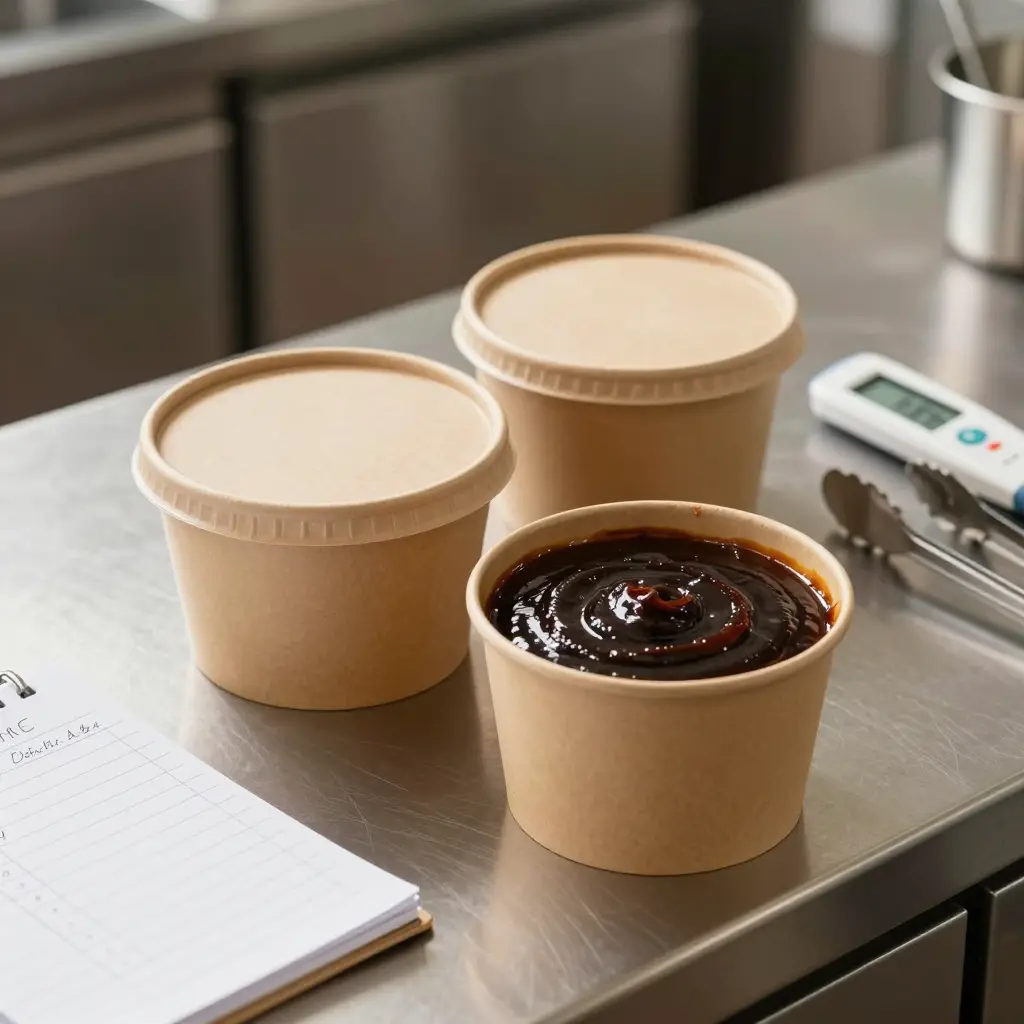
Run each candidate through the same checklist and score them side by side. Suppliers who welcome the testing usually turn out to be the ones worth keeping.
What a reliable manufacturing partner looks like
Price is the easy part to compare and the least useful on its own. A sauce programme needs a line that holds tolerances, a material spec that keeps hot oily sauce where it belongs, and packaging that survives the trip across town. The heavy-duty paper cups, bowls and buckets are made with rim fit as part of the design brief rather than an afterthought, which is the practical difference between the lid you approve and the lid that arrives in month six.
Durability and lower material impact can share a box. Coated kraft paper takeaway boxes give saucy menus the structural support they need, and the board can go into a recycling stream where a mill accepts coated paper, though the coating is what limits that in practice, so check the local stream before printing a recycling claim on the pack. For hot beverages and greasy sides, paper sleeves add grip and a second layer of protection without adding a plastic component.
And when something needs answering, support matters more than a brochure. A supplier who confirms specs in writing, ships on the date promised and picks up the phone during your peak season is worth a few centavos more per piece.
Compare landed cost, test the samples yourself, and the decision usually stops being difficult.
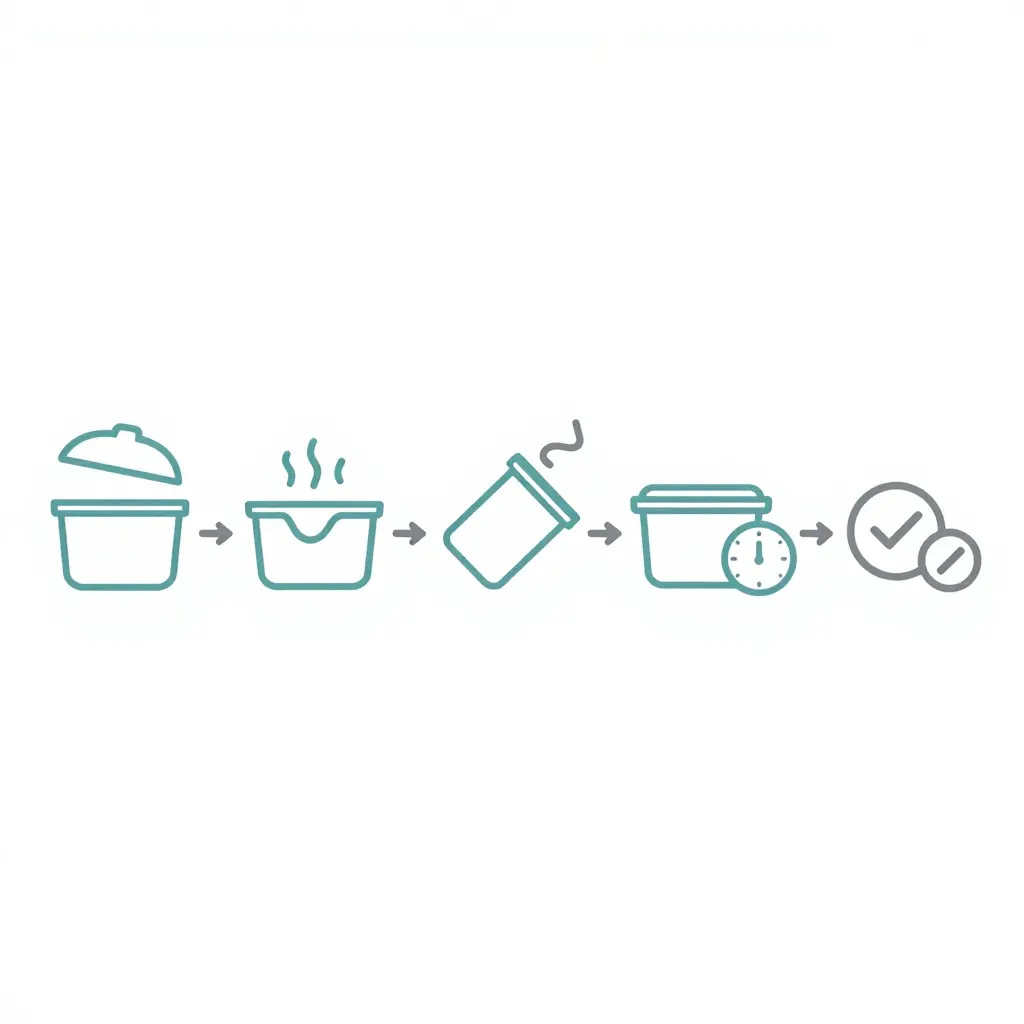
Visual cue only: read it left to right and follow the arrows. The five shapes walk you through matching a container with its own lid, filling with real sauce at service temperature, tilting to stress the rim seal, letting it stand, then signing off or sending the batch back.
When to Pair or Replace Foam: Paper, Sugarcane and Hybrid Systems
Foam still earns its place on hot, saucy, long-haul takeout. It is rarely the whole answer. Many operators in the Philippines now run a hybrid menu: foam where heat retention and leak resistance matter most, lighter eco-friendly packaging where presentation, texture or brand feel carry more weight. The trick is matching each material to the job instead of swapping everything at once.
Kraft and paper boxes for lower-moisture items
Dry-leaning food is where paper wins. Sandwiches, pastries, fried chicken with a liner, garlic rice meals and bakery items all travel well in kraft or paper boxes. They breathe, print cleanly and read as more premium than foam. The trade-off is real: paper softens under steam and sheds heat faster, so broth-heavy or very saucy dishes stay in foam or a lined container.
Sugarcane food containers and clamshells for dine-in and catering
Sugarcane reads as tableware rather than takeout: rigid, cut-resistant, microwave-friendly, and better at holding heat than thin paper. That makes sugarcane food containers a natural fit for dine-in service, buffets, catering spreads and events where guests photograph the plate. Expect a higher cost per piece and more weight in the delivery bag, usually a fair exchange for the presentation.
Paper bowls and buckets for high-volume sauce service
When the menu leans on noodles, rice bowls, soup-coated viands, gravy fries or sharing portions, paper bowls and paper buckets give you volume without the foam squeak. Coated bowls handle more sauce than most operators expect, and buckets keep fried items crisp while stacking neatly on a rider’s rack. Check the coating and the seam before committing to a full run.
The accompanying kit: straws, napkins and bags
Small items decide whether an order feels eco-friendly. Paper straws belong on cold drinks only, since they soften in hot liquid. Add napkins sized to the meal, and pack everything in a sturdy paper bag rated for the load. These are low-cost swaps with high visibility, which is why customers notice them first.
Trade-offs at a glance
| Option | Heat retention | Rigidity | Cost per piece | Pairs with foam when |
|---|---|---|---|---|
| Foam (baseline) | High | Moderate | Low | Insulated, leak-prone or delivery-heavy items |
| Kraft / paper box | Low to moderate | Moderate | Low to moderate | Low-moisture items such as sandwiches and pastries |
| Sugarcane container / clamshell | Moderate to high | High | Moderate to high | Dine-in, catering and cut-resistant service |
| Paper bowl / bucket | Moderate | Moderate | Low to moderate | Noodles, rice bowls and sharing portions |
| Paper straw, napkin, bag | Not applicable | Low to moderate | Low | Always, as part of the accompanying kit |
Specify lid fit separately for every material
Hybrid systems fail here. Paper, sugarcane and foam are pressed to different tolerances, so a lid approved on one will not automatically snap onto another, even when the stated diameter matches. Request lid samples per material, then test the actual snap, stack height, rim gap and leakage with real sauce at real service temperature. Confirm lid dimensions in writing on the purchase order, and re-check whenever the supplier or the mould changes.
A practical hybrid checklist
- Map your menu by moisture and heat, then assign foam, paper or sugarcane to each line.
- Fit-check three to five pieces per material, then run the full 30 to 50 unit test before any bulk order.
- Specify lid fit, wall thickness and coating separately for each SKU.
- Standardise napkins, straws and bags across the menu to keep stock simple.
- Plan storage: paper and sugarcane need dry, flat, stacked space to hold their shape.
Run the hybrid route deliberately and foam does the work physics demands while lighter packaging does the brand work. For shops ordering Styrofoam food containers wholesale Philippines volumes, pairing materials by function rather than replacing everything at once usually keeps both the menu and the margins intact.
Frequently Asked Questions
Does a thicker wall guarantee a leak-proof lid fit?
No. Thickness affects rigidity, heat retention and how well a body holds its shape under load. Lid fit depends on rim geometry, dimensional tolerance and the lid material. A heavier wall that pushes the rim diameter outside spec can seat a lid worse than a lighter, more consistent one. Buyers comparing Styrofoam food containers wholesale Philippines suppliers should ask for rim diameter and lid tolerance data instead of judging by thickness, then confirm performance with a sauce test before scaling up.
Can I use standard lids with heavy-duty containers?
Not reliably. Heavy-duty bodies usually carry wider rims and deeper lid skirts, so a standard lid sits loose and lifts when sauce weight or steam pushes against it. Always match the lid to the exact container SKU. If interchangeable parts matter across a menu, review compatible paper lid and container combinations so the packing line keeps one consistent fit.
What wall thickness should a bubble tea or beverage chain specify for cups and food containers in the same order?
Treat them as two specs, even inside one purchase order. Cold beverage cups carry liquid weight and usually perform well around 0.8-1.2 mm. Hot cups and saucy food containers need standard grade or heavier, which on Table 1 means 2.0 mm and up. A 1.5-2.2 mm body on a saucy menu is light foam doing a standard-grade job, and it bulges and distorts under sustained heat. Ask your supplier to confirm that each gauge is paired with a tested lid fit for that specific SKU, and never let a blended unit price override the rim and lid specification.
How many samples should a procurement team test before committing to a bulk order in the Philippines?
Plan for at least two sampling rounds, with 30 to 50 units per SKU rather than three or four. Fill them with your heaviest sauce, stack them exactly as they will stack in delivery, and check lid fit immediately after filling, after 24 hours, and again after handoff. Include a second production batch if you can, since thickness variance between runs is what usually breaks a fit that passed on the first sample.
Is eco-friendly packaging compatible with saucy takeout?
Yes, when the construction matches the food. Coated paper and bagasse containers with a water-resistant liner, adequate wall thickness and a tested lid hold gravies, curries and milk-based drinks through a normal service window. None of them are liquid-proof in absolute terms, so very oily or high-acid sauces still call for a lined or heavier-wall option. Specify thickness and lid fit in writing, then verify on samples rather than trusting the word “eco-friendly.”
The Practical Takeaway for Wholesale Buyers
Two specifications decide whether a saucy takeout order arrives intact: wall thickness and lid fit. Wall thickness carries the structural and thermal load, keeping a hot, heavy tray from flexing, sagging or leaking heat into the bag before the rider reaches the customer. Lid fit decides whether the seal still holds once steam builds and sauce starts moving inside the container. A thick wall with a loose lid fails, and so does a tight lid on a flimsy body.
That is why styrofoam food containers wholesale decisions hold up better when the two are written into the purchase order as one matched system, rather than sourced as separate line items from different suppliers. The evaluation sequence stays short:
- Define the sauce load first, including portion size, viscosity and serving temperature.
- Test matched samples as a complete container-and-lid set, not as individual parts.
- Compare landed cost per serving, factoring in freight, duties and breakage rates.
To compare options side by side, the paper lids and packaging ranges sit alongside the multi-compartment sugarcane food containers from the same supplier.