

PFAS-free takeout boxes: barrier performance and cost trade-offs
PFAS-free takeout boxes are food service containers made without per- and polyfluoroalkyl substances, the synthetic chemicals long used to keep grease, oil, and moisture from soaking through paper and molded fiber. Manufacturers have replaced those fluorinated coatings with water-based acrylics, plant waxes, clay dispersions, and polyethylene or compostable film liners. That change is part of a broader move toward eco-friendly takeaway packaging. Regulators in the European Union, several U.S. states, and parts of Asia have restricted or banned PFAS in food-contact materials, while large chains and institutional buyers have set their own phase-out deadlines. For operators, this is a compliance and supply-chain problem more than a matter of preference.
The trade-off at the center of it is barrier performance versus cost. Alternatives that match PFAS on grease and moisture resistance usually cost more per unit, require formulation changes, or handle a narrower range of foods. Curries, fried foods, and rich sauces are the hardest to contain without fluorinated chemistry, so operators typically choose between faster wicking and leaks, or paying a premium for a coating that holds up.
What Are PFAS and Why Is the Industry Phasing Them Out?
PFAS — per- and polyfluoroalkyl substances — are a family of thousands of synthetic chemicals built on carbon-fluorine bonds, among the strongest in chemistry. That structure makes them resistant to heat, oil, and water, which is why they became so useful in food service packaging. The same durability makes them persist in the environment, which earned them the label “forever chemicals.”
For decades, takeout boxes, clamshells, and sandwich wrappers relied on PFAS coatings for grease resistance and a dependable moisture barrier. One treatment kept fried food crisp, stopped sauces from soaking into paperboard, and let a single lightweight container cover an entire menu. The performance was excellent. The costs came due later.
Regulation moved first. The U.S. FDA has retired several PFAS food-contact approvals, and California, Maine, New York, and Minnesota have banned the chemicals in packaging. The EU is advancing broad PFAS restrictions, so compliance risk is no longer a regional issue.
Retail and brand policy pushed the change faster. Major chains and grocery brands have publicly committed to PFAS-free packaging, and many now require suppliers to prove it through third-party testing. A single announcement from a large buyer can reset an entire supply chain.
Buyer expectations reinforce those policies. Diners look for a “PFAS-free” claim on the box, and institutional buyers write grease resistance and moisture barrier specifications into procurement contracts. A supplier who cannot document PFAS-free status increasingly loses the bid.
Liability is the final driver. PFAS litigation and cleanup costs have already reached into the billions, and packaging manufacturers, distributors, and food brands can all be named in claims. Avoiding PFAS is risk management, not just marketing. Operators weighing cleaner options can start by understanding eco-friendly takeaway food boxes before comparing barrier performance and cost.
PFAS-Based versus PFAS-Free Barrier Systems
The table below compares the two systems on the factors food service operators weigh most: compliance, performance, and cost. For a starting point, see these eco-friendly takeaway food boxes built around the newer barrier technologies.
| Characteristic | PFAS-based barrier | PFAS-free barrier |
|---|---|---|
| Barrier mechanism | Durable fluorinated surface repels both oil and water | Plant-based coatings, films, or physical liners |
| Grease resistance | Excellent, even for heavy, hot, greasy foods | Good to very good with quality coatings |
| Moisture resistance | Strong long-term water and vapor blocking | Adequate for short service; softens with wet foods |
| Heat tolerance | High; stable during hot-holding and reheating | Moderate; best within defined temperature ranges |
| Recyclability and compostability | Generally not recyclable; disrupts fiber composting streams | Widely compostable and recycle-friendly in fiber systems |
| Regulatory status | Restricted or banned in many states and countries | Favored, compliant, and expanding under new rules |
| Typical cost index | Lower upfront unit cost, higher long-term liability | Higher upfront cost, falling as scale grows |
| Supply availability | Mature global supply but shrinking as rules tighten | Growing supply; lead times and quality still vary |
PFAS-free barriers now win on compliance and disposal; PFAS-based options still lead on price and heavy-duty performance.
How to Measure Barrier Performance in PFAS-Free Takeout Boxes
Barrier performance is how well a box keeps grease, water, steam, and heat from moving through its walls. When manufacturers remove PFAS (per- and polyfluoroalkyl substances, the durable chemical coatings once used almost everywhere), they replace that invisible shield with plant-based coatings and denser fiber blends. That turns “leak-proof” into a claim you verify rather than one you trust.
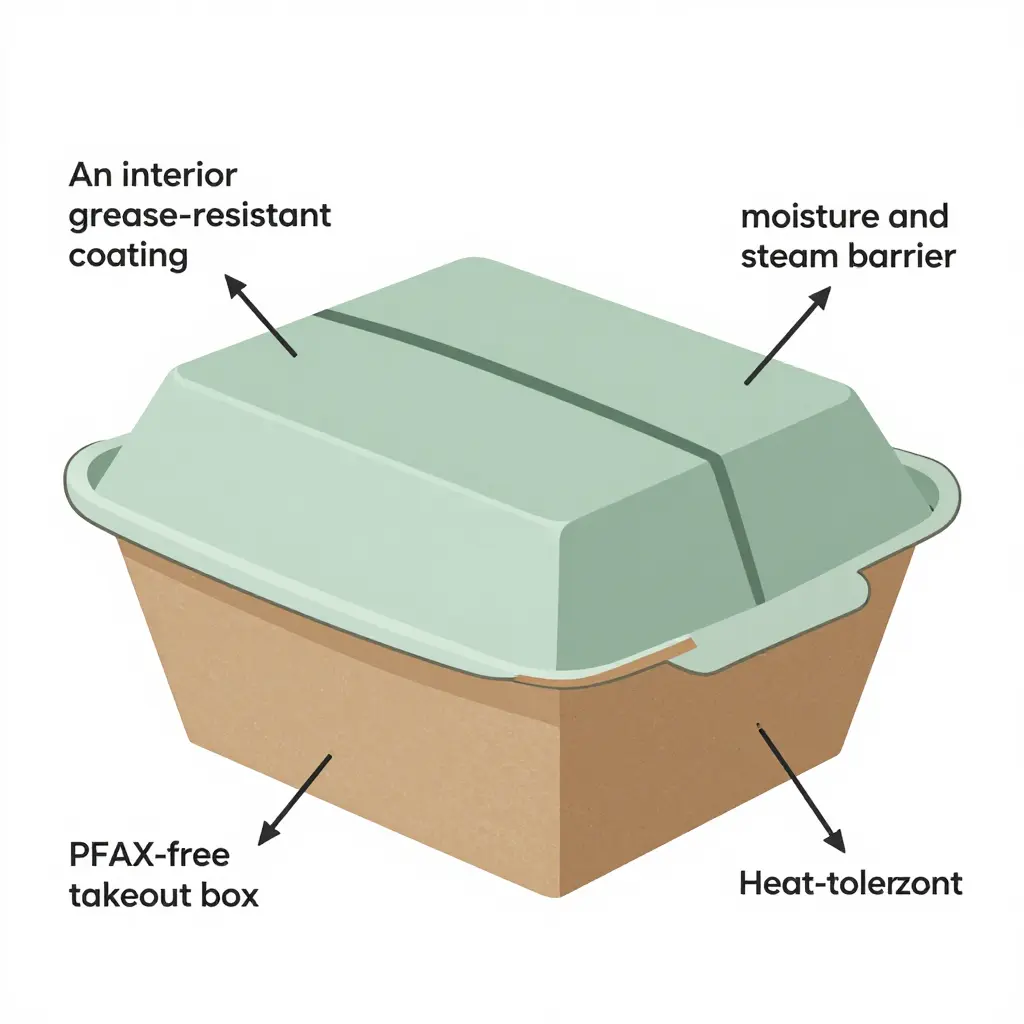
Five metrics turn supplier promises into numbers you can compare.
Grease Resistance: The Kit Test Rating
The Kit test drips numbered liquids (1 to 12) onto the surface and records the strongest one that doesn’t soak in within 15 seconds. A rating of 1 means almost no resistance; 10-12 shrugs off heavy fried foods. For grease-resistant takeout boxes used with sandwiches or bakery items, target Kit 4-6. For fried chicken or oily curries, insist on Kit 8 or higher.
Water and Moisture Vapor Transmission (WVTR)
WVTR, or moisture vapor transmission rate, measures how many grams of water vapor cross one square meter of board in a day (g/m2/day). Lower numbers keep food crisp and stop lids from fogging. Soups, noodles, and steamed dumplings stress this barrier hardest.
Oil and Sauce Penetration
Beyond the Kit test, a “creep test” shows how far oil wicks up a sidewall or seam over 30-60 minutes. Saucy, acidic dishes like tomato curry or butter chicken push this limit fastest. Ask whether the box keeps its seam strength after a two-hour sauce soak.
Heat Tolerance
This is the highest temperature a box holds without warping, typically 200-220 F (93-104 C) for coated paperboard. Hot soups and food straight out of the fryer stress it most. Always ask for a stated hold time, not just a peak number.
Structural Integrity Under Stacking and Transport
Edge-crush and compression tests measure the vertical load a box survives before collapsing. Heavy combo meals and delivery stacking stress this most. Ask for a stack-height figure that holds through a 30-minute simulated transit.
| Metric | What it measures | Ask your supplier | Foods that stress it most |
|---|---|---|---|
| Kit test rating | Grease resistance (1-12) | “What Kit rating, tested by an outside lab?” | Fried chicken, burgers |
| WVTR | Water vapor passing through | “WVTR in g/m2/day?” | Soup, noodles, dumplings |
| Creep test | Oil wicking up seams | “30-60 min creep result?” | Curries, saucy rice bowls |
| Heat tolerance | Warp-free temperature | “Max temp and hold time?” | Hot soups, fried food |
| Edge crush | Stacking strength | “Stack height for 30 min?” | Combo meals, delivery |
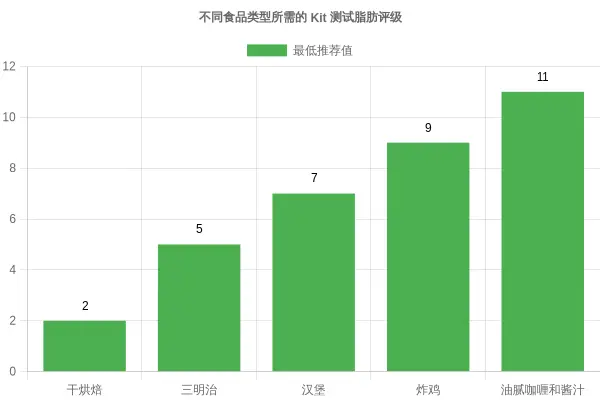
Together, those five numbers turn vague wording into something you can line up side by side. As you compare takeaway food box suppliers, request third-party test reports and match each metric to your actual menu. That is how PFAS-free packaging earns its keep instead of just sounding green.
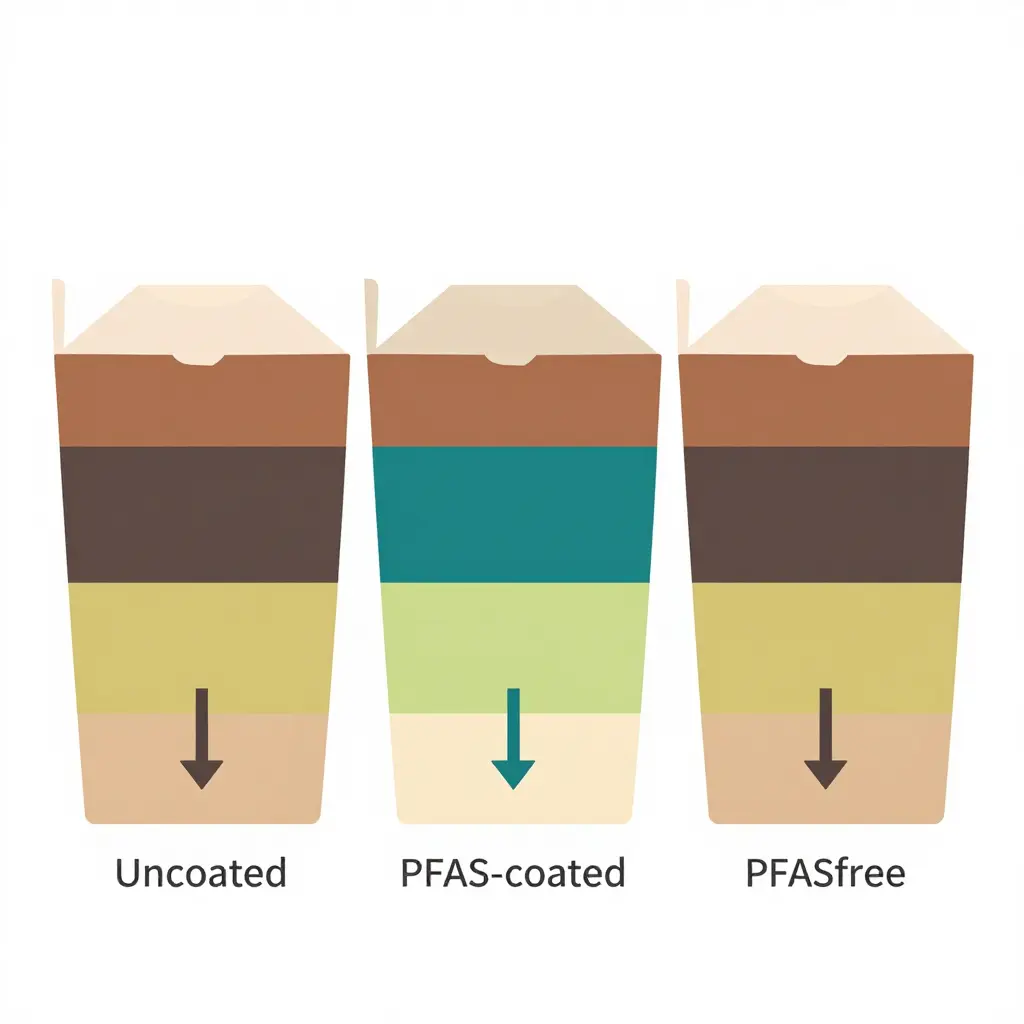
“A side-by-side cross-section shows how a bare paperboard wall lets grease and moisture wick through, a PFAS coating forms a hard chemical barrier, and a PFAS-free coating still resists penetration while allowing controlled breathability.”
PFAS-Free Barrier Technologies Explained
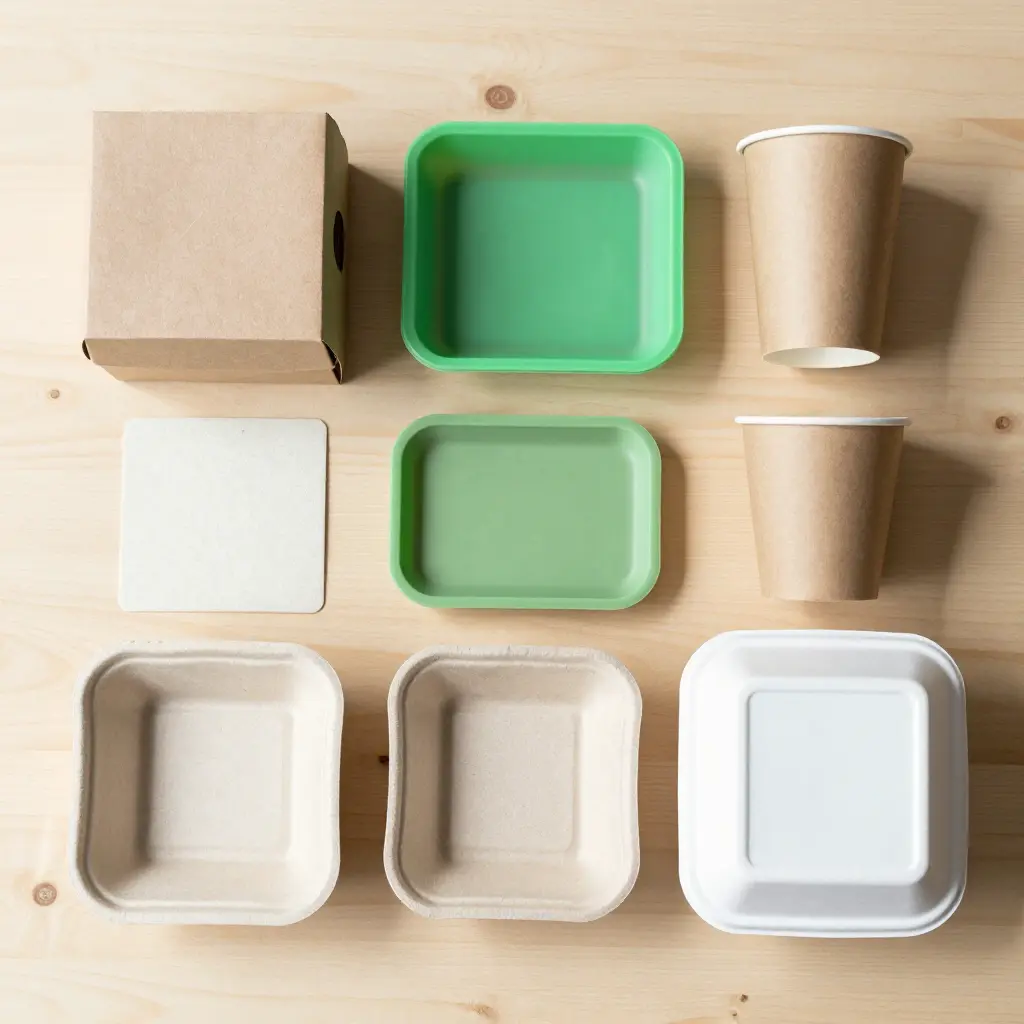
Dropping PFAS means rethinking how a package keeps grease, moisture, and heat from bleeding through. These are the main PFAS-free barrier options available to food service businesses today, with a note on how each performs and where it fits.
- Water-based acrylic coatings. A smooth, flexible film that resists light grease while running on standard coating equipment. Best for dry and lightly oily items such as pastries, sandwiches, and bakery boxes.
- Silicone-based coatings. A slick, heat-tolerant surface that repels both water and oil without fluorinated chemistry. A strong pick for hot, greasy foods such as fried chicken or pizza, where temperature and oil resistance matter most.
- Biowax and plant-wax coatings. Wax barriers, often made from soy or carnauba, deliver excellent moisture resistance and a natural feel. They suit cold and room-temperature items: salads, cold drinks, chilled desserts.
- Starch and cellulose-based barriers. Bio-based films with reliable grease resistance that compost fully alongside food scraps. A good fit for takeout boxes carrying moderately greasy meals, and a natural pairing with compostable packaging goals.
- Clay and mineral-based dispersion coatings. Mineral particles held in a binder resist oil and heat while keeping the board recyclable. Best for ovenable or heat-held applications and paperboard trays.
- Laminated or film-based liners. A thin plastic or bio-film layer delivers the highest overall barrier performance of the group. Suited to demanding, high-grease, high-moisture combinations such as saucy curries or heavy combo meals.
Matching technology to the job simplifies the trade-offs. For high-grease menus, laminated liners and silicone coatings lead on oil holdout, while mineral-coated board is the go-to for high-heat, ovenable service. High-moisture foods lean on wax and film-based liners that block water vapor without going soggy. Blending two approaches, such as a starch base with a silicone topcoat, often gives the best balance for PFAS-free takeout boxes. Businesses comparing eco-friendly takeout packaging should test real menu items, because performance and cost rarely peak on the same option.
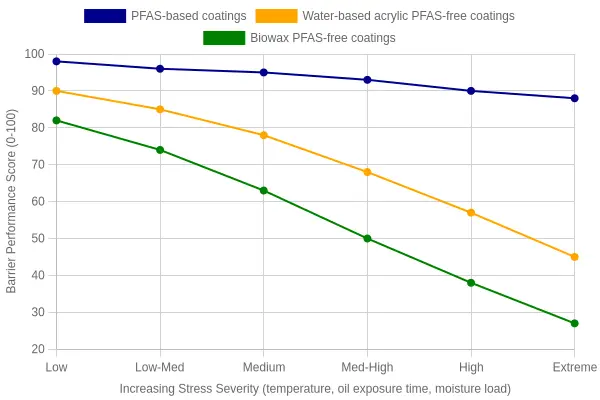
What the chart plots
The chart plots Barrier Performance Score (0-100) on the vertical axis against increasing stress severity — rising temperature, longer oil exposure, and heavier moisture load — on the horizontal axis, from Low to Extreme. Three lines trace the coatings: PFAS-based coatings hold near the top, falling from 98 to 88; water-based acrylic PFAS-free coatings decline moderately, from 90 to 45; and biowax PFAS-free coatings fall fastest, from 82 to 27.
What the trends tell us
PFAS-based coatings stay strong and barely dip as conditions worsen. Water-based acrylics degrade gradually and hold up better than biowax under harsh, greasy, and humid loads. Biowax drops sharply, so it fits lighter, short-duration uses rather than demanding takeout applications. Match the coating to the stress the food actually creates, not to the marketing claims around it.
For businesses weighing sustainable packaging alternatives, our guide to eco-friendly takeaway food boxes compares the barrier options in more detail.
The Cost Trade-Offs of Switching to PFAS-Free Takeout Boxes
Switching away from grease-resistant coatings is rarely a simple price swap. The cost trade-offs behind PFAS-free takeout boxes show up less in the sticker price than in how volume, tooling, storage, and compliance interact. Here is how to model each piece.
Unit cost: the number that starts every model
Because PFAS-free barriers rely on heavier paperboard or water-based coatings, the raw material bill is higher. At small volumes, the food packaging cost per unit typically runs 15-35% above a PFAS-coated equivalent. Premium fibers and reformulated coatings raise material input, and higher order volume is what pulls the per-unit cost back down.
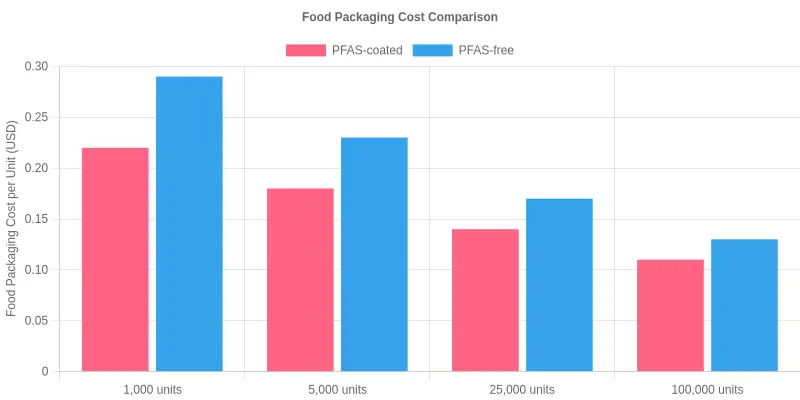
| Cost factor | PFAS-coated | PFAS-free | Net impact |
|---|---|---|---|
| Unit cost (low volume) | Lower | Higher | +15-35% |
| Unit cost (high volume) | Lower | Closer | +5-12% |
| Tooling setup | Established | May need rework | One-time cost |
| Storage life | Longer | Shorter | Carrying cost |
| Compliance risk | Rising | Lower | Risk savings |
Volume and minimum order quantity effects
Suppliers of PFAS-free boxes often set higher MOQs to justify a production run. That locks more cash into a single order even when the unit price improves. Compare your true landed cost after freight and warehousing, not just the invoice line.
Tooling and printing changes
If your logo or branding was printed on coated stock, the new surface may absorb ink differently. You may pay for new plates, a print test, or a small design tweak. Budget a one-time setup charge rather than a recurring one.
Storage and shelf-life considerations
Uncoated and water-based barriers absorb ambient moisture faster, so stack life shortens and rotating stock matters more. Factor in slightly more frequent deliveries and tighter inventory turns.
Waste and defect rates
New board grades behave differently on folding and filling lines. Expect a short learning curve and higher first-run spoilage. Run a pilot batch to measure real scrap before committing to a full rollout.
Indirect savings that offset the premium
This is where the cost trade-offs flip. PFAS-free packaging is easier to recycle and compost, which lowers disposal fees and compliance headaches and gives customers a brand story they reward. Many operators find those gains recover 30-50% of the unit premium.
To see how a compliant format fits a live menu, look at our guide to an eco takeaway food box.
Bottom line: model unit price, MOQ, tooling, storage, and scrap together, then subtract the indirect savings. For most buyers, larger and less frequent orders win.
Mapping the PFAS-Free Barrier Decision
Choosing the right PFAS-free barrier for a takeout box comes down to two forces: how demanding the food is and how much you can afford to spend per unit. The diagram below turns that logic into a decision path you can walk through with your team.
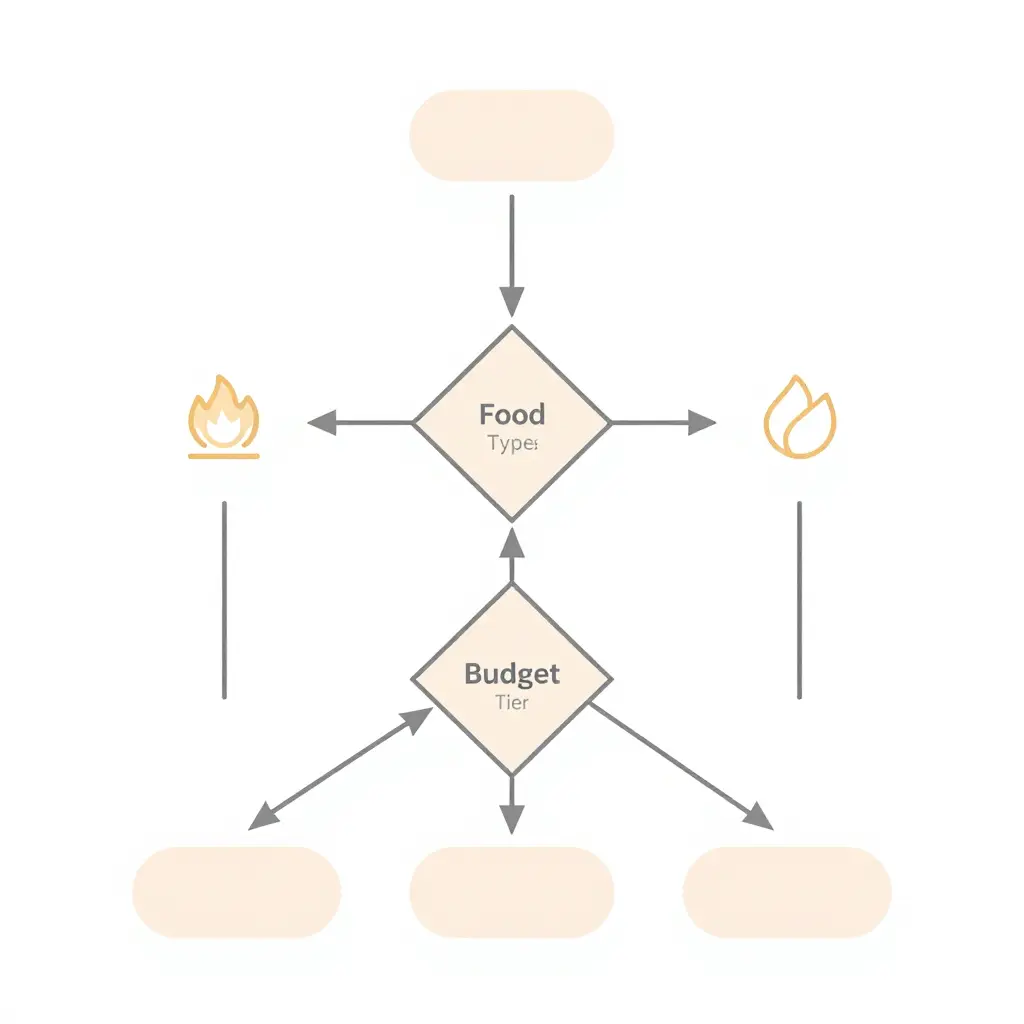
How to read the flow
Start at the top node, then work down through two decision gates:
- First gate: food type. Greasy, hot, and moist dishes each stress a barrier differently. Grease breaks down weak coatings, heat pushes vapor through thin films, and moisture softens uncoated fiber.
- Second gate: budget tier. Once you know the demand level, cost narrows the realistic options. A premium water-based acrylic coating costs more but handles the toughest loads; a lighter dispersion or clay-based layer saves money on gentler menus.
- Terminal nodes: barrier technology. Each path ends at a recommended barrier family, from high-performance aqueous coatings to mechanical grease-barrier liners.
Turning the flow into a buying habit
Use the diagram as a quick triage tool before you request samples. If you already run a range of container formats, standardizing your barrier choices across similar items lets you buy in larger, cheaper volumes. Operators building out a full menu of eco-conscious packaging can review a curated range of eco-friendly takeaway food boxes to see which barrier tiers map onto the dishes they actually serve.
Match the barrier to the stress, then let budget pick the exact grade. Do not pay for premium performance a menu doesn’t need, and do not cut cost on a food type that will soak or stain its way through a cheap coating.
Navigating PFAS-Free Packaging Regulations: What Takeout Boxes Must Prove
Rules on per- and polyfluoroalkyl substances (PFAS) in food packaging are tightening, and the direction is unmistakable. Regulators in the United States and the European Union increasingly treat PFAS-free packaging as the default expectation rather than a premium option. For food service owners, keeping ahead of these regulations is now a baseline business requirement, not a distant compliance chore.
A Patchwork of State Restrictions in the U.S.
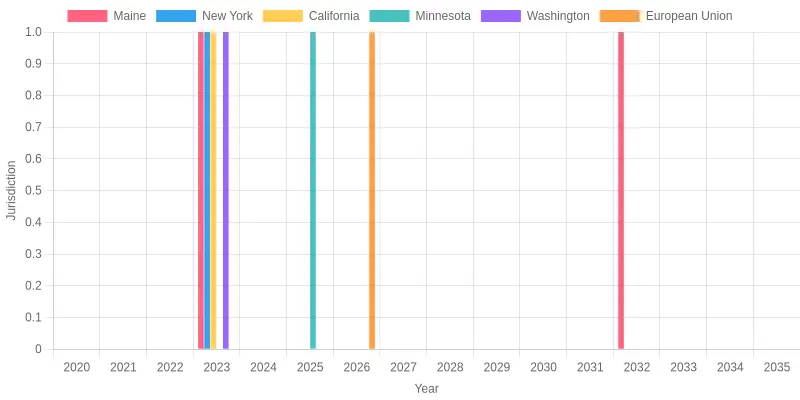
With no single federal ban yet, U.S. states are leading. Maine fired the opening shot with a 2021 law banning intentionally added PFAS in food packaging from 2023, backed by a broader reporting mandate and a near-total sales prohibition by 2032. New York, California, Washington, and Minnesota have followed with their own phase-out dates, and each defines “PFAS-free” slightly differently, often as a threshold rather than a literal zero.
| Jurisdiction | Key Milestone | Effective Date |
|---|---|---|
| Maine | Ban on intentionally added PFAS | 2023 |
| Maine | Full sales prohibition | 2032 |
| New York | Food packaging PFAS ban | 2023 |
| California | PFAS ban in plant-based food packaging | 2023 |
| Washington | PFAS in food packaging | 2023 |
| Minnesota | PFAS-free requirement | 2025 |
| European Union | PFAS limits in food-contact packaging (PPWR 2025/40) | Aug 2026 |
The European Union’s Coordinated Approach
The EU relies on harmonized rules rather than a state-by-state patchwork. Food-contact packaging must meet Framework Regulation (EC) 1935/2004. The Packaging and Packaging Waste Regulation (EU) 2025/40, in force since February 2025 and applying from August 2026, restricts PFAS in food-contact packaging above set thresholds; separately, a broad REACH restriction proposal submitted in 2023 is still working through the EU process. Migration testing and a declaration of compliance are non-negotiable for any box entering the European market.
Manufacturers vs. Food Service Operators
Obligations split along the supply chain. Manufacturers must prove their formulations contain no intentionally added PFAS, maintain technical documentation, and run migration tests. Food service operators must source compliant packaging and keep records showing they exercised due diligence.
Warning: Do not rely on vague or unverifiable supplier claims such as “eco-friendly” or “non-toxic” without written documentation – these terms have no legal definition and could leave you fully liable for non-compliant packaging.
What Business Owners Should Verify
Before committing to a supplier, confirm that you can obtain a written PFAS declaration, migration test summaries, and a certificate of analysis. The regulatory trend favors PFAS-free options, so sourcing sustainable takeout packaging options early protects both your margins and your brand reputation.
Cost by Packaging Material: What the Numbers Actually Show
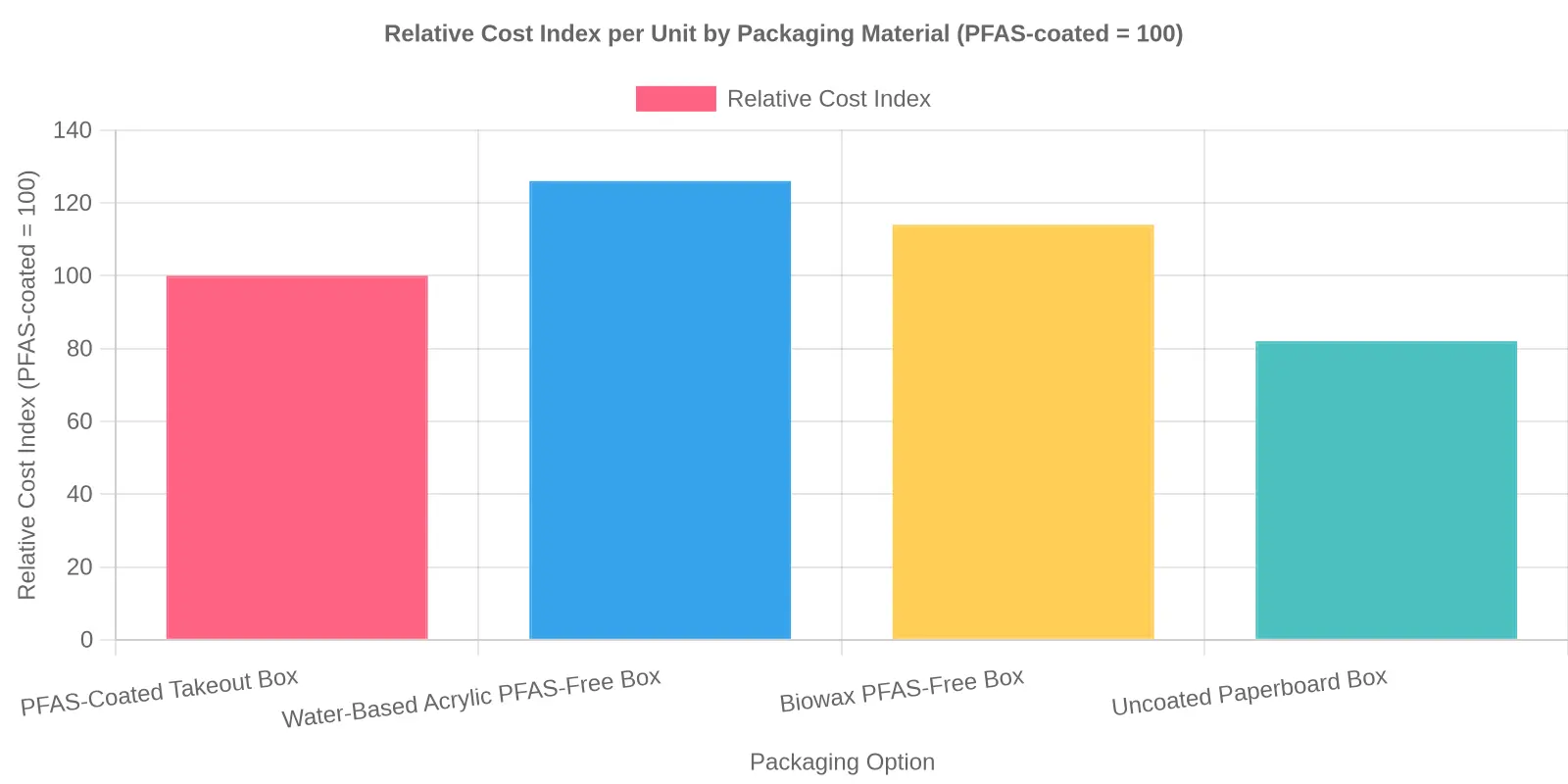
Note: Index based on total unit cost, PFAS-coated baseline = 100. Higher values indicate greater cost.
The practical takeaway: High-volume operations absorb the 14-26% premium of PFAS-free coatings more easily, because fixed switching and tooling costs spread across millions of units. Low-volume kitchens feel the squeeze hardest and often pay closer to the top of the index. For them, uncoated eco-friendly takeaway boxes or a staged transition usually makes better financial sense.
Supplier Selection and Procurement Checklist for PFAS-Free Takeout Boxes
Moving to PFAS-free takeout boxes is a smart call for your brand and your customers, but the payoff depends on choosing the right supplier. Run through this checklist before you commit to a purchase order.
- Request third-party test reports. Ask for lab documentation proving the box is genuinely free of PFAS (per- and polyfluoroalkyl substances), not just a marketing promise. Confirm the testing lab name, the method used, and the report date.
- Confirm grease and moisture ratings. Grease-resistant takeout boxes must stand up to oil, sauces, and steam. Ask for quantified barrier ratings and, ideally, a sample tested against your actual menu items.
- Check certification and documentation. Look for food-contact compliance, plus compostability or recyclability certificates relevant to your market, along with a current Safety Data Sheet.
- Verify compatible printing and tooling. If you need branded packaging, confirm the supplier supports your printing method and that their tooling matches your box dimensions without surprise retooling fees.
- Assess minimum order quantities and lead times. Weigh MOQs and delivery windows against your real volume so you neither overstock nor run dry during peak season.
- Review breakage and warranty terms. Clarify how the supplier handles damaged shipments, replacements, and refunds, and get the policy in writing before ordering.
- Evaluate material sourcing and coating. Understand the fiber source and whether a water-based or dispersion coating is used, since this shapes both performance and end-of-life recycling.
Once you’ve shortlisted two or three suppliers, place a pilot order of a few hundred units and push them through real service conditions: hot, greasy dishes, delivery delays, and stacked storage. Track leaks, sogginess, and customer complaints side by side, then calculate the true cost per use rather than cost per box. That comparison exposes false savings, like a cheaper box that doubles your waste. For a wider view of matching the right format to your menu, see our guide to eco-friendly takeaway food boxes, or compare vetted takeaway box suppliers directly before you scale up.
Frequently Asked Questions About PFAS-Free Takeout Boxes
Can PFAS-free takeout boxes hold greasy or hot foods?
Yes. Contemporary PFAS-free takeout boxes rely on water-based acrylic, silicone, or clay-based coatings instead of fluorochemicals, and these barriers are tested against oil and water for roughly 30 to 60 minutes of contact. In typical service conditions, such as fried chicken, curries, and sauces served up to about 90 degrees C (194 degrees F), molded fiber and coated kraft boxes generally prevent grease soak-through and leaks. Heavier or longer-hold applications, such as catering pans held beyond an hour, may need a thicker coating or a dual-layer construction. Always confirm the manufacturer’s temperature and grease-resistance ratings before specifying a product for high-fat menus.
How much more do PFAS-free takeout boxes cost than PFAS-coated boxes?
Cost depends on material type and order volume. PFAS-free takeout boxes typically run about 15 to 35 percent higher per unit than conventional PFAS-coated versions, because compliant coatings and certified raw materials cost more to produce. In bulk orders that premium often narrows to 5 to 12 percent, and it can drop further once you standardize sizes across a menu. Many operators offset the increase by reducing over-packaging and choosing right-sized containers. Modeling total cost per order is more useful than comparing sticker prices alone, since fewer leaks and fewer customer complaints can lower overall operating expenses.
Are PFAS-free takeout boxes recyclable or compostable?
It depends on the base material and the coating. Plain molded fiber and uncoated kraft boxes are widely recyclable and, when certified, industrially compostable. Boxes with water-based or clay coatings often remain compostable, but heavy plastic-laminated or silicone-coated liners can block recycling and composting streams. Look for third-party certifications such as BPI, TUV OK Compost, or FSC to confirm disposal claims, and check your local hauler’s rules, since acceptance varies by region. Broader guidance on eco-friendly takeout food boxes covers disposal options in more detail.
Do PFAS-free takeout boxes affect shelf life or food quality?
Barrier performance strongly influences how well food holds up during transit and storage. A well-formulated PFAS-free box resists moisture and grease much like legacy coatings, so hot, oily, or saucy dishes keep their texture through the typical 30 to 60 minute delivery window. Highly acidic foods or items held for many hours may see slightly more moisture migration, so a higher-barrier coating is the better choice there. For most takeout and delivery use, PFAS-free options do not measurably shorten shelf life or alter taste.
How can I verify a supplier’s PFAS-free claims?
Start by requesting written test reports from an accredited laboratory. Total organic fluorine (TOF) testing below a set threshold, often 100 ppm, is the current standard for confirming a product is genuinely PFAS-free. Reputable suppliers will also provide third-party certifications, safety data sheets, and country-of-origin documentation. Ask specifically whether the coating, the ink, and any release liner are all PFAS-free, since contamination can come from any component. Finally, request samples and run your own hot-and-greasy test before committing to volume.
How does barrier performance vary between coating technologies?
Different coatings have different strengths. Water-based acrylic coatings offer good grease resistance and printability at lower cost, but they can soften under prolonged heat. Silicone coatings excel at release and tolerate higher temperatures, though they often complicate composting, while clay-based coatings provide strong grease barriers for dry and moderately oily foods but are less effective against liquids. The table below summarizes the trade-offs to help you match a coating to your menu.
| Coating Type | Grease Barrier | Heat Resistance | End-of-Life |
|---|---|---|---|
| Water-based acrylic | Good | Moderate | Often recyclable |
| Silicone | Excellent | High | Limited |
| Clay-based | Good (dry to moderately oily) | Moderate | Compostable |
| PLA or bioplastic film | Good | Moderate to high | Industrially compostable |
Final Takeaways: Weighing Barrier Performance and Cost
Stronger grease, moisture, and heat resistance generally raises the price per unit, while lighter-duty formats keep budgets lean. PFAS-free takeout boxes now cover the vast majority of everyday food service needs, so most operators no longer have to choose between compliance and function.
In practice, that means:
- Modern PFAS-free coatings and liners handle the greasy, saucy, and hot menu items that once seemed to require fluorinated chemistry.
- The best choice still depends on three variables: the food type, the order volume, and the available budget.
- Higher-barrier formats pay off for heavy, oily, or long-hold dishes, while standard formats stay the cost-efficient fit for lighter menus.
- Buying in larger volumes lowers the per-unit premium on premium-barrier options, so the cost gap narrows over time.
Two points stand out. PFAS-free technology is no longer a niche compromise; it is a workable fit for most food service menus. And there is no single “best” box for every operation, only the box that matches your food, volume, and spending limits.
The smartest path forward is practical rather than theoretical. Rather than guess, shortlist vetted suppliers, request samples, and run real-world trials with your actual menu items before committing to large orders.
For teams ready to move, compare takeaway food box suppliers and test a few options side by side, then lock in the format that delivers reliable barrier performance at a price your margins can support.