
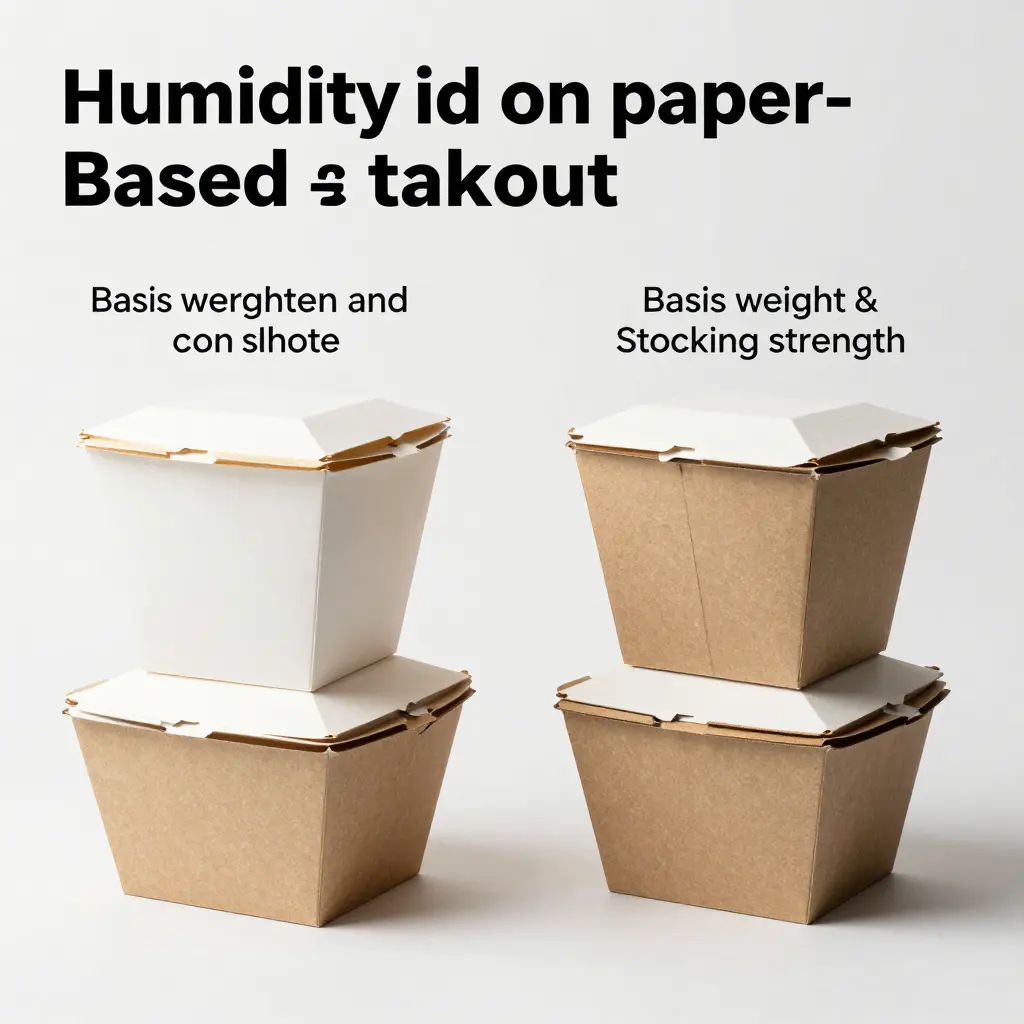
Softening in humid storage is a routine, expensive problem for paper takeout boxes. Moisture migrates into the paperboard, the fibers absorb water, the sheet loses stiffness, and a box that stacked cleanly in a dry warehouse begins to sag, then buckle, then collapse under load. For packaging buyers the useful question is narrower: which material property decides how much structural performance a box loses when the air turns damp.
Two specifications drive most purchasing decisions. Basis weight is the mass of paper per unit area; stacking strength is the load a box can bear before it deforms. They are related, but moisture does not treat them the same way. Heavier board carries more fiber and is stronger when dry, yet moisture uptake can reduce rigidity faster than the extra mass compensates for. Anyone sourcing paper-based takeaway food boxes learns quickly that a bigger number on the spec sheet does not guarantee a stable pallet in a damp environment.
What follows is a practical comparison of the two specifications under moisture exposure: where each one holds up, where it fails, and how to balance them when humidity is a permanent condition rather than an occasional risk.
Key Definitions: Basis Weight and Stacking Strength
Two numbers do most of the work in that comparison.
Basis weight is the mass of paperboard per unit of area, expressed in grams per square meter (gsm). It is measured by cutting a precisely sized sample, conditioning it at a controlled temperature and humidity, and weighing it on a calibrated balance before converting the reading to gsm. A higher basis weight generally means a thicker, denser sheet with more fiber in the same area.
Stacking strength is the top-to-bottom compressive load a box can bear before it buckles or crushes. It is measured with a compression tester following standards such as ASTM D642 or TAPPI T804, which press a filled box between two platens until it fails and record the peak force in newtons or pounds.
| Metric | What it measures | Unit | Typical test |
|---|---|---|---|
| Basis weight | Mass of board per unit area | gsm | Sample cut and weighed |
| Stacking strength | Top-to-bottom load before failure | N or lb | Compression test |
The two numbers answer different questions. A high-gsm box can still collapse in a humid walk-in cooler, because moisture weakens the fiber-to-fiber bonds that give the board its rigidity. Basis weight tells you how much material you have. Stacking strength tells you how much load it can hold once conditions turn damp.
That is why packaging specs should quote both figures, and why field testing in realistic humidity matters as much as the lab result. Operators weighing durability against cost can compare formats and materials in detail when reviewing practical guidance on eco-friendly takeout boxes.
Basis Weight vs Stacking Strength at Varying Humidity Levels
| Basis Weight (gsm) | Relative Humidity (%) | Moisture Content (%) | Stacking Strength Retention (%) | Observed Effect |
|---|---|---|---|---|
| 250 | 30 | 5.8 | 98 | Minimal softening; box edges stay crisp and load-bearing |
| 300 | 45 | 8.2 | 92 | Slight flex under load; stack height remains stable |
| 350 | 60 | 11.5 | 84 | Noticeable sidewall sag; reduce stack height by one layer |
| 300 | 75 | 15.0 | 71 | Marked buckling; middle layers compress under top load |
| 250 | 85 | 18.4 | 55 | Severe softening; boxes collapse under normal top load |
| 350 | 90 | 21.0 | 68 | High moisture absorption; edges lose rigidity despite heavier board |
Stacking strength retention drops sharply as humidity and moisture content climb, and heavier basis weight only partially offsets the softening.
The Role of Basis Weight in Humid Conditions
Basis weight is the first number most packaging buyers check, and reasonably so. Expressed in grams per square meter, it tells you how much fiber mass sits in a given area of board. Raise that number and you generally raise both initial stiffness and fiber density: more fibers packed together resist bending and buckling. A heavier board feels rigid the moment you pick it up.
What it does not buy is moisture resistance. Stiffness is a dry-state measurement. Put boxes in a damp walk-in, a humid warehouse, or a closed delivery van and water vapor migrates into the fiber matrix, loosening the hydrogen bonds that hold fibers together. Once those bonds weaken, the box softens regardless of how many grams per square meter it started with. A 400 gsm sheet in an uncoated box can soften faster than a lighter, well-protected one.
Basis weight works best as one part of a system. Three things matter alongside it:
- Caliper (thickness): Two boards can share the same basis weight and still differ in caliper. A thicker sheet with lower density traps more air and often holds its structure longer in humid air.
- Fiber type: Long virgin fibers and well-refined recycled fibers behave differently under moisture. If you source recycled kraft paper packaging, expect solid performance, but confirm how the fiber blend responds as humidity climbs.
- Coatings: A polyethylene, PLA, or water-based barrier layer physically blocks vapor and is often the single most effective defense against softening.
Spec basis weight for the stiffness you need at packing time, then use caliper, fiber choice, and coatings to protect that stiffness once humidity arrives.
How Moisture Sneaks Into the Fiber Wall
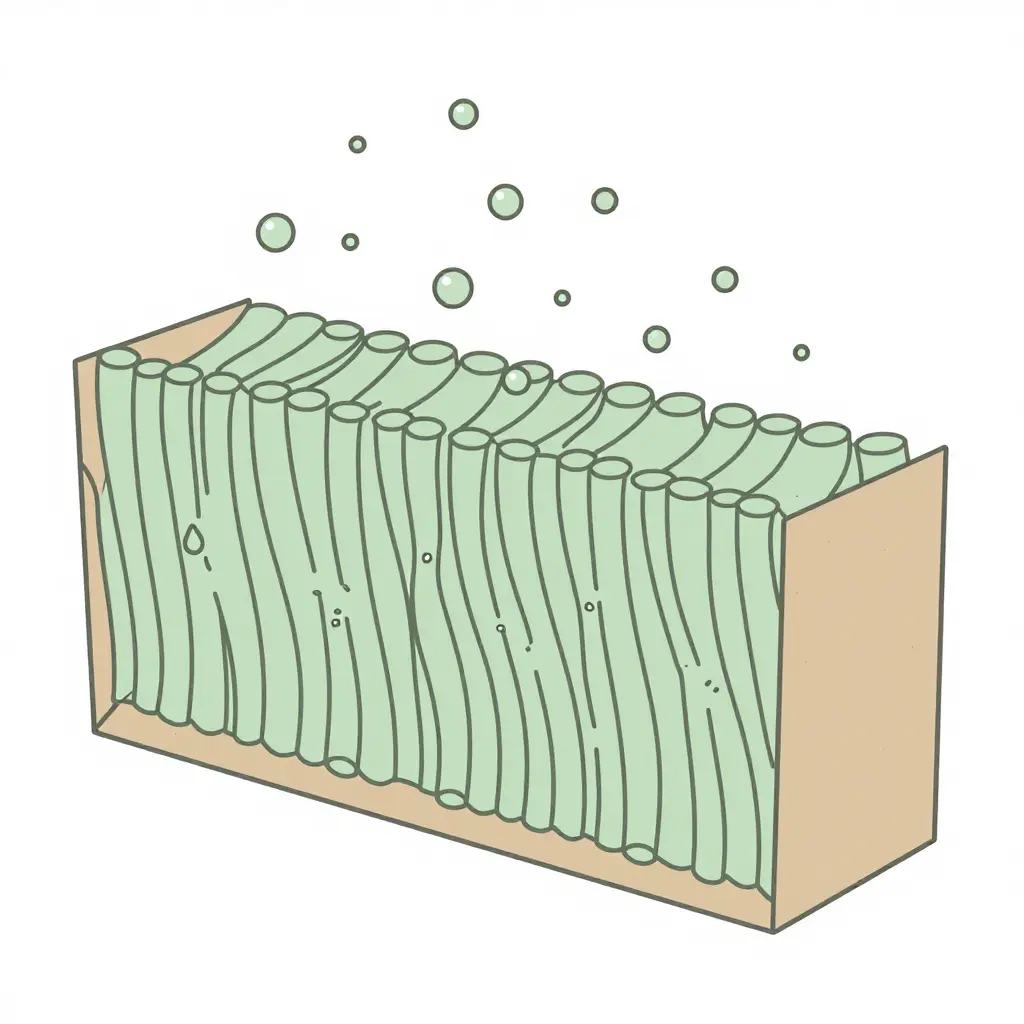
The mechanism is unremarkable, which is why it goes unnoticed. Water vapor in the surrounding air migrates into the cellulose fiber network of the box wall, passes between the fibers, and settles at the bond points that hold the structure together. As those hydrogen bonds take on moisture, they relax. The fibers no longer grip each other as tightly, and a wall that felt crisp on the pallet goes soft under load.
That is what is happening when a paper takeout box caves in on a warehouse shelf: not one dramatic failure, but countless bonds loosening at once. If you are sourcing eco-friendly takeaway boxes, the behavior of the fiber wall is worth understanding, because the same moisture that softens the sheet also reduces the weight it can safely carry when stacked.
Factors That Accelerate Softening in Storage
Molded pulp and kraft takeout boxes do not fail on their own schedule. They soften when the environment pushes moisture into their fibers faster than the material can shed it. These conditions do most of the damage.
- Ambient relative humidity. As airborne moisture climbs, fibers absorb water vapor and swell, weakening the hydrogen bonds that hold the board stiff. In genuine humid storage above roughly 65% RH, a box can shed a meaningful share of its stacking strength within days.
- Temperature. Warm air carries more moisture and speeds diffusion into the paper, so a hot, muggy warehouse softens packaging far faster than a cool, dry one. Sharp temperature swings are just as damaging, because each condensing cycle deposits fresh liquid water on the surface.
- Storage duration. Softening is cumulative. The longer boxes sit in inventory, the more time moisture has to migrate inward, and the slow creep under constant load gradually flattens walls that looked crisp on day one.
- Ventilation (or the lack of it). Poor airflow traps damp air against the pallet, holding relative humidity high exactly where it does the most damage. Open, well-spaced stacking and gentle air movement let paper packaging moisture equalize and escape instead of soaking in.
- Packaging coatings. Water-based barrier and grease-resistant coatings slow vapor transmission, but a thin or uneven film leaves pinholes that funnel moisture straight into the pulp. Certain grades of recycled kraft paper packaging soak up moisture more eagerly than virgin board.
- Stacking load. Every box in a column carries the weight stacked above it. Pair that sustained compression with softened fibers and you get buckling at the corners, where the load concentrates and structural failure begins.
- Cold-chain transitions. Moving pallets from a chilled room into warm air triggers condensation that beads directly on the board. Repeated warm-ups work like a slow drip feed, keeping inner plies damp even when the surrounding room reads dry.
Stacking Strength Retention vs Relative Humidity
Stacking strength is not a fixed number. It falls as ambient moisture rises. The line chart below tracks how much of its original top-load capacity a takeout box retains as storage humidity climbs from a dry 30% to a muggy 90%, comparing two common board weights: 250 gsm and 350 gsm.
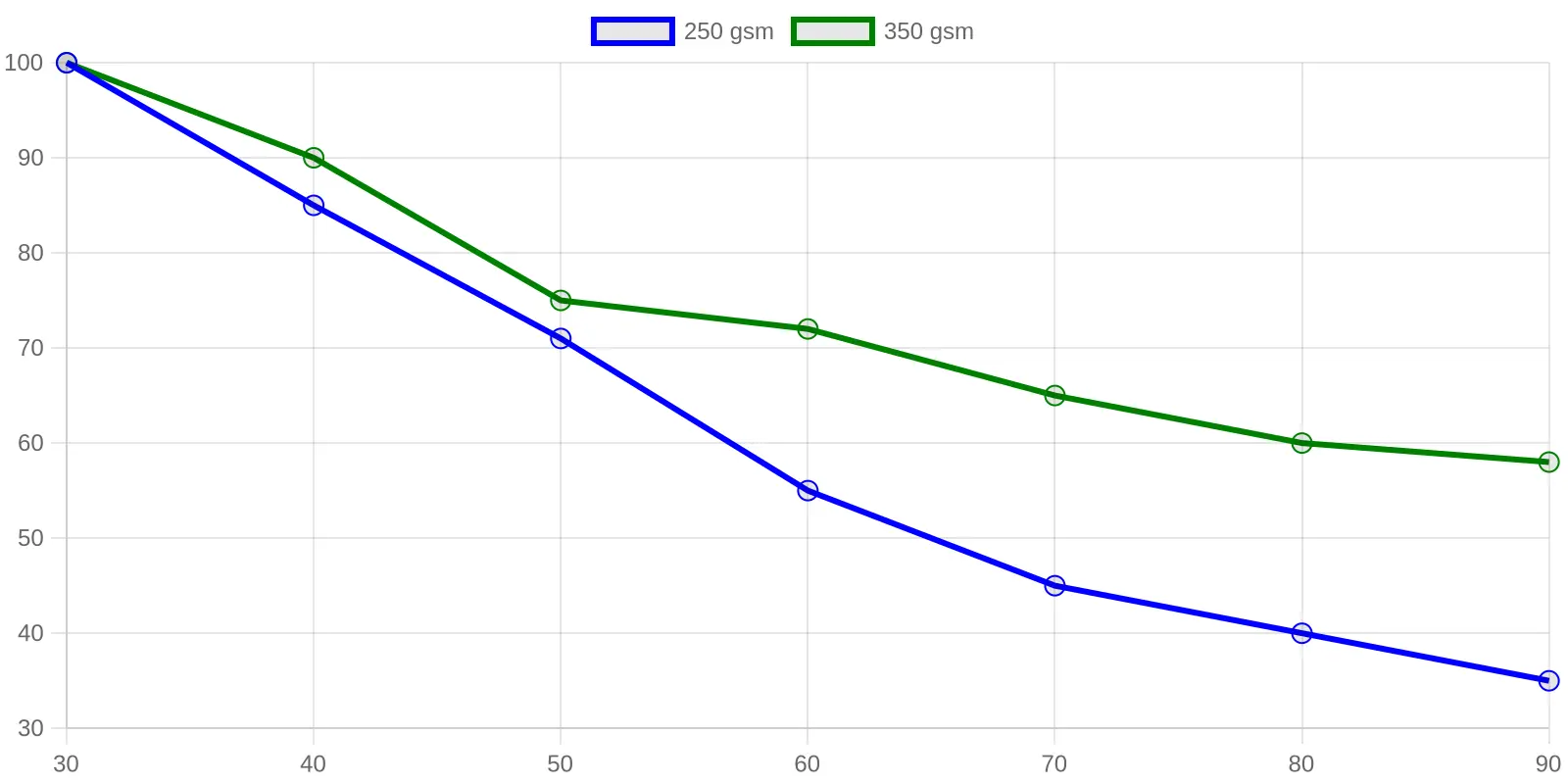
Both 250 gsm and 350 gsm boxes lose stacking strength as relative humidity rises, but the heavier 350 gsm board retains its load-bearing capacity far better – holding roughly 58% of its original strength at 90% RH versus just 35% for 250 gsm.
What the Curves Tell You
- The gap widens with humidity. At a comfortable 30% RH both weights start at 100%, but by 60% RH the difference is already large: 250 gsm has dropped to about 55% while 350 gsm still holds near 72%.
- The knee of the curve matters most. Watch the 250 gsm line between 40% and 60% RH. That steep drop is where warehouses, food trucks, and humid summer kitchens lose their stacking margin.
- Heavier board buys you headroom. Because the 350 gsm line declines more gradually, it keeps a safer buffer for tall pallets and long trailer rides.
If you are sourcing takeout packaging for humid climates or long-haul distribution, choosing a heavier basis weight – or pairing it with moisture-barrier handling – is one of the simplest ways to protect your stacks. For more on matching box formats to real-world logistics, see our guide to reliable takeaway food box suppliers.
How Stacking Strength Changes Under Load and Moisture
When you stack takeout boxes in a warehouse or on a pallet, each carton becomes a structural column. The bottom layer carries the weight of everything above it, and that downward force is measured as the compression strength of the box. If the bottom carton buckles, the stack collapses – a failure that usually shows up not on the production line but weeks later in a distribution center.
Compression Testing and Edge Crush Behavior
Packaging engineers quantify this with two tests. A box compression test loads a complete, filled carton between two platens until it deforms, giving a real-world failure threshold; ASTM D642 and TAPPI T804 describe the procedure. An edge crush test (ECT) isolates the board itself, pressing a small sample edgewise to rank the combined board’s raw strength. ECT applies to corrugated board, not to solid paperboard or molded pulp, so it is only relevant when the takeout box is made from corrugated stock. Where that is the case, the vertical flutes act like tiny I-beams: if they stay rigid and the liners resist crushing, the box holds; if the edges splay or the liner crushes, load capacity drops fast.
Why Moisture Erodes Effective Strength
Fibers in paperboard bond through hydrogen bonds that weaken as humidity rises. Above roughly 70% relative humidity, absorbed water plasticizes the fibers, softening the walls and reducing the board’s stiffness. This is why a carton that passes a lab compression test at 50% RH can sag in a damp, unventilated storeroom. The lost strength is not recovered once the air dries – creep has already taken its toll.
Combined Effect of Sustained Load and Humidity Over Time
The real danger is the interaction. A stack under continuous load experiences creep, a slow, permanent deformation. Add moisture and the process accelerates, because the load keeps the weakened fibers stretched. The chart below shows how retained stacking strength diverges by storage humidity over 30 days.
<
If you specify cartons by basis weight alone, you may miss how quickly real-world load and dampness erode performance. Sourcing well-engineered, moisture-resilient boxes from a verified 3-division takeaway food box supplier helps protect your stack height, your pallet configuration, and your reputation with customers who expect intact containers.
Quick Reference
| Factor | Effect on Stacking Strength | Practical Response |
|---|---|---|
| Low humidity (under 50% RH) | Minimal loss, predictable creep | Standard box design is fine |
| Moderate humidity (60-70% RH) | Noticeable reduction over weeks | Reduce stack height, increase safety factor |
| High humidity (above 80% RH) | Rapid, severe loss | Vapor barriers, desiccants, ventilated storage |
| Sustained load | Gradual permanent deformation | Derate capacity for long-term storage |
Design and store boxes for the worst humidity and dwell time they will actually face, not for the clean, dry conditions of a lab.
Storage and Mitigation Strategies for Humid Environments
Paperboard absorbs moisture from the air, softens, and loses stacking strength well before the spec sheet suggests it should. The fix is not heavier board. It is controlling the environment and combining the right basis weight with a protective barrier.
Control the Climate First
- Keep relative humidity between 40 and 50 percent using industrial dehumidifiers and steady HVAC. Above 60 percent, absorption accelerates sharply.
- Maintain even temperatures (roughly 18-24 °C). Sharp swings cause condensation to form on boxes and pallets.
- Promote airflow with proper aisle spacing and elevated pallets, so boxes never sit directly on damp floors.
- Install hygrometers or IoT sensors and log the readings. React to trends before visible damage appears.
Use Desiccants and Moisture Control Packaging
Silica gel, clay, or molecular sieve packets placed inside master cartons absorb residual moisture during transit and storage. For long dwell times, pair desiccants with moisture control packaging – liners, barrier bags, or vapor-resistant wraps – that slow moisture transmission into the stack. The combination does considerably more than upgrading board weight on its own.
Wrap Pallets Properly
Stretch-wrap every pallet and seal the top and bottom edges so humid air cannot migrate into the load. Shrink hoods are worth considering for seasonal peaks or ocean freight. On multi-tier loads, add a desiccant layer between tiers to intercept trapped vapor.
Rotate Stock Ruthlessly
Apply FIFO or FEFO discipline and cap dwell times. The longer a box sits, the more moisture it gathers. Store inventory away from walls, dock doors, and wash-down areas, where humidity concentrates.
Balance Basis Weight With Barriers
A heavier board does not defeat humidity; it delays the softening while raising both cost and shipping weight. Instead, match a moderate basis weight to a coating, liner, or film barrier. Operators sourcing more sustainable options can review well-specified eco takeaway food box designs to see how coated, recycled boards retain strength without excess weight.
| Strategy | Practical Action | Suggested Target |
|---|---|---|
| Climate control | Dehumidifiers, HVAC, RH sensors | 40-50% RH |
| Desiccants | Silica gel in master cartons | 1-2 packs per carton |
| Pallet wrapping | Sealed stretch or shrink wrap | Full top and base seal |
| Stock rotation | FIFO/FEFO with dwell-time caps | Use within 6-8 weeks |
| Basis weight | Moderate board plus barrier | Coating over heavier board |
Balancing Basis Weight and Stacking Strength
Basis weight and stacking strength are related, but they are not the same measurement. A heavier board or thicker wall gives a takeout box its initial rigidity, so it feels firm and stands up straight when first packed. That early stiffness is largely a function of material mass and structure.
Stacking strength retention behaves differently. Once boxes sit in a humid storeroom, the board absorbs moisture and the fiber matrix softens. At that point even a heavy box can lose the compression strength it needs to support a full pallet. Moisture control, not extra basis weight alone, does most of the work in protecting stacked loads over time.
For packaging professionals, the practical move is to write basis weight and moisture resistance as two separate requirements rather than one. Food service operators get the most out of the rigidity they have already paid for by storing boxes dry and ventilated. Supply chain managers avoid the slow collapse of soft loads by planning humidity-controlled storage and realistic stack heights.
A well-balanced specification, paired with careful storage, keeps takeout boxes performing from the first fill to the final stack. Operators comparing options can review trusted takeaway food box suppliers to match board grade and moisture protection to their real storage conditions.