
Introduction
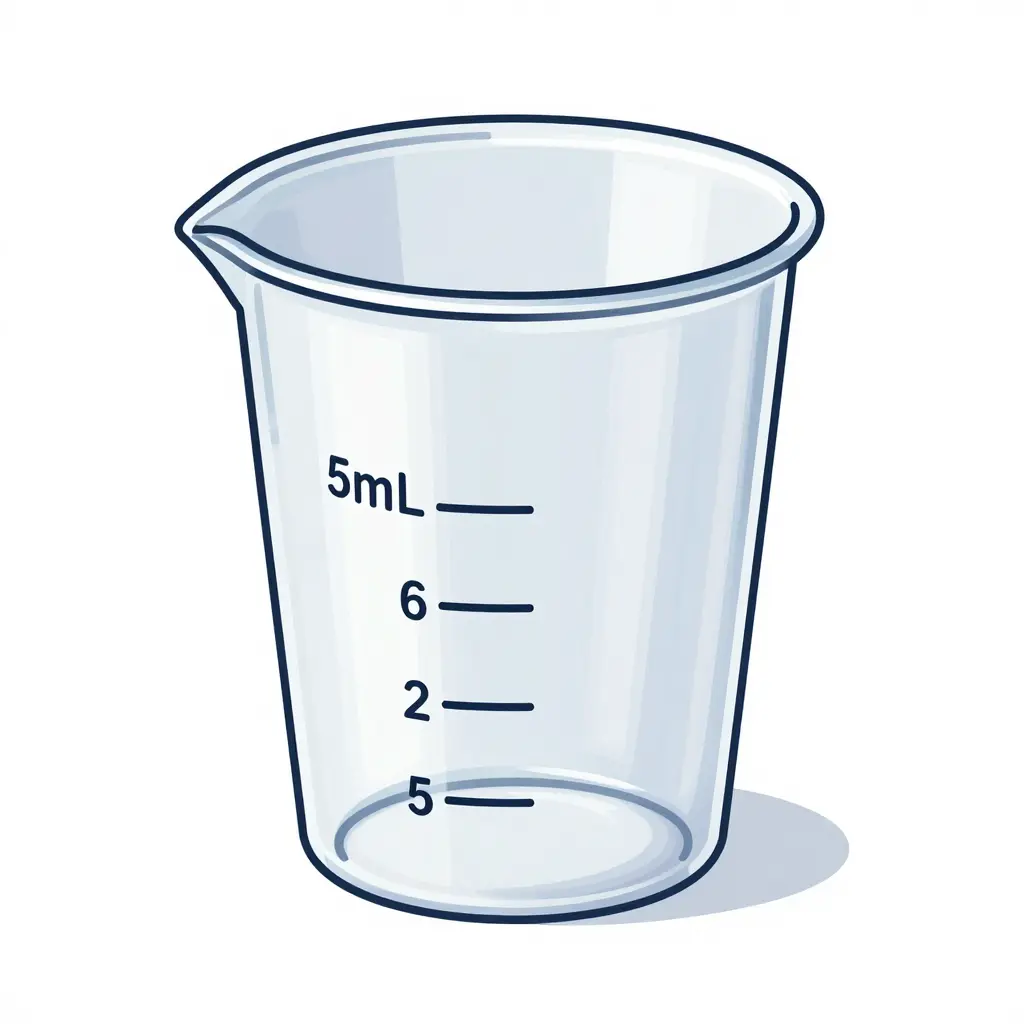
A teaspoon dose looks like an easy thing to reproduce: fill a spoon-sized volume, pour it into a clear plastic cup, hand it over. The catch is that the cup itself decides how much liquid it actually holds. Two conventions define a 5 mL teaspoon dose: printed fill lines and the cup’s taper. Near the bottom of the cup, the two rarely agree.
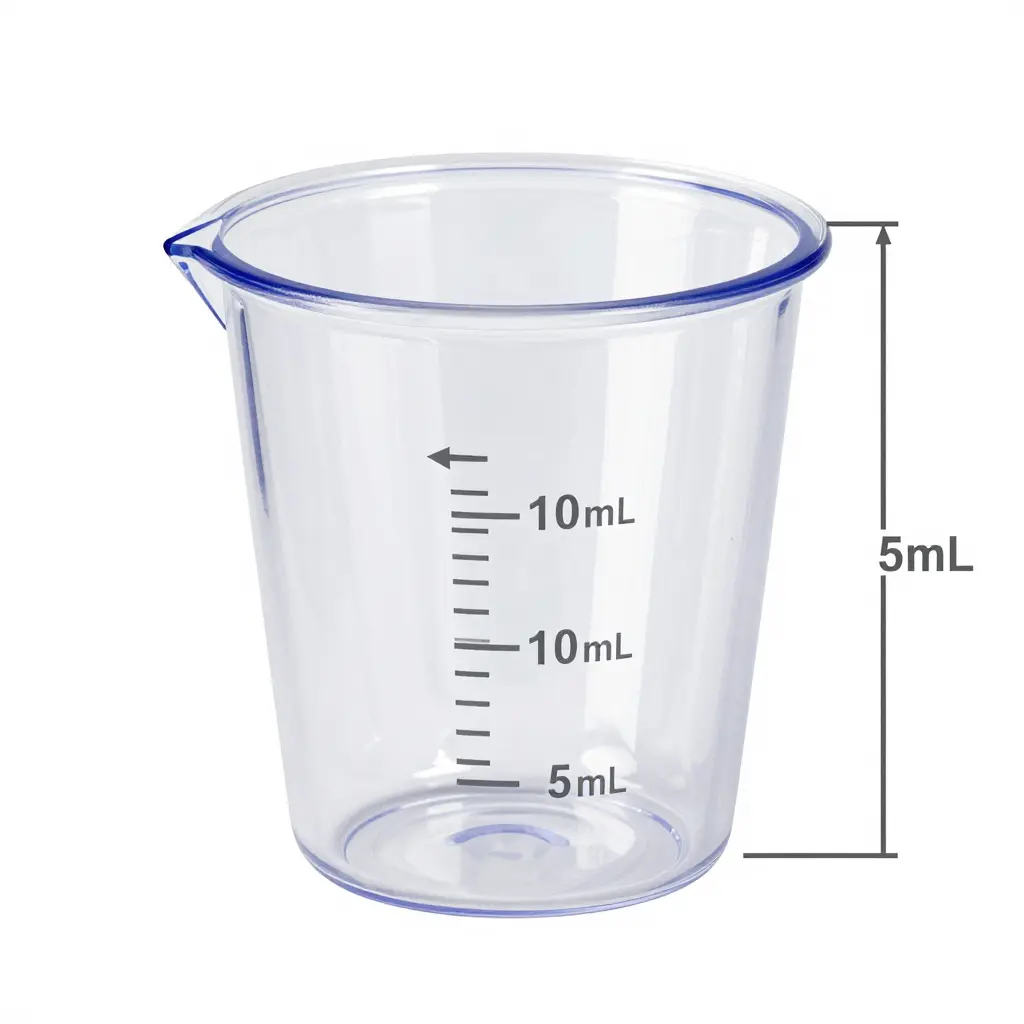
Printed fill lines state the volume outright: graduated marks printed or molded on the wall for 5 mL, 10 mL, or another target. Taper-based dosing instead infers volume from the wall angle, the rate at which the sidewall widens from base to rim, plus the height the liquid reaches on that slope. The two methods diverge because a tapered cup’s cross-section changes with height. Near the narrow base, a small vertical error costs far more volume than the same error near the wide rim, which is why two cups both labeled 5 mL can deliver measurably different amounts.
For healthcare professionals, caregivers, and pharmaceutical packaging manufacturers, the stakes are the same. Pharmacists, nurses, and parents go by the printed line they can see; manufacturers and quality-control specialists go by the geometry they specify. Both depend on one relationship holding steady across a production batch: line placement against wall taper.
What follows compares printed lines with taper-derived volume in clear plastic cups: where the two diverge, how much measurement error each introduces, and which design and quality-control practices keep liquid volume consistent.
One method puts a deliberate mark on the cup; the other leans on the natural widening of the molded wall. That difference reaches from how a user reads the cup to how consistently a batch performs, and it applies to the geometry of any molded vessel, including the kind of standard disposable paper cup most pharmacies and clinics already stock.
Table 1. Printed Fill Lines vs. Cup Taper Geometry as Dosing Guides
| Comparison Factor | Printed Fill Lines | Cup Taper Geometry | Practical Implication for Dosing Accuracy |
|---|---|---|---|
| Marking method | An ink line, notch, or graduated scale applied during flexo or offset printing | An emergent property of the molded wall angle; no explicit mark is added | Printed lines depend on print registration and ink QC, while taper geometry depends on tooling tolerances and is never visible to the user |
| Reference point | A fixed datum printed at a defined height on the cup wall | The moving cross-section at whatever height the liquid happens to reach | Printed lines give an unambiguous target; taper alone offers no discrete target, forcing the user to estimate a level |
| Sensitivity to user eye level | Moderate – parallax can shift the apparent line position, especially on thick or glossy walls | High – relative to the tapered silhouette, the perceived correct level shifts further as the viewing angle changes | Parallax and angle error tend to be larger when taper is the only available cue for the dose |
| Tolerance to fill height error | Small – near-cylindrical bands change diameter little with height, so a vertical slip causes a small volume change | Amplified – where the cup widens sharply toward the rim, the same height error produces a larger volume swing | Taper-based dosing is comparatively forgiving near the base and least forgiving near the rim, so accuracy drifts with fill level |
| Consistency across batch production | Governed by per-batch print registration; mold variation is largely irrelevant to line placement | Governed by the mold and tooling, making the taper angle highly repeatable batch to batch | Taper is reproducible but cannot be verified by the user; printed lines are verifiable on sight but depend on print quality control |
| Volume linearity with height | Lines can be spaced non-linearly to compensate for the taper, yielding an accurate corrected scale | Volume grows non-linearly with height, so equal height steps are not equal doses | Printed lines can encode a corrected scale that taper geometry alone cannot express, which is why graduated cups remain the reference standard for teaspoon dosing |
The tension here is between mold and print: taper accuracy is fixed in the mold, printed lines are fixed in the print run. A cup that doses reliably needs both under control, because neither one on its own keeps a patient clear of a mismeasured dose.
Cup Taper Geometry and Frustum Volume Principles
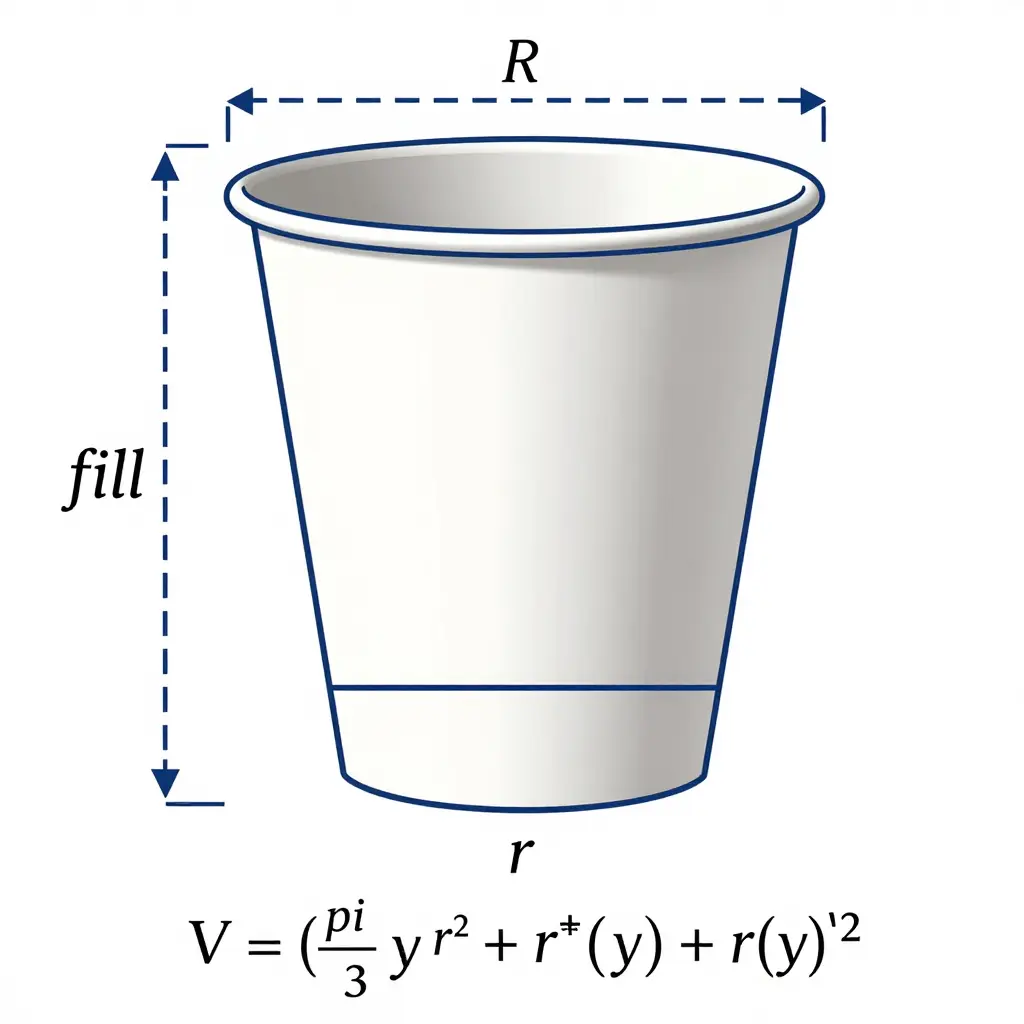
Most disposable cups used for teaspoon dosing are not cylinders. They narrow toward the base, and that shape decides how measured volume responds to fill height. Geometrically, such a cup is a frustum: a cone with its tip sliced off parallel to the base. Three values describe it fully: the base radius (r), the rim radius (R), and the total wall height (h).
The local radius changes linearly with height. At any height y measured up from the base, r(y) = r + (R – r) * (y / h). Volume does not follow that straight line, because it accumulates cross-sectional area, and area scales with the square of the radius. The result is a cubic relationship between fill height and volume:
V(y) = (pi / 3) * y * (r^2 + r * r(y) + r(y)^2)
That curvature is what makes fill height a poor stand-in for dose.
Because the cup narrows toward the base, a small vertical fill error near the bottom corresponds to a proportionally larger volume error than the same error placed higher up the wall. Near the base the cross-section is smallest and the contained volume is smallest, so the relative sensitivity dV / V = A(y) dy / V(y) reaches its maximum. A 1 mm placement or meniscus-reading deviation that is trivial near the rim can represent a substantial fraction of a 5 mL teaspoon dose drawn low in the cup.
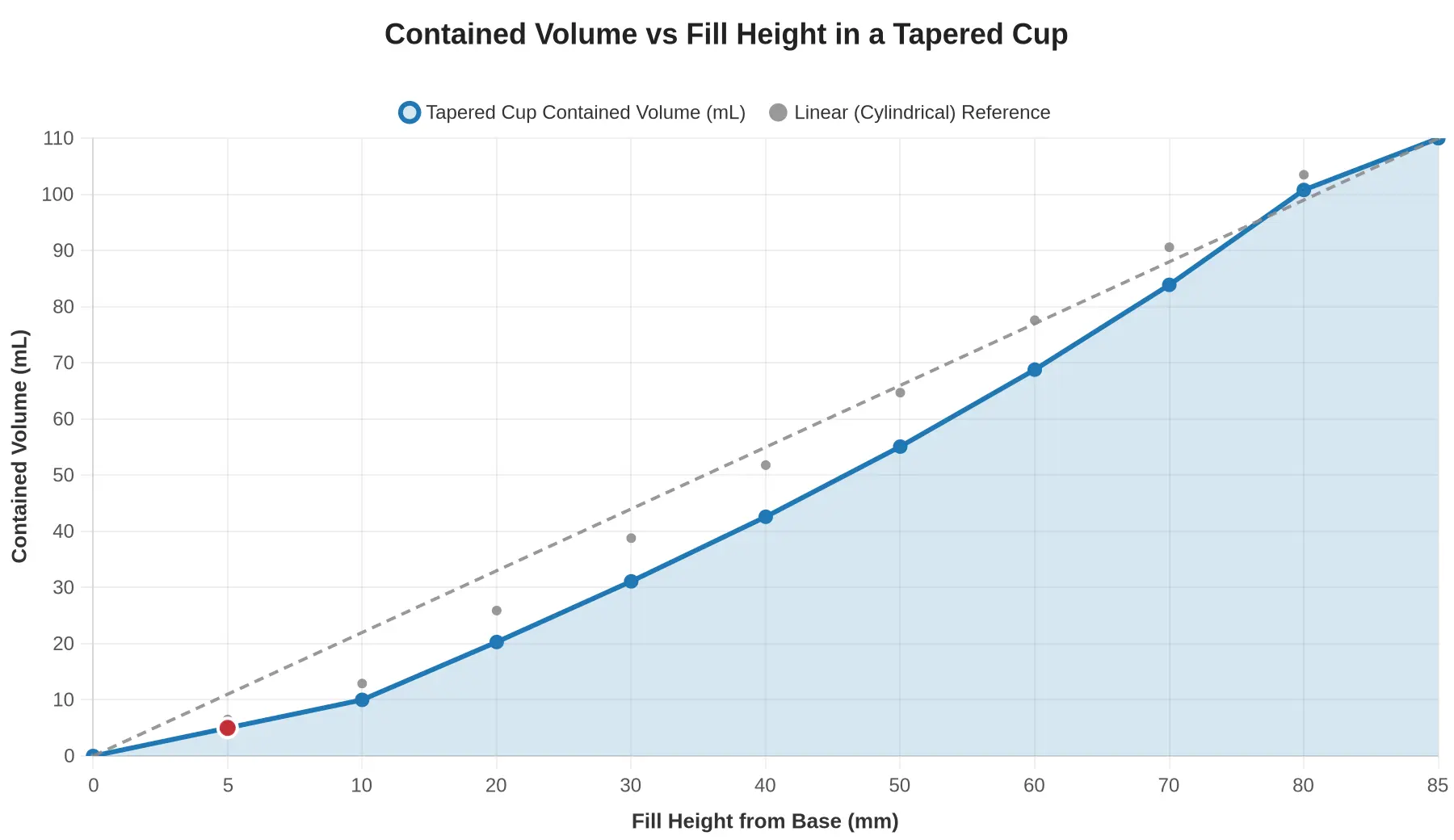
This is the range where a printed fill line has to be positioned and read most carefully. For anyone writing tapered cup packaging specifications, modeling the frustum rather than assuming a cylinder is the difference between a defensible dose and a rounding error.
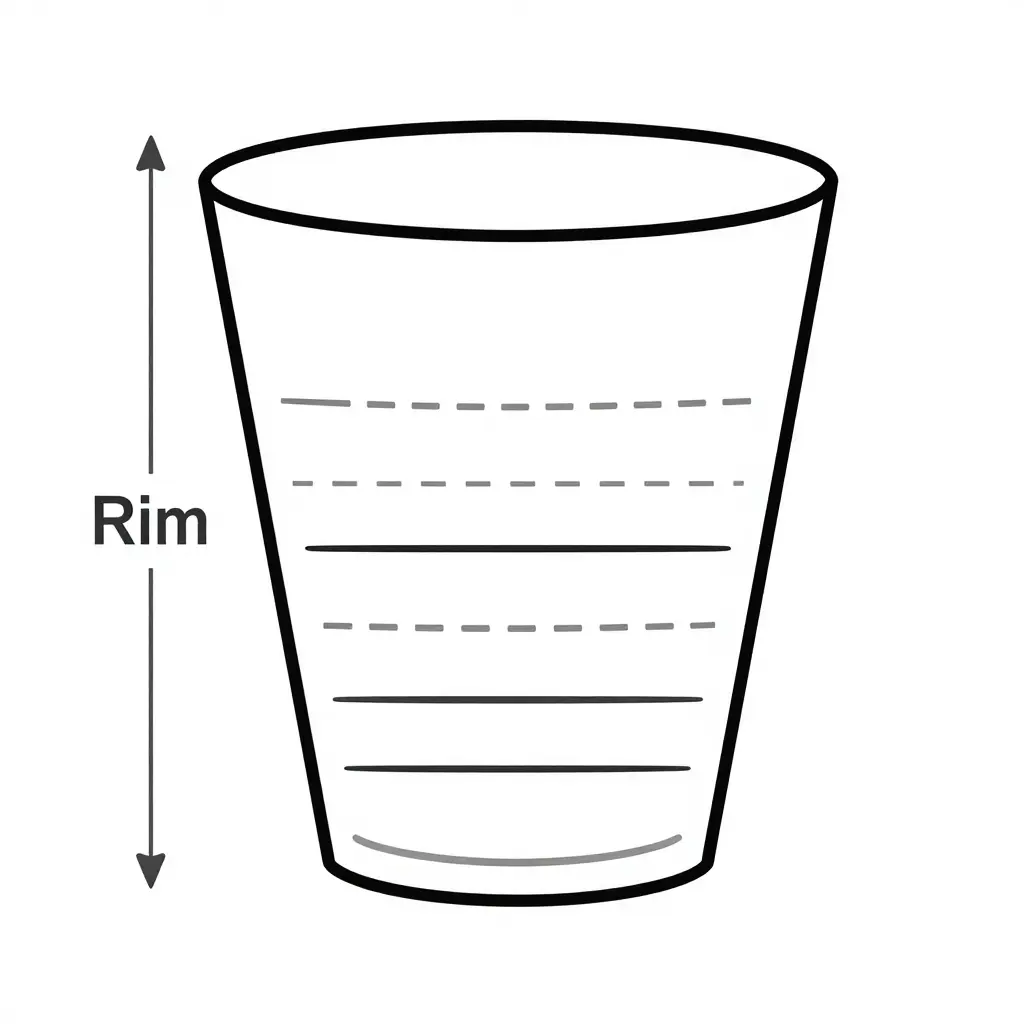
Figure: Cross-section of a tapered cup illustrated as a frustum. Fill-level lines are spaced at equal vertical heights, but the spacing between them widens toward the rim as the radius grows from base to rim – the geometric reason that volume rises non-linearly with height in tapered cups.
Quantifying Volumetric Error: Taper Versus Printed Fill Lines
The Governing Principle
For any vessel, the volume held below a given fill height equals the integral of horizontal cross-sectional area across that height. A tapered cup approximates a truncated cone (frustum), so its cross-sectional area enlarges as height rises from base to rim. A fixed height error, Δh, therefore adds or removes a volume ΔV = A(h)·Δh that scales directly with the local cross-sectional area.
Percentage volume deviation then follows as ΔV/V(h) = A(h)·Δh / V(h). Because both the area A(h) and the accumulated volume V(h) are smallest near the narrow base, the ratio is steepest there. Using a representative frustum (top radius 40 mm, base radius 25 mm, height 80 mm), a 1 mm error at a 10 mm fill height yields approximately a 10.7% volume deviation, whereas the identical 1 mm error near the 70 mm rim yields only about 2.1%.
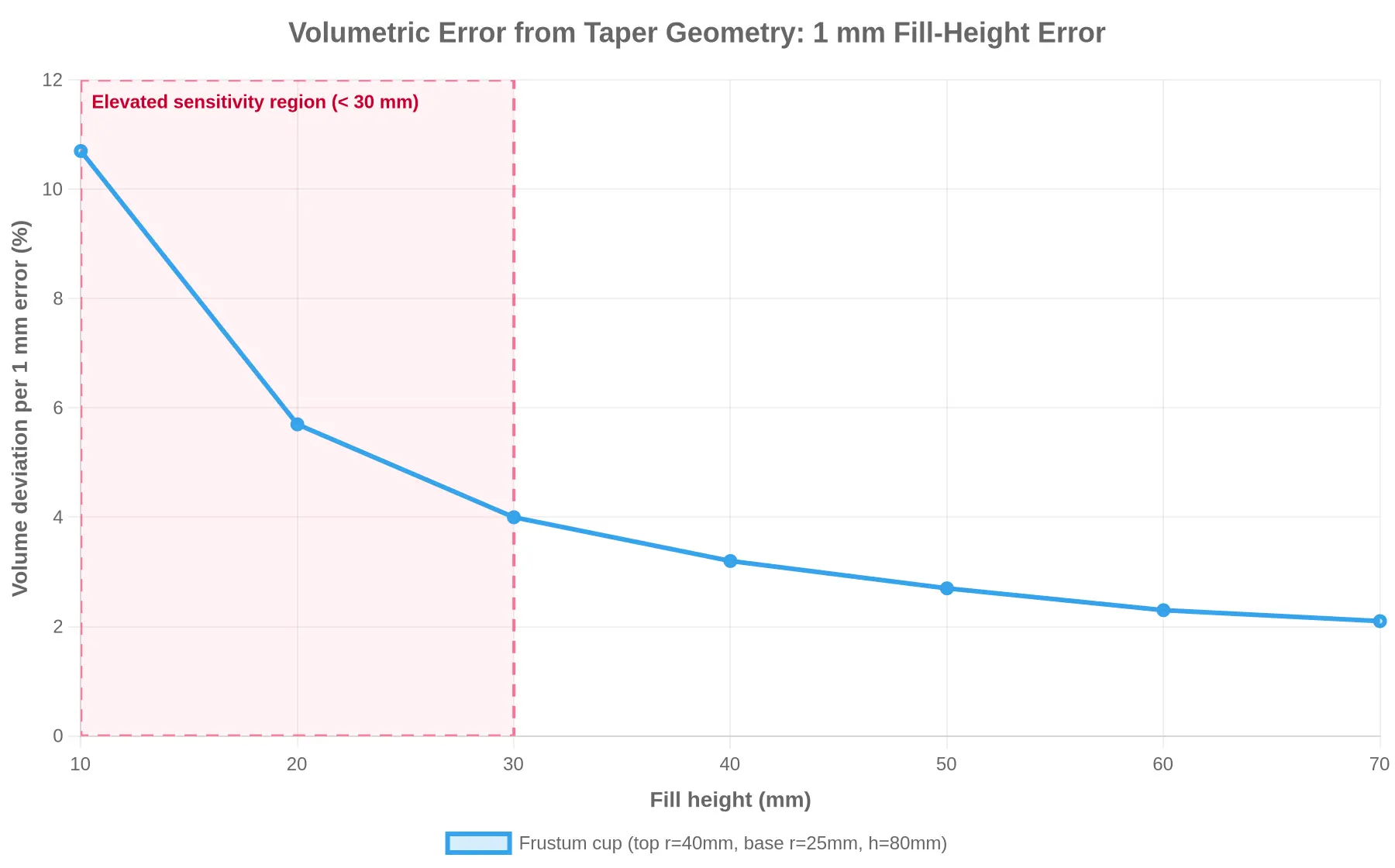
Implication for Dosing Reliability
That asymmetry is the reliability gap between estimating from the taper and reading a printed line. A printed line maps an intended volume to one height and leaves nothing to interpret. Estimating from the taper puts human judgement on top of variable geometry, so the error compounds multiplicatively as the wall widens.
Because the amplification is steepest at low fill heights, small-volume doses are the most sensitive to positioning error. Cup taper accuracy is not cosmetic: it sets the size of the dose error at the low volumes used in pediatric and concentrated formulations. Manufacturers can benchmark line placement against measured geometry using our printed fill line references.
Technique matters as much as the cup. These practices cut the error:
- Read the level at eye level. Looking from above or below introduces parallax.
- For clear aqueous liquids, read the bottom of the meniscus, not the top.
- Below 5 mL, use an oral syringe; that is where teaspoon error grows largest.
- Check printed lines against a calibrated graduated cylinder before dispensing to patients.
- Check taper consistency within each batch; a small angle shift changes volume at the same height.
- Choose cups with graduated markings that stay legible after medication is poured.
- Set the cup on a level surface. A tilted base misaligns the liquid surface with the marking.
- Under bright light, recheck each dose for overfills and underfills before administration.
The same 5 mL target, measured under four cup-reading conditions:
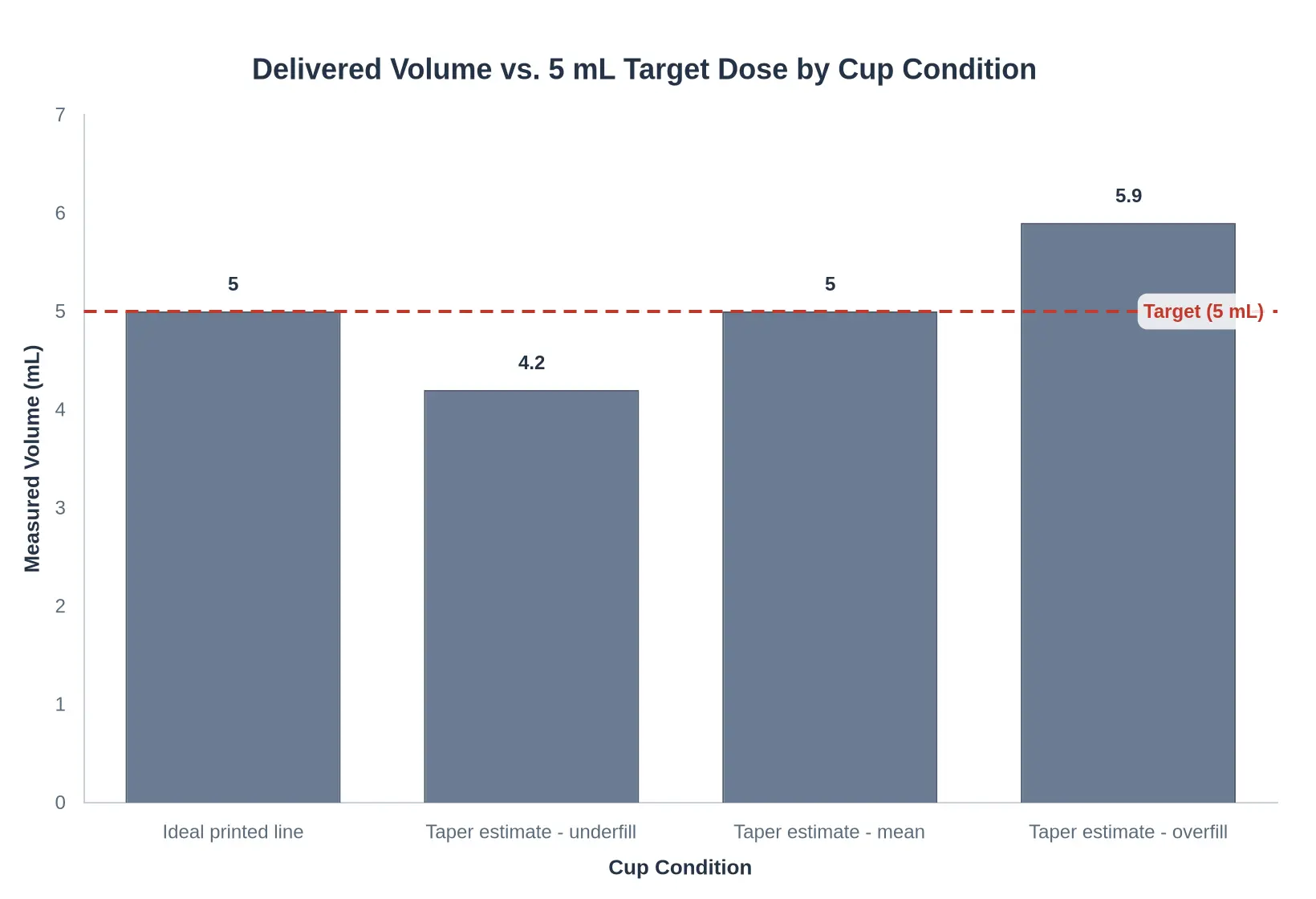
| Cup Condition | Measured Volume (mL) | Deviation from 5 mL Target |
|---|---|---|
| Ideal printed line | 5.0 | 0.0 mL (on target) |
| Taper estimate – underfill | 4.2 | -0.8 mL (under-dose) |
| Taper estimate – mean | 5.0 | 0.0 mL (on target) |
| Taper estimate – overfill | 5.9 | +0.9 mL (over-dose) |
A precisely printed fill line keeps delivery locked to the 5 mL target. The taper-based estimates swing nearly 1 mL in either direction, depending on how the liquid seats against the cup wall. That spread matters: a 0.8-0.9 mL error on a 5 mL teaspoon dose is roughly a 16-18% deviation, enough to push a pediatric dose outside its therapeutic window. For teams specifying the disposable drinkware behind these measurements, controlling wall geometry and fill-line placement is the difference between a compliant dose and a costly one — see our range of paper cups engineered for consistent volume control.
Manufacturing and Quality-Control Perspective: Where Dosing Accuracy Is Actually Decided
Dosing accuracy is decided on the production line, not at the pharmacy counter or the bedside. For teaspoon-calibrated cups, three things dominate how reliably a cup measures: the consistency of the mold taper, the tolerance on print registration, and whether the substrate is a clear food-grade polymer or paper.
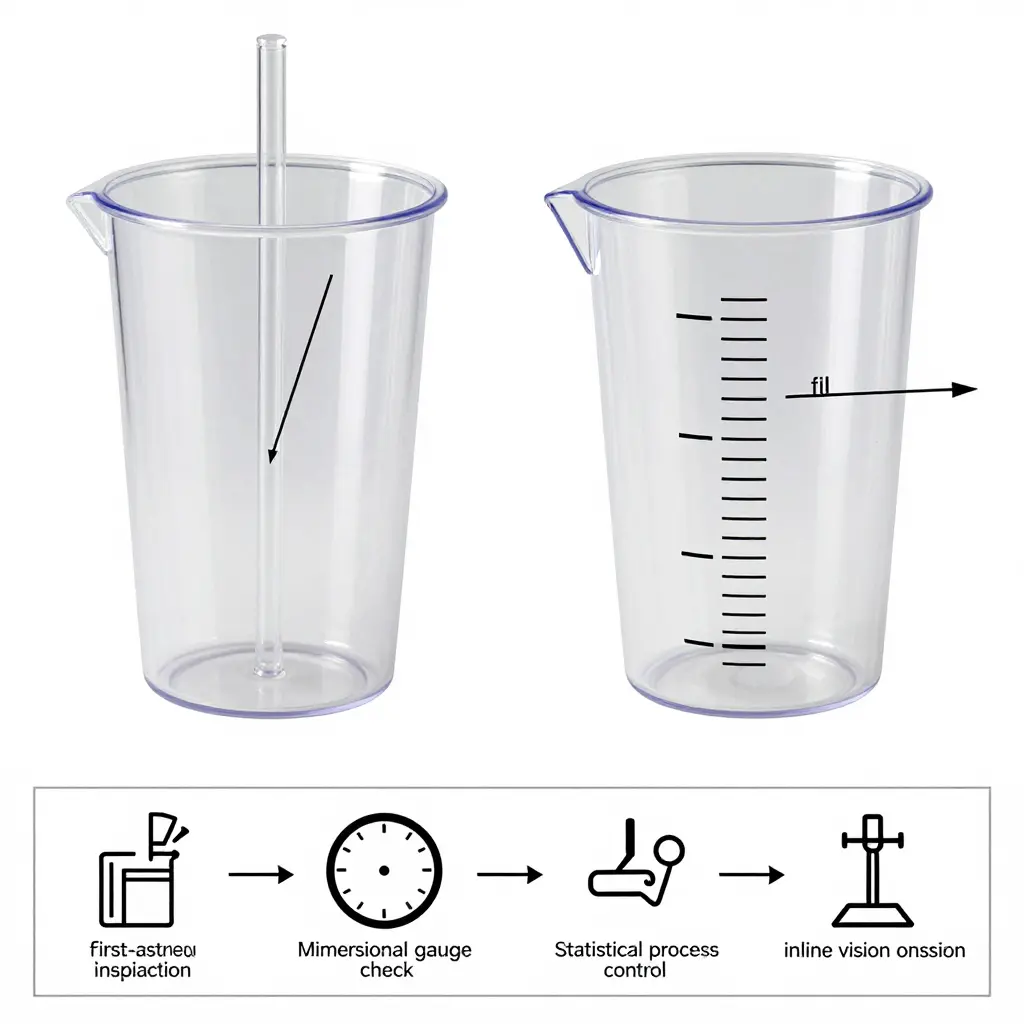
Mold taper consistency. Whether a cup is injection-molded or thermoformed, the draft angle of the wall turns each millimeter of fill height into a specific volume. When the taper drifts off its nominal angle, that height-to-volume relationship drifts with it, and the same fill height no longer means the same dose. Cooling gradients, tool wear, and cycle-time variation all push the angle out of specification over a production run. Holding it inside a defined band takes first-article inspection, interval dimensional gauging, and statistical process control (SPC); a pass/fail check of finished samples is not enough.
Print registration tolerance. A printed fill line works only if it is registered to the true volumetric geometry of the cavity. Pad printing and flexographic decoration can drift laterally and rotationally, leaving a line above or below the volume it claims to mark. Near the narrow base of a tapered cup, even a small lateral misregistration turns into a meaningful dose error. Tight registration callouts, plate and transfer control, and inline vision inspection keep each mark aligned with the cavity it describes.
Material choice. Clear food-grade polymers such as PP and PET hold their dimensions, take up little moisture, and stay transparent enough for a clinician or caregiver to check the meniscus against the line. Paper and sugarcane alternatives are valued across healthcare and food service for their lower environmental footprint, but they behave differently: they can absorb or wick liquid, vary more in wall thickness, and hide the fill level, which makes both the printed line and the taper harder to verify by eye.
| Attribute | Clear food-grade polymer | Paper / sugarcane substrate |
|---|---|---|
| Dimensional stability | High; minimal moisture uptake | Lower; swells and wicks |
| Taper consistency | Tight, repeatable molding | More wall-thickness variation |
| Fill-line visibility | Transparent; meniscus readable | Opaque; level harder to read |
| Printed fill line reliability | Reliable with tight registration | Line obscured by absorption |
| Primary fit | Volumetric medicine dosing | Service ware and paper-based packaging |
The manufacturer’s role. Tolerances belong to the manufacturer, who has to define, measure, and defend them: the taper angle band, the print registration limit, calibration of gauges and vision systems, first-article and in-process checks, and traceability records for every batch. The same discipline applies to other disposable packaging, from sugarcane cups to food-service containers, where wall thickness and print placement decide whether a printed fill line can be trusted as a measurement instrument.
Frequently Asked Questions: Printed Fill Lines vs. Cup Taper Accuracy
Are printed fill lines accurate enough for medication dosing on their own?
No. A printed line is a reference mark, not a calibrated measurement, and its placement tolerance is generally looser than that of a dosing syringe or a graduated cylinder. With a teaspoon dose treated as 5 mL, even a 1-2 mm displacement can shift the delivered volume by a clinically relevant margin, so teaspoon dosing should never rest on printed lines alone.
How does cup taper reduce volume precision at small doses?
At low volumes the internal radius grows quickly with height, so each extra millimeter of liquid adds a larger increment than the last. Around a 5 mL dose, the meniscus curve and the widening cross-section turn a small reading error into a disproportionate share of the target.
Should clear plastic cups replace calibrated oral syringes for dosing?
No. Calibrated oral syringes, graduated dosing spoons, and dosing cups deliver volumes verifiable within defined standards; an ordinary clear plastic cup is not a validated measuring instrument. Use a calibrated device to deliver the dose and treat cup markings as approximations.
How can manufacturers improve taper and line-print tolerances?
They can tighten mold tooling so wall angles stay inside a narrow specified range, control print registration to hold line placement within a defined band, and validate each lot gravimetrically against a reference volume. Buyers can compare those dimensional guarantees across suppliers by reviewing documented paper cup specifications. Printed fill lines become dependable when controlled taper geometry is paired with verified print placement.
Conclusion
Printed fill lines and cup taper each bring their own source of dosing error. A line can look perfectly legible and still mark a volume that no longer matches the intended measure once the sloped wall is taken into account; how much interior volume shifts across a single pour is set by cup taper accuracy. Neither can be judged on its own, which is why reliable teaspoon dosing depends on both.
For healthcare professionals and caregivers, the practical rule is simple: use standardized measuring tools and clear written instructions, and do not treat a printed line as precise until it has been verified. For manufacturers, tolerance control in mold design, labeling, and quality checks decides how closely a cup performs against its stated volumes. As packaging manufacturers refine their practices and tighten packaging tolerances, the gap between the volume a cup displays and the volume it delivers should narrow.