
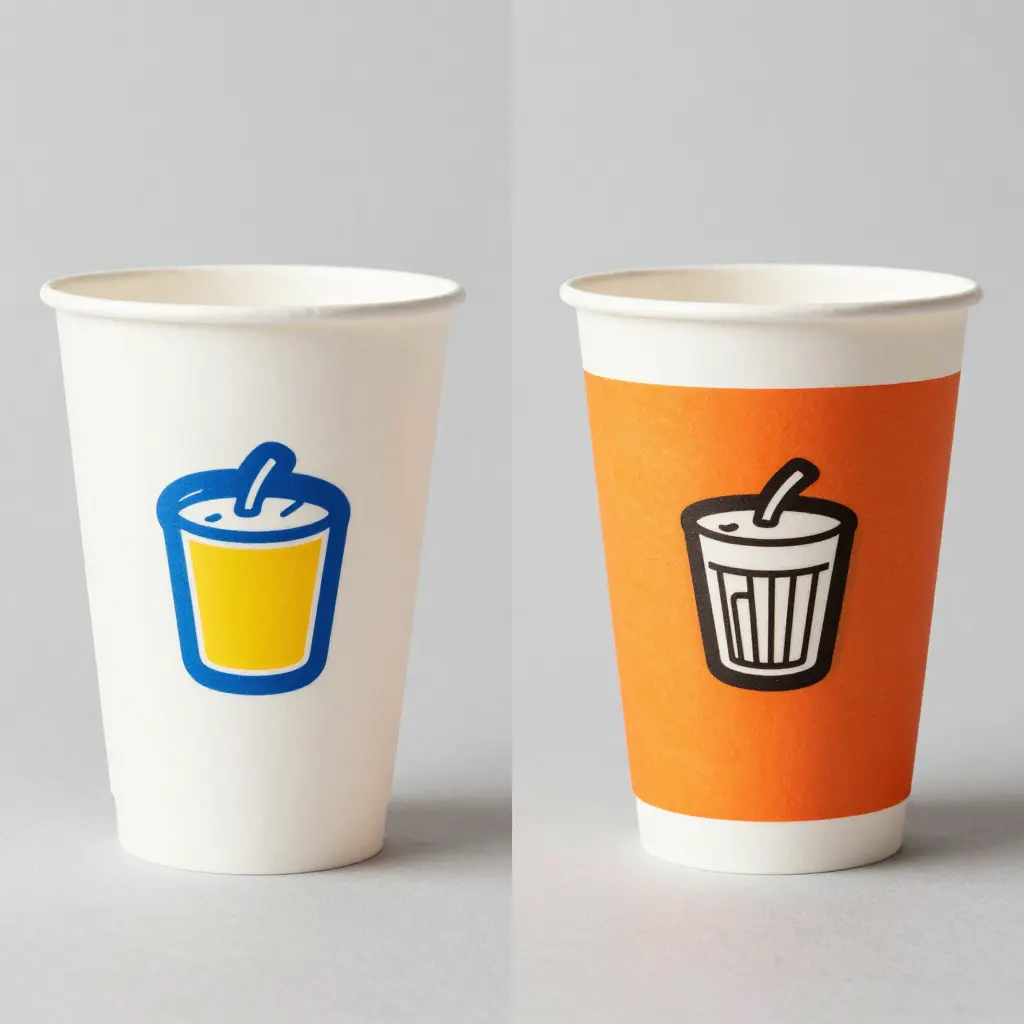
Introduction: In-Mould Labelling or Screen Printing?
Before production starts, UK buyers of personalised disposable plastic cups have to choose a decoration method: in-mould labelling or screen printing. Both turn out branded cups that survive daily use. The difference shows up at low order quantities, which is where cafés, bars, restaurants and event organisers do most of their buying.
Cost is the first dividing line. In-mould labelling carries higher upfront tooling costs, while screen printing spreads its cost across screens and colours. Setup times follow the same split, and together they decide how quickly a job moves from artwork to a finished cup. Print quality matters too: both methods can look sharp, but they suit different artwork, finishes and levels of detail.
The comparison below runs both methods against four criteria – cost, setup, print quality and suitability for short runs – and points to the range of cup formats available, so you can match the printing choice to the right cup and compare quotes on equal terms.
How In-Mould Labelling (IML) Works: A Plain-English Guide
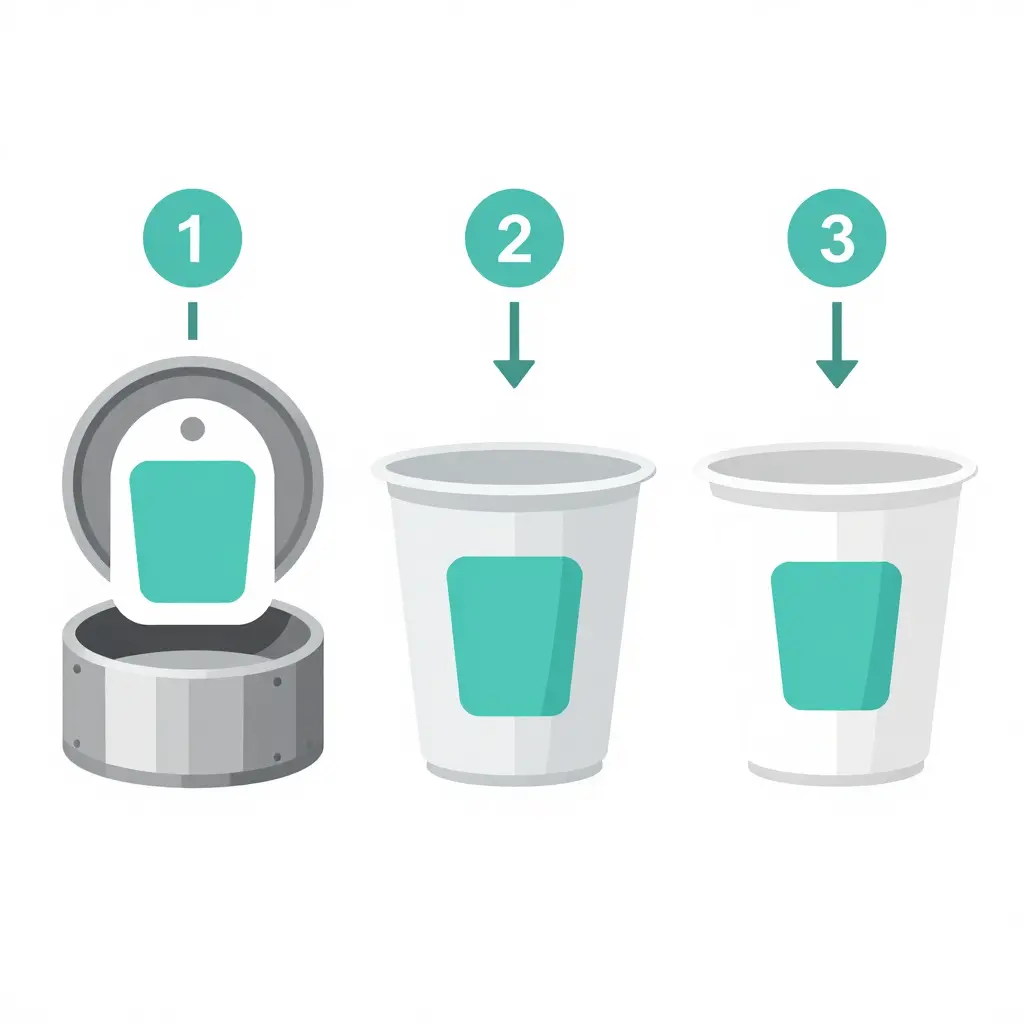
In-mould labelling – often shortened to IML – is a way of decorating a cup while the cup itself is being formed, instead of printing on it afterwards.
A label is pre-printed on a special film or paper. Before the cup is shaped, that flat label is placed inside the mould. Molten plastic is then injected around and behind it.
As the plastic cools and sets, the label fuses directly into the cup wall. It does not sit on top of the surface. It becomes part of the cup.
What this means for durability
Because the graphic is embedded rather than applied, there is no edge for a fingernail to catch, and nothing to peel, rub off or lift.
The printed image is protected by the plastic itself, so it resists scratching, fading and everyday handling far better than ink sitting on the outside of a cup.
Moisture, dishwasher and condensation
The fused surface is smooth and sealed. Condensation from a cold drink, and repeated dishwasher cycles, will not lift the print or cause it to run.
Where screen-printed ink can wear or crack over time, an IML graphic typically stays sharp for the full life of the cup.
Finish quality and long-life branding
IML delivers crisp, photo-quality graphics with a clean finish, which is why it is usually linked to higher-quality, long-life branding.
For businesses ordering personalised disposable plastic cups, the result is a cup that still looks new after many washes – a fit for reusable-branded programmes, cafés, bars and events where the cup is part of the presentation.
If you are weighing decoration methods across your whole range, it also helps to review the cup options available before deciding.
How Screen Printing Works on Disposable Plastic Cups
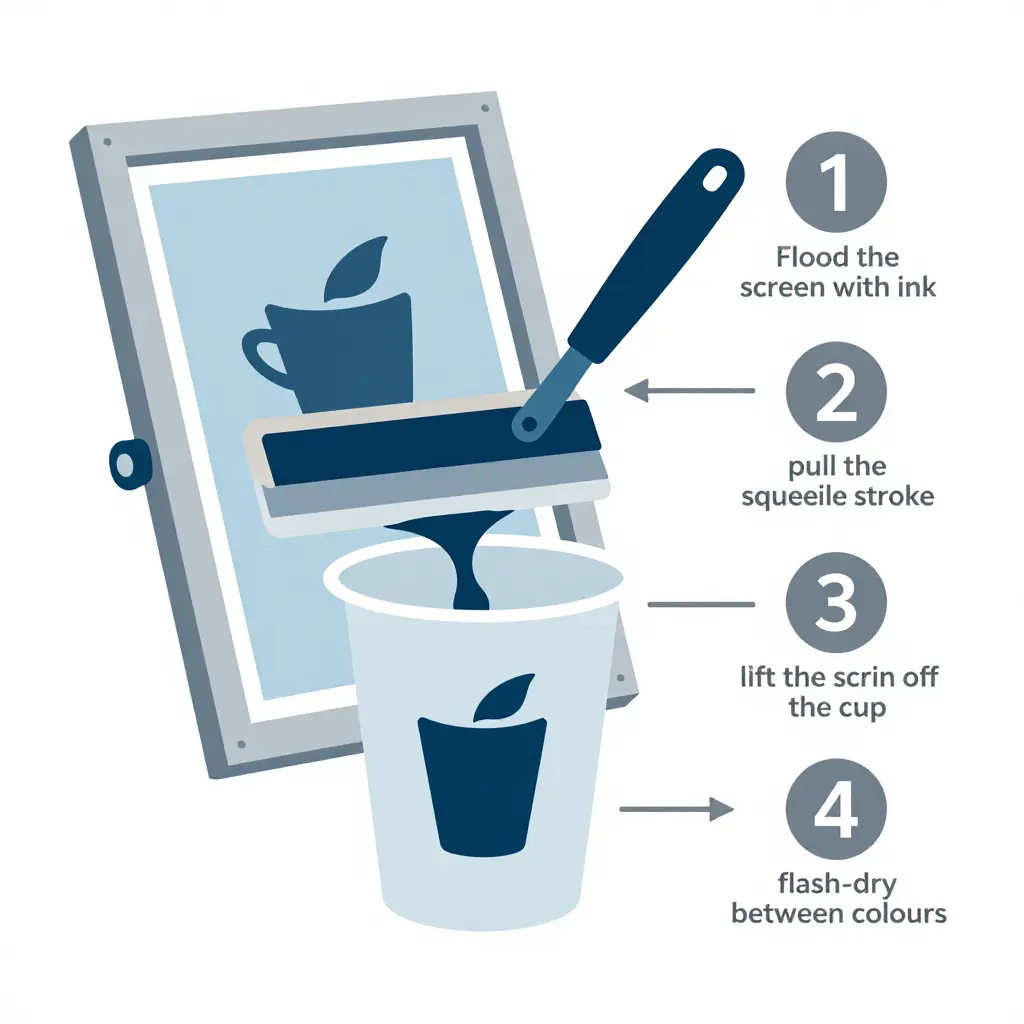
Screen printing (sometimes called silkscreen printing) is one of the simplest ways to put a logo or design onto a plastic cup. A fine mesh is stretched tight over a frame. The parts of the mesh you want to print stay open; everything else is blocked off to form a stencil.
To print, the operator floods the screen with ink, then pulls a rubber blade (a squeegee) across it. The blade pushes ink through the open areas of the mesh and onto the cup surface below. Because cups are round, each one is held in a fixture and often rotates during the stroke so the design wraps neatly around the curve.
Colours, passes and finishes
Each colour needs its own screen and its own pass. A single-colour logo takes one pass. A two-colour design takes two passes, with a short drying step in between so the inks do not blend. More colours mean more passes, more setup, and more chances to misalign the artwork.
Unlike in-mould labelling, where the label fuses into the plastic wall, screen-printed ink cures on top of the surface. It sits as a thin raised layer rather than becoming part of the cup itself. That gives excellent opacity and vibrant, punchy colour: whites stay bright and solid blocks look bold and even.
The trade-off is detail. Screen printing favours large shapes, thick lines and flat colour. Fine text, tiny logos, sharp gradients and photo-style images are difficult, because the mesh can only hold so much resolution. Soft fades usually have to be faked with halftone dots, which look best from a distance.
For custom-branded disposable plastic cups ordered in short runs and other small batches, this simplicity is the appeal: minimal setup, quick turnaround, and strong colour at a modest volume. If your artwork is a clean, high-contrast logo rather than a detailed illustration, screen printing is a reliable and cost-effective fit. You can also browse our range of disposable cup formats to compare styles before committing to a print method.
IML vs Screen Printing: Head-to-Head for Short Runs
For UK buyers weighing up in-mould labelling vs screen printing for personalised disposable plastic cups, the short answer is that screen printing wins on short runs, while in-mould labelling rewards scale. If you need a few hundred to a few thousand branded cups quickly and cheaply, screen printing keeps setup costs low and minimum order quantities achievable. IML only becomes the cheaper route once your volumes climb and you want a durable, premium, full-wrap finish.
| Criteria | In-Mould Labelling (IML) | Screen Printing |
|---|---|---|
| Setup cost | High – new print plates and mould changes required | Low – reusable screens, minimal tooling |
| Minimum order quantity | High – typically 10,000+ units | Low – often 500 to 1,000 units |
| Cost per unit at low volumes | Very high | Low and affordable |
| Cost per unit at high volumes | Low and highly competitive | Higher per unit at scale |
| Print quality and detail | Photographic, high-resolution, full-wrap | Crisp solid colours, limited fine detail |
| Colour options | Unlimited, with smooth gradients possible | Limited – one colour per screen pass |
| Durability and finish | Excellent – label fuses into the cup wall | Good – ink sits on the surface and can scratch |
| Water/moisture resistance | Superior – sealed within the cup wall | Moderate – depends on ink and curing |
| Lead time | Long – tooling and production cycles | Short – fast turnaround for urgent orders |
| Best-fit use case | Large, long-term branded campaigns | Short runs, promotions, events and cafes |
Why the table points short-run buyers toward screen printing
For anyone ordering personalised disposable plastic cups in modest quantities, screen printing’s low setup cost and small minimum order quantity mean you can launch a branded cup without tying up thousands of pounds in tooling or committing to pallet-loads of stock you may never use. Cafes, bars, pop-ups, wedding planners and marketing teams running limited promotions all benefit from that flexibility, because their designs change before their volumes grow. In-mould labelling demands the volume that justifies its higher upfront investment. Compare it alongside custom-printed paper cups if you also want sustainable paper-based formats.
The Economics of Setup Cost and Per-Unit Pricing
Every quote for personalised disposable plastic cups in the UK contains two separate numbers: a one-time setup cost and a recurring per-unit price. How those two behave as your order grows decides which printing method is cheaper for you.
Screen printing is the lighter investment. You pay once for a plate and a mesh for each colour in your artwork, then a modest price per cup. In-mould labelling is heavier: the label has to be printed, and you fund the tooling that positions it accurately inside the mould. That upfront figure is often several times higher than screen printing’s setup.
Why Break-Even Volume Decides the Winner
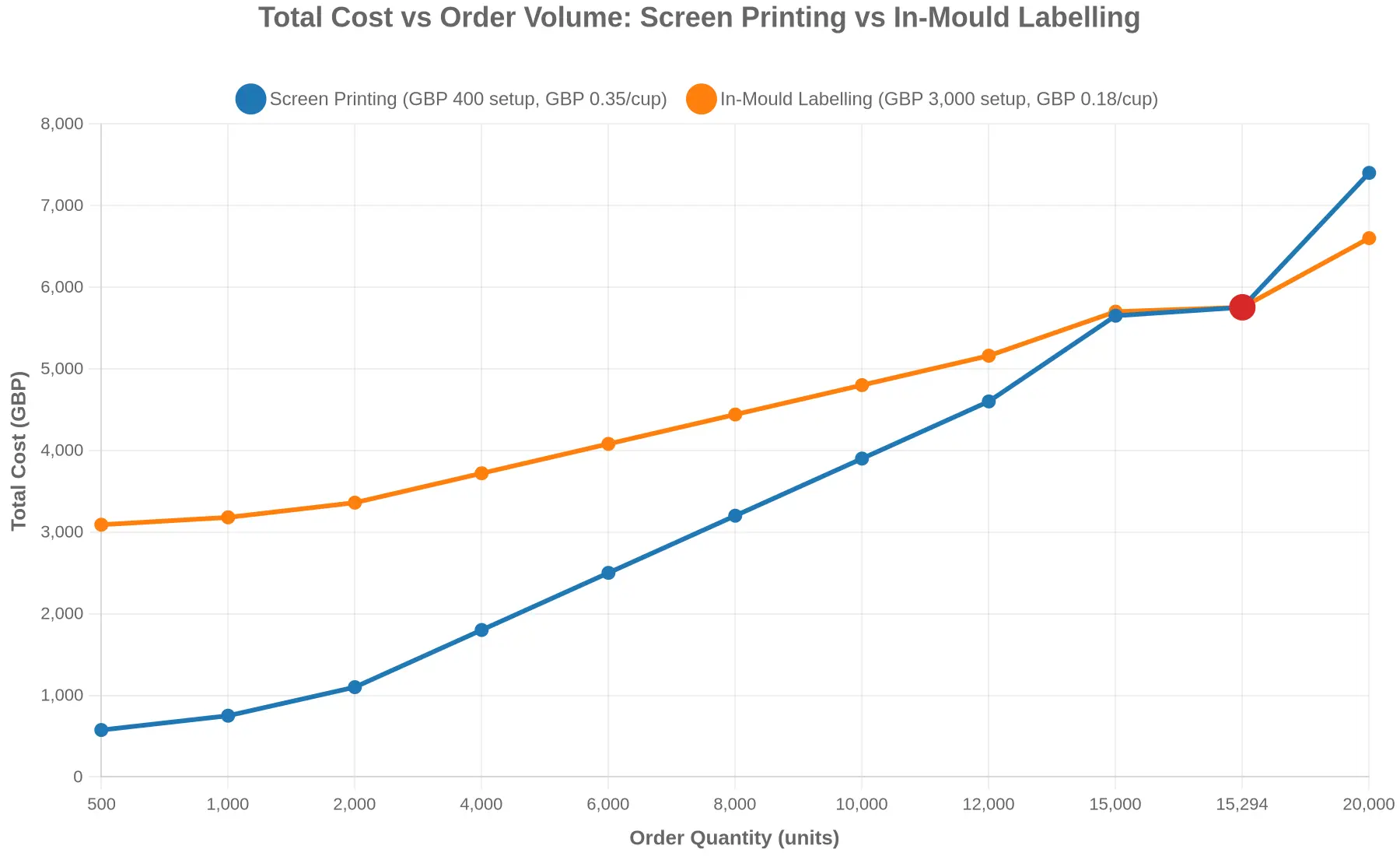
Total cost comes to setup cost + (per-unit price x quantity). At low quantities, setup dominates the total, so the method with the smallest upfront fee wins even when its per-unit cost is higher. As volume climbs, the cheaper per-unit price slowly erodes the bigger initial investment. The point where the two total-cost lines cross is the break-even volume.
For short runs, screen printing usually sits well below that crossover. Businesses ordering sample batches, seasonal specials or event-specific branded custom-branded disposable cups rarely reach the volume needed to justify in-mould tooling.
Hidden Costs That Reshape the Numbers
The headline price rarely tells the whole story. Reprints triggered by colour mismatches add both cost and delay. Precise colour matching to a Pantone reference is harder on some substrates and may carry a surcharge. And minimum order quantities can force you to buy more cups than you need, tying up cash in stock you might not sell.
Weigh these alongside the visible setup cost before committing. For most UK buyers running short runs, a lower setup cost protects the budget more reliably than a per-unit discount that never gets a chance to pay off.
Setup vs Unit Costs: IML vs Screen Printing at a Glance
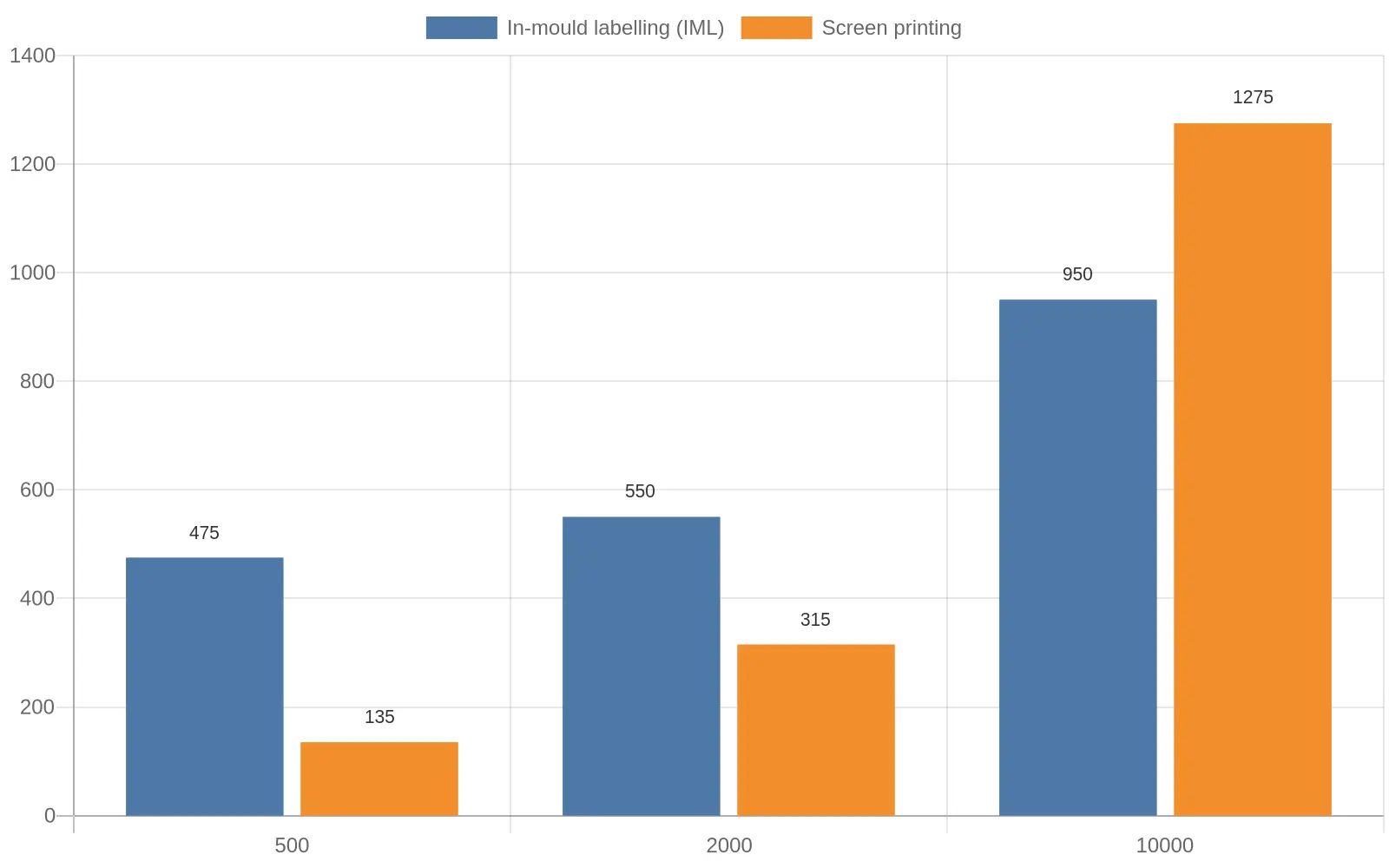
In-mould labelling (IML) carries a heavy upfront tooling cost but a very low cost per cup; screen printing flips that model with cheap setup and a higher unit price. The illustrative bar chart below compares the total cost of each method across three order volumes.
The numbers behind the bars (indicative figures)
| Cost component | In-mould labelling (IML) | Screen printing |
|---|---|---|
| One-off setup | £450 | £75 |
| Cost per cup | £0.05 | £0.12 |
| Total – 500 cups | £475 | £135 |
| Total – 2,000 cups | £550 | £315 |
| Total – 10,000 cups | £950 | £1,275 |
Figures are illustrative examples only, intended to show the pattern rather than quote for any specific job. Real prices vary with artwork, colours and supplier.
Screen printing wins comfortably on short runs because its small setup charge keeps 500-cup orders affordable. As volumes climb, the low per-unit cost of in-mould labelling takes over, making it the cheaper option once you pass roughly 5,000 cups.
If you are ordering custom-branded disposable cups for cafes, bars and events, that crossover point is the most useful number to know when choosing between the two methods.
Print Quality and Durability: In-Mould Labelling vs Screen Printing
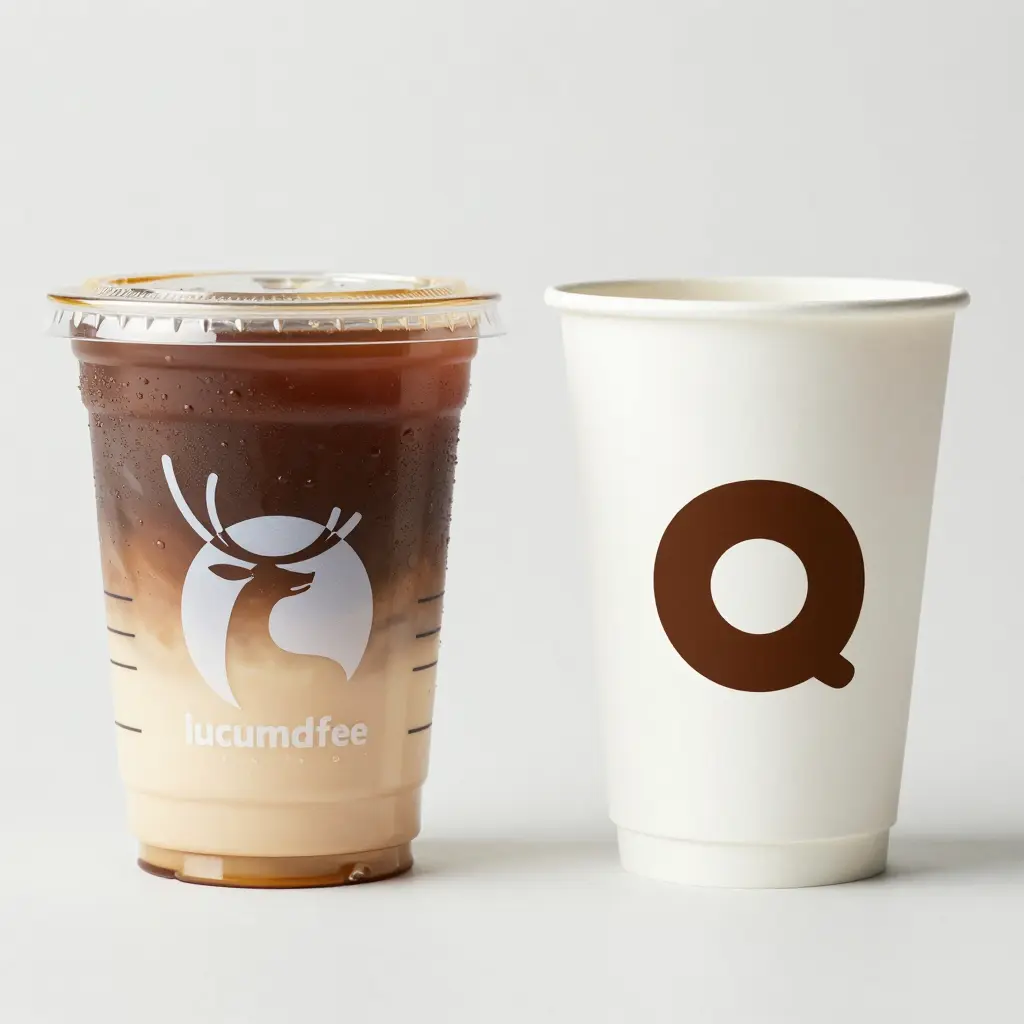
When businesses order custom-branded disposable plastic cups, the finish is often the first thing a customer notices. The two main production routes, in-mould labelling and screen printing, behave very differently once the cup leaves the shelf.
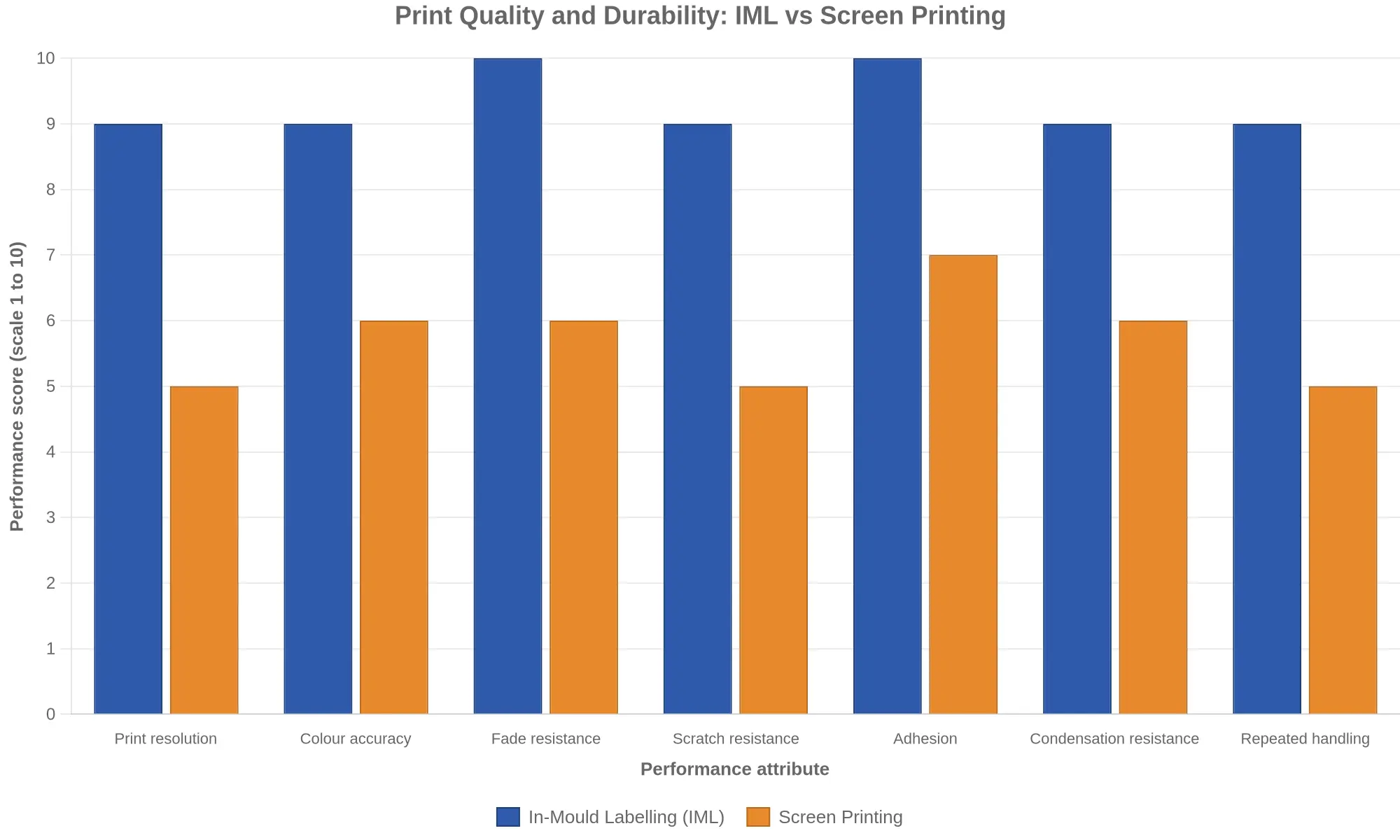
In-mould labelling produces the strongest print quality. The printed label is fused into the plastic while the cup is formed, so the artwork sits flush with the surface. Resolution is high enough to reproduce photographs, gradients, fine text and detailed logos, and colour accuracy holds steady across an entire run. Because the ink is sealed inside the material, it will not flake, scratch or fade, even after long exposure to condensation or repeated handling.
Screen printing applies ink directly onto the finished cup in solid layers. It excels at bold, flat colours and simple, high-contrast logos, but fine detail, gradients and photographic images are hard to reproduce. Adhesion is generally good on straightforward designs, yet heavily handled or heavily chilled cups can pick up scuffs, and there is more colour variation from batch to batch.
Durability under real-world use widens the gap further. Cold drinks and condensation are the toughest test for any cup graphic. In-mould labelling handles both because there is no exposed ink to lift or smear. Screen-printed cups usually cope with condensation, though prints are more vulnerable on the rim and base where hands grip most.
The chart below scores both methods across the attributes that matter most to buyers.
| Quality attribute | In-mould labelling (IML) | Screen printing |
|---|---|---|
| Print resolution | High, photo-quality detail | Limited to simple, bold graphics |
| Colour accuracy | Consistent across the run | Good, with minor batch variation |
| Colour fading | Ink sealed in, does not fade | Can fade with UV and heavy wear |
| Scratching | Fused, scratch resistant | Exposed ink can scuff |
| Adhesion | Permanent, bonded into the plastic | Good, can lift at edges over time |
| Condensation | Unaffected | Usually fine, more vulnerable at grip points |
| Repeated handling | Excellent | Moderate |
The choice shapes brand perception. Cafes, bars and takeaways that choose in-mould labelling present a glossy, photo-quality look that reads as care and quality, which matters on a counter or at a bar where the cup is part of the experience. Screen printing delivers solid-colour branding that reads clearly from a distance, a practical match for high-volume venues and event organisers who want a bold, instantly recognisable logo rather than intricate artwork.
If you want to explore the wider range of custom-branded disposable cups that pair well with these printing options, it is worth reviewing the full range before you commit.
How In-Mould Labelling Works, Step by Step
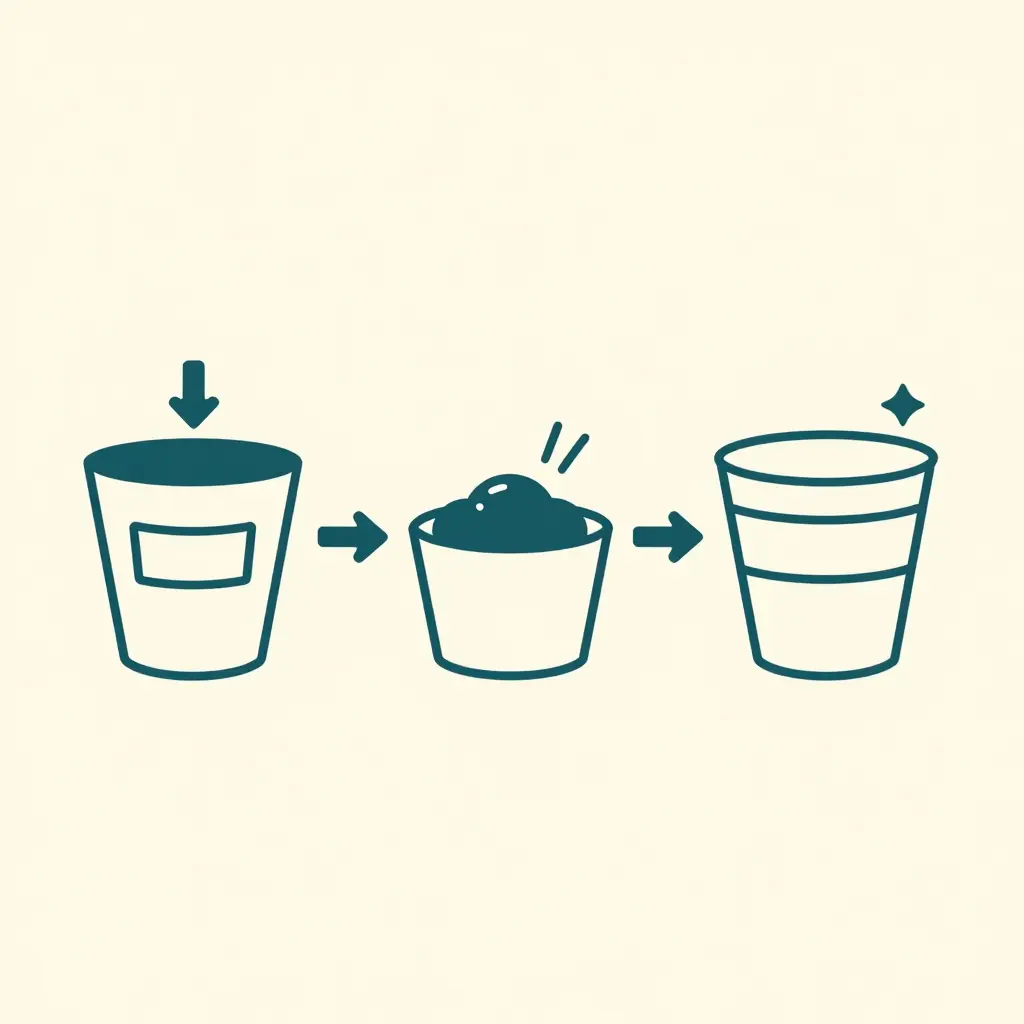
The schematic above strips the technique back to its essentials. In-mould labelling runs in three stages, and that flow explains why it behaves so differently from screen printing on short runs.
- The label goes in first. A pre-printed label – already carrying your artwork, logo or full-colour design – is placed inside the open mould. The print exists on the label from the beginning, not on the finished cup.
- Molten plastic is injected. Hot plastic is injected into the mould behind the label. As it flows and cools, the label fuses into the cup wall itself. The print does not sit on the surface – it becomes part of the structure.
- The cup comes out printed. Once the mould opens, the finished cup emerges with its design fully integrated. There is no separate decoration step, no ink drying stage, and nothing to rub off.
That fused-in result is the main benefit: graphics that cannot peel, flake, scratch or fade through washing and handling, which matters when branded cups are stacked, carried and reused across a busy service. For operators evaluating decorated drinkware alongside other packaging formats, it helps to compare the durability on offer across a broader range of paper cup and packaging options.
What the Diagram Does and Does Not Show
This illustration is deliberately schematic. It is designed to make the sequence obvious rather than to represent any specific machine, tooling design or production line.
| The diagram shows | The diagram omits |
|---|---|
| The three-step order of operations | Real moulding machinery and robotics |
| Where the label sits relative to the cup wall | Line speed, cycle times and throughput |
| The fused, integrated print in the final stage | Label materials, inks and substrates |
| The direction of flow via sequence arrows | Any text, labels or annotations |
Keeping it text-free and two-tone means it can be dropped into a quote deck, a supplier comparison or an internal briefing without competing with the rest of the page.
Why the Three Steps Matter for Short Runs
The detail that matters for a buyer is what is absent from this flow: there is no separate print stage after the cup is formed. In screen printing, every colour is applied in a distinct pass after moulding, which is why short runs carry higher per-unit setup costs and longer lead times. In-mould labelling front-loads the work into a pre-printed label and folds the decoration into the forming step itself.
That structural difference is the thing to understand when weighing up which method suits a limited production run, and it is worth revisiting before you request samples or pricing.
Suitability for Short Runs
For short runs, screen printing is the smarter choice in most circumstances. In-mould labelling (IML) fuses the label into the cup wall during moulding, delivering a premium, near-photographic finish, but it demands expensive tooling and long production cycles. Those costs only make sense when they are spread across tens of thousands of cups.
Four factors decide the winner:
Minimum order quantity (MOQ). IML suppliers usually enforce high MOQs because every design needs dedicated tooling. Screen printing accepts far smaller batches, so a genuine short run stays affordable.
Setup economics. Screen printing relies on inexpensive screens and quick plate changes. IML setup can run into thousands of pounds, so it only pays off at volume.
Turnaround times. Screen printing can complete modest orders in days. IML needs tooling, sampling and longer press runs, stretching lead times.
Design flexibility. Screen printing lets you change colours, text or seasonal themes between batches without new tooling. Once an IML mould exists, edits are costly and slow.
Matching the Method to the Scenario
| Scenario | Typical volume | Recommended method | Why |
|---|---|---|---|
| Small cafe ordering seasonal cups | 500-2,000 | Screen printing | Low MOQ and designs that change by season |
| Event planner needing a one-off batch | 250-1,000 | Screen printing | A one-off rarely justifies IML tooling |
| Marketing team running a limited promotion | 1,000-5,000 | Screen printing (IML only above roughly 5,000) | Speed and flexibility beat finish |
When Screen Printing Wins, and When IML Is Worth It
Choose screen printing for personalised disposable plastic cups when volumes are modest, deadlines are tight, or the artwork is likely to change. It keeps upfront costs low and keeps you flexible.
Turn to in-mould labelling when you order consistently at high volume, want premium shelf presence, or need artwork durable enough to survive heavy use. At that scale, the higher setup is repaid by a better product and a lower unit cost.
If you are building a takeaway range around these cups, pairing them with coordinating paper cup holders protects hot drinks and reinforces your branding.
Choosing your printing method
If you’re weighing up how to brand a custom cup order, this quick checklist matches common business priorities to the printing method that fits best.
- Ordering under 1,000 cups: screen printing keeps short runs affordable without the costly tooling that in-mould labelling demands.
- Needing photo-quality, multi-colour artwork: in-mould labelling reproduces intricate, high-resolution designs across the whole cup in a single pass.
- Requiring moisture-resistant branding: in-mould labelling fuses the label into the cup wall, so it won’t smudge, peel or fade when chilled or iced.
- Working to a tight budget: screen printing avoids the expensive plate and mould setup that in-mould labelling carries, so it suits simple logos.
- Needing fast turnaround: screen printing handles small orders quickly, while in-mould labelling suits planned, larger production runs.
- Wanting a wrap-around finish: in-mould labelling delivers seamless, full-surface coverage that looks sharp on the shelf.
- Testing a new design before scaling up: screen printing lets you trial short runs cheaply and adjust before committing.
Whichever route you take, matching the method to your order size, artwork and deadline will keep your custom-branded disposable cups, available at our paper cup range, both cost-effective and on time.
Frequently Asked Questions: In-Mould Labelling vs Screen Printing
Which method is cheaper for a first small order?
Screen printing is almost always the more economical choice for a first small order. Its setup relies on a reusable screen and a straightforward print station, which costs far less than the precision tooling required for in-mould labelling. With no separate label to print, cut and insert, short runs of personalised disposable plastic cups can be produced with minimal upfront investment. In-mould labelling only becomes cost-effective once your volumes are high enough to spread the tooling and label costs across many thousands of units.
Can I switch from screen printing to in-mould labelling later?
Yes, and plenty of growing brands do. Start with screen printing to validate your design and demand, then migrate to in-mould labelling once volume and premium presentation justify the higher setup. The main considerations are artwork adaptation, since labels need higher resolution, and confirming that your chosen cup mould supports label insertion. Plan the transition a few weeks ahead so your packaging artwork and print-ready files are fully prepared.
How many colours can each method reproduce?
Screen printing works best with a small number of solid spot colours, typically one to four, and each extra colour adds a screen and a pass. In-mould labelling reproduces full-colour, high-resolution graphics with photographic gradients and fine detail, because the label is printed separately using processes such as offset or flexo before being fused into the cup wall.
What is the typical minimum order quantity for each?
| Method | Typical MOQ | Best suited for |
|---|---|---|
| Screen printing | 1,000-5,000 cups | Short runs, pilot orders, single-event branding |
| In-mould labelling | 10,000-50,000 cups | High-volume, premium retail and branded ranges |
Exact figures vary by supplier, cup format and artwork complexity, so always confirm with your print partner.
Which method lasts longer on cold drinks?
In-mould labelling wins on durability. The label becomes part of the cup wall, so it resists condensation, ice and constant handling without peeling, fading or smearing. Screen-printed ink sits on the surface and can rub off or dull when a cup sweats heavily or sits in a cooler. For iced drinks and long events, in-mould labelling holds up better; for quick-service short runs, screen printing is perfectly serviceable.
How do I choose the right cup size and format for my brand?
Match the cup to your best-selling serve first, whether that is an espresso, a regular cold drink or a large sharing format. Then consider lid compatibility, sleeve fit, and whether you need a single or double wall. Explore our paper cup collection to compare sizes and formats before locking in your print method, so your artwork and cup dimensions stay aligned.
Conclusion and Final Recommendation
Choosing between in-mould labelling and screen printing for personalised disposable plastic cups comes down to one question: how many units do you need, and how often will the design change? For short runs, screen printing wins. It keeps setup costs low, turns work around quickly, and lets you produce small, varied batches without tying up budget in expensive tooling – the flexibility cafés, bars, restaurants, takeaways and event organisers need when testing a new brand, trialling a seasonal design or running a one-off promotion.
In-mould labelling, by contrast, offers a superior finish. Because the artwork is fused into the cup during moulding, the print is durable, waterproof and resistant to scratching and condensation. Those strengths matter most when volumes are high and consistency across a large, repeatable order is the priority.
The recommendation:
- Short, small, or frequently changing runs – screen printing, for lower setup cost and greater flexibility.
- Large, repeatable, or premium runs – in-mould labelling, for durability, a refined finish and consistent quality at scale.
Either route leads to branded cups that reinforce your identity and improve the customer experience. This comparison is a decision-making tool for procurement buyers, so the right printing method can be matched to the right order size and budget.
When you are ready to move forward, explore our paper cups and the matching paper lids to complete your packaging setup.