

Introduction: Why Wall Thickness and Film Peel Strength Decide Whether a Cup Leaks
If you buy clear plastic cups by the pallet for a bubble tea shop, a beverage chain, a restaurant, a food truck, a catering operation or an event, two numbers decide whether those cups leak: the thickness of the cup wall, and the peel strength of the film you seal it with.
Wall thickness is the measured gauge of the cup’s sidewall and rim, usually stated in millimeters or mils. Film peel strength is the force required to separate the sealed lid film from the cup rim, typically recorded in grams or newtons per unit of seal width.
A thin sidewall flexes when the sealing head applies heat and pressure. The rim deforms, the film bonds to a surface that is no longer flat, and the result is a channel where liquid escapes once the cup starts moving. A thicker, stiffer rim holds its shape and gives the film a flatter surface to bond to, but it also absorbs and conducts heat differently, which shifts the peel strength you reach at a given temperature and dwell time. Match the two and you get fewer leaks, fewer manual re-seals, and fewer customers walking out with a dripping cup.
What follows covers what gauge controls during those few seconds under the sealing head, what peel strength tells you once the cup is sealed, and how to check both on your own line, whether you run a few hundred cups a day or several thousand. If your program also includes paper formats, the paper cup range covers that side of the menu.
What Wall Thickness Actually Controls in a Bubble Tea Cup
Wall thickness sits behind almost every sealing complaint, from leaky seams to films that peel too easily. Before you blame the film, it helps to know what the gauge of a bubble tea cup is doing during those few seconds under the sealing head. It controls three things: how flat, how stiff, and how warm that rim is when the film lands on it.
Rim Rigidity: The Flat Plane That Films Need
A film bonds well only to a rim that stays flat and level. Heavier-gauge clear plastic cups hold that plane under pressure. Very light walls tend to bow slightly at the rim, and a small bow is enough to leave part of the circumference sitting lower than the rest.
Resistance to Deformation Under the Sealing Head
Sealing heads push down with real force, and the cup has to push back. In thin-walled PP cups, the rim can compress or roll outward just enough to change the contact footprint. Thicker walls resist that compression, so the seal lands where you set it.
Heat Transfer During Sealing
Heat does not stop at the rim; it travels into the wall below. A thin wall heats and cools quickly, which shortens the dwell window and makes results sensitive to line speed. A heavier wall takes heat up more gradually and holds it longer, giving the sealing head a steadier surface to work against.
How Thin Walls Flex and Create Micro-Gaps
Under pressure, a flexible wall can deflect inward or outward by fractions of a millimeter. When the head lifts, that deflection relaxes and pulls the rim away from the film, leaving micro-gaps along the seal. Nobody sees them on the line. They show up later as a slow drip, or as a peel that starts too early.
Common Gauge Ranges for Cold Cups
| Category | Typical Feel | Best Suited To |
|---|---|---|
| Light gauge | Flexible, budget-friendly | Small cold cups, short service windows, quick-serve settings |
| Standard gauge | Balanced stiffness and cost | Everyday cold bubble tea service and most sealing lines |
| Heavy duty | Stiff, sturdy rim | Large sizes, heavy toppings, longer transport and delivery |
These ranges are directional rather than fixed, since cup diameter and resin blend shift the outcome too. For a mixed menu, our cup options for different service styles are worth a look alongside your plastic program.
A stable wall keeps the rim flat through pressure and heat, and that is what lets film peel strength stay consistent from cup to cup. It is the foundation the seal is built on.
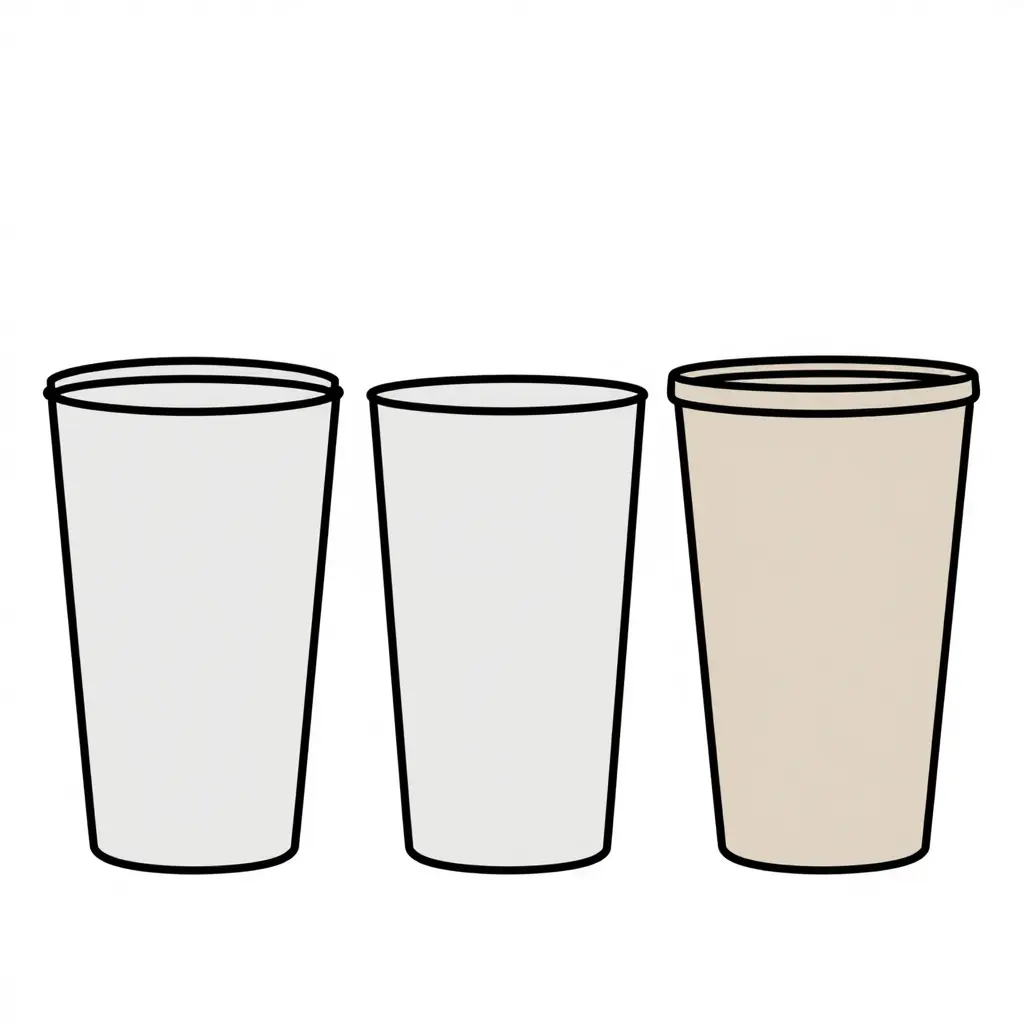
Reading the Diagram at a Glance
The drawing shows three rim profiles at the moment a sealing head comes down on the rim of a clear cup.
- Left – thin wall: the rim rolls inward the way a straw bends under a fingertip. The head presses, the wall gives, and the film meets an uneven surface instead of a flat ring.
- Middle – standard wall: the rim stays level, the film lands evenly all the way around, and contact looks clean and consistent. This is the geometry most bubble tea shops already seal every day.
- Right – heavy wall: extra thickness holds the rim flat and nearly immovable, so pressure spreads out rather than distorting the cup edge.
Rim rigidity comes from material thickness, not from pressing harder. A wall that flexes cannot give you even film contact no matter how well the machine is tuned, and that is why peel strength drifts when cup specs change between deliveries. Before your next order, hold a cup rim against a straight edge and press gently: watch whether it stays flat or bows.
The same straight-edge check works on paper cups, and our paper cup range covers those formats too.
How Wall Thickness Influences Seal Formation
The seal forms before the bar drops. Heat leaves the heating head, travels through the rim of the cup, and melts just enough of the sealing film to fuse with the plastic below it. Wall thickness sits directly in that path, and it moves results as much as temperature and dwell time do.
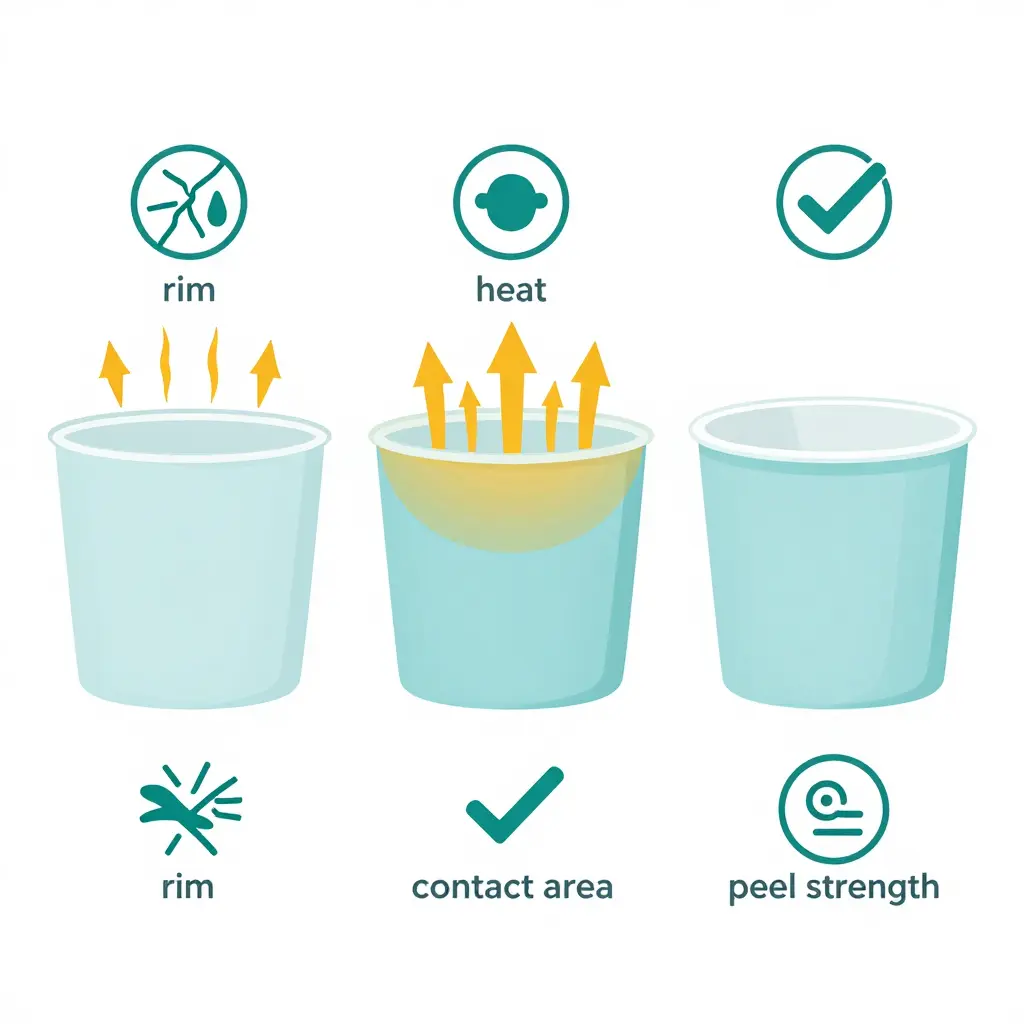
Heat has to travel through the rim first
When the sealing head presses down, heat moves from the hot bar into the film and into the cup rim. A rim that is too thin heats fast but cannot absorb and hold that energy, so the bond cools almost immediately and stays shallow. A rim that is too thick acts like a heat sink: it pulls energy out of the film before the film can fully melt. Both extremes leave a seal that looks fine on the surface and fails under a straw.
Contact area is where strength is actually built
The bonded zone is only as wide as the area where film, rim and heat meet at the same time. Consistent gauge means the rim flattens evenly under the sealing bar, so the full ring of the lip contacts the film at uniform pressure. That full-width contact is what turns into predictable film peel strength.
Dwell time and pressure are downstream settings
Gauge sets heat transfer, heat transfer sets melt depth, and melt depth sets how much dwell time and pressure you need. Thin rims want shorter dwell and lighter pressure, or the lip deforms. Thick rims need longer dwell and firmer pressure to push heat through. If you tune your cup sealing machine on one gauge and then switch cup suppliers, every one of those settings is now slightly wrong.
Why uneven or flexible rims create weak spots
A rim that varies in thickness, or that flexes when pressed, cannot deliver even pressure around the circle. Thicker segments under-heat; thinner segments over-heat and thin out further. The seal ends up strong in two places and marginal everywhere else. Those weak spots open first under vibration in transport, or when a customer pushes a straw through the film, and they are the failures that show up as leaks in a delivery bag.
A quick buyer check with tools you already have
- Measure gauge at four points. Use digital calipers on the rim at 12, 3, 6 and 9 o’clock on five cups from the same sleeve. Note the spread, not just the average.
- Check rim flatness with a straightedge. Lay a steel rule or the edge of a card across the lip and hold it up to a light. Any visible gap marks a high or low spot that will lose pressure during sealing.
- Run a filled-cup test. Seal cups filled with water at your normal settings, then press firmly on the film with your thumb. If the film stays taut and does not crinkle or give, the bond is holding.
- Do a hand peel. Peel the film back slowly at a shallow angle and watch the failure pattern. Clean, even resistance is a good sign; a seal that peels easily at one clock position is a gauge problem.
- Log the batch and supplier. Record the gauge spread and peel result next to the lot number, so a run of weak seals can be traced back to a specific delivery.
The takeaway
Match your gauge to your machine settings, insist on a flat and consistent rim, and peel strength stops being a surprise. If you are pairing cups with new lid and film formats, review the cup and lid options in our paper cup range before you lock in a sealing profile.
Wall Thickness versus Film Peel Strength: Practical Comparison
Two cups can look identical on the shelf and behave completely differently under a sealing head. The variable most buyers overlook is how much resin sits at the rim. A heavier wall soaks up heat and holds its geometry; a lighter wall passes heat through fast but softens quickly, which changes how the film grips, stretches and releases. The table below pulls those trade-offs into one view, so your team can line up cup stock and film stock before the next production run. If your menu also includes hot drinks, our paper cup formats need the same spec-first treatment.
| Wall category | Typical use case (bubble tea and cold beverages) | Rim rigidity under a sealing head | Expected peel strength behavior | Sealing temperature sensitivity | Best-fit film type | Procurement note |
|---|---|---|---|---|---|---|
| Light | Iced tea, cold brew, fast-turnover drinks | Some flex under pressure | Easy release, narrow tolerance | High: small changes show up fast | Thin, heat-sensitive sealing film | Verify every incoming lot |
| Standard | Classic milk tea, fruit tea, daily menu | Firm and even seating | Balanced, predictable peel | Moderate: forgiving working range | General-purpose laminated film | Safe default for mixed menus |
| Heavy duty | Large sizes, ice-blended, catering orders | Rigid, resists deformation | Strong hold, needs a clean tear tab | Low: prefers steady, higher heat | High-tack, heavier-gauge film | Confirm seal head pressure first |
How to read the table
Treat it as a starting point for a trial, not a substitute for one.
- Start with your heaviest drink. If large ice-blended cups dominate the menu, begin with heavy duty walls and work lighter, since a strong hold is easier to temper down than to build up.
- Match sensitivity to your equipment. Light walls leave little room for a fluctuating sealing head, so they suit operators with tight temperature control and steady line speeds.
- Judge peel by the customer experience. A seal should survive the car ride and still open without a struggle, so test peel with real drinks rather than water.
- Re-check after any supplier change. A new cup lot or film roll can shift behavior even when the specification looks unchanged.
What Film Peel Strength Means for Leak-Free Delivery
Film peel strength is the resistance you feel when you lift the film away from the rim of the cup: the force holding film to lip, expressed as the effort needed to pull it free. Too little grip and the lid gives way on its own. Too much grip and it fights back at the moment you least want it to.
Easy Peel vs. Tight Peel
An easy peel releases with light, steady pressure and lifts cleanly in one motion, which suits a customer opening a drink one-handed on a train platform. A tight peel takes real effort: the film clings, stretches, and often lets go suddenly once the seal breaks.
That difference is the whole trade-off:
- Too low: the seal fails in transit. A cup tips in a delivery bag, the film lifts a few millimeters, and the drink arrives on the carrier.
- Too high: staff and customers struggle to open the cup. When the film finally gives way, the sudden release can splash tea over hands, sleeves and tabletops.
How Operations Judge It Day to Day
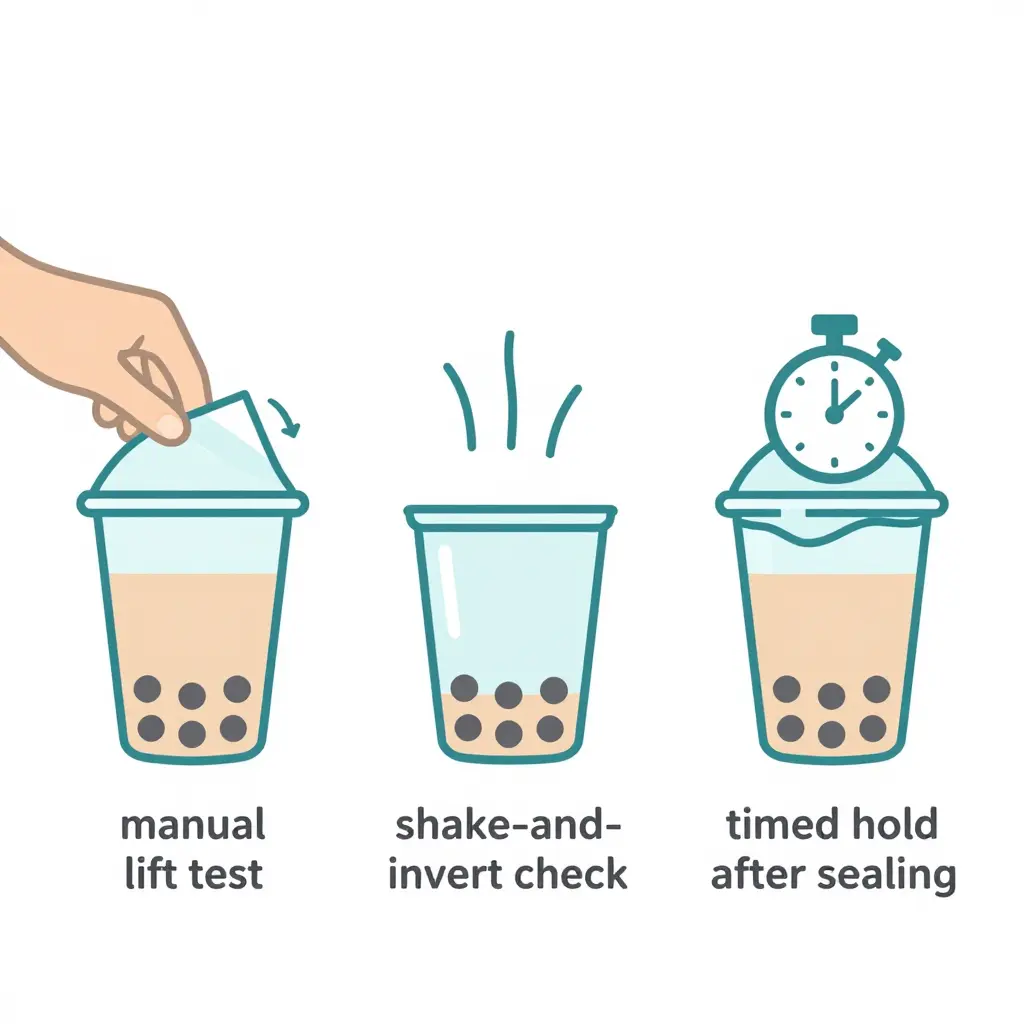
Most shops do not run lab tests. They rely on three quick habits:
- The manual lift test. Seal a sample cup, hook a fingernail under the film edge, and lift at a gentle angle. If it takes several determined tugs, or peels away with no resistance at all, the setting needs attention.
- The shake-and-invert check. Give a sealed cup a short, controlled shake, then hold it upside down for a few seconds. No weeping at the rim, no damp ring on the counter.
- The timed hold after sealing. Wait a set interval before packing or handing over the drink, so you confirm the weld has fully set and behaves the same way at minute one and minute ten.
All of this matters most with clear plastic cups, where customers see the seal as part of the product, and in bubble tea sealing, where heavy toppings press against the film from below. When you weigh cup formats for a new menu, compare them together with your film choices rather than separately, and check the paper cup line at the same time if you run one.
What the Peel-Strength Picture Looks Like Across Wall Categories
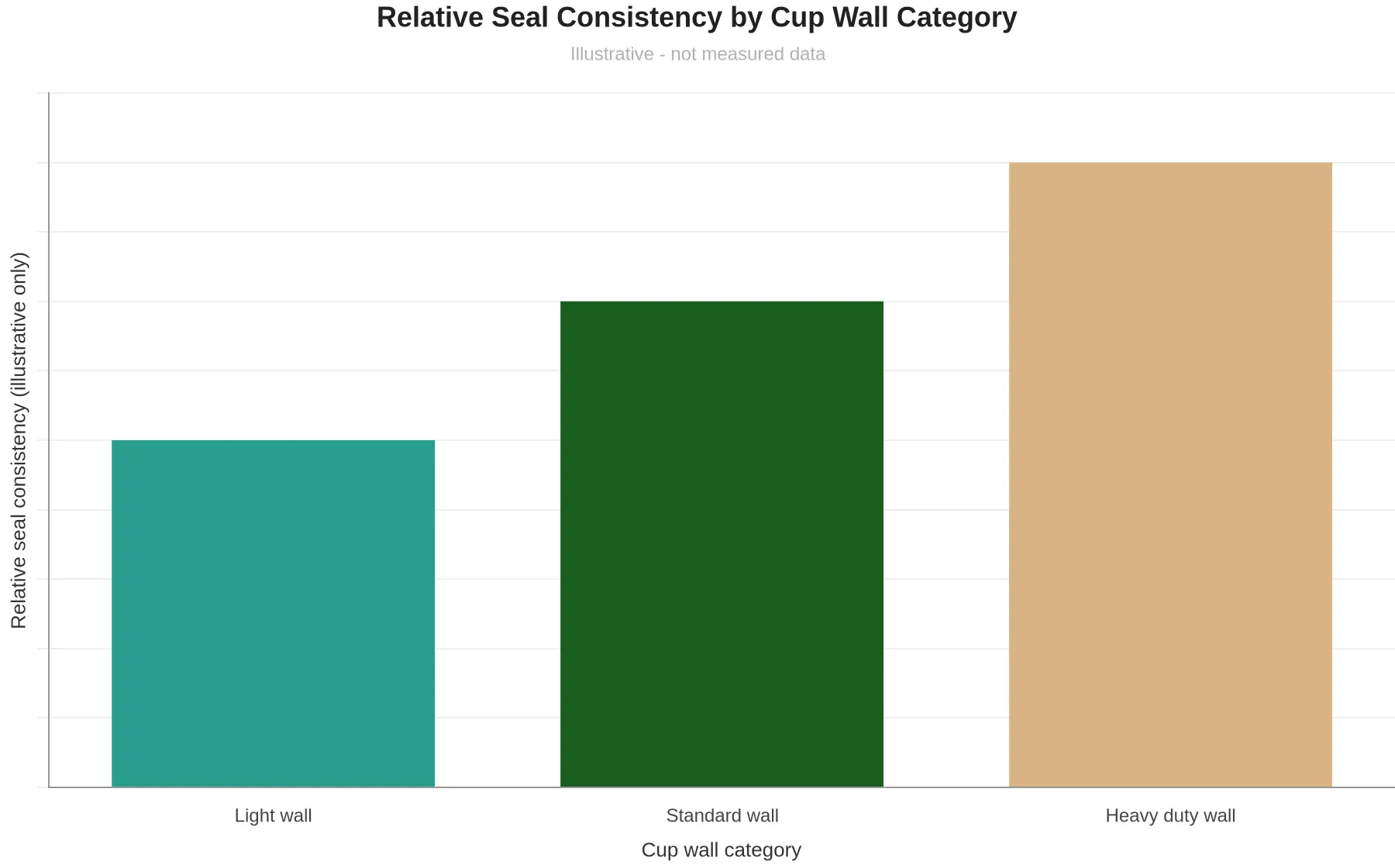
Chart caption: An illustrative comparison of relative seal consistency across light, standard and heavy duty cup walls under identical sealing settings. The bars show direction and pattern, not real measured values.
How to read it
The chart is a directional sketch, not a lab report. Same film, same heat, same dwell time; only the cup wall changes. What it illustrates is the trend most shops see on the line: a light wall gives you the least forgiving seal window, a standard wall sits comfortably in the middle, and a heavy duty wall holds its seal consistency highest because there is more material to absorb and spread heat evenly into the film bond.
| Wall category | Typical feel | What the pattern suggests about sealing |
|---|---|---|
| Light wall | Thin, flexible, light in hand | Narrower tolerance window; small machine changes show up fast |
| Standard wall | Balanced, the everyday choice in most shops | Predictable, repeatable seals across a long shift |
| Heavy duty wall | Rigid, substantial, premium in hand | Most forgiving seal consistency, especially at speed |
Why this pattern matters to a buyer
Peel strength is never just about the film. If you buy cups on price alone, a light wall looks like the bargain until your team is re-sealing a tray and your film spend creeps up through rework. Seal consistency is where your labor cost hides: a more forgiving wall category gives you a wider band of “good enough” settings, which matters most during rush hours, staff turnover, and hour six of a busy machine.
Use the shape of the bars as a buying question, not a number. Ask your supplier how their cup wall behaves when the sealing temperature drifts by a few degrees, and how the film bonds when the cup is filled with a cold, wet or creamy drink. Those are the conditions that decide whether your lids peel on the counter or travel cleanly in a delivery bag. If you also run hot drinks, compare our paper cup range on the same basis, and match wall thickness to the way your team actually works rather than the way a spec sheet reads.
One caveat: relative consistency is not a promise of absolute strength. Film grade, sealing head pressure, fill temperature and rim cleanliness can all move the result more than wall thickness alone. Treat this chart as a conversation starter with your supplier, then test your own cups and film on your own machine before you commit to a pallet.
A Sealing Checklist for Buyers
Whether you are ordering your first pallet of clear plastic cups or auditing a supplier you have used for years, a short, repeatable checklist saves you the slow bleed of leaky lids and remakes. Run through these ten points before you commit to a bulk purchase, and again at the start of each shift.
- Verify gauge readings on every incoming lot. Caliper-check cup diameter, height and rim thickness on at least ten samples per carton; out-of-spec cups either jam the sealing head or sit too low for the film to bond properly.
- Measure wall thickness at the base, middle and rim. Thin spots pull heat away from the seal zone faster than the rest of the cup, so uneven walls produce a mix of strong and weak seals in the same sleeve.
- Confirm rim flatness with a straight edge on twenty cups. A wavy or warped rim leaves a gap that no temperature setting can close, and the gap shows up later as a seal that fails under a full cup.
- Match film thickness to the cup grade you stock. Under-thick film tears at the straw point, while over-thick film needs extra dwell time and can scorch the print. Confirm the pairing before you scale up a purchase order.
- Inspect the sealing head before every shift. Nicked or carbon-baked Teflon and silicone pads spread pressure unevenly, which shows up later as partial seals that only fail once the drink is in the bag.
- Set temperature and dwell time per cup-and-film combination, not per machine. Drifting temperatures create seals that look perfect on the counter and open in a delivery bag twenty minutes later.
- Spot-check film peel strength on cooled samples. A steady hand-pull on five sealed cups tells you whether the bond survives shaking, straw piercing and a bumpy ride, and it is the fastest quality signal you have.
- Store cups and film in a dry, dust-free area off the floor. Moisture and grit interfere with adhesion, and film kept near a cold wall or open doorway can seal inconsistently for a whole shift.
- Rotate stock and use the oldest film first. Film adhesives lose tack with age, so dating rolls prevents the mystery failures that appear weeks after you blamed the machine.
- Run a five-cup pre-shift seal test. Seal, cool, then cut and peel each cup, logging the result before the first customer order goes out. It takes two minutes and pre-empts most complaints.
When you are ready to line up cups, lids and film as one system, compare foodservice cup options that match your sealer and volume.
Write your settings down. Keep a simple log by the machine (temperature, dwell time, film grade, cup batch) so that when a seal performs well you can repeat it exactly, and when one fails you can trace it back in seconds instead of guessing. Repeatability is what turns a good shift into a reliable operation.
Matching Cups with Lids, Films and Sleeve Accessories
A drink leaves your counter in four parts: the cup, the sealing film, the lid, and whatever sleeve or holder carries it. When those four work together, the seal survives the ride. When one is out of step, bubble tea sealing fails in the customer’s hand.
Film-to-cup diameter matching comes first
Start with the rim, not the body. Measure the outer diameter of the cup lip, because that is the only surface the film actually grips. A 90 mm rim needs a 90 mm roll: too narrow and the film stretches thin at the edges, too wide and you trap wrinkles and air pockets that peel open an hour later.
Rim condition matters just as much. Thin-walled clear plastic cups flex under the sealing head, so the sealing film cools against a surface that is still moving. Thicker walls hold their shape and give the adhesive a flat, stable landing. Match your film to the cups you actually stock, and if you also run paper cups for hot beverages, keep a separate spec sheet for that line instead of swapping rolls between them.
| Check | What to verify | If mismatched |
|---|---|---|
| Rim diameter | Film roll width equals cup lip OD | Tails, wrinkles, weak peel |
| Wall thickness | Rim stays flat under the sealing head | Creep and air channels |
| Storage | Cool, dry, sealed in original bag | Curling, spotty adhesion |
| Secondary lid | Snap-fit sits over the sealed rim | Rim crushed during stacking |
Why hot or humid storage ruins film performance
Sealing film is a coated product, and the coating does the work. Store rolls in a humid stockroom and the adhesive layer draws moisture, turns cloudy, and stops wetting out evenly across the rim. Store them next to an oven or a sunny window and the film softens, stretches under tension, and sags across the sealing head.
Either way you get the same symptom: spotty seals that look fine on the counter and leak twenty minutes later. Keep rolls in their original bag, below roughly 25 °C, off the floor, and rotate oldest first.
How lids and sleeves protect the seal afterwards
A good seal is strong in peel but surprisingly weak against sideways pressure, which is where accessories earn their keep. A snap-fit paper lid for takeaway drinks adds a rigid shoulder across the rim, so cups can be stacked and bagged without squeezing the film. A paper sleeve for hot and cold cups keeps hands off the bare wall and stops customers from flexing the cup as they drink, a common but easily missed cause of seal failure.
For delivery runs, sugarcane cup holder trays keep cups upright and separated, so nothing tips onto a neighbor’s lid. None of these parts fix a bad seal, but they stop a good one from being stressed to death.
If you can control only one variable, control the film-to-cup diameter match. Everything else is protection; that match is the seal itself.
Frequently Asked Questions
Does a thicker wall always mean a stronger seal?
No. Seal quality depends on how well rim geometry, film adhesive activation temperature, and the sealer’s pressure and dwell time work together. A thick rim can slow heat transfer to the film, so the adhesive never fully activates and peel strength drops. Check rim flatness and your sealer settings before assuming thicker is better.
Can a thin-wall cup work with heavy sealing film?
Yes, as long as the film is matched to the cup. Heavy film needs more heat and pressure to bond, and on a thin-wall clear plastic cup that extra energy can distort or crush the lip. Use a film gauge the cup can support, then confirm peel strength by testing sealed cups instead of relying on film specifications alone.
Why do seals fail on one side only?
One-sided failures usually point to uneven pressure or a tilted sealing head rather than the cup. Warped rims, cups not seated flat in the holder, or a worn gasket will each create a partial bond. Rotate the cup 180 degrees and re-seal to isolate whether the fault sits with the cup or the machine.
How do we keep peel strength consistent across busy shifts?
Hold the variables still: same cup SKU, same film roll, same dwell time, pressure and temperature, verified at shift start and again mid-peak. Pull a test cup every 30 to 60 minutes and log the result. Most drift comes from switching film rolls mid-shift or letting the sealing plate cool between rushes.
Do eco-friendly or alternate-material cups change film requirements?
Yes. Plant-based and coated cups often need a specific film formulation because the rim surface behaves differently from standard PP or PET bubble tea sealing setups. Confirm the film is rated for that substrate and re-run peel tests, since a film that bonds perfectly to one cup may peel cleanly off another. If you are weighing plant-based options alongside your current line, review these plant-based sugarcane cups before finalizing film specs.
Conclusion: Set the Rim First, Then Measure the Seal
Three things are worth carrying into your next order:
- Wall thickness sets the rim conditions for sealing. A sturdier wall resists the heat and pressure of the sealing head, so the rim stays flat and the film makes even contact. A wall that is too thin deflects slightly, and the seal lands unevenly no matter how carefully the machine is dialed in.
- Film peel strength is the measurable result. Once the rim is right, peel strength tells you what actually happened at the interface: whether the bond will survive a delivery bag, a straw push, or a cup tilted sideways in a carrier. It is a number you can test, log and compare batch to batch.
- Consistency comes from routine testing, not guesswork. Sealing performance drifts with cup lots, film rolls and machine temperature. A short, repeatable test schedule catches that drift early, while “it looks fine” catches it only after a customer does.
For clear plastic cups used in bubble tea sealing, the order of operations is straightforward: choose the cup by its rim specification, validate the film against that rim, and re-check both whenever either one changes.
Our Manufacturing and Supply Capability
We manufacture and supply disposable tableware, packaging paper and boxes for beverage shops, restaurants, food trucks, catering services and event procurement teams. Our work centers on safety, durability and eco-friendly practices, with support for buyers who need specification guidance, samples or repeat orders.
Drink programs that need dependable cup handling often pair their cups with paper cup holders for multi-drink trays and carriers. Teams widening their range can also look at sugarcane cups as a plant-based alternative, and browse our paper packaging selection for lids, sleeves, napkins and boxes that complete the serve.
If you are weighing cup wall thickness against film peel strength for your own line, you can review the range on greendispopack.com and compare specifications directly.