
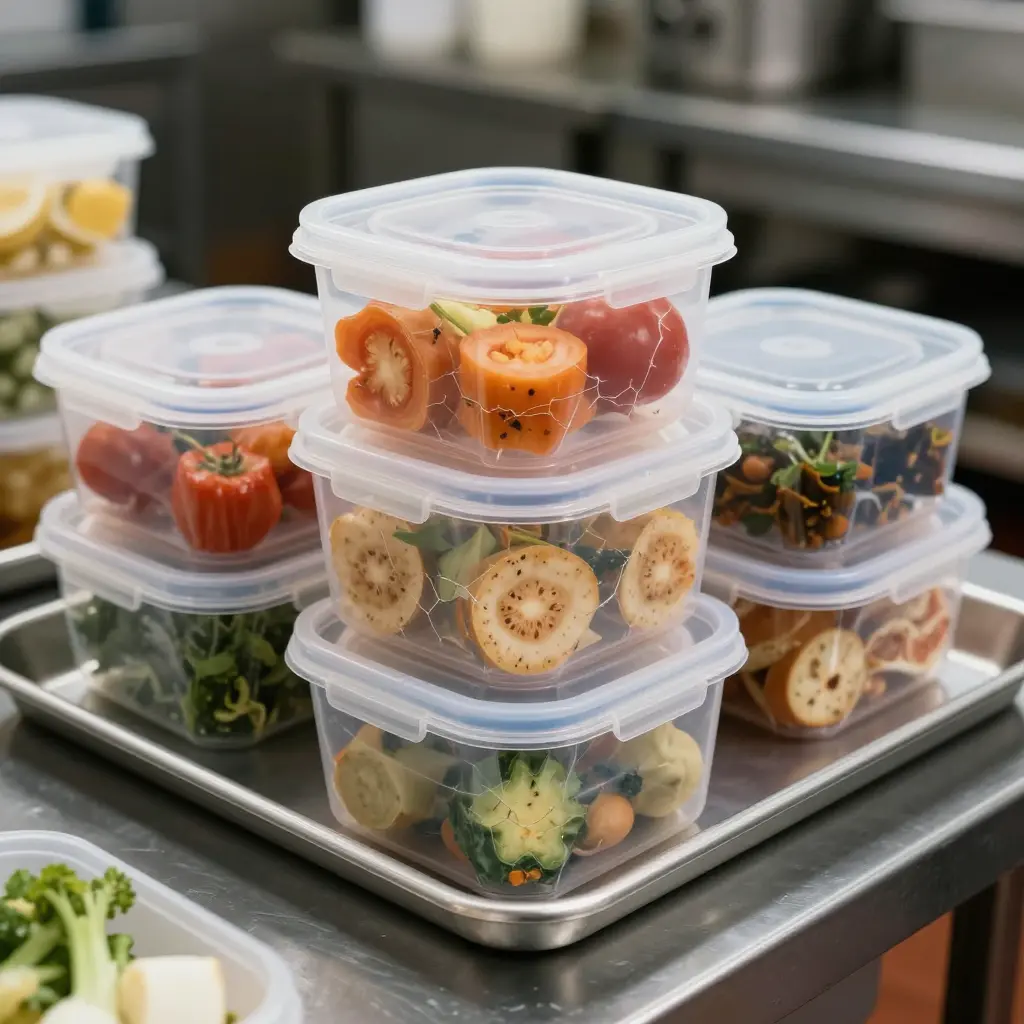
3 Compartment Plastic Food Containers: Tray Weight vs Crack Resistance in Central Kitchen Catering
A cracked tray at the bottom of a delivery bag announces itself as sauce on everything underneath. That failure, rather than the spec sheet, is the subject here: how tray weight and crack resistance relate in 3 compartment plastic food containers, and how to use both figures when you write a purchase order.
The teams we hear from pack and move food at volume: bubble tea shops and beverage chains, restaurants, food trucks, caterers, event planners and corporate procurement teams. They all buy disposable food containers on the same bet, that the tray survives stacking, transport and reheating without becoming someone else’s mess.
The short answer is no on both counts: a heavier tray is not automatically stronger, and a lighter one is not automatically fragile. Geometry and resin grade decide crack resistance at least as much as gram weight does. A well-ribbed 18 g tray with rounded corners can outlast a flat 26 g tray that splits along the base seam the first time it is squeezed.
So we treat tray weight as one data point, not a quality score. The same logic carries across other multi-compartment disposable food containers, where wall thickness, corner design and lid fit usually matter more than the number on the spec sheet.
How Tray Weight and Crack Resistance Interact
Two trays that both scale at 32 g can behave nothing alike, because the grams sit in different places: wall thickness, divider ribs, flange, base. One flexes gently and springs back. The other hairline-cracks at a corner the first time a loaded stack lands on a steel prep table. That is why buyers who specify multi-compartment food containers for a living compare structure rather than grams.
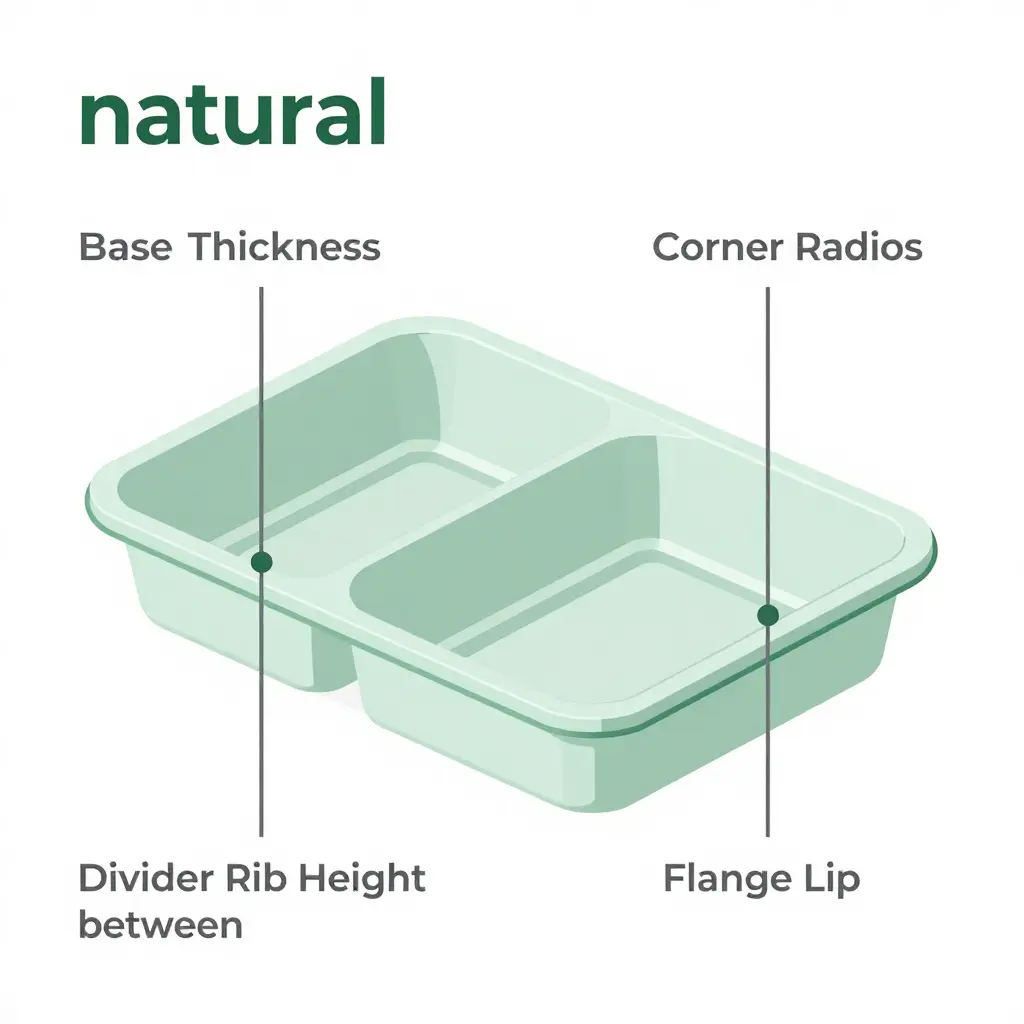
The Four Structural Levers
Base thickness comes first and is the most obvious lever. A thicker floor resists bowing under a heavy scoop of rice and curry. Extra grams spent only on the base do very little for the corners, though, and the corners are where stress concentrates.
Corner radius decides how that stress spreads. Sharp 90-degree corners create tight stress risers and crack first; a generous radius lets the polymer bend and distributes load across a wider arc, usually at almost no extra weight.
Divider rib height controls how the tray behaves as a whole. Taller, well-drafted ribs turn three separate wells into one stiffened beam, so the tray resists twisting when it is lifted from a single end on a crowded pass.
The flange lip is the handshake between tray and lid. A rolled or double-wall lip stiffens the rim, holds the lid sealed under stacking pressure, and stops the curl from splitting when the tray is snapped shut.
What Weight Tells You, and What It Doesn’t
- It tells you roughly how much polymer is in the tray, and usually how it feels in the hand and holds shape when filled.
- It does not tell you how that polymer is distributed across base, ribs, corners and rim.
- It says nothing about grade. A lighter tray moulded from high-grade, properly dried PP resin with impact modifiers can outlast a heavier one made from regrind.
- It ignores processing. Cooling time, mould design and moisture control can leave internal stress that only shows up after chilling.
Temperature and Food Acidity in Central Kitchen Use
Temperature swing is where crack resistance really gets tested. Trays filled hot at around 85 °C and then moved into 0-4 °C chilled transport shrink at different rates in thick and thin zones, and each hot-fill-to-chill cycle leaves the polymer a little more brittle. Acidic sauces (tomato, vinegar dressings, citrus) are the second stress source: in lower-grade PP plastic food containers they show up as faster stress cracking, while trays moulded from food-grade virgin resin with impact modifiers tolerate a month of daily cycling far better. Gram weight captures none of this.
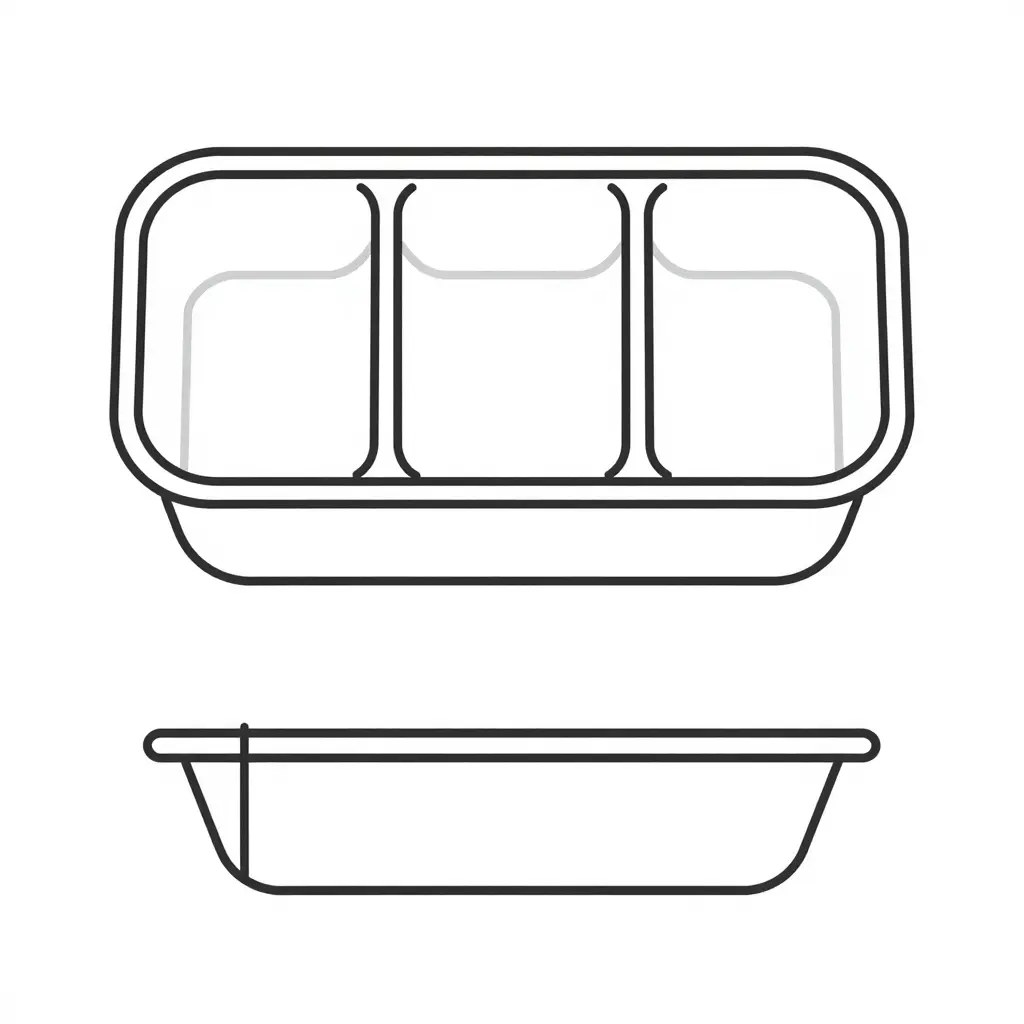
The drawing shows the trade-off in two views. On top is the outline of a three-compartment tray, the two divider ribs acting as small beams that tie opposite walls together. The cross-section underneath traces the load path: wall thickness as a double line, the divider rib standing as a vertical brace, the rounded corner softening stress concentration, and the flared lip stiffening the rim the way a folded edge stiffens paper.
Read it as a map of where material earns its keep. A tray that puts its grams into ribs, corners and flange resists cracking far better than one that simply pours plastic into flat wall panels. If you are still comparing formats for a catering menu, our multi-compartment range is built on the same principle.
Reading Tray Weight in Tiers, Not in One Number
Ask ten suppliers for the tray weight of a 3 compartment plastic food container and you get ten numbers with no shared scale. Read the figure in tiers instead, the way most central kitchen catering teams spec packaging: light, mid, heavy, each doing a different job. The ranges below are the ones used for the rest of this article.
Light Tier (roughly 18-22 g per tray)
Light compartment trays flex at the rim. Lid fit is snug but forgiving of slight misalignment, which speeds up hand-packing. They stack very high and behave well on a cold prep line; carry one loaded, one-handed, and it bows. Best for cold dessert, toppings and small-portion prep.
Mid Tier (roughly 24-30 g per tray)
The workhorse. Sidewalls hold their shape under a full fill, lids seat with a clean click, and stacks stay stable eight to ten high. Assembly, chilling and transport need almost no babysitting.
Heavy Tier (32-40 g and up)
This is where heavy-duty catering trays live: thicker walls, reinforced corners, lids that resist popping under load. They stack lower, but they survive protein-heavy portions, sauces and repeated kitchen-to-van-to-buffet handling. Above them sits the ultra-heavy band at 45-60 g, for long-haul chilled or frozen freight and bulk event stacks.
Weight Only Means Something With Dimensions
A large footprint at low weight flexes more than a small footprint at the same weight, because the material is spread thinner across a longer span. Pair tray weight with length, width and depth, and compare trays at similar footprints, or the number misleads you.
Who Buys Which
Beverage chains live in the light and mid tiers: cold dessert, pudding and topping prep where the tray never carries much mass. Catering services handling protein-heavy portions drift upward. If you are still choosing a format, these multi-compartment trays show how compartment layout and wall thickness scale together.
| Tier | Rigidity | Lid fit | Stacking | Best use |
|---|---|---|---|---|
| Light | Flexible rim | Snug, forgiving | Very high | Cold dessert, toppings |
| Mid | Holds under fill | Clean click | 8-10 high | Mixed hot and cold prep |
| Heavy | Reinforced corners | Load-resistant | Moderate | Protein-heavy catering |
Tray Weight vs. Crack Rate at a Glance
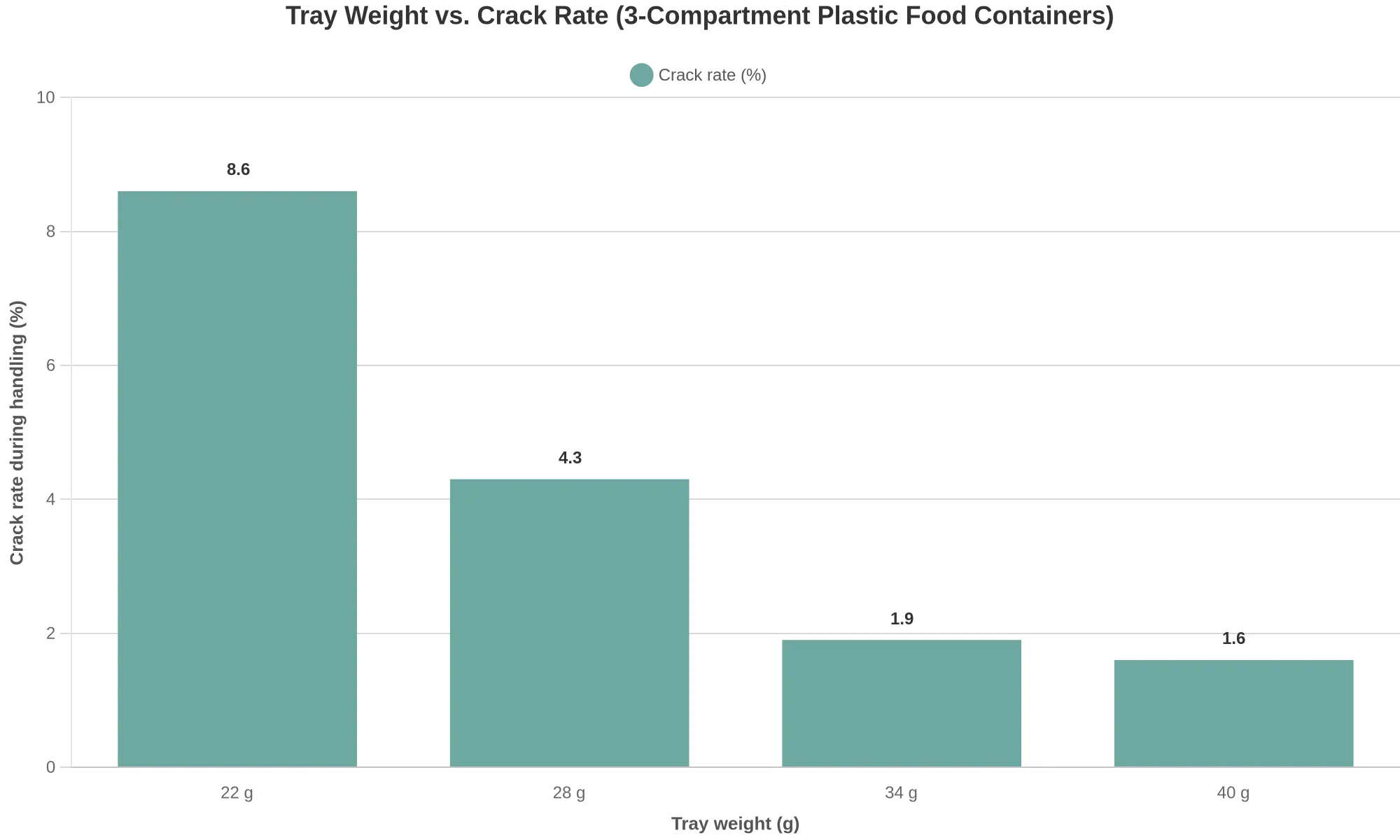
Each bar below is one weight from those ranges, and its height is the share of trays that cracked during ordinary central kitchen handling: packing, stacking, transport, pass-through.
How to Read It for Your Order
- 22 g to 28 g (8.6% to 4.3%): six more grams roughly halve the crack rate. That is the single biggest jump on the chart, and the cheapest quality you will ever buy.
- 28 g to 34 g (4.3% to 1.9%): another six grams cut failures by more than half again. For central kitchens pushing loaded trays through stacked transport and hot holding, this is the sweet spot.
- 34 g to 40 g (1.9% to 1.6%): six extra grams buy a 0.3 percentage point improvement. That plateau is the diminishing-returns zone: more plastic, more cost, more waste, no meaningful change in breakage.
The Procurement Takeaway
Pay for rigidity where it changes the failure curve, not for maximum thickness. If your operation handles trays gently over short distances, 28 g may already be enough. If trays are stacked deep, chilled, then reheated with sauce-heavy loads, 34 g is usually the last stop worth paying for. Suppliers often quote weight per tray without saying so plainly, which is why you should ask for the gram figure before comparing prices; if you are also weighing compartment layouts, put our multi-compartment food containers beside your plastic baseline.
One caveat, and it matters: weight only predicts crack resistance when material grade and design are comparable. A well-ribbed 28 g tray can outperform a poorly designed 36 g one, so treat the chart as a guide to where the plateau starts, not a guarantee.
Where Cracks Actually Start
Cracks in 3 compartment plastic food containers rarely start in the middle of a flat panel. They start at three predictable spots, and each one is a design decision rather than bad luck.
- The outer wall corner. A sharp, square corner has nowhere to send stress, so it piles up in one small area. Under a stack of trays, that corner splits first.
- The joint where a divider meets the base. Dividers carry load from the tray above. If the joint is a thin, abrupt wall instead of a filleted (smoothly curved) base, it flexes every time the tray is lifted and cracks along the seam.
- The flange edge the lid snaps onto. The rim takes repeated bending during lidding. A thin flange, or one with a sharp lip, gives you a crack line and a lid that no longer seals, which is how a leak-resistant tray starts leaking.
Three factors decide which of those spots fails first: corner radius (how round the inside corner is), rib depth (how tall the stiffening ridges are), and resin consistency (how evenly the plastic is melted and packed). A generous radius spreads pressure, shallow ribs leave the base unsupported, and uneven resin leaves cold spots that crack before the rest of the tray does.
That is how a heavier tray with thin corners ends up failing before a lighter tray with well-radiused corners. The mass was there; it just sat in the wrong place.
Checks you can run without a lab. Load a sample tray, lid it, drop it from waist height onto a hard floor, then inspect the corners and the flange, not the middle. Next, stack filled trays five or six high, leave them a few hours in a warm room, and look for bowing and hairline splits at the divider joints. Both tests take minutes and tell you more than a spec sheet.
For trays built with those three stress points in mind, see our multi-compartment disposable food containers.
Gram Weight Against Load: The Reference Numbers
Weight is still the fastest proxy for crack resistance in central kitchen catering: heavier walls mean fewer split corners through hot filling, chilled transport and multi-stop delivery, and also higher unit cost and freight. Use the table to match gram weight to the job. Running fibre or multi-compartment food containers instead? Test them against the same numbers before you commit.
| Tray Weight Tier | Typical Gram Range | Expected Crack Resistance | Best Suited Operation |
|---|---|---|---|
| Light | 18 – 22 g (0.63 – 0.78 oz) | Flexes at the rim under ~2 kg top-load; safe stacking height of 4 – 5 trays; corner drop from 0.9 m splits roughly 1 in 8 units; rim warps above 65 °C | Cold prep assembly, grab-and-go salads, dessert and side sets for beverage chains; no hot fill |
| Mid | 24 – 30 g (0.85 – 1.06 oz) | Holds 3 – 4 kg top-load; stacks 8 high with lid seated; survives 8 of 10 corner drops at 0.9 m; tolerates 75 – 85 °C fill after a 5-minute rest | Standard hot filling at 75 – 85 °C, chilled transport in 4 – 6 hour windows, mixed-menu central kitchen runs |
| Heavy | 32 – 40 g (1.13 – 1.41 oz) | 5 – 6 kg top-load; clean at 1.2 m corner drop; no rim warp when filled at 85 – 95 °C; transit split rate under 1% | High-volume hot filling lines, multi-stop delivery of 6+ stops over 2 – 3 hours, rice, curry and gravy trays |
| Ultra-Heavy | 45 – 60 g (1.59 – 2.12 oz) | 8 – 10 kg top-load; 12-high stacking without lid creep; 1.5 m drop tested; freezer-to-95 °C fill tolerant; in-transit breakage under 0.3% | Long-haul chilled or frozen transport, bulk event catering stacks, sauce-heavy combos, corporate multi-course delivery |
Takeaway: lighter trays cut resin cost and freight, heavier trays buy crack resistance. Choose the lightest tier your hot-fill temperature and delivery route can survive.
A Procurement Checklist for Compartment Trays
Before you hit reorder, walk your sample lot through these checks. Five minutes of verification is cheaper than a week of cracked lids and soggy deliveries.
- Weigh ten trays from the carton on a kitchen scale and log each result against the declared spec, flagging any tray weight that drifts beyond ±5% as a hint of thinner walls.
- Run a fingertip and a soft gauge along every cavity’s corner radius to confirm smooth, equal arcs; consistent radii are what protect crack resistance at the seams.
- Snap the lid on, lift the loaded container by its lid edge five times, and check for creeping hinges or white stress lines at the rim. It is the same pass-fail test we apply to our own multi-compartment trays.
- Stack loaded compartment trays six high on a flat trolley for thirty minutes, then measure side-wall bulge and sag before approving the batch. Mirror the test on our boat trays if your menu also runs sides.
- Confirm the rated temperature window by cycling one sample through your blast chiller and warmer, making sure the range matches how you actually handle these disposable food containers.
- Request supplier documentation, including food-contact certification, resin grade and batch traceability, and file it with the purchase order for your next audit.
The Tray’s Journey, at a Glance
A filled tray passes through six stages in a central kitchen, and each stage is a chance to crack it. The diagram below lays out the sequence without any lettering, so the whole workflow reads in one look.
Left to right: filling, lidding, stacking, holding (chilled or heated), transport, and handoff. Six touches, six chances for a crack to start, and every stress point in this article maps back to one of them.
Matching Tray Weight to Your Menu and Service Model
Spec-sheet numbers only become useful once they meet your service conditions. How tray weight and crack resistance interact shifts with how far a filled container travels, how high it is stacked, and who handles it along the way. What that means in an actual order, buyer group by buyer group:
Bubble Tea Shops & Beverage Chains
For most beverage-led operations, the food tray is a supporting player. A mid-weight line of 3 compartment plastic food containers covers snack combos and small hot items well, while the larger share of the packaging budget goes to drinkware. Plan trays and drinks as one unit: pair them with a well-fitted paper cup and a matching paper lid, so a cup-and-tray order leaves the counter stable and easy to carry. The compromise to accept is skipping the heaviest gauge when the food never leaves the store.
Restaurants
Restaurants usually carry two jobs at once: dine-in sides and off-premise orders. Splitting the purchase works better than averaging it. Mid-weight trays suit dine-in service and short delivery runs, while heavy-gauge stock belongs in central kitchen catering dispatch, where trays sit stacked in insulated bags for hours. Crack resistance is what protects you there, because a tray that flexes under a stack tends to fail at the seam rather than the base.
Food Trucks & Catering Services
Vibration, tight storage and fast handoffs make this the group with the least tolerance for failure. Lean toward higher crack resistance even at a slightly higher unit cost: heavy gauge for hot, sauce-heavy dishes, lighter stock only for cold or dry sides. For grab-and-go items that do not need compartments, kraft paper boxes are the lighter option on the shelf.
Event Planners & Corporate Procurement Teams
Volume orders pass through more hands, so consistency matters more than the lowest unit price. A mid-to-heavy mix handles third-party loading and buffet-line service, and paper boxes with clear lids allow fast visual checks during plated or boxed service. Request a sample run at your expected stack height before committing to a full order.
Sizing the Mix, and Where to Compromise
| Share of order | Weight tier | Typical use |
|---|---|---|
| 50-60% | Mid-weight | Cold sides, dine-in, short runs |
| 25-35% | Heavy-gauge | Hot, sauce-heavy, stacked transit |
| 10-15% | Light | Dry items, low stacking |
Compromise on weight for cold and dry items, never on lid fit or corner strength. And avoid single-tier ordering, which over-specifies simple dishes while under-specifying the risky ones.
Frequently Asked Questions
Does a heavier tray always mean better crack resistance?
Not always. Weight helps, but resin quality, wall thickness and corner geometry matter more. A well-designed mid-weight tray with rounded corners often beats a heavy, brittle one, so judge crack resistance by testing rather than by tray weight alone.
What tray weight suits hot filling versus cold filling?
Hot filling needs a thicker gauge because steam softens the polymer and lids clamp down; 28-32 g trays usually work. Cold or chilled dishes, including bubble tea snacks and salads, run safely at 20-24 g. Match tray weight to temperature and holding time.
How do we test crack resistance before placing a bulk order?
Request samples and run a drop test from 1.2 m with typical fill weights, then stack 24 hours at 40 °C to check deformation. Repeat ten times per SKU. Ask suppliers for resin data and seal integrity reports, so crack resistance is proven before your central kitchen catering order ships.
Can 3 compartment plastic food containers be stacked during multi-stop delivery?
Yes, if lids are flat and fully seated. Limit stacks to five or six units, keep the heaviest at the bottom, and use dividers between layers. Trays with reinforced rims hold their shape well, which is what protects crack resistance across multi-stop central kitchen catering routes.
How do compartment trays compare with sugarcane and paper alternatives?
3 compartment plastic food containers win on hot, saucy dishes and repeated stacking. Sugarcane clamshell boxes handle ovenable and freezer use, while paper sleeves suit cutlery and condiment packing. Choose on heat, grease and transport, and confirm tray weight and crack resistance on samples first.
Choosing Tray Weight with Confidence
Tray weight earns its place at the quotation stage. It is quick, it sits on the spec sheet, and a supplier who will not state the gram figure is hiding something. What it cannot tell you is whether a container survives a rush hour of stacked, sauced, jostled meals. Corner radius, rib design, resin grade and lid fit decide that, and the only reliable judge is a filled sample you have stacked and dropped yourself.
The tier logic then follows from your worst day, not your average one. Light trays suit low-load, short-distance service where cost per unit dominates; mid-weight trays carry the standard fills and moderate stacking of most central kitchen catering routes; heavier, rib-reinforced trays take the dense, hot, tall-load deliveries where flexing is the enemy.
For a repeat order, keep a reference sample from your last approved batch and run a fill-and-stack comparison against the new shipment before the full run ships, noting weight, lid seating and any corner cracking. To see how rib patterns differ between ranges, compare options across our multi-compartment sugarcane food containers.
As a manufacturer and supplier of disposable tableware, packaging paper and boxes, we build our ranges around safety, durability and eco-friendly practice, and our team answers specification questions quickly. Send us your filling weights and stack heights and we will match them to a tray specification that holds up in transit.