
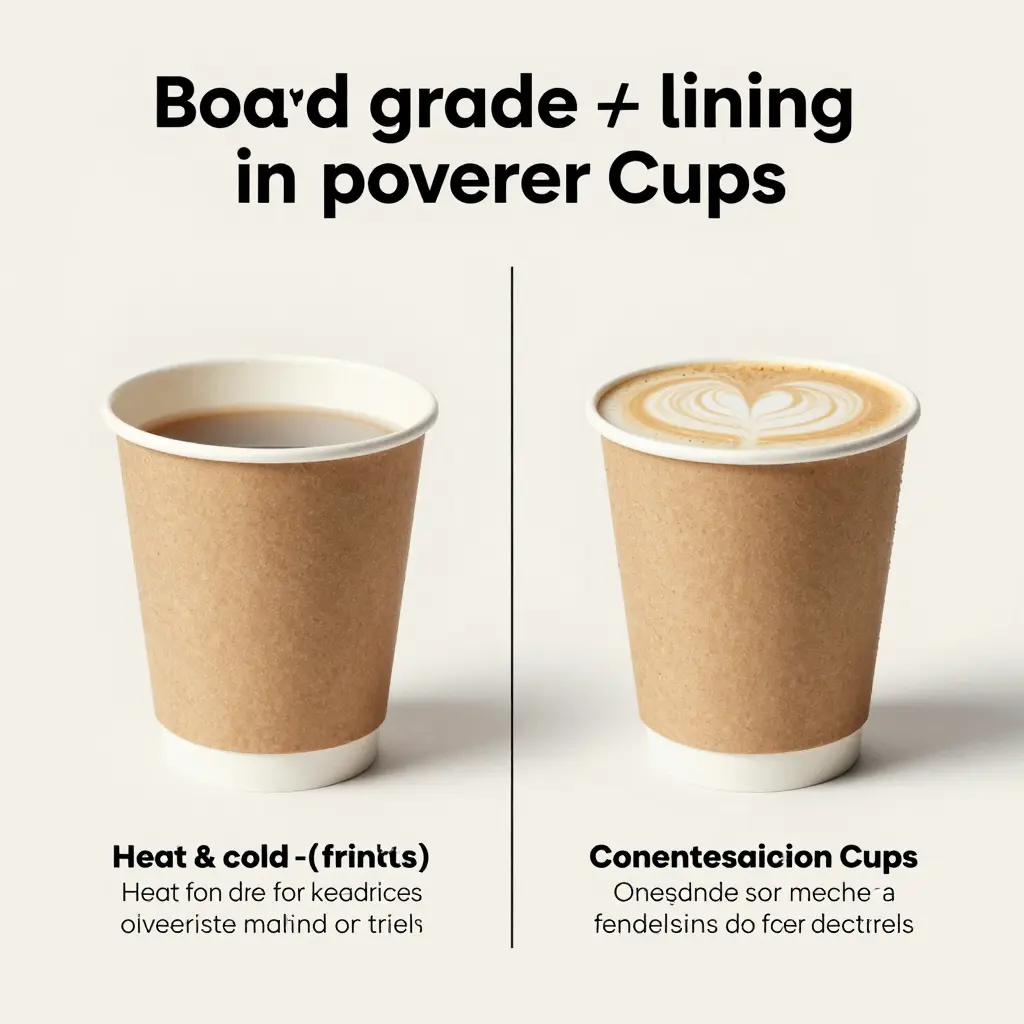
Two Drinks, Two Very Different Cup Problems
A hot cup and an iced cup fail in different ways. Hot drinks lose heat through the wall and buckle once the fiber softens. Iced drinks sweat on the outside, and every unsealed edge gives that water a route into the board. Two specifications decide how well a cup copes with either job: board grade and lining coverage.
Board grade is the structural decision. Heavier, denser board holds heat longer and stays rigid when a hot drink softens the fibers, so the hold time you promise at the counter should set the grade you order. Go too thin and the cup feels flimsy in the customer’s hand before they reach the door.
Lining coverage is the barrier decision, and on cold drinks it does more work than most buyers expect. Full coverage seals the whole interior, rim and base seam included, so neither the drink nor the condensation running down the outside has bare fiber to soak into. Partial coverage saves money on cups that never see ice. On an iced line it shows up as soft walls, lids that lift, and rings on the table.
| Variable | What it governs | Typical failure |
|---|---|---|
| Board grade | Heat retention and rigidity | Flimsy feel, fast heat loss |
| Lining coverage | Barrier at the seam and rim | Soft seams, leaking lids |
Running both sides of the menu is simpler when the two numbers come off a single spec sheet: one supplier, one grade, one paper cup range that behaves the same whether you fill it with espresso or cold brew.
Board Grade: The Structural Side of Heat Retention
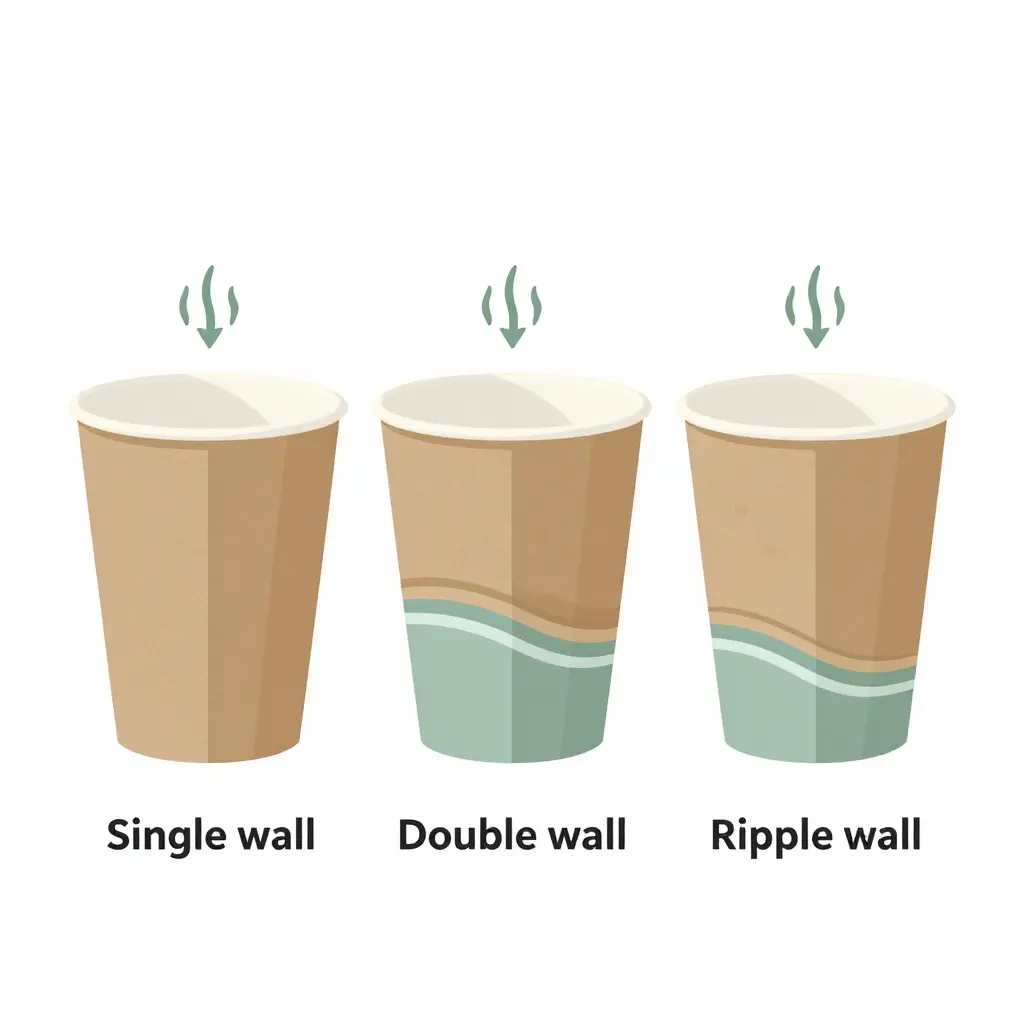
Board grade is how much fiber sits between the drink and your fingers. It is quoted as GSM, grams per square meter, while caliper measures the same thing in a different unit: the actual wall thickness. Higher GSM usually means more caliper, which means more fiber and more trapped air for heat to cross. The wall works like a thin blanket, and a thicker one slows the heat on its way out. That is why board grade sets insulation before the lining enters the picture.
A light single-wall cup, around 190 to 240 GSM, is thin and light in the hand. Heat moves through it quickly, and most hot drinks in this format need a sleeve.
A mid-weight single-wall cup, roughly 260 to 300 GSM, holds heat noticeably longer. It still sits close to the drink, so the gain is steady rather than dramatic.
A heavy single-wall cup at 320 to 350 GSM adds fiber again, which shows up in large fills and long holds.
Double-wall cups add a second board layer with an air gap between the layers. Air conducts heat poorly, so the gap does quiet, effective work, and the outer wall stays comfortable to hold. Ripple-wall cups go further and replace the flat outer layer with a corrugated one, whose pockets of air do the same job over more surface area.
| Construction | Typical board (GSM) | Wall thickness (approx.) | Heat retention |
|---|---|---|---|
| Light single wall | 190-240 | 0.30-0.36 mm | Low, sleeve often needed |
| Mid-weight single wall | 260-300 | 0.40-0.46 mm | Moderate |
| Heavy single wall | 320-350 | 0.48-0.54 mm | Good |
| Double wall | 230-280 inner plus 250-300 outer | 1.0-1.3 mm including air gap | High |
| Ripple wall | 230-280 plus corrugated layer | 1.3-1.6 mm including flutes | High, with a cooler outer surface |
So board grade is mostly a hot-drink number. It does little for a cold drink, where a drink warming up is the smaller problem and condensation is the larger one, and condensation happens at the surface rather than through the mass of the wall. A sweaty cup drips because moisture in the room air condenses on the chilled outer wall. Extra fiber does not stop that, and once the board is wet it can hold dampness longer. Lining and lid handle cold cups; board grade handles the warm ones.
If you want to compare wall builds across formats, the paper cup range sets board grade and size side by side.
See the wall before you read the numbers
Grams per square meter and coating heights are easier to judge once you can picture what is actually stacked inside the cup in a customer’s hand.
The diagram shows two simplified cross-sections of a paper cup wall. On the left, a fully lined wall: the thick outer board, the thin lining film and the drink-side surface, in three bands side by side. On the right, the same wall with a lining that stops partway up. The arrows carry the point. Heat leaves through the exposed board on the outside, and moisture creeps back into that board from the inside.
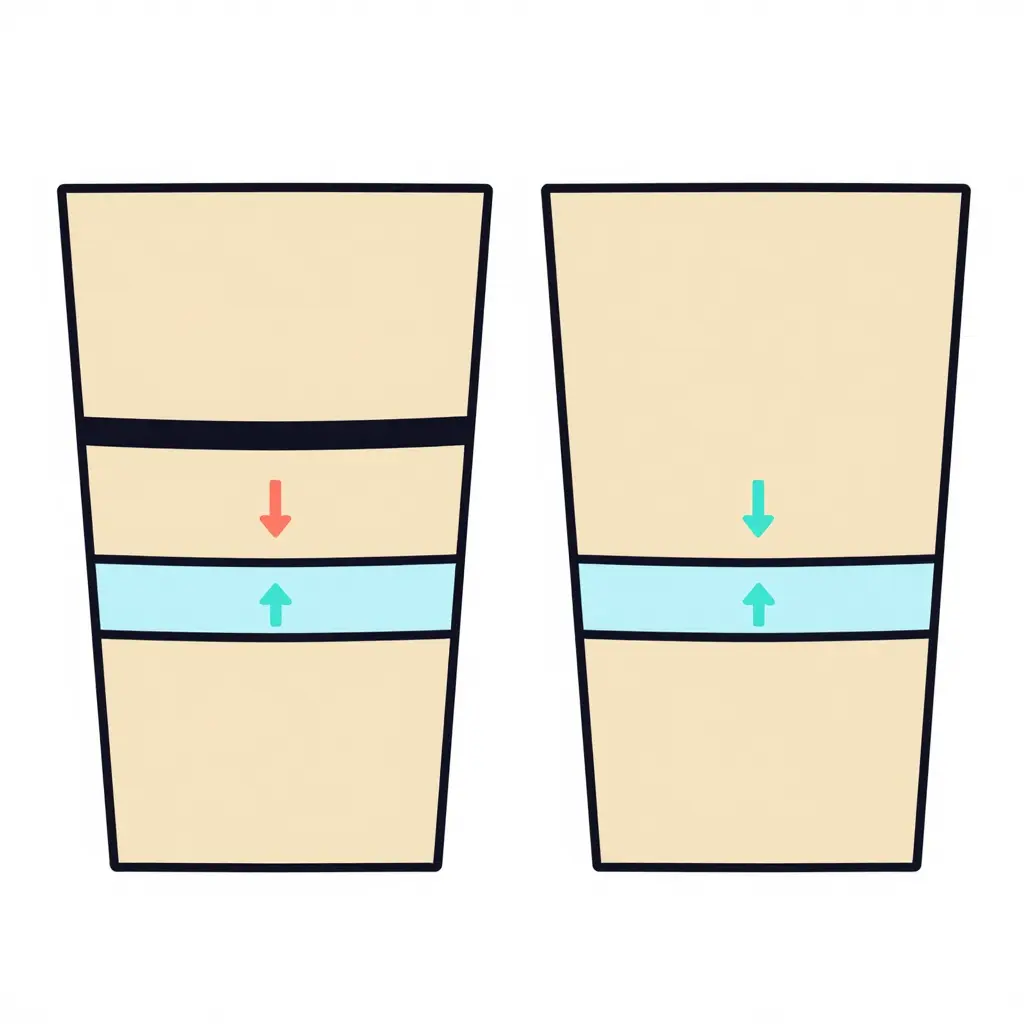
Board thickness decides how rigid the cup feels and how well it holds heat at the start. Lining coverage decides how much liquid and steam ever reach the board. A thick cup with a short lining still softens at the seam, and a thinner cup with full coverage often comes through a long delivery run better. For a mixed drinks menu, the paper cup range is where the wall grades sit beside each other.
Board grade also has to match hold time. The hotter the fill and the longer the drink sits, the more insulation the wall has to deliver.
| Board grade profile | Best suited drink type | What it delivers |
|---|---|---|
| Light single-wall board (around 190 to 240 gsm) | Iced coffee, iced tea, sodas and cold brew served fast | Lowest cost per cup for high-volume cold menus, easy-grip rigidity even at a full fill, quick stacking behind the counter |
| Mid-weight single-wall board (around 260 to 300 gsm) | Short-hold hot drinks such as espresso, flat white or tea handed over within 10 to 15 minutes | Heat retention that covers a quick serve, steady wall rigidity without a sleeve, comfortable hand feel for dine-in and counter pickup |
| Heavy single-wall board (around 320 to 350 gsm) | Longer-hold hot drinks like large filter coffees, hot chocolate and catering batches | Stronger rigidity under a full fill, more consistent heat across the sip, less buckling and slower moisture buildup on the outside |
| Double-wall cup (two board layers with an air gap) | Hot drinks for delivery, drive-thru and event service | High heat retention across 20 to 30 minute holds, a cool outer wall for the hand, an insulation barrier that keeps condensation off the fingers, a sturdier feel |
| Ripple-wall cup (fluted outer layer) | Hot and cold drinks in busy queues, from lattes to bubble tea and specialty serves | Air-gap insulation for reliable heat retention, a non-slip grip, extra rigidity for tall builds, and an outer wall that works on iced lines as well as hot ones |
Read the two numbers off the same line of the spec sheet rather than from separate documents. A heavy grade with a thin lining still sweats, and a light grade with a full coating still feels flimsy once it is full. Match board grade, rim size and lid pairing to each drink line when you lock in a specification for a menu launch, and heat retention and condensation both stay predictable from the counter to the delivery bag.
Lining Coverage: The Barrier That Controls Condensation
Lining coverage describes how much of a cup’s interior is sealed by the PE or water-based barrier layer. Two cups can use identical board and behave completely differently at the counter, purely because one is coated to the rim and the other is not. The barrier layer is a raincoat for the board; coverage is how far up the raincoat reaches.
Paper cups are converted in three common configurations. Full-coverage lining seals the entire interior, from the base seam to the top edge of the rim, leaving no bare fiber exposed to the drink. Side-wall-only lining coats the main body and stops short of the rim, which keeps converting costs down. Bottom-seam-only sealing protects the base join and leaves most of the wall unlined. Only the first keeps moisture away from every part of the cup the drink can reach.
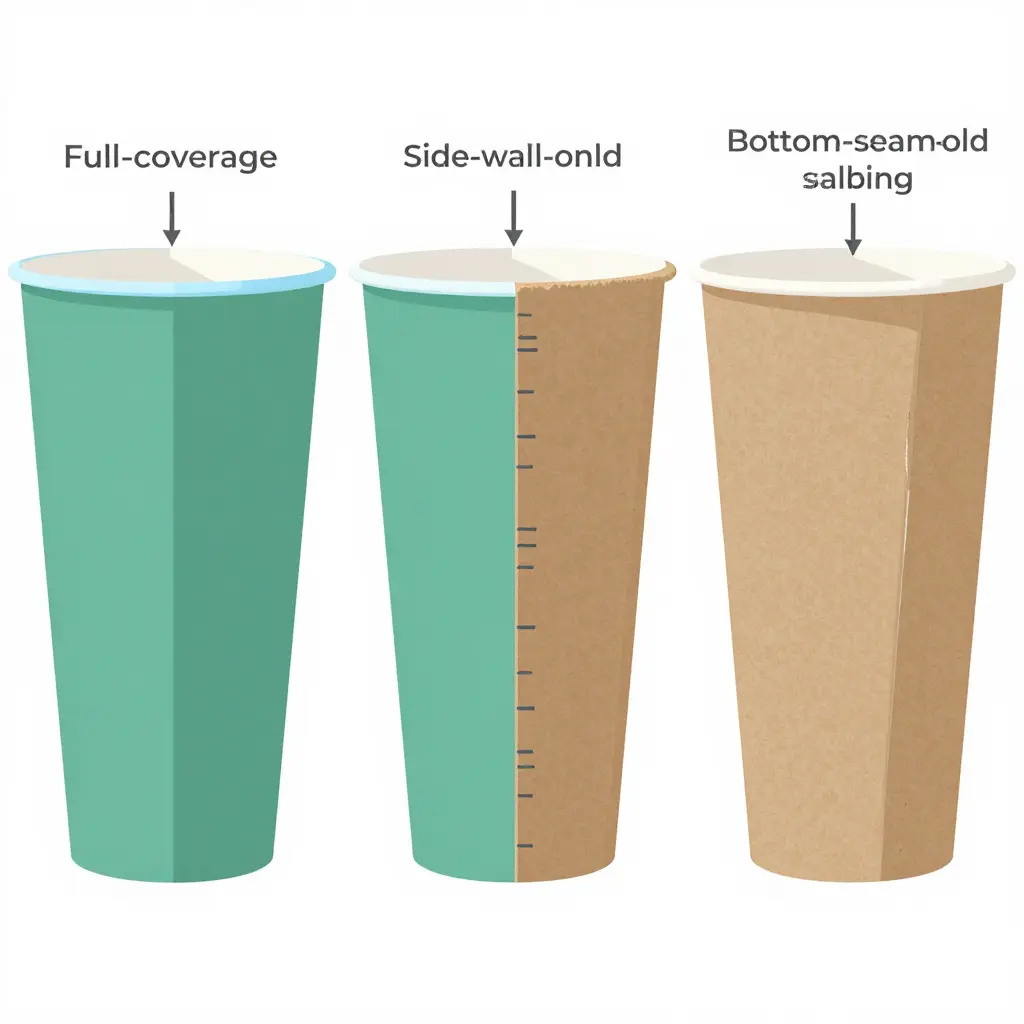
An unlined or partly lined rim and seam is an open door. The fiber absorbs water, softens and swells, which weakens the structure exactly where it needs to stay firm. Wicking along the seam also carries liquid to the outside, and a damp surface shows condensation sooner and more visibly than a dry one.
On cold drinks, the water on the outside comes from the temperature difference across the wall: the cold liquid chills the board, and moisture in the surrounding air condenses on the cooled surface. A lining cannot cancel that physics. What it controls is how wet the cup ends up, because it decides whether the board stays dry and insulating, and a tight-fitting lid keeps humid air from escaping over the rim. Together they reduce sweating and seam wicking instead of hiding it.
Ask for lining coverage alongside board grade when you compare quotes. A fully lined cup also holds its shape and stacks cleanly, so strength in the hand and stable, space-efficient stacking on the shelf come from one specification.
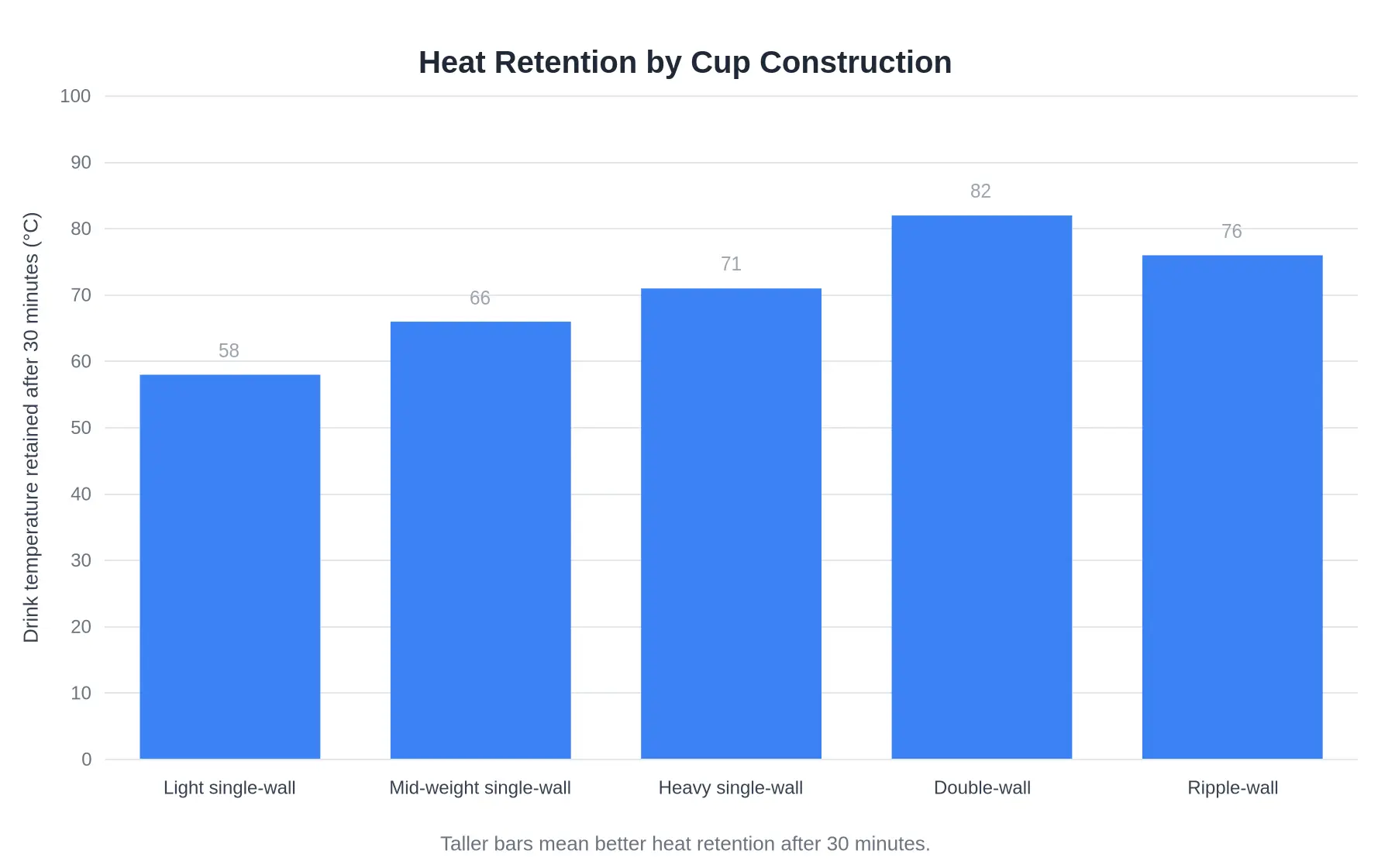
Higher bars mean better heat retention: after 30 minutes, double-wall cups held the most warmth, ripple-wall and heavy single-wall followed, while light single-wall cups lost heat fastest.
Why Cold Drinks Sweat: Condensation Mechanics in Paper Cups
A cup of iced drinks usually sits in air 15 to 30 °C warmer than the liquid inside. Cold liquid chills the outer wall, the thin layer of air touching that wall drops below its dew point, and moisture already in the room condenses there. That happens whatever the board grade or the price per thousand.
The useful question is where the water goes next, and the answer is in the lining.
The barrier layer decides what the water can do
A continuous barrier layer does two jobs. It keeps the drink out of the fiber, and by sealing the full height of the wall it closes the edges where outside moisture would otherwise get in. A fully lined cup stays dry to the touch and keeps its shape, because the board underneath never absorbs anything.
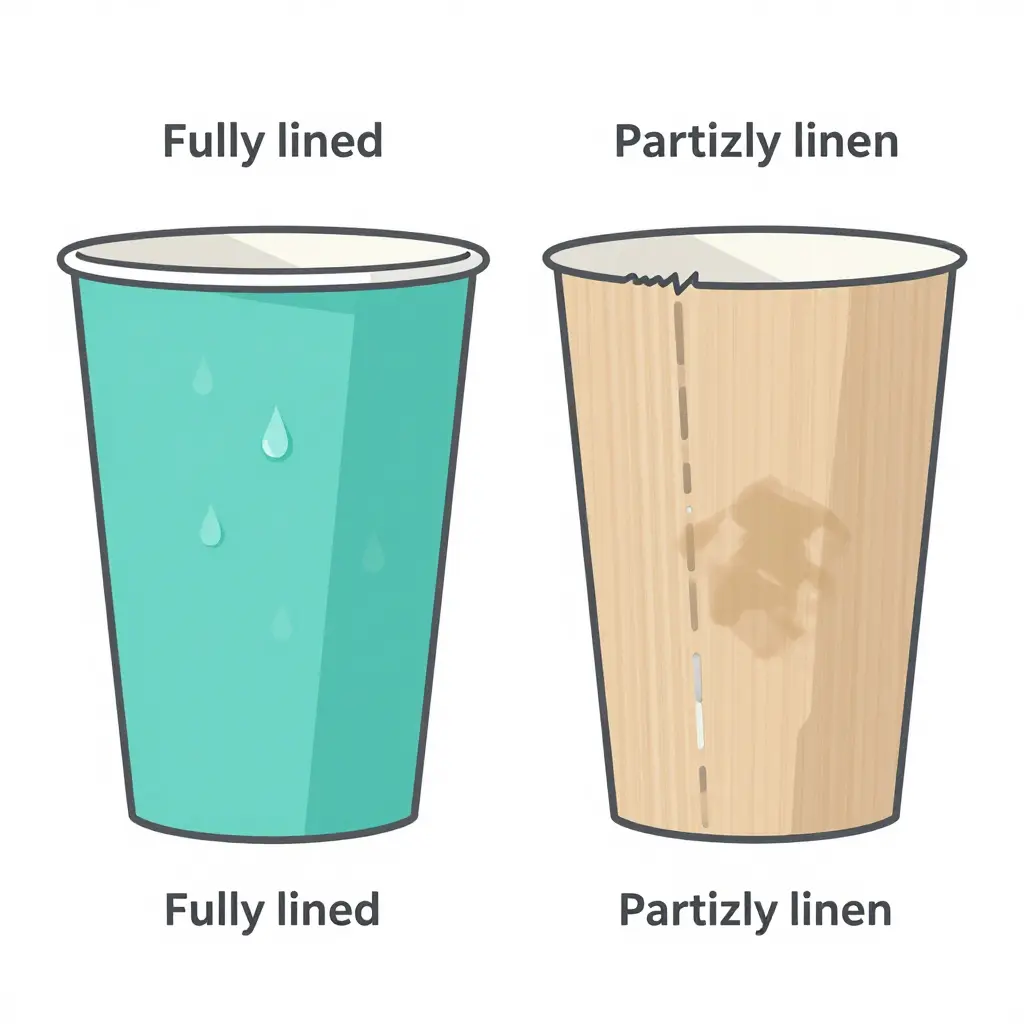
Where partial lining coverage breaks down
An inadequately sealed rim or bottom seam is an open edge. Water pooling on the outside of the cup, or spilled into the rim gap, wicks along the exposed fiber and travels up through the wall by capillary action. Inside the board it weakens the structure, and the cup goes soft in the hand after a few minutes of holding. The water also reaches the printed surface, leaving the dull, cloudy tide marks that make a branded run look tired before the customer has finished the drink.
Condensation is a lining and lid problem, not a board grade problem, which is the distinction that saves buyers the most money. Upgrading board weight often adds cost without touching the wet-hand, soggy-cup complaint. Sealing the cup properly and choosing a lid that grips the rim does touch it.
Fully lined vs. partially lined, side by side
| What you notice | Fully lined cup | Partially lined cup |
|---|---|---|
| Surface wetness | Light beading, wipes away cleanly | Standing water and a ring on the table |
| Board softness after extended holding | Stays firm, wall does not give | Gives under thumb pressure, feels spongy |
| Lid fit over time | Lid stays seated and seals the rim | Rim swells, lid lifts or leaks at the seam |
| Print appearance | Crisp from first sip to last | Stained, mottled, faded edges |
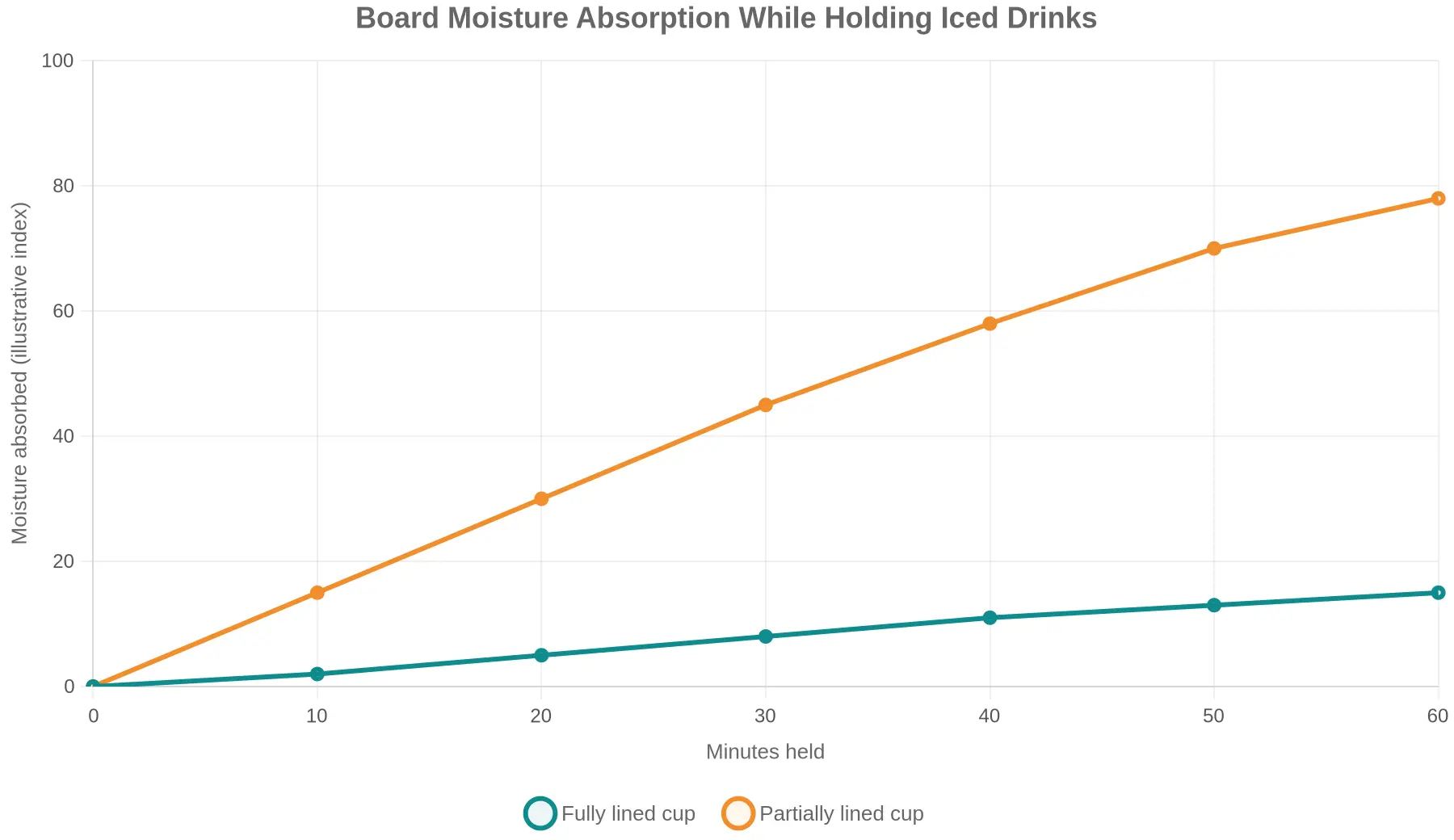
The absorption chart shows the same pattern over an hour of holding: with full coverage, moisture pickup stays low and mostly flat, while a partly lined cup climbs from the first few minutes.
What this means when you buy
When you compare quotes, ask one question: is the lining continuous, and is every seam sealed? If both answers are yes, the board is protected on hot and cold lines alike. Our fully lined paper cups list the specifications, and they are worth pairing with a lid that fits the rim so the seal holds from the filling line to the customer’s hand.
The Diagram: What a Gap in the Lining Does
The schematic puts two identical cup walls side by side. The only difference is how the lining behaves.
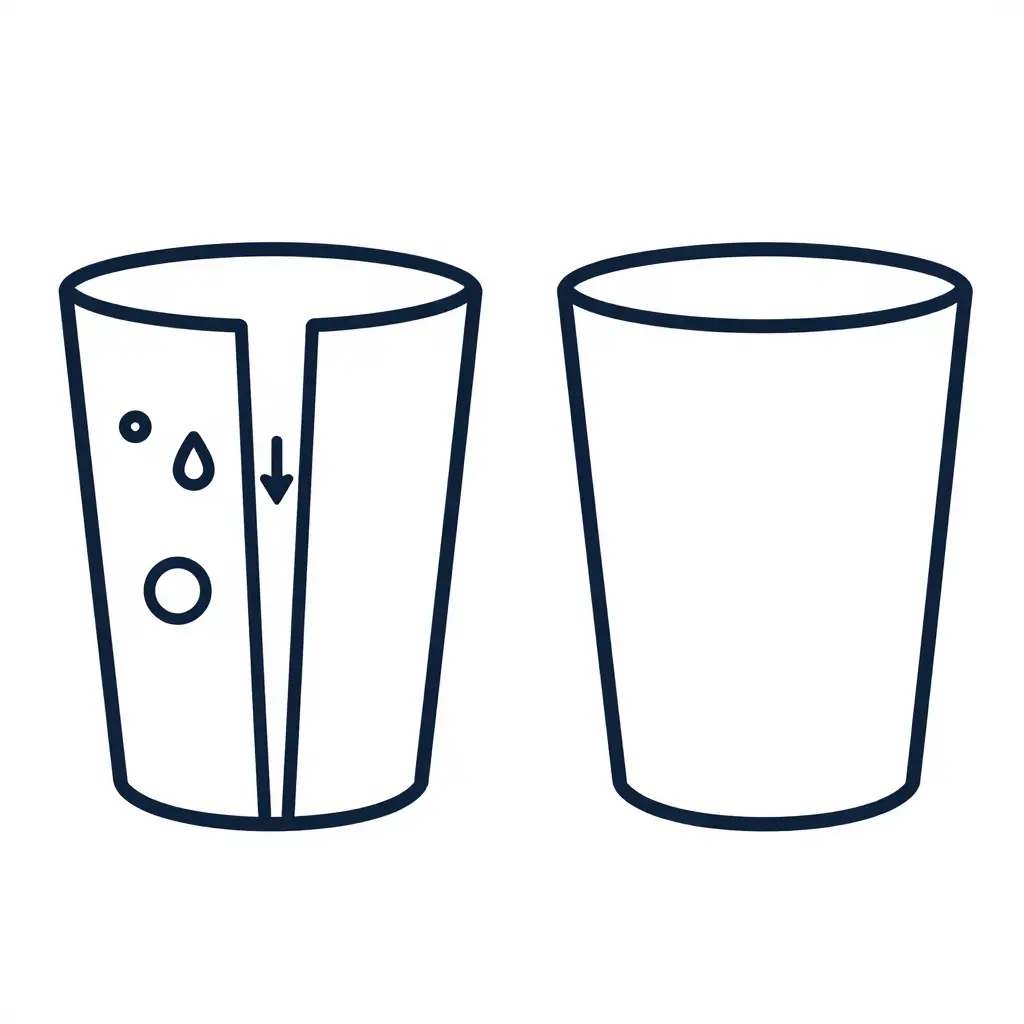
Left panel, interrupted lining. Where the inner coating thins out or breaks, moisture from the drink finds a path through the board. The droplets gather on the outside of the wall right beside the gap, with an arrow marking that outward movement. Once the board is wet, heat escapes faster and the outside of the cup turns damp and slippery.
Right panel, continuous lining. The coating runs unbroken from rim to base. Moisture stays where it belongs, so the outer surface stays clean and dry, which is what servers and customers notice first.
Both panels point to the same conclusion: condensation on the outside of a cup is usually a coverage story, not a weather story. When you are matching board weight and coating to a specific menu, choose the paper cup options by format and size so the wall and the lining are picked as one system rather than two separate line items.
Paper Cup Selection Checklist for Buyers
A handful of checks covers most of the risk when you compare paper cups for a takeaway menu or a new drink line.
- Match the board grade to the expected hold time. Longer delivery and dine-in periods need the heavier board to keep heat in and the wall rigid.
- Check lining coverage at the rim and the seam. Incomplete coverage lets liquid wick into the paper and softens the cup where leaks begin.
- Make sure the lining suits the drink as well as the food-contact requirement: temperature, acidity and fat content each narrow the choice.
- Test the lid against the rim and pick the format your service model needs. A closure that grips properly prevents spills, cuts remakes and speeds up handoff.
- Add a sleeve or double-wall insulation to hot lines where hands need protection and serving temperature has to hold.
- Check cup diameters against the holders, trays and carriers you already use, so cups sit level instead of tilting or jamming.
- Ask how the print and coating behave under condensation, which dulls printed surfaces and leaves cups feeling damp to customers.
Confirm those points with your supplier before a volume order, so the final specification matches both the drinks and the conditions you serve them in.
Matching Cup Specifications to Your Beverage Menu
The workable approach is to sort the menu into groups and give each group a board grade and a lining coverage. Drinks do not behave alike, and running one cup across the whole menu forces a compromise somewhere.
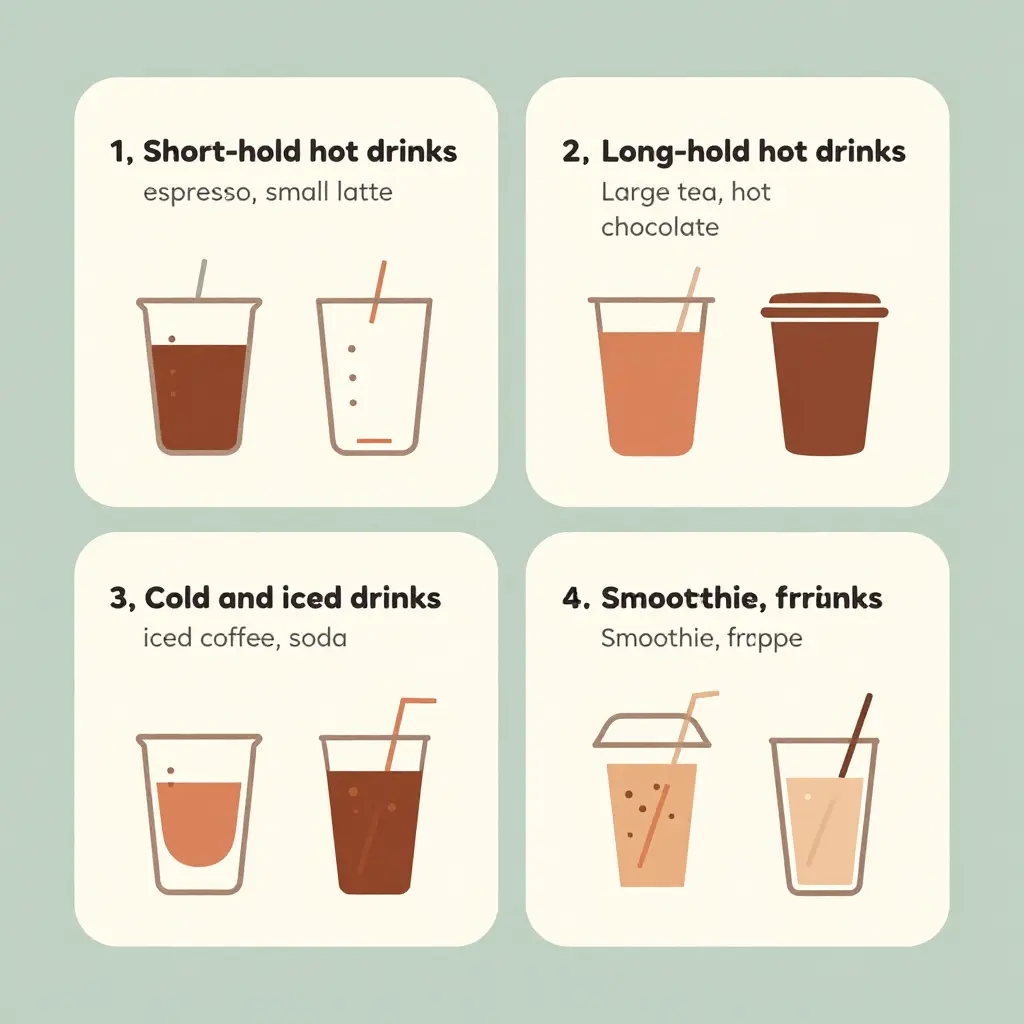
The four menu groups
Short-hold hot drinks. Espresso serves that are handed over and drunk within minutes. A moderate board grade with a standard hot lining is enough, because the drink never sits long enough to test the cup.
Long-hold hot drinks. Large teas, hot chocolates, mulled-style serves and anything sipped over 20 to 30 minutes. This is where heat retention earns its cost: heavier board, double-wall or ripple construction, and a vented lid.
Cold and iced drinks. Condensation is the enemy, not heat loss. Mid-weight board, full lining coverage inside, and a moisture-resistant outer treatment keep the cup firm in the hand.
Blended and ice-heavy drinks. Thick smoothies, frappes and heavy ice loads need the stiffest board, the most complete coverage, and a dome lid that clears the straw and any topping.
A simple mapping reference
| Menu group | Board grade priority | Lining coverage | Handling add-ons |
|---|---|---|---|
| Short-hold hot | Moderate | Standard hot lining | Flat lid, small sleeve |
| Long-hold hot | Heavy or double-wall | High, heat-focused | Vented lid, corrugated sleeve |
| Cold and iced | Mid-weight | Full, condensation-resistant | Flat or dome lid, sleeve for grip |
| Blended / ice-heavy | Stiffest | Maximum | Dome lid, wide straw, carrier |
Completing the system around the cup
A cup on its own is not the finished article. Lids hold temperature and stop spills in transit, so match the lid format to the drink rather than to the cup size. Sleeves add insulation and grip where heat or chill would reach the customer’s hand. Orders leaving in multiples need carriers that keep everything upright, and straws have to suit both thin iced drinks and thick blended textures. Start with the paper cup range, then pair it with paper lids, paper sleeves, multi-cup carriers and paper straws. Sugarcane carriers hold up better under heavier tray loads.
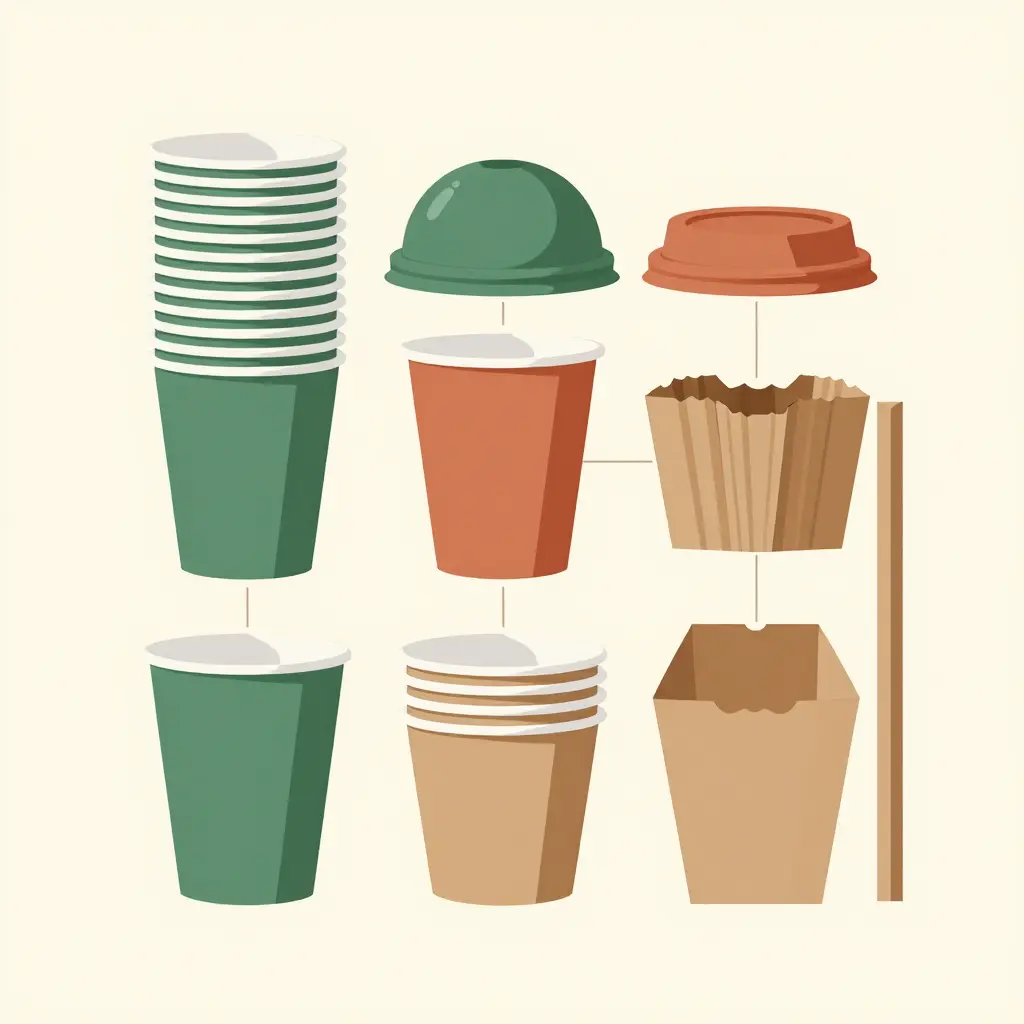
Once each menu group has a target board grade and lining coverage written beside it, ordering turns into a short conversation instead of a guessing game. Green Dispo supplies disposable tableware, packaging paper and boxes, and the support team will confirm specifications before you commit to a mix or plan a menu change.
Temperature and Surface Moisture Over a 45-Minute Hold
The dual-axis chart below comes from the side-by-side holding tests we run most often. Solid lines track drink temperature in °C on the left axis for three cups: a fully lined heavy-board cup, a fully lined light-board cup and a partly lined cup. Dashed lines track cup surface moisture in mg/cm² on the right axis, the condensation film that makes a cup feel damp and slippery in a customer’s hand.
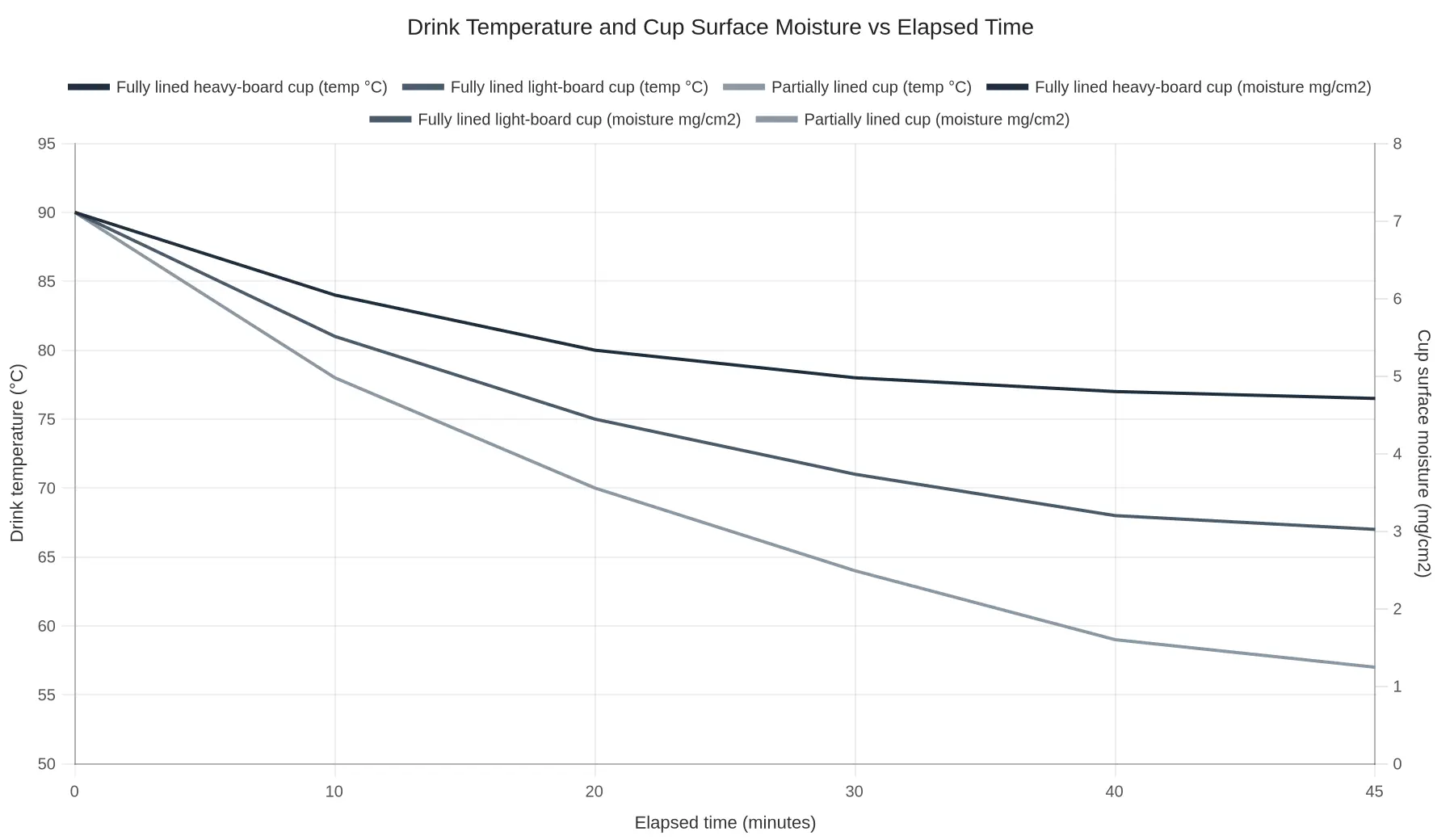
Counter staff can read the shape of the curve rather than a single number. The fully lined heavy-board cup flattens soonest, still above 76 °C at the 45-minute mark, with its moisture trace leveling off around 2.7 mg/cm². The partly lined cup keeps falling to 57 °C and keeps building condensation right to the end. The fully lined light-board cup sits between them: fine for a short serve, drifting once a drink sits past half an hour.
If your menu runs large milk teas or slow-sipping lattes, paper cups by board grade and lining will get you the weight that matches the hold time. Pair the heavier board with a sleeve and the drink stays hot and the outside stays dry from pour to pickup.
Frequently Asked Questions: Board Grade vs Lining Coverage
Does a thicker board grade alone stop condensation on cold cups?
No. A heavier board adds structural rigidity and slows heat transfer slightly, but condensation forms when the outer surface of a cup drops below the dew point of the surrounding air, and thickness alone does not stop that surface from chilling. Without a moisture barrier or a double-wall air gap, a thick single-wall cup still sweats in a humid room or on a warm day. Board grade and lining coverage solve different problems and are worth specifying separately.
Does full lining coverage change how a hot drink tastes, or is it safe for food contact?
A complete, food-grade polyethylene or water-based coating is odorless and tasteless at normal serving temperatures, so it should not alter the flavor of coffee, tea or milk tea. Coverage matters more for safety and integrity: it keeps liquid out of the paper fiber, which is where off-flavors, sogginess and seam failure usually start. Ask the supplier for a food-contact declaration, and check that the coating is rated for the temperatures you actually serve.
Do double-wall cups still need paper sleeves?
Usually not. The air gap between the two walls provides insulation and keeps the outer surface cooler than the drink inside. Sleeves still earn their place for very hot brews, long holds, and branding or order-labeling space. Choosing between a double-wall cup and a single-wall cup plus a sleeve is mostly a cost and logistics decision, and you can compare both across the paper cup range before committing.
How does lining coverage affect cup recyclability and eco-friendly claims?
More complete lining coverage generally makes a paper cup harder to recycle in standard fiber mills, because the plastic film has to be separated from the paper before repulping. Cups with water-based or minimal-coverage coatings fit existing repulping lines more easily, which is why coating chemistry usually matters more than the millimeter of coverage. Keep claims specific and verifiable: state the coating type and the recycling pathway available in your market instead of using a broad “eco-friendly” label.
How can I tell whether a cup is fully lined before ordering volume?
Ask for the coating specification and a coverage diagram, then test samples directly. Fill one cup with hot water and another with iced liquid, hold them for 20 to 30 minutes, and inspect the sidewall, bottom seam and rim for soft spots, wicking or separation. Cut a sample in half to see whether the lining runs continuously across the bottom disc and the seam overlap. Testing on a small sample order costs far less than finding gaps after a full pallet arrives.
Getting the Specification Right the First Time
Board grade sets how well a cup holds heat and how rigid it feels in the hand. Lining coverage sets both condensation control and structural integrity under load. The right cup is the pairing of the two, matched to the drink you serve and how long it has to hold up. Neither specification works in isolation, and choosing either one out of habit rather than by drink profile is where most quality complaints start.
A practical next step: write down the cup sizes and drink categories on your menu, then confirm board grade and full lining coverage with your supplier before placing an order. Two questions do most of the work.
- What board grade (in grams per square meter) does this size use, and is it the same for hot and cold lines?
- Where does the lining stop, and does it cover the full interior including the rim area?
Running that check against each size takes a single conversation, and it prevents the common mismatch of a lightweight board carrying a long-hold iced drink, or an under-lined cup sweating across a counter.
Green Dispo supplies disposable tableware, packaging paper and boxes with a firm emphasis on safety, durability and eco-friendly practice across every category. For size-by-size specifications, the paper cups, bowls and buckets range is the place to start.