
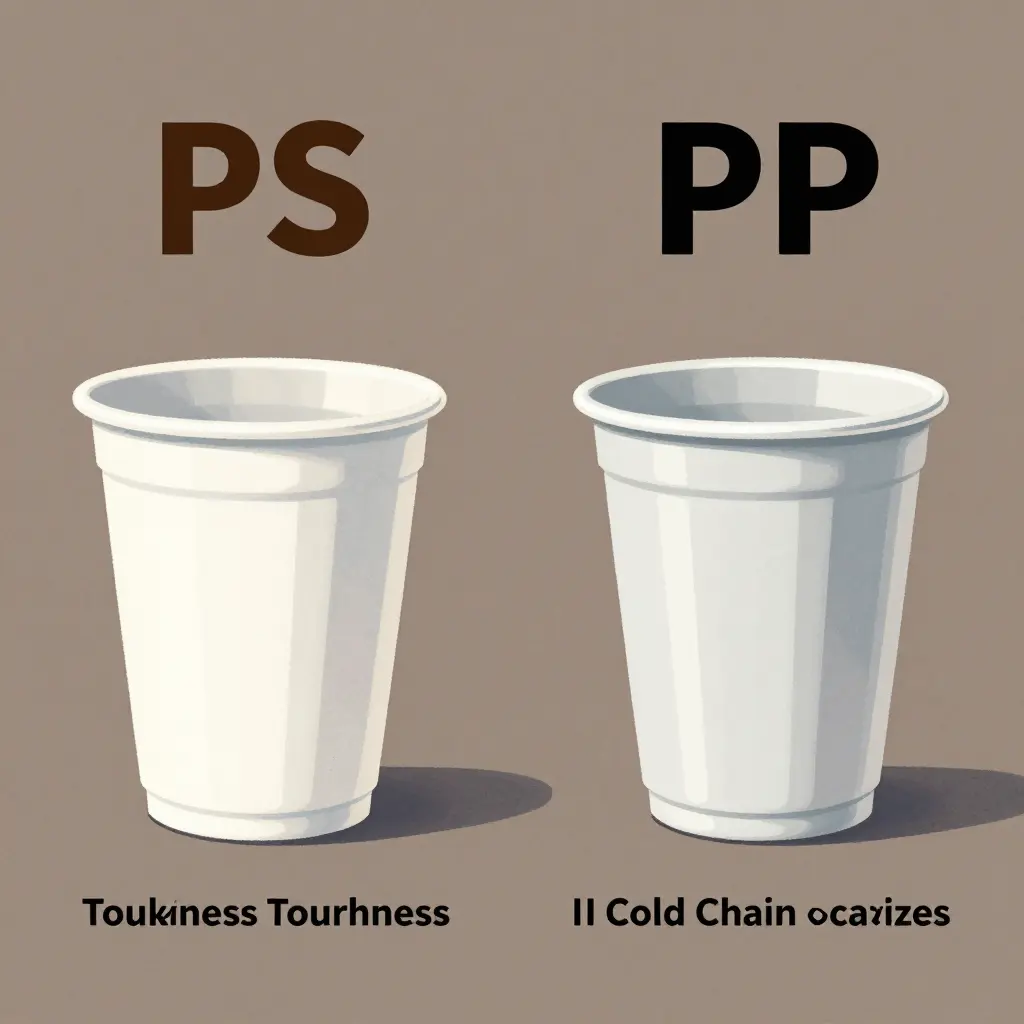
2 oz Disposable Plastic Cups for Sauce Portions in the Cold Chain: PS Crazing vs PP Toughness
A 2 oz disposable plastic cup looks like a routine line item until it has to hold a sauce portion through refrigeration, freezing, and repeated trips between kitchen and distribution. Then the wall, rim, and lid interface have to carry mechanical loads in an environment that changes how the polymer itself behaves. This is a material-selection reference for B2B food packaging buyers, foodservice operators, sauce and condiment manufacturers, and cold-chain logistics teams that specify these cups.
The question it answers is narrow: why polystyrene (PS) and polypropylene (PP) diverge under cold-chain stress, and how to choose between them.
Why Material Choice Decides Cold-Chain Performance
A failed cup leaks product, contaminates adjacent packaging, and can end in a customer complaint or a recall. Failure is usually brittle fracture rather than simple deformation: a crack starts at a stress concentration, most often the rim or the base radius, and runs because the polymer has already lost its ductility.
- Crazing – fine, crack-like microvoids that form inside a polymer under tensile stress. They are precursors to cracks, and in PS they are the main way a cup begins to fail under low-temperature load.
- Polymer glass transition – the temperature (Tg) below which an amorphous polymer behaves as a rigid, glassy solid instead of a tough, rubbery material. PS has a Tg near 100 C, so cold-chain temperatures put it deep in its glassy, brittle state. PP keeps more toughness under the same conditions.
- Cold-chain temperature range – the span a sauce portion sees from kitchen to distribution, typically about 4 C (refrigerated) or -18 C (frozen) up to ambient during staging and thaw.
PS crazing and PP toughness sit at opposite ends of one design question: will the cup crack, or will it bend and recover? Buyers sourcing compatible serving formats can also review our small-format foodservice packaging options alongside the material analysis here.
How the Cold Chain Stress-Tests Sauce Portion Cups
A filled 2 oz disposable plastic cup never sits at one stable temperature. It is filled hot (roughly 75-90 C for thermal-processed sauces) or at ambient (20-25 C), then enters the cold chain, where blast chilling drops the core to 0-4 C within 60-120 minutes. Refrigerated distribution holds 2-8 C, and downstream storage may add frozen holding at -18 C or repeated freeze-thaw cycling. Each transition forces the wall, lid, and seal interface to absorb dimensional change they were not molded to tolerate.
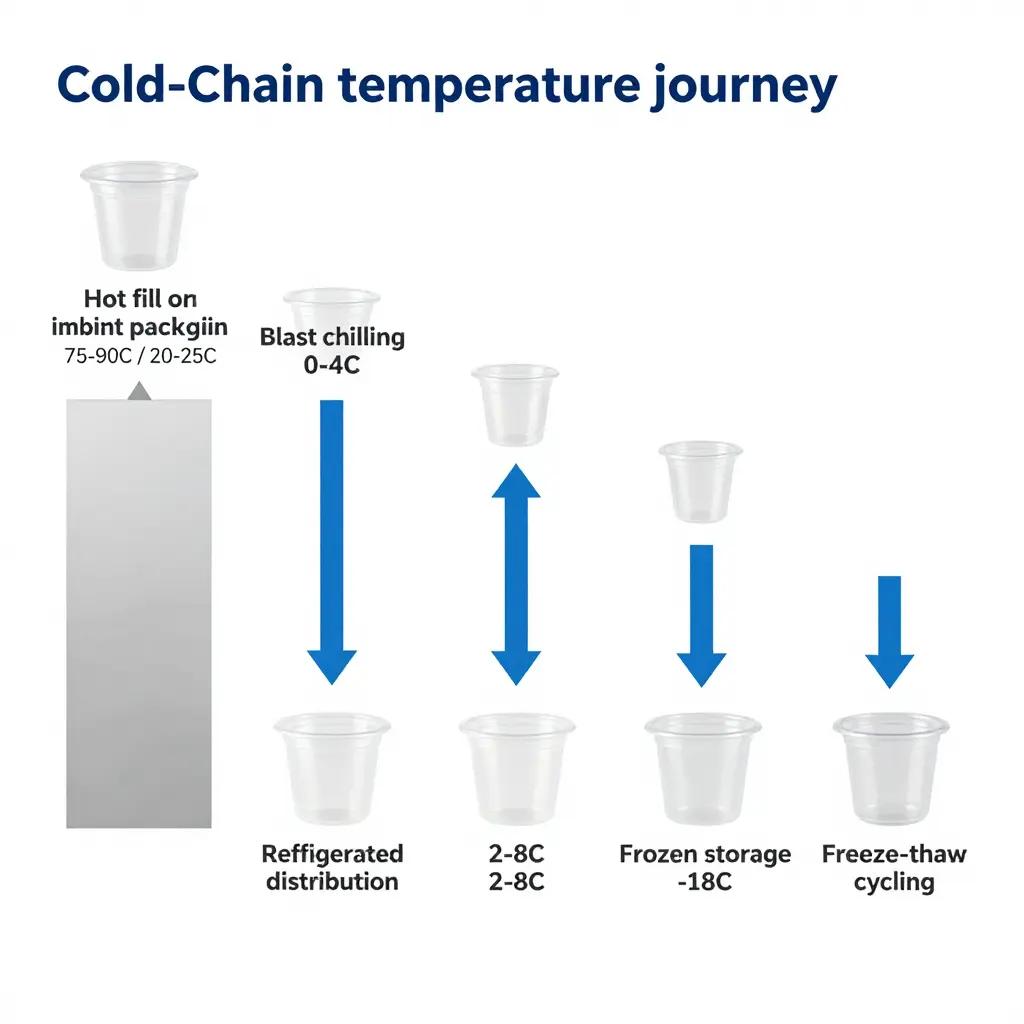
Thermal contraction shrinks the cup wall and lid at different rates. Residual molding stress, locked into the wall during injection or thermoforming, releases as the polymer stiffens, and that is where PS crazing starts. Lid-fit interference shifts as the lid contracts off the rim seat and seal preload drops. Impact loads during case packing, pallet drops, and tote handling hit a part that is already embrittled.
Cold-chain stress factors that cause cup or lid failure
- Differential thermal contraction between wall and lid when the two resins have mismatched coefficients of thermal expansion.
- Residual molding stress released at low temperature, which nucleates crazing and microcracks in polystyrene walls.
- Rim shrinkage that reduces lid holding force and breaks the seal line.
- Impact during palletizing, case handling, and single-box drops at frozen temperatures.
- Repeated freeze-thaw cycling, which fatigues the flange and drifts its dimensions.
- Stacking compression at -18 C, which embrittles the wall and flattens lids under load.
- Oil and moisture migrating into the seal interface and weakening adhesion between cup and lid.
Business consequences
These modes turn into cost. Leakage during refrigerated distribution contaminates adjacent cases and loses product; where it compromises food safety, it can force a recall. Cracked or lifted lids produce returned loads and distributor chargebacks. Condensation, clouding, and crazing on the cup surface cost shelf appearance and consumer trust. Because the faults usually show up only after the part is cold, room-temperature QC misses them and they surface downstream. That makes material selection – tough PP versus brittle PS – a cold-chain decision, not a room-temperature one.
PS Crazing: How Polystyrene Fails Under Low-Temperature Stress
General-purpose polystyrene (GPPS) and high-impact polystyrene (HIPS) are amorphous, atactic polymers with a glass transition temperature (Tg) near 100 C, roughly 120 C above the coldest point of most frozen and refrigerated distribution. Service temperatures never approach Tg, so the chains stay frozen in a glassy, immobile state with almost no capacity for plastic flow. GPPS is the more brittle grade, and HIPS, toughened with dispersed polybutadiene rubber particles, keeps the same low craze resistance in the matrix.
Why polystyrene is vulnerable: Tg, brittleness, and low craze resistance
Below Tg, polystyrene cannot relieve stress through shear yielding, so mechanical energy concentrates at flaws. The only outlet left is crazing: load-bearing, void-filled fibrillar zones that thin the material and precede fracture. In thin-walled portions, this is one of the most documented cold-chain failure modes.
Craze initiation, void coalescence, and brittle fracture
Crazing unfolds in a predictable sequence:
- Craze initiation. Stress concentrates at surface scratches, weld lines, flow marks, or gate areas left by injection molding, on top of the residual molding stress already in the part.
- Micro-void formation. Thermal contraction during freezing, plus the residual stress locked into the part, pulls the glassy matrix apart and generates micro-voids bridged by stretched fibrils – the silver cracks visible to the eye.
- Void coalescence. Under continued loading or further cooling, individual voids grow and merge as the fibrils fail.
- Crack propagation and brittle fracture. A coalesced craze becomes a true crack that runs through the wall, often shattering the cup with little warning.
The 2 oz cup: surface finish, wall thickness, and rim stress concentrators
At 2 oz, the wall is thin while the rim and base radii act as stress concentrators. A polished, defect-free surface delays craze initiation; a rough or scratched one accelerates it. The rim edge is the weakest point because lid-closing and stacking loads land directly on that thin section.
Environmental stress cracking with sauce constituents
Acidic (vinegar, citrus, hot sauce) and oily sauce components act as environmental stress cracking agents. They lower the surface energy needed for craze growth, so a cup that survives a dry cold hold can still silver-crack once it is filled. The mechanism is distinct from pure thermal crazing, but the two often compound in the same cold-chain cycle.
Buyers evaluating material options often compare plant-fiber portion cups that tolerate acidic and oily fillings with a far lower crazing risk.
PP Toughness: Ductile Performance in Low-Temperature Service
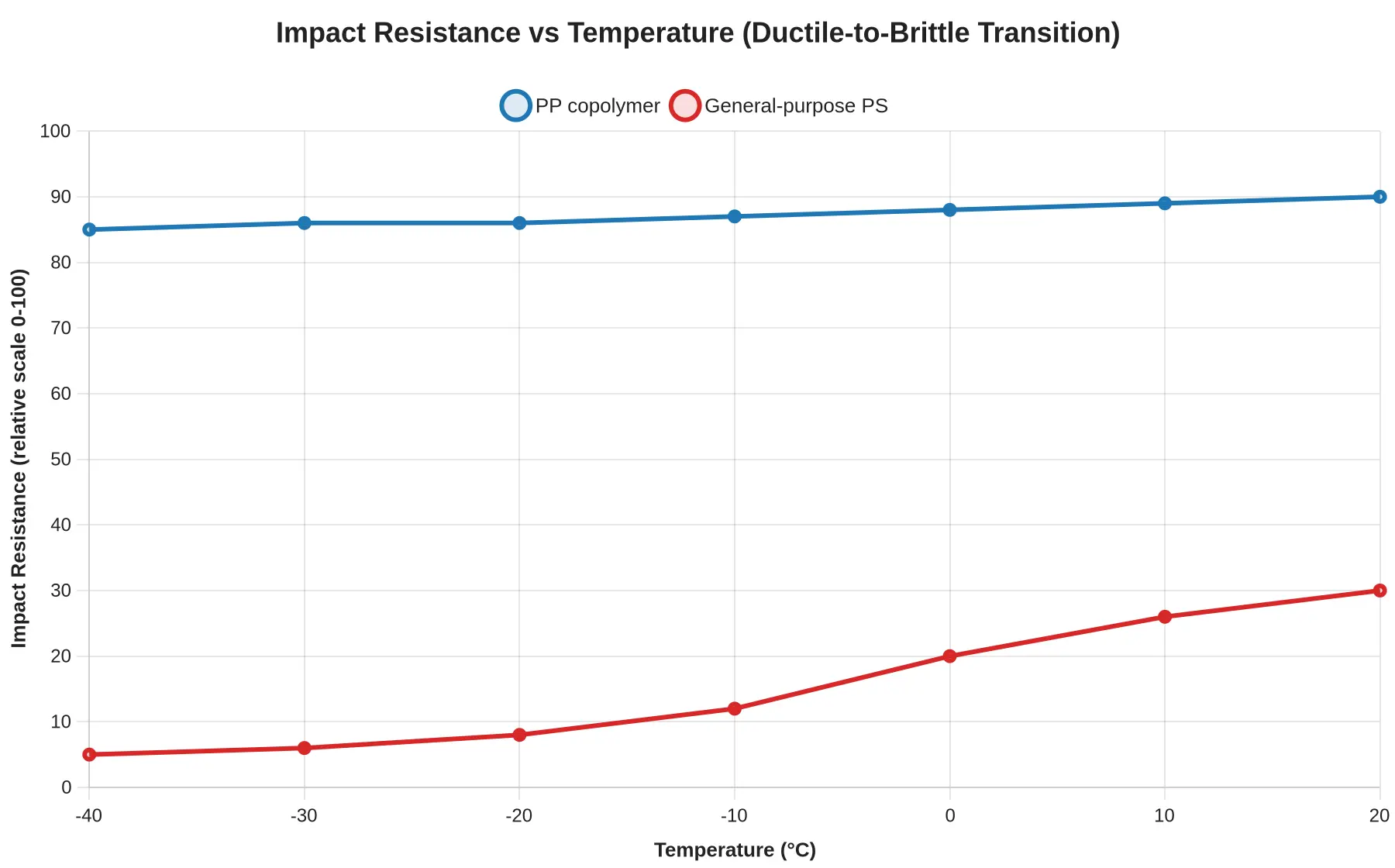
Polypropylene holds up in frozen and chilled applications because its glass transition sits near or below 0 C and its crystalline phase carries much of the load. General-purpose polystyrene (PS), by contrast, has a glass transition near 100 C and stays glassy and brittle even at room temperature. For PP the ductile-to-brittle transition lies well below freezing, so its chains can still mobilize and dissipate stress instead of shattering when a frozen sauce portion cup is squeezed, dropped, or crushed under stacked loads.
The reason is PP’s semi-crystalline structure. Rigid crystalline lamellae sit inside an amorphous matrix, which gives the material stiffness for stacking and rim integrity along with ductility for impact. Under stress, PP deforms by ductile yielding rather than brittle fracture, and the deformed zone shows stress whitening as micro-voids scatter light. That yielding absorbs energy progressively, so a PP cup bends, hinges, and whitens at a rim or sidewall instead of cracking. The ductile-to-brittle transition – the temperature band where a polymer shifts from yielding to fracturing – sits far lower for PP than for PS. The chart below illustrates that gap.
Copolymer content is the main lever for tuning low-temperature toughness. Random copolymers that incorporate ethylene lower the Tg further and improve clarity, while impact (block) copolymers disperse ethylene-propylene rubber domains that function as an internal impact modifier, blunting crack propagation before it can run. Adding nucleating agents refines the crystalline structure, raising stiffness and batch-to-batch consistency without sacrificing ductility.
PP versus PS cups in the same cold-chain service
| Property | PP copolymer cup | General-purpose PS cup |
|---|---|---|
| Glass transition (Tg) | Near or below 0 C | Near 100 C |
| Behavior at -20 C | Ductile yield, stress whitening | Brittle crazing, cracking |
| Failure mode | Deformation and whitening | Shatter, rim splits |
| Impact modifier | Ethylene-propylene domains | None (homopolymer) |
| Cold-chain service | Reliable | High risk |
In identical chilled or frozen conditions, PS cups craze and fracture at rims and bases while PP copolymer cups yield and stay intact. PP resin typically costs more than general-purpose PS; PP parts are more flexible, so they need design allowances to hold rim rigidity; and PP is harder to heat-seal because of its higher melting point and low surface energy, so cups need controlled heat or ultrasonic sealing. Buyers balancing these factors often review a range of cold-chain cup packaging formats when specifying portion programs.
Selection Criteria for 2 oz Sauce Portion Cups in Cold-Chain Programs
Material selection for 2 oz sauce portions in a cold chain decides whether a portion cup survives temperature abuse, resists cracking, and protects the product until it reaches the end user. Work through the factors below in order; each one leans toward polystyrene (PS) or polypropylene (PP).
-
Sauce chemistry and acidity. Water-based sauces with neutral pH – ketchup, mayonnaise, ranch – are generally compatible with PS. Highly acidic or oil-rich sauces such as vinegar, citrus, and chili oil attack PS and accelerate stress cracking and haze. PP has better chemical resistance and is the safer choice for aggressive formulations. Check pH, fat content, and preservative systems before locking the resin.
-
Target temperature range (chilled vs frozen). Chilled programs hold product at 0 to 4 C and put moderate stress on 2 oz cups, so PS performs acceptably when the wall is thick enough. Frozen programs at or below minus 18 C push PS into its glass-transition range, where it turns brittle and crazes. PP keeps its toughness at freezer temperatures, which makes it the default for frozen sauce portions.
-
Required shelf life and barrier. Longer shelf life demands low moisture-vapor and oxygen transmission. Both PS and PP resist moisture well, but PP’s higher crystallinity and better moisture retention suit extended ambient or frozen storage. For oxygen-sensitive sauces, multi-layer PP or PP with a barrier coating outperforms standard PS.
-
Lid sealing method. The closure sets the leakage risk. Lidding film, press-fit lids, and snap-on closures behave differently on PS and PP. PP’s flexibility supports repeatable snap-fit lidding without fracture, while PS lids can stress-crack when over-torqued. Pair the resin with a compatible closure; paper lids are a complementary option for branding-forward programs.
-
Clarity and branding needs. Clear PS gives glass-like transparency that shows off sauce color. PP is more translucent and usually needs clarified grades to match it. When product visibility comes first, PS wins; when durability and matte-surface printability matter more, PP is the better pick.
-
Total landed cost per portion. Unit price alone misleads. Weigh resin cost, cycle time, scrap from cracking, freight, and return or credit costs. PP may cost slightly more per unit yet cut cold-chain failure losses, while thin-wall PS can be cheaper where chilling is tightly controlled. Teams comparing formats can also explore the paper cup product range for non-plastic alternatives.
Applied together, these criteria turn a general material question into a defensible specification. Acidic or frozen portions lean toward PP, tightly controlled chilled programs can justify PS, and any choice should be validated with real fill, seal, and temperature-stress testing before full production.
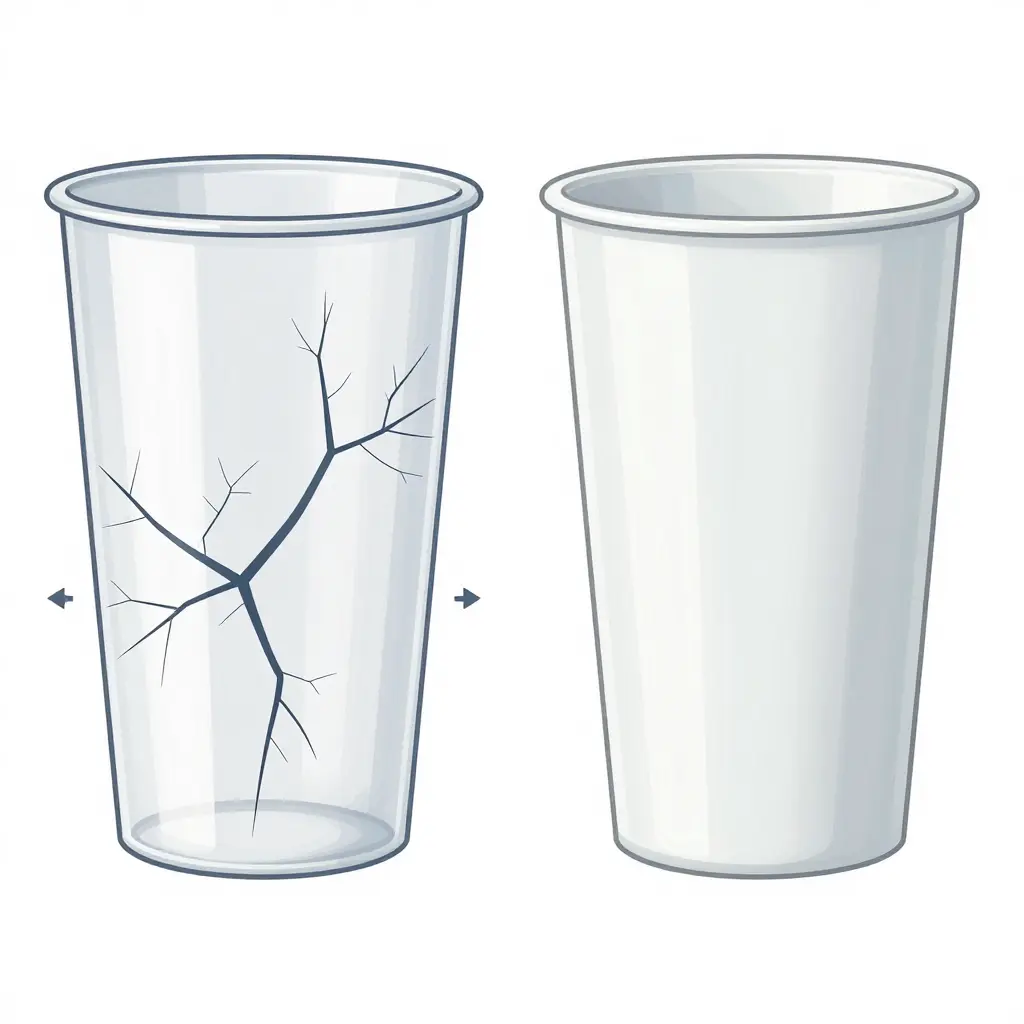
The schematic shows how the two materials answer the same low-temperature load. On the left, the polystyrene (PS) wall develops a network of crazes, stress-induced micro-voids that scatter light and gradually coalesce into a brittle crack that runs straight through the wall. On the right, the polypropylene (PP) wall whitens and yields, deforming plastically and dissipating energy rather than failing outright. The inward arrows are the cold-chain handling stresses (impact, stacking compression, and thermal contraction) that drive either mechanism.
Frequently Asked Questions: PS and PP Sauce Portion Cups
What is PS crazing, and why does it appear in the freezer?
PS crazing is the network of fine hairline cracks that forms when polystyrene sees low temperature plus residual molding stress. As the polymer cools below its glass transition temperature it turns brittle, so thermal contraction and frozen sauce expansion concentrate stress and start microcracks across the cup wall.
Are PP cups always better than PS for frozen sauce portions?
No. PP toughness gives polypropylene better impact resistance at freezer temperatures, so it resists cracking when dropped or handled roughly. PS still offers better clarity and a lower unit cost for chilled applications. Choose on temperature range, clarity needs, and handling conditions rather than assuming PP wins everywhere.
Do 2 oz cups need different materials for chilled versus frozen use?
Yes. In chilled distribution, 2 oz disposable plastic cups in PS perform well because temperatures stay above freezing and crazing risk stays low. Frozen cold-chain portions call for PP, which keeps its flexibility. Select material by the lowest temperature the product will see.
How do lids affect crazing and cracking?
A tight, mismatched, or rigid lid adds hoop stress to the rim during sealing and freezing. That concentration accelerates PS crazing and can push cracks outward from the rim. A compatible lid with slight flexibility spreads the stress and lowers failure rates.
What is the most cost-effective material for a cold-chain sauce program?
For a frozen cold chain program, PP usually delivers the lowest total cost despite a higher unit price, because its toughness reduces leakage, returns, and customer complaints. For chilled-only programs, PS remains cheaper and adequate. Compare landed cost against defect and spoilage rates.
When specifying portion cup options, match the polymer to the coldest temperature in your distribution path and validate lid fit before scaling a program.
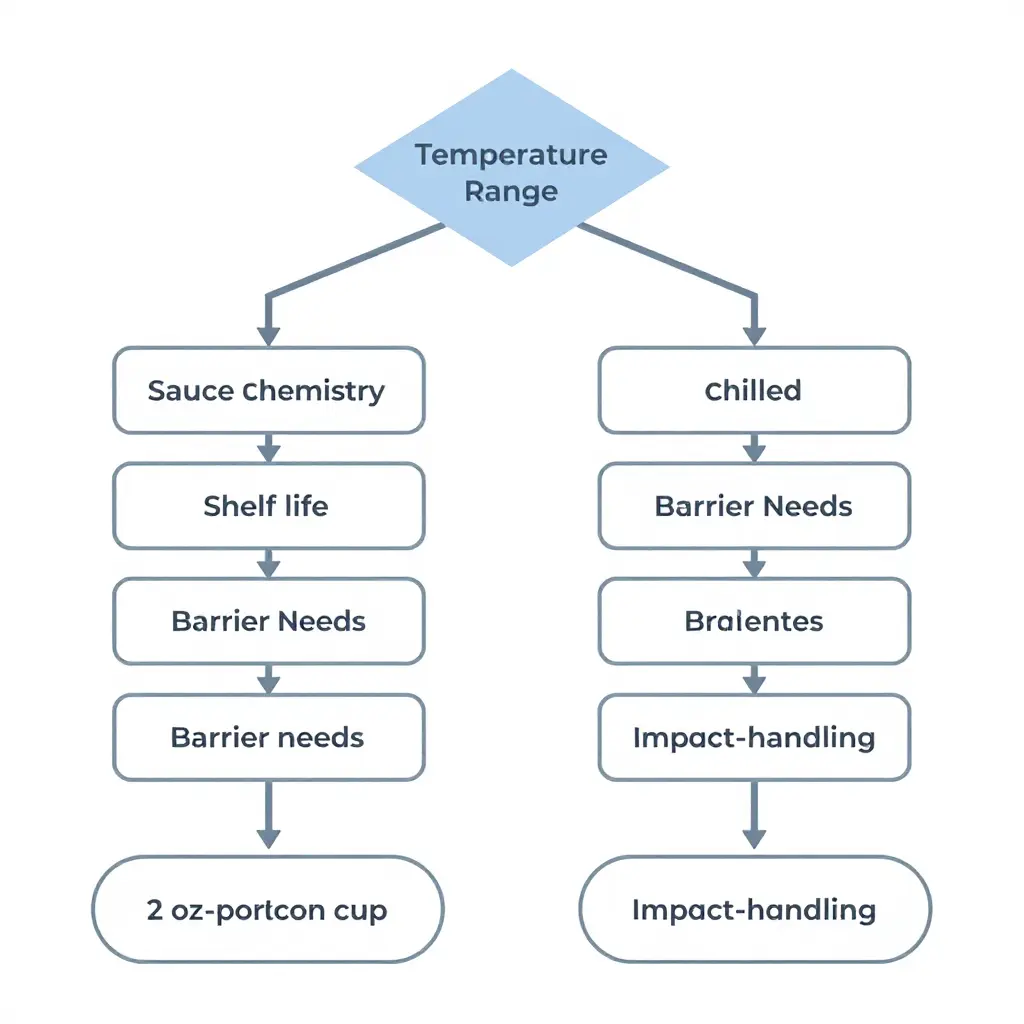
How to read this decision flow
The diagram above is a quick visual companion to the selection criteria in this section. It walks a specifier from the application requirement to a material verdict in four stages:
- Temperature range (chilled vs. frozen). This gate separates the two branches. If portions stay chilled, PS remains viable; as soon as the cold chain dips to frozen conditions, the frozen branch activates and pushes toward PP.
- Sauce chemistry, shelf life, and barrier needs. Acidic, oil-heavy, or long-shelf-life sauces tighten the requirements and narrow the acceptable field.
- Impact-handling requirements. Drop risk during fulfilment, vending, or high-volume tray handling puts a premium on toughness, which favors PP.
- Outcome nodes. The flow resolves into PS suitable or PP recommended, a clear answer for the 2 oz format.
Treat the flowchart as a first-pass filter, then confirm final performance with real-time conditioning and drop testing.