
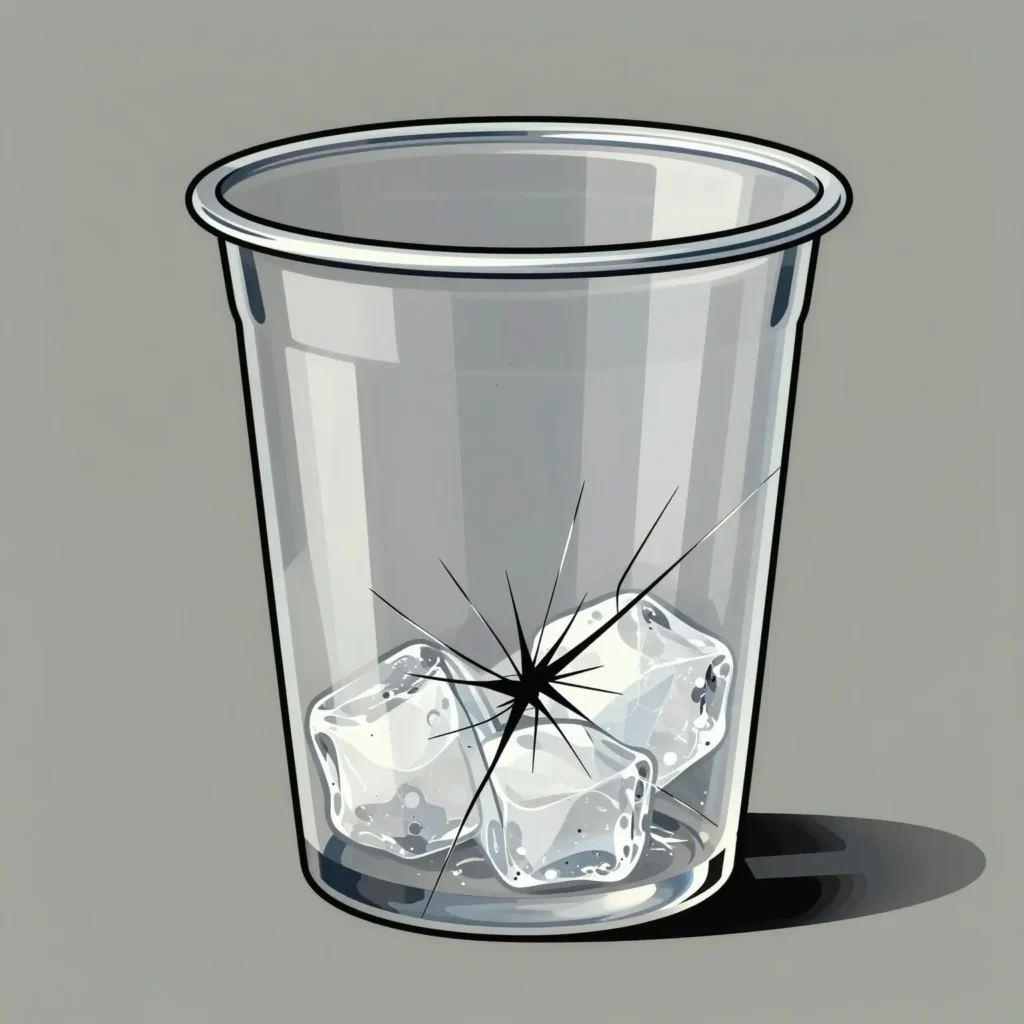
Failure Mechanism Under Ice Pressure
Fill a beverage cup with ice, or let liquid water freeze inside it, and the contents expand by roughly 9% by volume. Rigid walls leave that expansion nowhere to go, so it becomes internal pressure pushing outward on the cup.
The pressure shows up as two linked stresses. Radial stress pushes perpendicular to the wall, driving the sidewall outward. Hoop stress runs tangentially around the circumference and pulls the wall in tension, the way a hoop resists being stretched. Raise one and the other rises with it.
Stress rarely spreads evenly. Sharp transitions, corner radii, and the injection gate at the bottom center interrupt the load path, the route force takes through the material. At those points, stress concentration multiplies local stress well above the average. In a cold cup, the two hot spots are the base knuckle, where the sidewall curves into the bottom, and the gate area, the last region to fill during molding, often weaker and oriented differently at the molecular level.
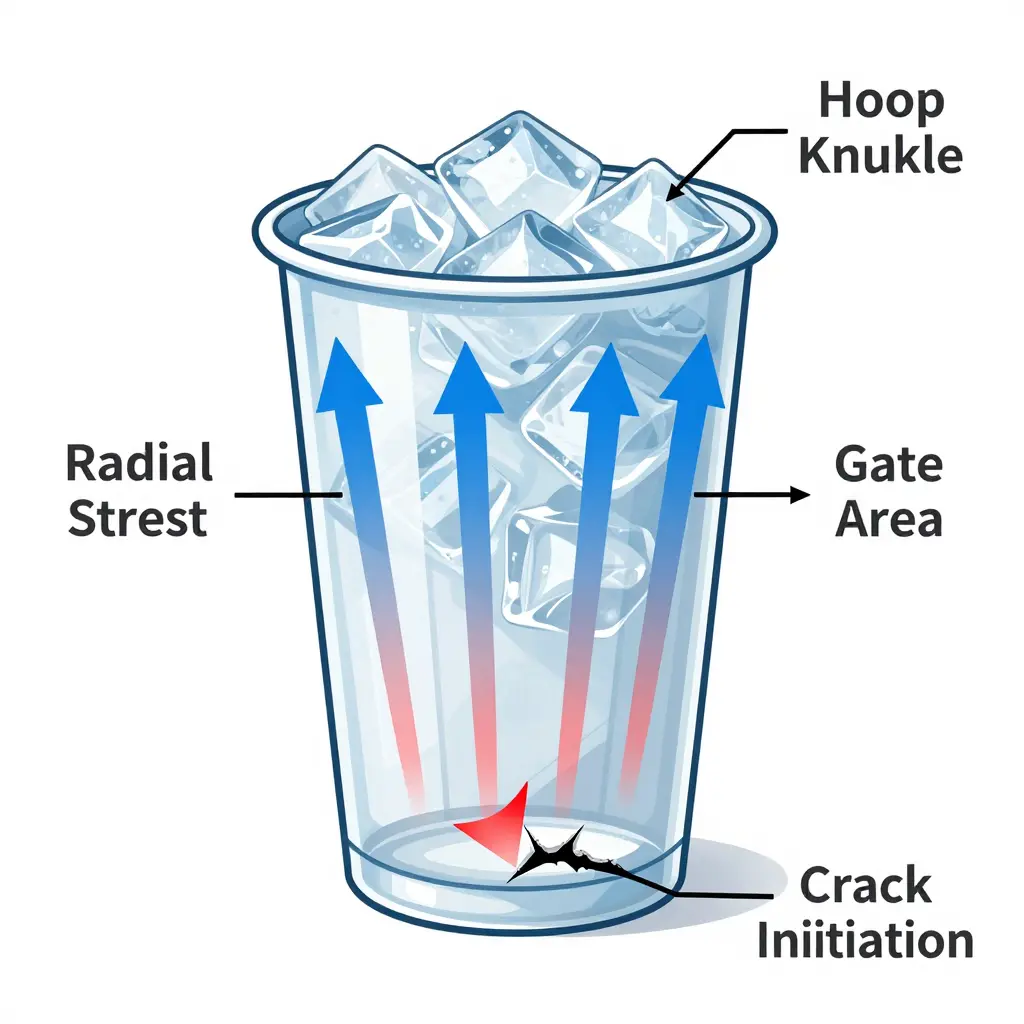
From there, failure takes one of two routes. Brittle fracture is sudden and catastrophic: a crack opens and runs with little stretching, which is common in cold or highly oriented PET. Ductile yielding is gradual, with the material stretching and whitening before it tears and absorbing more energy along the way. Cold temperatures push PET toward the brittle end, which is why cracking under ice pressure usually shows up as a sharp, fast-propagating split.
Sequential Failure Stages
- Stress build-up – freezing expansion loads the radial and hoop stress fields, and stress concentrates at the base knuckle and gate.
- Crack initiation – the most flaw-prone point, often the gate or a thin knuckle, reaches its local strength limit and a micro-crack opens.
- Crack propagation – the crack races along the hoop-stress direction, releasing stored energy and splitting the base.
Buyers comparing formats can apply the same mechanics to alternative cold-cup constructions, which tolerate ice loading in different ways.
Base Thickness as a Performance Variable
When a 9 oz clear PET cup cracks under ice pressure, the failure usually points to one variable more than the resin grade: how much material actually sits in the cup base, and how evenly it is spread. Base thickness is not a fixed figure on a drawing. It is a running process variable, and it decides whether the cup flexes and recovers or breaks outright.
Nominal vs. Minimum Thickness
Nominal is the design target, typically 0.50-0.80 mm for a 9 oz cold cup base. Minimum is the thinnest point the mold can realistically deliver, and minimum is the number that governs crack resistance. A cup specified at “0.65 mm” can still thin to 0.30-0.35 mm at its weakest spot. Under ice load, that thin spot is where the crack begins.
Thickness Distribution Across the Cup Base
Thickness is rarely uniform. The center next to the gate often runs 0.15-0.25 mm thicker than the outer cup base, and the transition toward the sidewall can sag 20-30 percent thinner. A cup can satisfy nominal thickness, distribute it poorly, and still fail. Even distribution across wall and base matters more than the average.
Knuckle Radius and Gate Geometry
A sharp knuckle radius, the curve where the base meets the wall, concentrates stress and starts cracks. Radii below roughly 0.5 mm are risky; 1.0-1.5 mm spreads load far more gracefully. Gate size and location matter too: an undersized or off-center gate fills unevenly, leaves weak weld lines, and produces a base that resists ice pressure inconsistently.
Injection-Molding Tolerances
Process windows decide what you actually get. PET cup tolerances commonly land around +/- 0.05 to 0.10 mm on the base, but thermal drift, hold pressure, and cycle time can push variation past that. Watching minimum thickness at the cup base, rather than nominal, is the only reliable quality gate.
Why a Thicker Base Is Not Automatically Stronger
Pushing thickness upward brings diminishing returns and eventually negative ones. Crystallinity and internal stress rise with thicker sections, making PET more brittle, so a very thick base can crack sooner under sudden ice impact. Extra thickness also adds weight (10-30 percent per 0.1 mm) and material cost without a proportional gain in strength. The chart below puts the sweet spot near 0.55-0.65 mm.
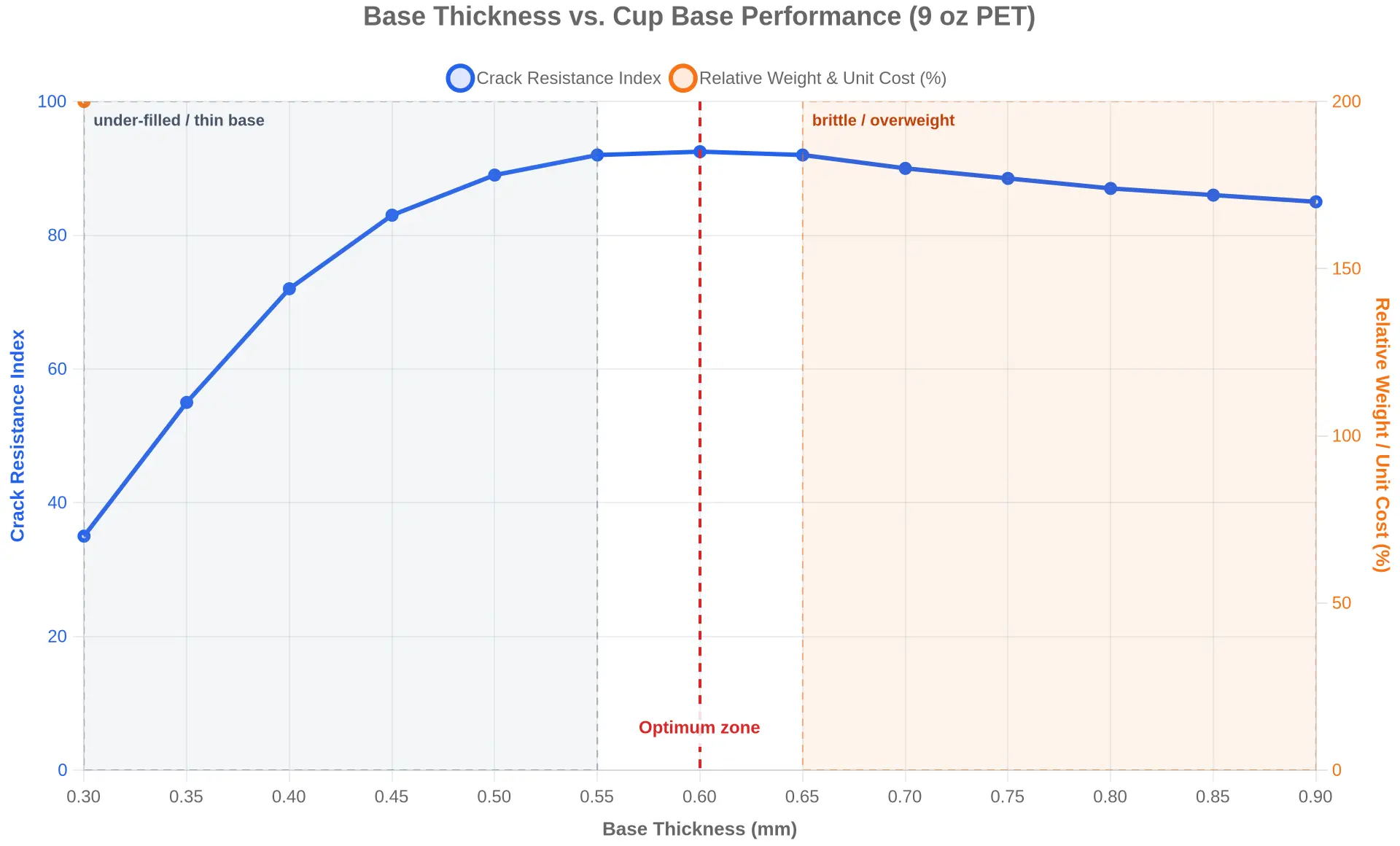
The practical point: optimize base thickness for balance, not bulk. If you are weighing PET against other formats, paper cup solutions can clarify the cost, weight, and performance tradeoffs across a cold-cup lineup.
Base Thickness vs. Base Failure Load Under Ice Pressure
Ice expansion puts an almost uniform radial and vertical load on the cup base, which makes base wall thickness one of the strongest single levers on whether a 9 oz clear PET cup survives freeze-thaw handling. The chart below isolates that variable: the same cup geometry, the same resin grade, and the same freeze protocol held constant, with only the preform base thickness stepped up in 0.05 mm increments.
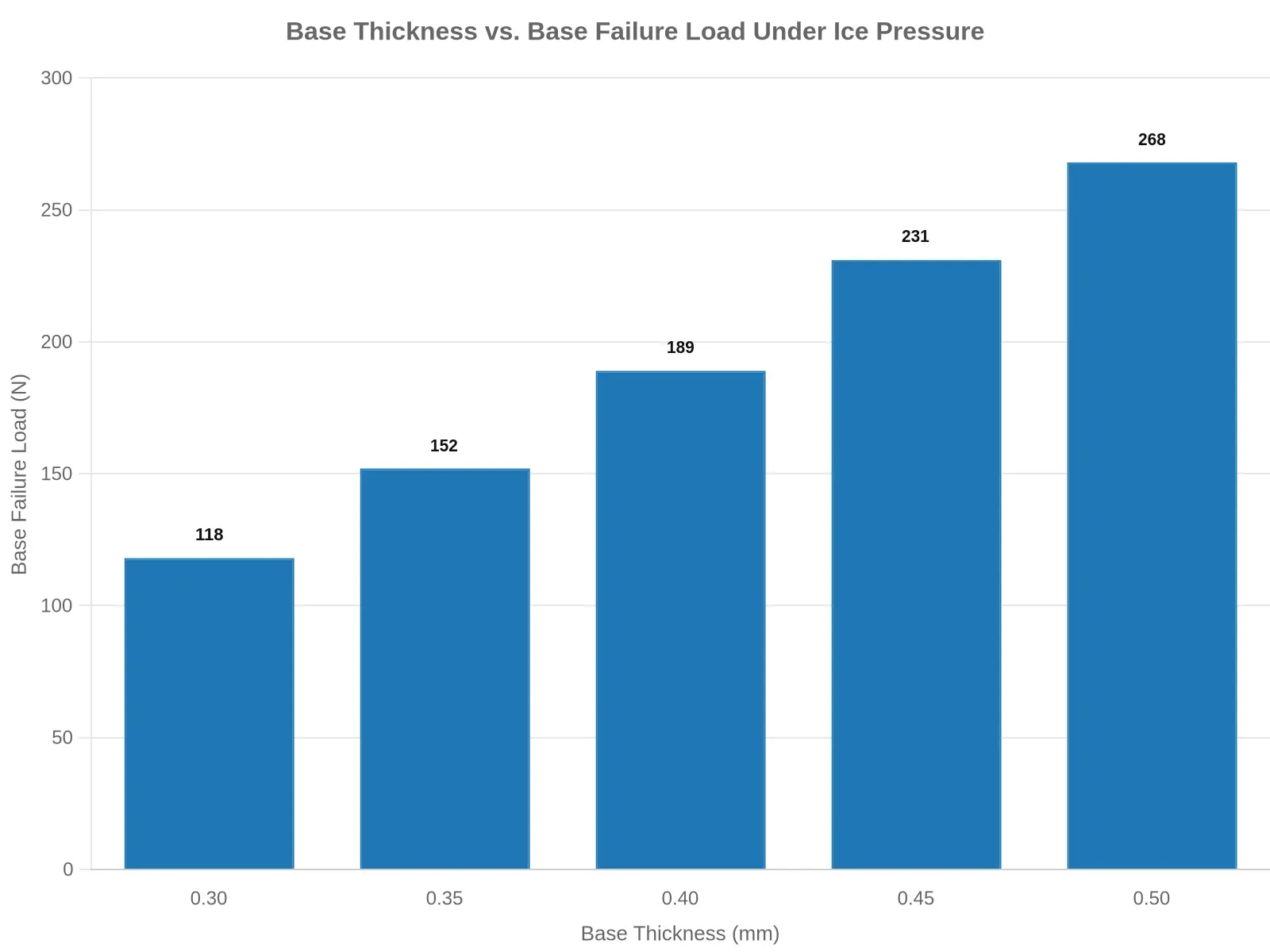
Measured Failure Loads at Each Base Thickness
| Base Thickness (mm) | Base Failure Load (N) | Approx. Load in kgf | Change vs. Previous Step |
|---|---|---|---|
| 0.30 | 118 | 12.0 | baseline |
| 0.35 | 152 | 15.5 | +29% |
| 0.40 | 189 | 19.3 | +24% |
| 0.45 | 231 | 23.6 | +22% |
| 0.50 | 268 | 27.3 | +16% |
Caption: Base failure load climbs steadily as base thickness goes from 0.30 mm to 0.50 mm, but the gains come early. The step from 0.30 mm to 0.40 mm delivers roughly a 60% jump in load-bearing capacity, while the final 0.10 mm (0.40 to 0.50 mm) adds a further but proportionally smaller improvement. In practical terms, this diminishing-returns curve means the most cost-effective crack resistance is usually captured by targeting the 0.38-0.42 mm window rather than over-thickening the base, which adds resin cost and can slow cooling and cycle times.
The engineering point is straightforward: thin bases fail because they cannot resist the bending stress that develops when the ice core locks into the cup and expands. Each added 0.05 mm increases the section’s second moment of area, so the base deflects less before it reaches its yield point. Thickness alone still cannot compensate for a weak resin grade or a poorly crystallized dome. Below the 0.35 mm threshold, even premium resin grades scatter dramatically in failure loads, which is why base thickness and resin grade must be specified as a paired system rather than tuned independently. For teams comparing formats, the same mechanics govern stiffness in complementary foodservice containers, so durability lessons carry over to a broad range of cup and bowl products.
Resin Grade as a Performance Variable: Where Base Cracking Really Begins
Wall thickness is only half the story when 9 oz clear PET cups crack at the base under ice pressure. The resin grade, meaning the specific polymer formulation behind the plastic, decides how that base behaves the moment a scoop of ice loads it. Two cups with identical dimensions can fail in completely different ways because their molecular architecture differs. Understanding that architecture is the fastest route to fixing base cracking without adding weight or cost.
Intrinsic Viscosity (IV)
Intrinsic viscosity is the most useful single number for predicting base performance. Measured in dL/g, it reflects polymer chain length. Longer chains entangle more, absorb impact energy, and resist crack propagation. Lower-IV grades (roughly 0.68-0.74 dL/g) flow easily but produce a more brittle base that fractures under concentrated ice pressure. Higher-IV grades (0.78-0.84 dL/g) toughen the base, yet they raise melt viscosity, demanding more processing energy and often reducing clarity.
Homopolymer vs Copolymer Grades
Homopolymer PET is highly regular, so it packs into dense crystalline regions. That rigidity boosts stiffness but leaves less amorphous material to absorb stress, making the base notch-sensitive. Copolymer grades add comonomers such as CHDM or isophthalic acid that disrupt crystallization, improving toughness and clarity at the cost of some heat resistance.
Molecular Weight Distribution (MWD)
A narrow MWD gives uniform, predictable flow. A broader MWD blends easy-flowing short chains with tough long chains, which can lift melt strength and impact performance during molding, but only if the converter tunes the process to the wider window.
Degree of Crystallinity
Crystallinity cuts both ways. Highly crystalline resin grades deliver stiffness and dimensional stability but turn brittle, exactly the failure mode seen when rigid, crystalline bases meet ice pressure in thin PET cups.
Comonomers and Impact Modifiers
Comonomers and impact modifiers are the formulator’s toughening levers. A rubbery modifier or a flexibilizing comonomer creates energy-absorbing domains that blunt crack tips, letting a thinner base survive the same ice load. When specifying cups for cold service, converters often pair these with proven foodservice cup formats to match resin choice to real-world handling.
The table below summarizes how the main resin variables trade off against one another:
| Resin attribute | Lower IV / high crystallinity | Higher IV / copolymer |
|---|---|---|
| Intrinsic viscosity (dL/g) | 0.68-0.74 | 0.78-0.84 |
| Base toughness | Low, brittle | High, ductile |
| Crack resistance under ice | Poor | Good |
| Processability | Easy flow, low energy | Harder, higher energy |
| Clarity | Haze risk from crystallinity | Improved with comonomers |
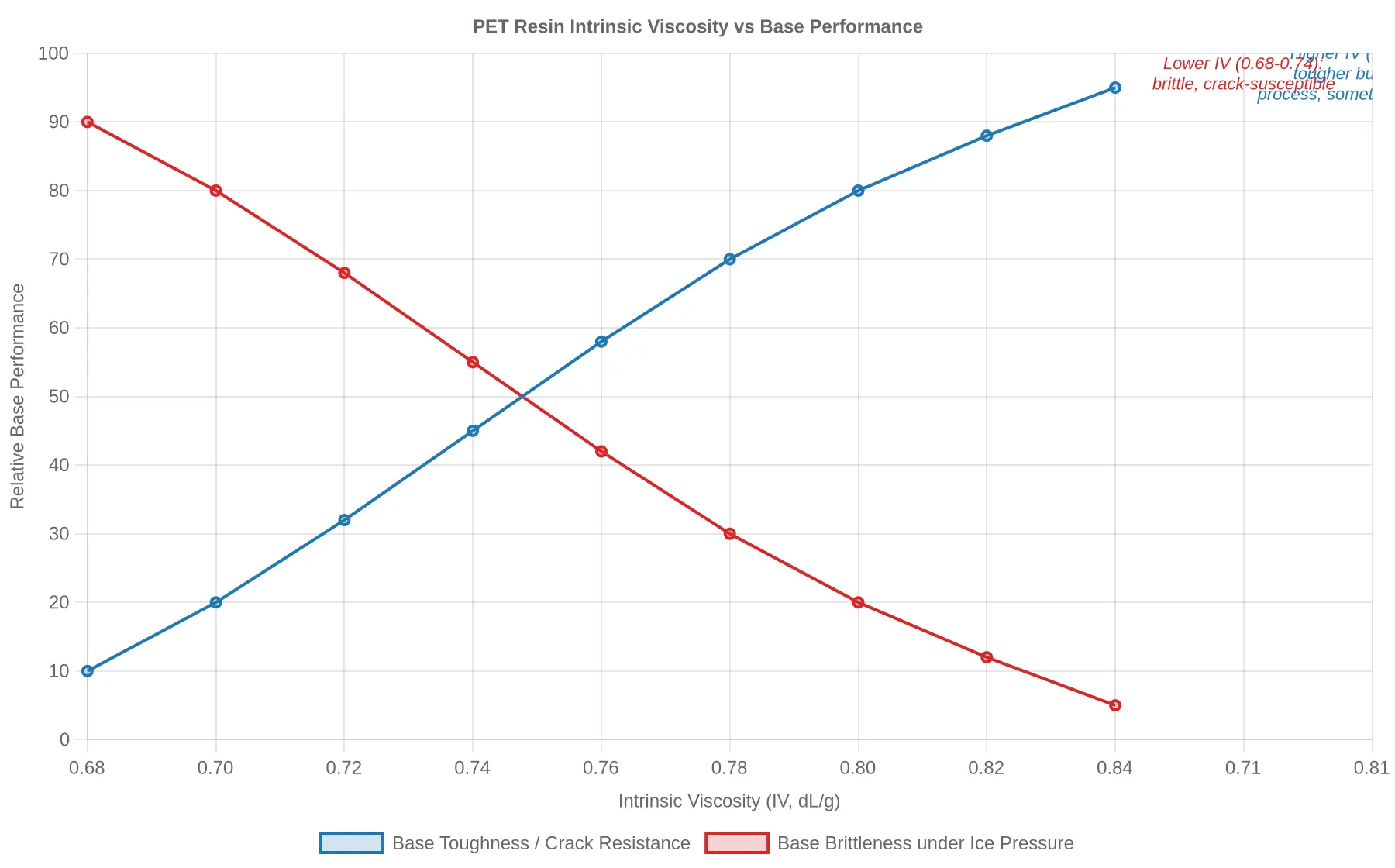
Resin grade is a first-order performance variable, not a background detail. Pair a thoughtfully chosen intrinsic viscosity with adequate base geometry, and cracking under ice pressure becomes an engineering decision rather than an unpredictable failure.
Why Base Thickness and Resin Grade Must Be Co-Optimized
Cracking at the base of 9 oz clear PET cups after ice is added is rarely the fault of a single variable. Base thickness and resin grade behave as one system: thickness sets how much material resists deformation, while resin grade, expressed as intrinsic viscosity (IV), determines how much stress that material absorbs before it fractures. Specify one and ignore the other, and a well-intentioned design still fails on the line.
Thin base, tough grade
A 0.35-0.45 mm base thermoformed from a high-IV (0.80+) grade can outperform a heavier design. The long polymer chains blunt crack tips and distribute load across the base, so a thinner wall survives the same ice load with meaningfully less material. In practice, a thin base made from a tough grade frequently beats a thick base made from a brittle grade, and it does so at a lower gram weight.
Thick base, brittle grade
Reverse the pairing and the advantage flips. A low-IV resin costs less per kilogram but crystallizes rapidly and fractures in a brittle mode; piling on extra thickness adds weight and cost without curing the underlying failure. The reverse also holds: where impact resistance is not the limiting factor, a thick base of a modest grade can be the more economical specification.
The cost-per-unit reality
High-IV resin carries a premium per kilogram, yet the thinner gauge it enables often lowers grams per cup. The metric that matters is not price per pound. It is cost per surviving unit. A cheap, brittle combination that generates returns and breakage is the expensive option once you account for scrap, rework, and complaints.
Lightweighting
Lightweighting and toughness are not opposites; they are partners. A high-IV grade lets engineers pull gauge down while holding performance, whereas a low-IV grade forces thickness up to compensate, eroding the very savings it promised. If you are weighing whether to keep optimizing a polymer cup or explore alternatives, it helps to review complementary cup and tableware formats before locking a spec.
Co-optimize, do not compromise
Treat both parameters together during design. Run a design-of-experiments matrix across base thickness and IV, then validate under real ice-loading conditions rather than on a bench. The configurations below show how the two variables trade off.
| Configuration | Base Thickness | Resin Grade (IV) | Crack Resistance | Relative Cost per Cup |
|---|---|---|---|---|
| Thin + tough | 0.40 mm | 0.84 | High | Low to medium |
| Thick + brittle | 0.60 mm | 0.72 | Low to medium | Medium to high |
| Thin + brittle | 0.40 mm | 0.72 | Very low | Low |
| Thick + tough | 0.60 mm | 0.84 | Very high | High |
The chart below ranks these four combinations on crack resistance against relative material cost. The thin-and-tough build delivers most of the durability of the thick-and-tough build at noticeably lower cost, which is why the two variables have to be optimized as a pair rather than in isolation.
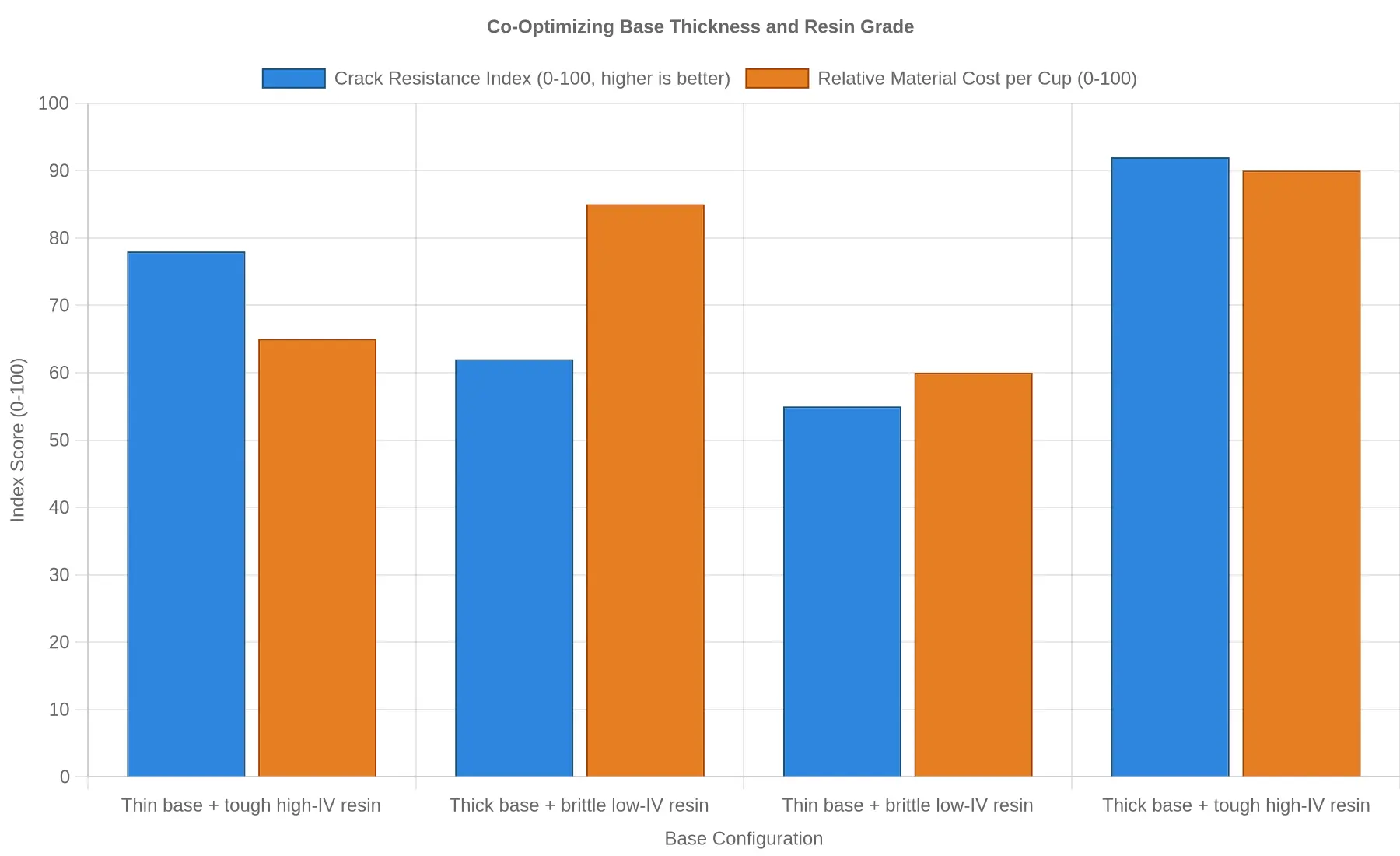
For procurement and engineering alike, the rule is simple: never approve a base thickness without stating the resin grade, and never approve a resin grade without stating the thickness. Only the pair tells you whether your 9 oz clear PET cups will survive the ice.
Base Thickness vs Resin Grade: Combination Comparison
The interaction between wall thickness and resin intrinsic viscosity (IV) determines how a 9 oz PET cup behaves when ice and liquid load converge on the base. Use the matrix below to benchmark representative combinations against the four variables that matter most in cold beverage service.
| Base thickness range | Resin grade / IV | Crack resistance under ice pressure | Clarity | Cycle time / processability | Relative cost index |
|---|---|---|---|---|---|
| Thin (0.25-0.32 mm) | Low IV (0.72-0.76 dL/g) | Poor – fast stress cracking | Excellent | Fastest, easy molding | 1.0 (lowest) |
| Thin (0.25-0.32 mm) | Standard IV (0.78-0.82 dL/g) | Low to moderate | Excellent | Fast | 1.1 |
| Thin (0.25-0.32 mm) | High IV (0.84-0.88 dL/g) | Moderate | Excellent | Moderate | 1.3 |
| Medium (0.33-0.42 mm) | Low IV (0.72-0.76 dL/g) | Moderate | Excellent | Moderate | 1.1 |
| Medium (0.33-0.42 mm) | Standard IV (0.78-0.82 dL/g) | Good – well balanced | Excellent | Moderate | 1.2 |
| Medium (0.33-0.42 mm) | High IV (0.84-0.88 dL/g) | Very good | Excellent | Slower | 1.4 |
| Thick (0.43-0.55 mm) | Low IV (0.72-0.76 dL/g) | Good | Very good | Slow | 1.3 |
| Thick (0.43-0.55 mm) | Standard IV (0.78-0.82 dL/g) | Excellent | Very good | Slow | 1.5 |
| Thick (0.43-0.55 mm) | High IV (0.84-0.88 dL/g) | Excellent – best in class | Very good | Slowest, highest energy | 1.7 (highest) |
For cold beverage service, the best balance is a medium base (0.33-0.42 mm) paired with standard IV resin (0.78-0.82 dL/g), which delivers good crack resistance and full clarity without the cost and cycle-time penalties of thick-wall or high-IV stock. Where heavy ice dosing and aggressive handling dominate, step up to a thick base with standard-to-high IV resin, comparable to the durable builds used across cold drink cup formats, to maximize resistance to base cracking.
Design and Quality-Control Criteria for Ice-Resistant PET Cups
When a 9 oz clear PET cup cracks at the base under ice pressure, the root cause is almost always a mismatch between wall geometry and resin performance. The criteria below give engineers and procurement teams a shared language for specifying cups that survive real-world cold-chain abuse.
- Minimum base thickness targets. Specify a nominal base-center thickness of 0.38-0.45 mm and a minimum knuckle thickness of 0.30 mm, then verify it by cross-section micrography on at least five cups per production lot. Thin or unevenly distributed bases concentrate stress exactly where expanding ice pushes outward.
- Resin IV specification range. Lock incoming PET to an intrinsic viscosity (IV) window of 0.76-0.80 dL/g for the base grade. Below 0.72 dL/g the molecular chains are too short to absorb impact; above 0.84 dL/g the melt becomes hard to stretch evenly and creates thin weak spots during thermoforming.
- Knuckle-radius standards. Design the base-to-wall transition with a minimum internal radius of 1.5 mm and a smooth tangent blend, never a sharp step. A generous radius spreads hoop and bending stresses across a wider band of material instead of a single line.
- Gate design. Use a centered gate sized to fill the base before the sidewall freezes, and include a cold-slug well to capture the first, thermally degraded melt. Off-center or undersized gates produce weld lines and residual orientation that crack first.
- Drop and load test protocols. Run a controlled vertical drop of a water-filled, frozen cup from 1.2 m onto a hard surface at both 23 C and 4 C, ten cups per lot, and record the pass rate plus failure location. Pair this with a static top-load test to simulate stacked cases in transit.
- Incoming resin verification. Require a certificate of analysis for every resin shipment, then independently confirm IV, moisture (target below 50 ppm), and acetaldehyde content. Reject any lot that drifts outside the agreed window before it reaches the thermoformer.
- Post-mold inspection points. Inspect base haze, crazing, gate blush, and wall-thickness distribution every shift, and quarantine any units showing stress whitening at the knuckle. Tracked over time, these readings become an early-warning system for tool wear and resin drift.
From Criteria to a Purchasing Specification
Each criterion above belongs in the purchase order as a measurable line item, not a vague adjective. Turn the list into a specification sheet that names the test method, the sample plan, the acceptance threshold, and the party responsible for verification, then reference that sheet directly in supplier agreements. Sourcing good cold-cup packaging depends on exactly this discipline. Done properly, “ice-resistant” stops being a marketing claim and becomes an enforceable, repeatable quality gate that protects both your margins and your brand reputation.
Before diving into thickness numbers and resin grades, it helps to see the geometry that fails first. The schematic below is a simple vertical cross-section of a 9 oz clear PET cup base, drawn to isolate the features that govern ice-load performance: the wall thickness at the heel, the knuckle radius where the sidewall rolls into the bottom, the central gate region left by injection molding, and the stress-concentration zones where failure risk is highest.
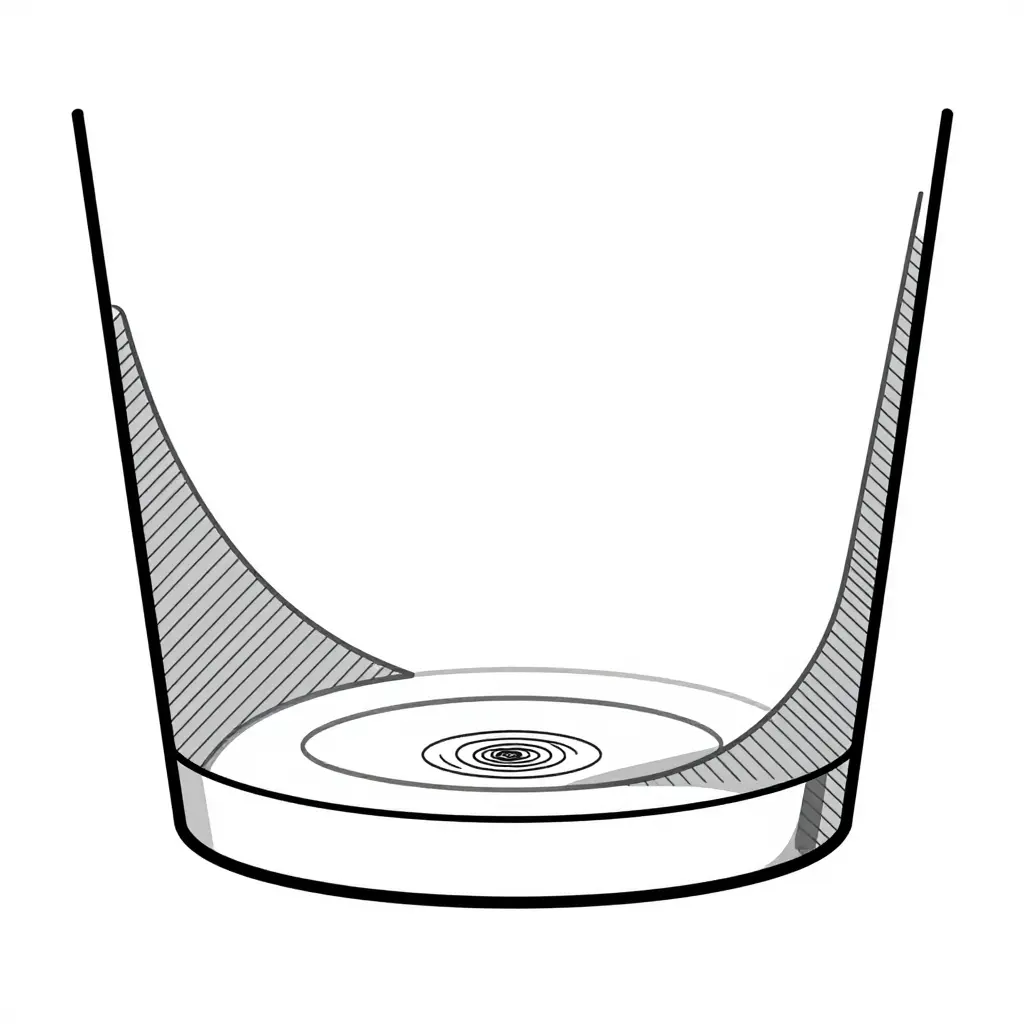
Reading the geometry
- Base thickness – The cross-hatched wall band shows how thin the molded heel gets as resin is stretched downward. A locally thin heel is the single most common precursor to a crack.
- Knuckle radius – The smooth curve joining sidewall to bottom. Too tight a radius acts like a notch, sharpening the stress field exactly where ice impact is highest.
- Gate region – The central point where molten resin enters the cavity. Poor gate conditions can leave residual stress or weak weld consolidation near the center.
- Stress-concentration zones – The shaded areas mark where tensile stress peaks under an outward ice load: the knuckle and the gate collar are the usual crack-initiation sites.
When you evaluate vendors, ask for a drawing that looks like this one. If the specification sheet only lists a nominal base thickness without calling out knuckle radius or gate placement, you are missing the two variables that most often decide whether a cup survives a full scoop of ice.
Frequently Asked Questions: 9 oz Clear PET Cup Base Cracking
Why do 9 oz clear PET cups crack at the base under ice pressure?
Clear PET is notch-sensitive, and the base is the thinnest, most highly stretched region of a thermoformed cup. When ice cubes settle, their sharp edges act as point loads, and melt-and-refreeze cycles add outward pressure. These loads concentrate at the base radius and gate area, where molecular orientation and wall thickness are already lowest. Because PET impact resistance drops sharply near 0 °C, the base can fail by stress cracking rather than simple deformation. Uneven base distribution, residual stress from forming, and poor gate crystallinity all accelerate the failure.
Does a thicker base always prevent cracking?
No. Thickness raises load-bearing capacity, but excess thickness can create amorphous, brittle zones and trap residual stress during forming. Uniform base distribution, correct heat history, and good gate design matter more than raw thickness. A thick but poorly oriented base often cracks sooner than a thinner, evenly stretched one.
How does resin IV affect toughness?
Intrinsic viscosity (IV) tracks molecular weight and chain length. Higher IV resins (typically 0.80-0.84 dL/g) have longer chains that entangle and dissipate impact energy, improving toughness and environmental stress crack resistance. Low IV grades are more brittle and prone to base cracking under ice pressure.
What base thickness is recommended for iced beverages?
For a 9 oz clear PET cold cup, aim for the target ranges below while prioritizing even distribution over peak thickness.
| Cup format | Recommended base wall (mm) | Recommended base wall (mil) |
|---|---|---|
| 9 oz thin-wall | 0.35 – 0.45 | 14 – 18 |
| 9 oz heavy-duty | 0.45 – 0.55 | 18 – 22 |
| Base radius/gate zone | 0.40 – 0.50 | 16 – 20 |
How do you test crack resistance?
Common methods include ice-load and top-load compression tests, drop testing at 0 °C, falling-ball impact, and environmental stress crack resistance (ESCR) tests using detergent or oil exposure. Fatigue cycling with repeat ice fills reveals long-term base performance.
Does a high-IV grade increase cost?
Yes. Higher IV requires longer polymerization and tighter process control, so resin typically costs more and can demand adjusted forming temperatures. For buyers comparing disposable cold cups, the offsetting benefit is fewer base failures, lower leak claims, and better brand reliability.
Sourcing Ice-Resistant PET Cups: Turning Specs into Purchase Orders
Spec sheets fail when adjectives replace numbers. When you source ice-resistant PET cups, your purchase order has to express base thickness, sidewall thickness, and resin grade as measurable tolerances the supplier can be held to. “Heavy-duty base” means nothing in a dispute; “base thickness 1.2 mm +/- 0.1 mm” means everything.
Translating thickness and resin into PO language
Base thickness drives crack resistance under ice pressure more than any other single variable. Specify it as a nominal value with an explicit tolerance band, then pair it with the intrinsic viscosity (IV) of the resin. A higher IV grade resists stress cracking, but it costs more and can slow cycle times, so tie both values to a defined end-use test rather than a data sheet alone.
| Parameter | PO specification | Verification method |
|---|---|---|
| Base thickness | 1.2 mm +/- 0.1 mm | Micrometer, 5 points per cup |
| Sidewall thickness | 0.9 mm +/- 0.08 mm | Sectional gauge |
| Resin IV | 0.78 dL/g minimum | Supplier CoA |
| Drop impact | No base fracture, 1 m, ice-filled | In-house audit |
Qualifying suppliers
Qualify vendors against process capability (Cpk), not a single golden sample. Request Cpk data on base thickness, third-party migration reports for food-contact compliance, and a retained-sample program. Audit injection or thermoforming lines for mold-cooling consistency, since uneven cooling creates the internal stress that nucleates base cracks.
Building a broader packaging program
Ice cups rarely ship alone. Consolidate complementary formats under one qualified vendor to cut audit overhead. Consider sugarcane cups for compostable cold service, paper cups for hot lines, kraft take-away boxes for grab-and-go meals, and paper cup holders for multi-drink carriers. Standardizing thickness language and certification requirements across these categories simplifies your supplier scorecard and protects service quality at the counter.