
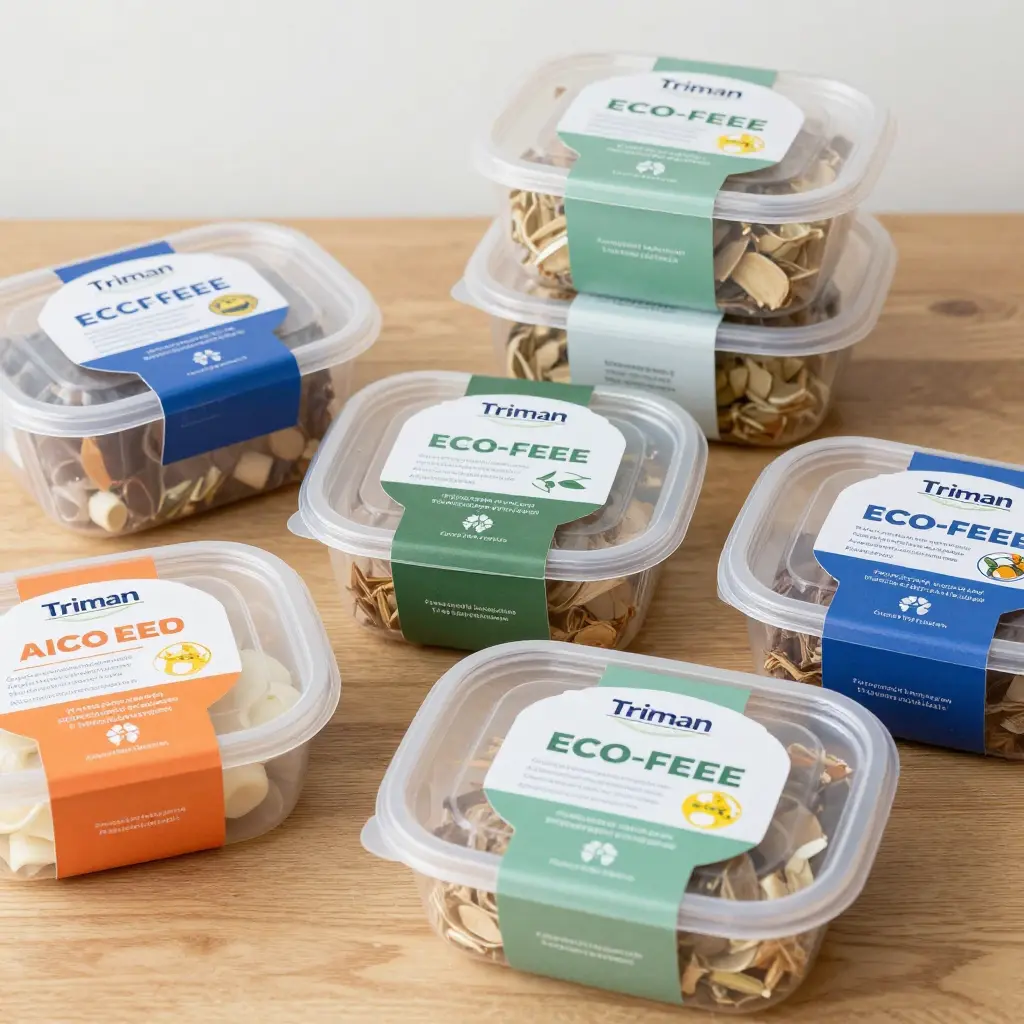
Triman Label and EPR Fees for Plastic Food Containers in Eaubonne, France
If you produce, import, or sell packaged food in France, two rules govern how you mark that packaging and who pays for it once it becomes waste: the Triman sorting label and Extended Producer Responsibility (EPR). Eaubonne, a municipality in Île-de-France, sits inside the national system built around Citeo (formerly Eco-Emballages), so the same plastic packaging requirements apply there as anywhere else in the country.
The Triman symbol is the sorting instruction French law requires on packaging, and it is printed alongside Info-tri, the standardized panel that tells consumers which bin each component belongs in.
Under EPR, known in French as REP (Responsabilité Élargie du Producteur), producers pay for the collection and recycling of their packaging after use. That payment is an éco-contribution, charged per unit or per tonne, and the rate depends on the material and the packaging weight.
The Triman Label: Legal Origin and Regulatory Basis
The Triman label comes from France’s Loi AGEC (Loi anti-gaspillage pour une économie circulaire, or Anti-Waste for a Circular Economy Law), enacted in February 2020. Article 17 turned the existing Triman symbol into a mandatory, harmonized sorting instruction for consumer products and packaging. ADEME, the French Agency for Ecological Transition, publishes the official usage guide for the label and the Info-tri panel that accompanies it.
On plastic food containers, the Triman marks an item as part of an EPR scheme and as waste that must be sorted under French collection rules. Info-tri adds the detail: which component goes where, for example separating a lid from its tray.
The marking is compulsory on packaging and on printed materials intended for French consumers, including takeaway boxes, cups, trays, and films. Producers and importers can consult a plastic food container compliance guide to align formats, inks, and digital alternatives with ADEME’s specifications.
The table below covers the Triman and Info-tri obligations for the plastic food container formats most commonly placed on the French market. Producers and importers shipping into the region should review Eaubonne-specific EPR guidance before finalizing label artwork.
Triman Labeling Requirements by Plastic Food Container Type
| Container Type | Example Formats | Triman Label Required | Accompanying Info-tri Sort Instruction | Typical Material Code |
|---|---|---|---|---|
| Rigid plastic trays | PP trays for produce, meat, ready meals | Yes | Separate the film, sort the tray | PP (5) |
| Clear plastic cups with lids | PET/PP cups for cold drinks, dairy | Yes | Remove lid, sort cup and lid | PET (1) / PP (5) |
| Takeaway food boxes | Clamshell or lidded boxes for hot meals | Yes | Empty and sort the packaging | PP (5) / PS (6) |
| Compartmentalized containers | Multi-compartment meal trays | Yes | Sort by compartment, detach film | PP (5) / PS (6) |
| Film / lidding | Sealing lids, stretch and shrink film | Yes | Detach the film, sort with plastics | LDPE (4) / PP (5) |
How EPR Fees for Plastic Food Containers Are Calculated
Under France’s EPR regime, éco-contributions on plastic food packaging are not a flat tax but a modular fee. The producer who first places packaging on the French market — the “mise sur le marché” — files an annual volume declaration (“déclaration annuelle”) with an approved éco-organisme such as Citeo, which then invoices the contribution. Four things drive the amount:
- Material type: resin and format set the base tariff
- Unit weight: charged per gram of packaging placed on the market
- Number of units placed on market: the total count declared
- Recyclability bonus/malus: modular adjustments that reward recyclable or reduced-plastic designs
The declared tonnage is multiplied by the base tariff, then adjusted by the bonus or malus. Lighter, mono-material, or recyclable formats earn reductions, while hard-to-recycle plastics incur penalties. Switching to recycled kraft paper packaging usually changes the fee treatment substantially compared with rigid plastic. Because the fee rises with volume and weight, accurate declarations matter: under-reporting triggers penalties from the éco-organisme.
The table below carries the data behind the chart “Indicative Annual EPR Fee Ranges by Plastic Food Container Category”. Treat the figures as order-of-magnitude planning estimates, not Citeo tariffs; actual fees depend on recyclability, material type, weight, and the specific rate schedule that applies to the declared packaging. Verify current rates before budgeting.
| Plastic food container category | Low estimate (EUR/tonne) | High estimate (EUR/tonne) |
|---|---|---|
| Rigid trays | 20 | 45 |
| Clear plastic cups | 25 | 55 |
| Takeaway boxes | 30 | 65 |
| Compartmentalized containers | 35 | 75 |
| Plastic film / lidding | 15 | 40 |
Producers and importers that place packaged food products on the French market must work through a set sequence of EPR obligations.
- Register with an approved éco-organisme such as Citeo, creating a producer account and submitting company, packaging, and contact details.
- Obtain your unique identifier (IDU), the registration number that confirms your legal standing and gives you access to declarations under the French EPR framework.
- Apply the Triman logo and Info-tri sorting instructions to every packaged unit, matching the latest harmonized specifications.
- Submit the annual déclaration, reporting the number of units and material types placed on the market during the reference year, with supporting documentation.
- Pay your éco-contributions, calculated from your declared volumes and material categories on the published tariff schedule.
Working through these steps in order keeps declarations accurate and products ready for the French market; our guide to EPR obligations for packaging in Eaubonne covers regional specifics.
How the Triman Labeling Process Flows
Labeling works as a three-stage sequence, and reading it that way makes clear that the Triman symbol is not a graphic dropped onto a package at the last minute.
Stage 1: The Packaging Design Element
The process starts with the packaging component itself. At this point the container is a design decision: its material, format, and surface area determine where a marking can realistically sit and how large it must be to remain legible. For moulded or formed products such as tubs, trays, and cups, the marking zone is typically engineered into the tooling rather than added afterward.
Stage 2: Applying the Marking
The second stage is application. The Triman symbol, often paired with sorting instructions, is printed, stamped, or moulded onto the container or its label in a way that survives handling, refrigeration, and food contact.
Stage 3: The Sorting Symbol Outcome
The finished package carries the Triman motif and, ideally, points the consumer toward the sorting bin. That is the outcome to aim for: packaging that tells the consumer clearly how it should be sorted and recycled.
Why the Order Matters for Compliance
Treating labeling as a sequence keeps producers focused on three checkpoints: design feasibility, application durability, and consumer-facing clarity. Miss one and the package risks falling foul of French environmental labeling rules. Because those rules are national, local guidance mostly concerns how the sorted waste is collected — our guidance on plastic packaging and food containers in Eaubonne breaks down how local obligations interact with national Triman rules.
How National Triman and EPR Rules Apply in Eaubonne
French EPR and Triman obligations are national law, not municipal. A plastic food container sold in Eaubonne faces the same requirements as one sold anywhere else in Île-de-France: display the Triman logo, join an approved éco-organisme such as Citeo, and pay éco-contributions based on packaging weight and material. There is no separate “Eaubonne rule” to satisfy.
What varies locally is post-consumer recovery. Eaubonne’s yellow bins (bacs jaunes) and the wider regional sorting network determine how residents actually recycle your packaging, so it is worth designing for that stream. Sellers and e-commerce importers shipping into Eaubonne must comply even when they are based outside France, and penalties can follow imported goods. Review the Eaubonne compliance requirements for plastic food containers, and compare regional expectations with our Bordeaux France EPR guidance.
Key Triman/EPR Deadlines and Fee Contributions for Plastic Food Containers
The table below covers the registration, declaration, and payment obligations that sit alongside the labeling requirements above. Deadlines follow the standard Citeo/ADEME framework; always confirm current dates with your registered éco-organisme.
| Obligation | Applicable Packaging | Typical Deadline or Reporting Cycle | Responsible Party | Notes on Fee Treatment |
|---|---|---|---|---|
| Registration (IDU unique identifier) | All household and professional plastic food containers subject to EPR | Before first placing on market; IDU must be stated on contracts/invoices from 1 Jan 2022 | Producer, importer, or first distributor placing items on the French market | No direct fee at registration, but lack of an IDU blocks fee declaration and may trigger penalties |
| Triman marking compliance | Household plastic food containers with the Triman logo and sorting instructions | Applicable since 1 Jan 2022 for packaging already in scope; new categories phased in on rolling dates | Brand owner / producer responsible for label design | Non-compliant marking does not itself change the fee, but risks enforcement fines and remediation costs |
| Annual declaration cycle | Declared plastic food containers (by material, weight, and unit count) | Annual declaration of previous year’s volumes, typically by 28 February (elements) / 31 March | The registered producer via its éco-organisme portal | Declared tonnage directly determines the calculated éco-contribution base |
| Éco-contribution payment | All declared plastic food containers in the EPR stream | Annual payment, generally due after declaration validation; possible installments at producer request | Registered producer (legal obligation to pay the éco-organisme) | Fee includes base rate plus modulation (bonus/malus) for recyclability and recycled content |
Before submitting, cross-check your filing category against the region-specific guidance for Eaubonne and the wider French market. Keep declaration records for at least five years as documentary proof of compliance.
Frequently Asked Questions
Is the Triman label mandatory for plastic food containers sold in France?
Yes. Under the French Anti-Waste for a Circular Economy (AGEC) law, the Triman logo is mandatory on household packaging, including plastic food containers. Producers in Eaubonne must affix the marking and sorting instructions before sale.
How are EPR fees calculated for plastic food containers?
Éco-organismes such as Citeo calculate them from the declared weight and volume of packaging placed on the market, multiplied by an eco-modulated rate. Rates vary by material, recyclability, and format. Producers report tonnages annually and pay the contribution.
Do foreign e-commerce sellers shipping into France have to register?
Yes. Any seller, including foreign e-commerce platforms, that first places packaged goods on the French market must register with a producer responsibility organisation and obtain a Unique Identification Number (IDU). This applies regardless of where the company is established.
What is the difference between Triman and Info-tri?
Triman is the sorting symbol that shows packaging belongs to a separate collection stream. Info-tri is the panel specifying the correct bin or drop-off point.
What happens if a producer does not comply?
Non-compliance can trigger administrative fines, per-unit penalties, and mandatory corrective action. Authorities may impose financial sanctions under AGEC provisions, and continued non-compliance can lead to market withdrawal.
Conclusion: What to Do Next
Anyone placing plastic food containers on the French market has to register with an approved éco-organisme, apply the Triman logo correctly, and pay éco-contributions calculated on packaging weight, material, and recyclability. In practice that means auditing your packaging portfolio, obtaining your IDU, affixing compliant labels, and filing accurate declarations before every deadline.
Design choices also show up in the fee. Recyclable packaging, such as plastic food containers sold in Eaubonne, can lower your éco-contribution exposure while meeting consumer expectations on sustainability.
For dependable trusted packaging solutions suited to your compliance and market needs, GREENDISPO PACK supplies disposable tableware, packaging paper, and boxes built around safety, durability, and eco-friendly practices.