
Why 64 oz plastic food containers bow under hot fill
Fill a large 64 oz plastic food container with something hot and it can bulge, bow, or warp. The rim flares out. The base dips downward. The sidewalls soften and lean. The industry calls this bowing under hot fill, and it shows up constantly in high-volume food service and takeaway kitchens.
Two things decide whether a filled tub stays square or turns into a wobbling oval on the line: the PP grade and the base thickness. Polypropylene grades soften at different temperatures, and the thickness of the base sets how much stiffness remains once heat reaches the bottom. Together they settle whether the container holds its shape or loses it.
For a closer look at how large tubs perform in real filling conditions, see this overview of 64 oz container performance under hot fill. Buyers comparing materials often work from a broader plastic food container selection guide before they settle on a resin and wall spec.
What follows is how PP grade and base thickness interact under hot fill, and how to write a spec that resists bowing.
What actually happens when a container bows under hot fill
Heat does not stay in the food. It conducts through the product into the container wall and pushes the wall temperature toward the heat deflection temperature (HDT). For polypropylene (PP), low-load tests put that range at roughly 90 to 105 °C depending on grade, but HDT falls by tens of degrees under the higher stresses a loaded container actually sees, so treat the low-load figure as a ceiling rather than a working number. As the wall nears that zone, the polymer chains loosen, stiffness drops sharply, and a wall that felt rigid at room temperature starts to behave like stiff rubber. That is when bowing becomes possible.
Three loads act on the container at once:
- Weight of the hot product, pressing out and down on the softened base.
- Headspace pressure, which runs above ambient while the fill is hot and reverses to a partial vacuum once the sealed package cools.
- Lid and stacking force, pushing sideways against walls that can no longer carry the load.
Above its HDT, PP does not spring back the way it would when cool. It creeps, shifting slowly and permanently under a steady load. The base bulges downward, the sidewalls bow outward, and the container loses dimensional stability: it no longer holds its intended shape, stacks properly, or seals reliably. A higher-crystalline grade with a higher HDT resists softening longer, and a thicker base spreads the load so no single point creeps past the point of recovery. To see how those variables play out at full size, this overview of the 64 oz plastic food container covers the design trade-offs that keep large hot-fill tubs stable.
PP grade: homopolymer vs copolymer and heat performance
The PP grade you choose often decides whether a 64 oz container holds its shape through a hot fill or bows and caves at the walls. The two families to compare are polypropylene homopolymer, pure propylene with a highly crystalline structure, and polypropylene copolymer, in which a small amount of ethylene comonomer (usually 2–7% in random grades) is polymerized into the chain. Homopolymer is stiff, hard, and heat tolerant. Copolymer trades some of that rigidity for toughness, which is why it is the usual choice for parts that have to survive cold drops and rough handling.
Ethylene content is the dial that sets the stiffness-versus-impact balance. More ethylene means less crystallinity, so the material gets softer and more flexible while impact resistance rises, especially in the cold. Two copolymer types matter here. Random copolymers scatter the comonomer through the chain, which improves clarity and softness. Impact (block) copolymers build a rubbery dispersed phase for high impact strength. Neither is better in every case: a stiffer grade resists bulging and sagging, a tougher one resists cracking when the container is dropped or frozen. The chart below shows the usual trade-off.
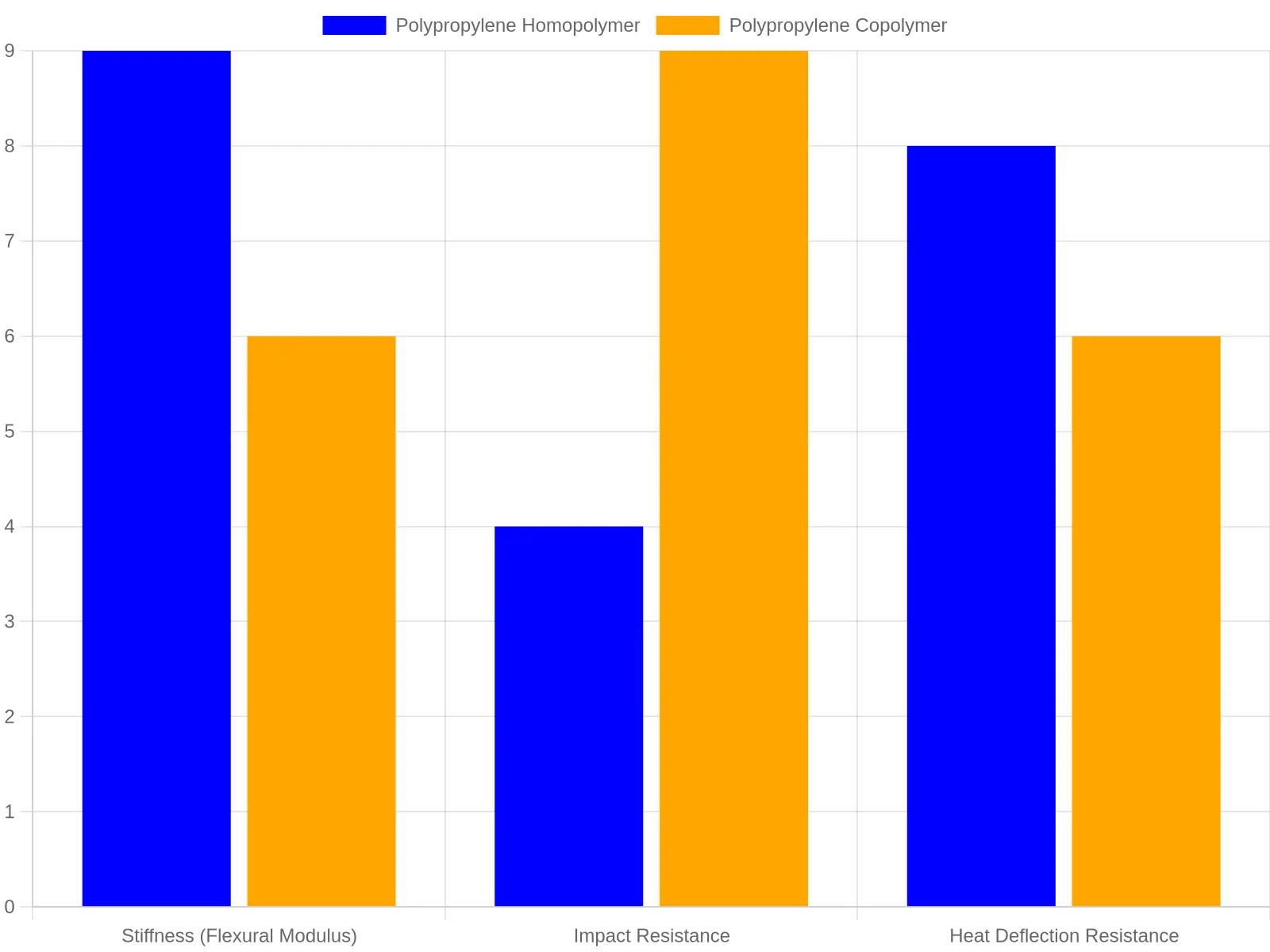
For hot fill resistance, stiffness and heat deflection temperature carry most of the load. A homopolymer generally holds its modulus and shape at higher fill temperatures than a standard copolymer, which softens sooner because the comonomer lowers the melting range. Homopolymer is also more brittle, so if the same container takes hard drops, the balance tips back toward copolymer. Melt flow index (MFI) adds another variable. A high-MFI resin flows more easily into thin walls and fills them more evenly, which spreads hoop stress and works against localized bowing, but high MFI usually means lower molecular weight and lower impact strength. A low-MFI resin pours tougher material at the cost of filling difficulty.
When you settle on a PP grade, weigh these factors together rather than optimizing one property:
- Hot fill temperature and dwell time – hotter fills favor stiffer, higher-HDT grades.
- Impact exposure – cold storage, stacking, and drop risk push you toward copolymer.
- MFI versus wall geometry – thin, deep, or complex walls need enough flow for uniform thickness.
- Base thickness pairing – grade and wall design have to be tuned as a pair, not separately.
A custom forming setup lets you test that pairing directly. You can see how forming machines handle disposable bowls and deep containers to match grade, MFI, and thickness before committing to a production run.
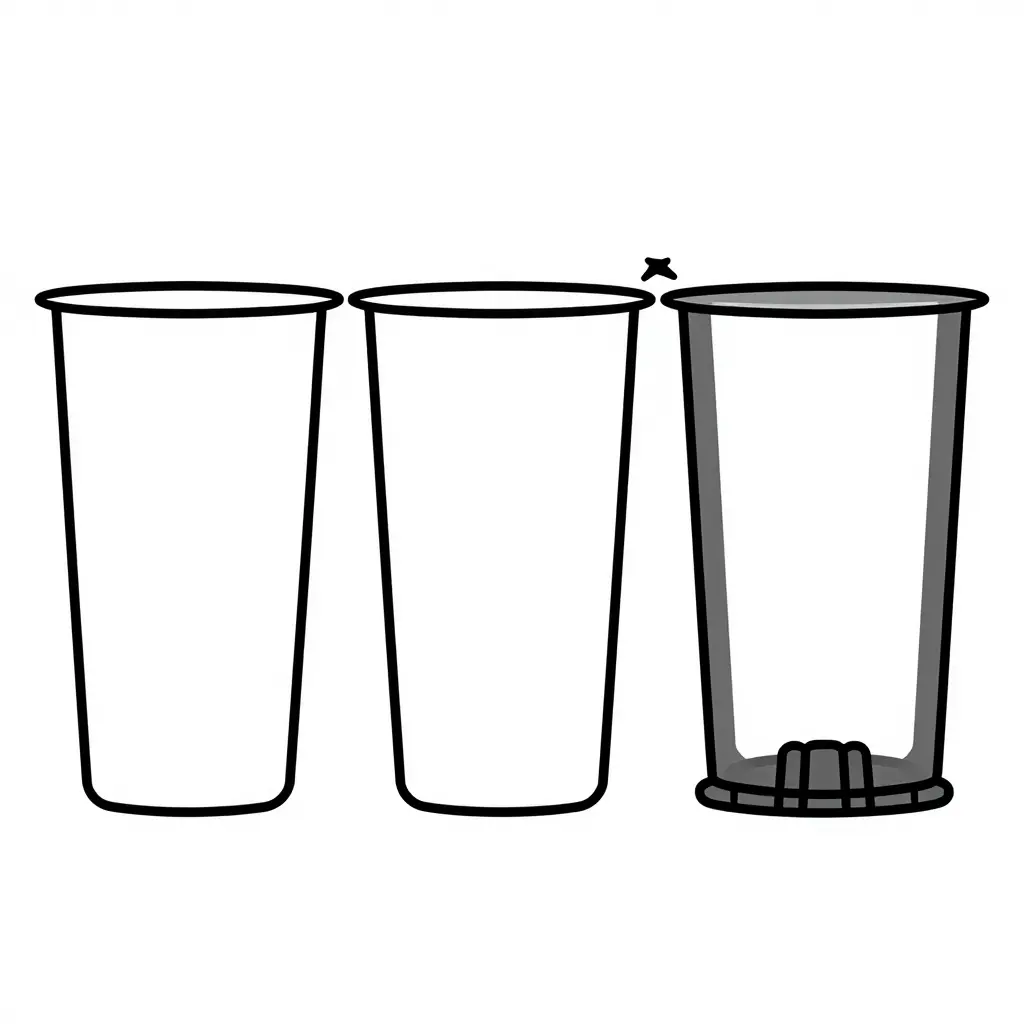
How base thickness resists bowing – the same 64 oz container profile, drawn three ways:
- Thin, uniformly walled base: equal wall and floor thickness leaves the least material to fight internal pressure, so the side walls flex outward first.
- Medium base: added wall and floor thickness spreads the flexing force over more material, raising stiffness without changing the shape.
- Thick reinforced base with a raised center: the heaviest floor and a domed, ribbed center act like a shallow beam, while side ribs lock the walls in place, so the outward push is absorbed instead of bowing the container.
For hot-fill work, a sufficiently thick base paired with the right PP grade for 64 oz hot-fill containers is what keeps a container square and stackable straight off the line.
Base thickness: the load-bearing variable
Base thickness carries the load in any hot-fill container. A flat panel’s resistance to bending rises roughly with the cube of its thickness, so small gains in thickness buy large gains in stiffness. When a large container is filled hot, the softened wall loses modulus and internal pressure pushes outward; the base has to resist that force without deflecting. Base thickness therefore sets the point at which a package begins to bow, and it usually counts for more than a single grade change.
Nominal wall thickness, though, is a misleading number on its own. Load concentrates at geometric discontinuities, so corner and edge thickness drives real-world performance far more than the average printed on a spec sheet. A generous corner radius and internal ribbing spread that load and raise effective rigidity, in the same way that internal structural bracing divides one large floor into several smaller stiff panels. A container can pass a nominal-thickness check and still fail because its corners are too thin.
Thermoforming adds the problem of draw ratio. The deeper the draw, the more the sheet stretches and thins, so thickness varies across the geometry. Those thin sections bow first under thermal and pressure load, and they tend to fail before the surrounding material shows any sign of stress. Keeping a base flat is a matter of controlling thickness distribution, not just average gauge.
- Specify a minimum base thickness at the thinnest point, not an average nominal value.
- Increase corner radius to spread load and avoid stress concentration at edges.
- Add ribbing to divide the base into smaller, stiffer panels.
- Cap the draw ratio to limit uneven thinning during thermoforming.
- Verify corner and edge thickness after forming, not from incoming sheet data alone.
How much does each design actually bow?
Deflection numbers side by side explain faster than any argument why some 64 oz containers hold their shape while others bulge. The chart below compares average outward base deflection – how far the bottom bows down after a hot fill – across five common configurations of 64 oz plastic food containers.
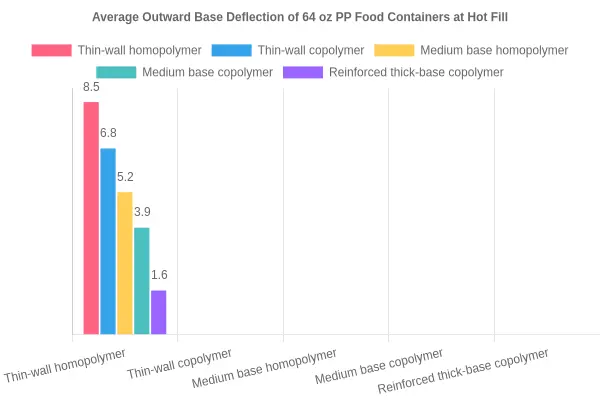
Figure 1: Thicker bases and copolymer grades both cut bowing, and the reinforced thick-base copolymer comes out best.
Two levers move those numbers: how thick the base is, and whether the resin is homopolymer or copolymer. Apply both and the gains stack.
- Base thickness helps, but it is not the whole answer. Going from a thin wall to a medium base cuts about 3 mm of deflection in the homopolymer family (8.5 mm down to 5.2 mm).
- Grade is just as influential. At each wall thickness, switching from homopolymer to copolymer removes another 1.3 to 1.7 mm, because the rubbery ethylene segments absorb stress instead of passing it straight to the base.
- Both together win. The reinforced thick-base copolymer lands at 1.6 mm, comfortably under the 4.0 mm limit most food service operations treat as acceptable, and less than one-fifth the bowing of the worst performer.
How bowing is measured: test methods and evidence
Manufacturers rarely judge bowing by eye. They run repeatable hot-fill tests that mimic the filling line. The most common is a fill-and-hold test: the container is filled to its rated volume with water or the actual product at a controlled temperature, usually 85 to 95 °C, then left to stand for a fixed hold period. Technicians watch the walls and base for the first visible change and record how quickly deformation appears while the contents stay hot.
The hardest numbers come from base deflection and dimensional recovery. A dial gauge or laser sensor tracks how far the base pushes down at its hottest point, and lid-fit checks confirm the lid still snaps on and seals after the container cools. Once cool, the sample sits for 24 hours and is measured again to show how much of its original shape returns. Together those steps define dimensional stability under real conditions. Typical criteria include:
- Peak base deflection (mm) at maximum internal temperature
- Change in rim diameter or ovality after cooling
- Lid engagement force needed for a full seal
- Permanent (non-recoverable) deformation measured 24 hours after cooling
Results are never fixed; they depend on fill temperature, cooling rate, and product weight. A heavier load and a slower cool both raise the risk of lasting deformation. The chart below shows how peak base deflection climbs with fill temperature for two PP grades.
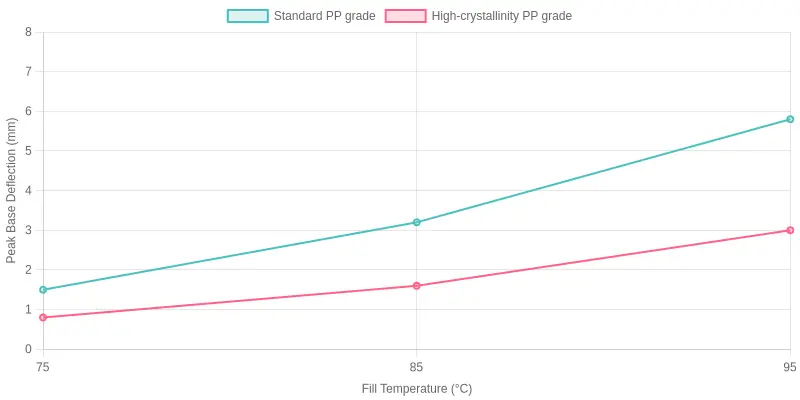
That evidence is why material and grade choice matter. To weigh the trade-offs, see how glass and plastic compare in our material comparison of food container options.
How to read it: scan left to right. Moving from thin-wall homopolymer to reinforced thick-base copolymer raises shape retention and lowers bowing risk, so match the row to your fill temperature and wall target when you specify 64 oz hot-fill containers.
| Configuration | PP Grade Type | Average Base Thickness | Relative Bowing Resistance | Bowing Risk under Hot Fill | Best-Fit Use Case |
|---|---|---|---|---|---|
| Thin-wall homopolymer | Homopolymer | 0.4-0.6 mm | Low | High | Chilled or room-temp items |
| Thin-wall copolymer | Copolymer | 0.4-0.6 mm | Medium | Moderate | Warm grab-and-go sides |
| Medium-base homopolymer | Homopolymer | 0.8-1.0 mm | Medium-High | Moderate | Room-temp meal prep |
| Medium-base copolymer | Copolymer | 0.8-1.0 mm | High | Low | Hot soups and stews |
| Reinforced thick-base copolymer | Impact copolymer | 1.2-1.5 mm | Very High | Very Low | 64 oz hot-fill bulk meals |
Before you lock in a supplier, run this checklist so your 64 oz plastic food containers keep their shape through every hot-fill cycle.
Specification checklist for hot-fill 64 oz containers
- Confirm your exact fill temperature and dwell time first. A 64 oz container behaves very differently at 195 °F than at 165 °F.
- Match the PP grade to the heat it will actually see. Upgrade to a heat-resistant copolymer when sauces or soups are filled close to boiling.
- Increase base thickness to counter the drum-like bulge that appears when a wide, flat bottom takes up thermal stress.
- Reinforce corners and side walls slightly; these high-stress zones buckle long before the rest of the body does.
- Verify wall uniformity across every mold cavity. An uneven flow front leaves thin spots that bow under hot fill.
- Test lid fit only after the container cools, to confirm the rim returns to tolerance and the closure still snaps or seals.
- Add controlled cooling so the contents are stable before stacking, which lowers long-term distortion risk.
Work through the list in order and most bowing problems will surface before a pallet leaves the plant.
The hot-fill sequence, step by step
Deformation does not happen at a single instant. It accumulates across five stages on a typical filling line:
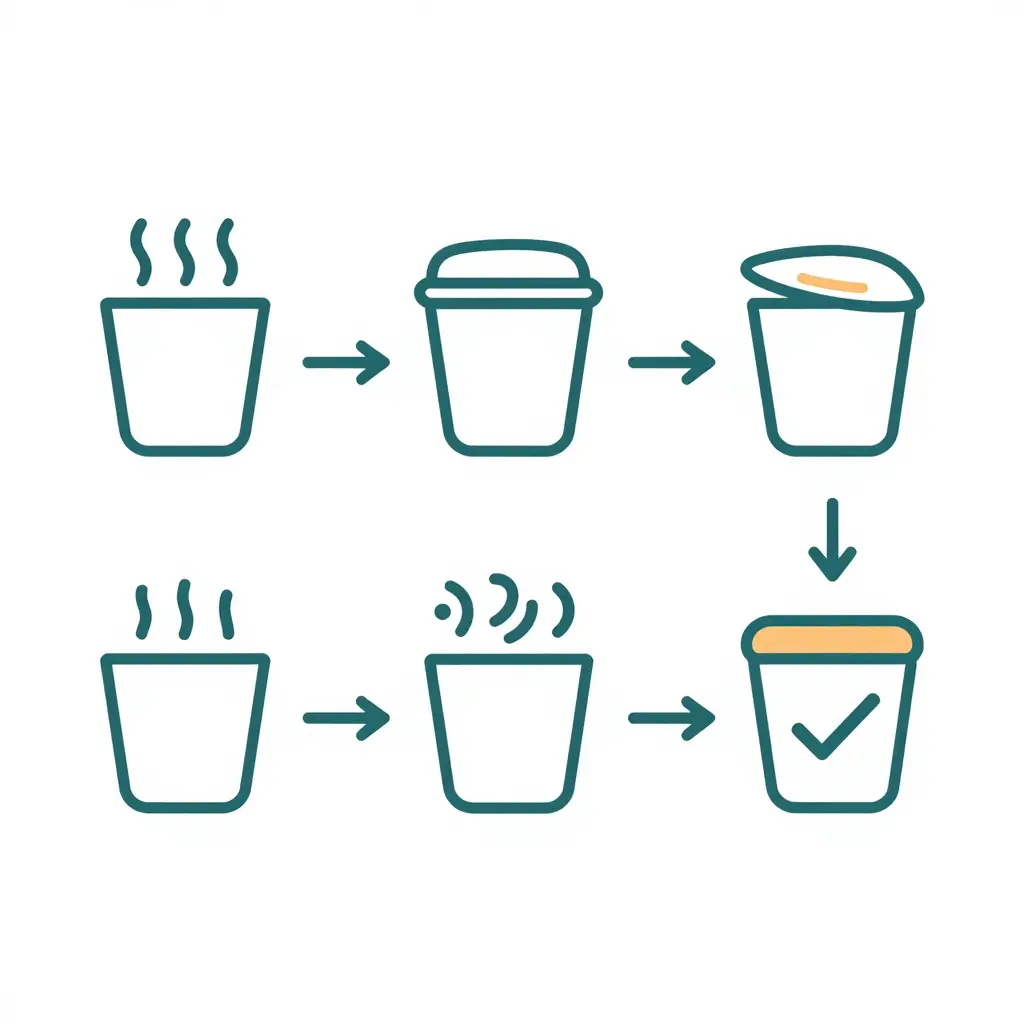
Reading left to right:
| Stage | What Happens | Bowing Risk |
|---|---|---|
| 1. Empty | A rigid, cold container enters the line. | None |
| 2. Fill | Hot product (often 85-95 °C) contacts the walls. | Medium |
| 3. Seal | A lid traps heat and vapor inside. | Medium |
| 4. Cool | Contents contract, internal pressure drops. | High |
| 5. Final | Container settles at room temperature. | Visible |
Outward bowing peaks while the fill is hot and the resin is soft. As the sealed container cools, the headspace contracts, internal pressure drops, and the walls can be pulled inward instead. Either direction becomes permanent when the material was hot enough to creep past recovery, and cooling rate decides how much of the change sticks. That is why the container’s final shape depends so heavily on the resin and wall thickness chosen long before the product touches it.
To see how a 64 oz format handles this pressure shift in practice, see our breakdown of 64 oz plastic food container specifications.
Frequently asked questions
Does a higher PP grade alone prevent bowing?
No. A higher grade raises stiffness and heat resistance, but it does not stop bowing on its own. Geometry, wall thickness, and cooling behavior count just as much. Many 64 oz plastic food containers still bow when the base and sidewalls are too thin, whatever the resin.
Is increasing base thickness more effective than changing grade?
In most cases, yes. Thickness gives a more direct gain in stiffness than a higher PP grade, because stiffness rises sharply with thickness. A modestly thicker base often controls bowing better than an expensive resin upgrade. The best results combine a reasonable grade with adequate base thickness.
What fill temperature is generally considered risky for 64 oz plastic food containers?
Above roughly 180 to 190 °F (82 to 88 °C), many standard PP containers are at risk. The material softens, and the combined heat and product load raise the chance of bowing. Higher-heat PP grades tolerate more, but they still need enough base thickness to hold their shape. If you are still choosing a format, this guide to selecting a plastic food storage container can help.
Can ribbing substitute for a thicker base?
Ribbing helps, but it is rarely a full substitute. Ribs add stiffness across flat areas and reduce deflection, which eases bowing. The base still carries most of the weight and heat load, so base thickness remains important. Treat ribbing as a complement to a solid base, not a replacement.
How does cooling affect final distortion?
Cooling decides how much the container settles after filling. Fast, uneven cooling can lock in stress and cause permanent bowing, while slow, uniform cooling lets the material relax. Managing the cooling rate matters as much as the grade and base thickness.