
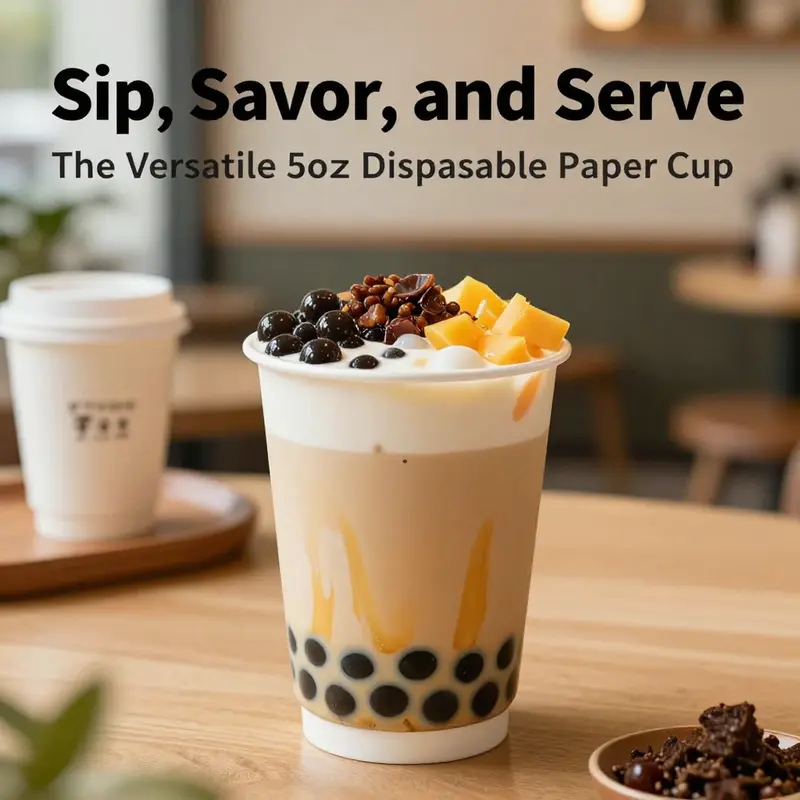
With the rising demand for convenient, safe, and eco-friendly packaging solutions in the food service industry, the 5oz disposable paper cup has emerged as a favorite choice among beverage chains, restaurants, food trucks, and event planners. This compact cup not only caters to a diverse range of beverages but also offers branding opportunities that enhance customer experience. Throughout this article, we will delve into the various applications of 5oz disposable paper cups, discuss the materials and manufacturing processes that ensure their efficacy, and analyze current market trends alongside pricing insights to help businesses make informed decisions.
Small, Essential, and Versatile: The 5oz Disposable Paper Cup in the Modern Food Service Landscape

The 5oz disposable paper cup sits quietly at the intersection of practicality and possibility in today’s food service world. It is a compact vessel, deliberately sized to fit the rhythms of busy cafés, fast-casual counters, and bustling event stands. Though small in volume, it embodies a design philosophy that emphasizes efficiency, reliability, and everyday versatility. A single-layer paper cup, typically crafted from food-grade base stock, is engineered to guard against leakage while accommodating a range of liquids from ice-cold beverages to the warm hum of a tea or coffee service. The cup’s interior may be lined with a food-grade polymer such as polyethylene, or a more sustainable, biodegradable coating that still preserves the barrier properties necessary to prevent seepage and retain heat or cold. This combination of materials is chosen not only for safety and performance but also for compatibility with high-volume operations where speed, sanitation, and predictable performance matter as much as the drink inside.
In practice, the 5oz cup operates across a spectrum of service styles. It is particularly well-suited for cold beverages, where its modest capacity curtails over-portioning and supports consistent serving sizes. In quick-service restaurants and convenience stores, the cup becomes a reliable workhorse for water, iced tea, soda, and other chilled drinks. The portion-control aspect is not merely a matter of economics; it translates into waste reduction and inventory predictability. For staff, the uniform size simplifies line workflows, reduces the cognitive load during peak hours, and helps maintain a steady pace that customers can rely on. The cup’s size also invites a certain intimacy in sampling or tasting contexts. At promotional events, product tastings, or dessert trials, it provides small, hygienic servings that invite customers to explore new flavors without the commitment of a larger cup. When a brand is trying to introduce a new beverage, a 5oz cup can function as a controlled exposure, a trial balloon that minimizes risk while offering a tangible, shareable experience.
Beyond beverage service, the 5oz cup finds a natural fit in sampling and retail environments. In-store demonstrations, food sampling at markets, or promotional stands at festivals, these cups serve as convenient, disposable vessels for desserts, sauces, condiments, or tiny taste portions. The flow of a tasting station often hinges on the crisp, clean presentation that a single-use cup provides, coupled with the ease of disposal after a brief interaction. Such scenarios highlight a core advantage of the 5oz format: hygiene and speed without demanding elaborate equipment. For healthcare-adjacent settings or hospitality suites, these cups can also support small but essential daily rituals, such as serving oral rinses or small snacks in bathrooms or staff areas where sanitation protocols are prioritized. The ability to maintain cleanliness while delivering a sanitary, grab-and-go solution is a facet sometimes underestimated in the planning phase of a service rack or a hotel’s front-of-house operations.
From a design perspective, the 5oz cup is often a straightforward, single-wall construct. Its raw form emphasizes a lean structure that supports quick production and rapid turnover. Yet even within this simplicity, there is nuance. The inner lining—whether a PE coating or a biodegradable alternative—must consistently deliver leak resistance, a critical attribute when the cup is exposed to a range of temperatures and beverages. The choice of coating also has downstream implications for recycling streams and end-of-life considerations. In environments that prioritize sustainability, brands may opt for coatings that align with compostability or recyclability goals, balancing performance with environmental commitments. This is not a mere afterthought; it shapes supplier selection, branding conversations, and long-term packaging strategies. The mechanical integrity of the cup under various temperature conditions is another practical consideration. While designed to handle cold beverages and lightly warm liquids, the cup must resist sagging, splitting, or leaking when subjected to brief periods of heat or steam—situations that often occur in busy kitchens, pop-up fronts, or outdoor events where heat and transit stress are part of the daily routine.
The supply ecosystem for the 5oz cup mirrors its role in service. Market activity shows a broad ecosystem of suppliers that offer standard options as well as customization capabilities. One striking feature is the ability to add branding through printed designs or logos without sacrificing the speed of fulfillment. Custom printing enables cafés, bakeries, or promotional campaigns to embed identity directly onto the cup surface, turning every take-away sip into a touchpoint that reinforces brand recognition. For large orders, prices correlate with the degree of customization, the presence or absence of protective lids, and the packaging method. Bulk scenarios, often measured in tens of thousands of units, can drive the unit price down substantially, with reported ranges dependent on coating type, print requirements, and packaging configurations. The economics of bulk procurement also intersect with lead times, inventory planning, and the reliability of supply chains that must meet seasonality and promotional cycles.
With regard to the broader packaging ecosystem, the 5oz cup’s role expands when combined with lids and accessories. A significant portion of a service operation will pair cups with corresponding lids and, in some cases, a straw port or sip-hole feature. The availability of such add-ons through the same supplier network simplifies ordering, reduces compatibility concerns, and helps staff maintain a consistent look across the service line. This compatibility is more than a convenience; it reduces the risk of misfit components that can disrupt service or create waste. The forward-looking establishments that plan for continuity in busy periods often adopt a modular approach: a steady supply of cups, a predictable stock of lids, and a simple, repeatable method for assembly at the point of service. The result is a smoother customer experience, where the quick-flip of a lid and the gentle seal of the cup becomes part of a familiar, reassuring ritual rather than a potential bottleneck.
The economic and ecological narratives surrounding the 5oz cup are increasingly shaped by consumer expectations. Modern diners are sensitive to packaging choices that reflect environmental responsibility, even for disposable items. A growing portion of these cups is produced with recyclable or compostable materials, designed to minimize environmental impact while preserving user-friendly performance. This aligns with broader shifts in the packaging value chain, where brands communicate their sustainability commitments through material choices, coating technologies, and end-of-life strategies. The conversation around disposables is evolving: it is not only about whether a cup can hold a beverage, but also about how it contributes to circular economy objectives, how it participates in local recycling streams, and how it supports the business’s public storytelling about responsibility and stewardship. In practice, this means that operators must weigh immediate cost considerations against longer-term reputational benefits, a calculation that increasingly factors into daily procurement decisions as well as long-range capital planning.
From a logistical perspective, the 5oz cup offers advantages in terms of storage, handling, and transport. Its compact geometry means that a retailer can pack more units per pallet or per shipping carton, reducing the space required for inventory management and enabling more flexible replenishment cycles. In a world where quick restocks are essential to keeping lines moving, the ability to replace failed units rapidly without disrupting service is a tangible benefit. This efficiency is not merely about labor hours saved; it translates into a more comfortable customer experience. Shorter wait times, consistent portioning, and predictable product quality all contribute to a favorable impression that can drive repeat visits. The cup’s simplicity also keeps training requirements light. New staff can quickly learn the correct way to dispense beverages into a cup, apply a lid, and maintain sanitary handling, without needing specialized equipment or complicated steps. In this sense, the 5oz cup functions as a foundational element of the service model—an unobtrusive enabler that enables a smooth, predictable workflow across a range of settings, from coffee counters to event pop-ups.
The consumer-facing narrative around such cups also intersects with the broader experience a brand aims to deliver. The 5oz format invites experimentation, whether in a tasting flight at a café, a dessert pairing at a bakery, or a promotional sampling at a health fair. The compact size makes it easy for customers to try multiple flavors or offerings in a single visit, expanding the potential for cross-sell and upsell opportunities. When paired with thoughtful branding and tasteful color schemes, these cups can contribute to a cohesive visual language that customers associate with quality and care. They can also act as a conduit for storytelling—each cup bearing a color, a motif, or a logo that evokes the ethos of the brand or the event where it is used. In a retail or hospitality environment, this subtle branding can reinforce a perception of value and attention to detail, turning a disposable container into a small ambassador for the business.
In terms of environmental stewardship, the conversation around the 5oz cup is not a one-size-fits-all proposition. Different facilities will adopt different pathways, from conventional recyclable plastics to compostable or laminated alternatives. The key is to align material choices with local infrastructure and consumer expectations, ensuring that the cup’s end-of-life outcome matches the stated sustainability goals. This alignment matters not only for corporate responsibility reporting but also for the consumer’s understanding of what happens after the cup leaves the counter. For some operators, this means partnering with suppliers that offer clear labeling, accessible recycling guidance, and compatible lids that do not compromise the cup’s barrier properties. For others, it means embracing compostable options when permitted by the local waste management framework, while tracking performance to avoid contamination that could undermine overall recycling or composting efforts. In all cases, the decision-making process for material selection should balance performance, cost, and environmental impact, recognizing that the best choice is contextual and dynamic.
The 5oz disposable cup thus emerges not merely as a container, but as a strategic component of a service model that values speed, hygiene, branding, and responsibility. It is a tool that can be leveraged to support portion control, organic growth of tastings and samples, efficient front-of-house operations, and consistent guest experiences. As the industry continues to evolve—with shifts toward customization, sustainability, and multichannel service formats—the 5oz cup remains a constant, quietly performing the essential job of holding what customers want, in the manner they expect, with a level of reliability that makes the rest of the operation possible. The practical implications for operators are clear: choose coatings and materials that align with your environmental and brand objectives; seek suppliers who can meet demand with consistent quality and scalable printing options; and design your service logic around the cup as a reliable, efficient instrument rather than a disposable afterthought.
For organizations exploring the next steps in their packaging and service strategy, the path often involves a deliberate assessment of how the cup integrates with other components of the service ecosystem. This includes the choice of lids, the presence of straw holes when applicable, and the selection of complementary packaging for food samples or condiments. By coordinating these elements, operators create a cohesive, efficient, and memorable guest experience. The 5oz cup’s role in this larger framework is not to dominate the scene, but to quietly enable the moment when a customer lifts a lid, experiences a familiar brand cue, and enjoys a small, well-contained beverage or sample. It is in this seamless coordination that the everyday magic of the 5oz cup reveals itself—a small but essential instrument in the orchestra of modern food service.
In this integrated view, the supply chain’s dynamics become part of the story. The availability of customization options allows a café or promotional event to imprint personality directly onto the cup, turning a simple takeaway into a mobile canvas for brand storytelling. The logistics of ordering—minimums, lead times, and packaging formats—interact with marketing calendars and promotional launches. The pricing structure, often sensitive to batch size and print complexity, plays into budgeting and forecast planning. And the environmental strategy, whether guided by recyclability, compostability, or dual-stream considerations, informs choices that resonate with guests who increasingly weigh sustainability alongside taste and value.
As the narrative of the food service industry continues to unfold, the 5oz disposable paper cup stands as a resilient and adaptable artifact. It is not glamorous in a way that a premium glass is, yet it offers a reliability and universality across settings that other containers struggle to match. It can be found in a bustling coffee bar, a pop-up dessert station at a fair, a hospital lounge, or a hotel concierge desk, always ready to perform its modest duties with precision. The cup’s unassuming presence belies its significance: it is a facilitator of service pace, a vessel of hygiene, a platform for branding, and a contributor to environmental decisions that shape the footprint of the modern food economy. In short, the 5oz disposable paper cup is a linchpin of everyday hospitality, quietly enabling countless experiences and providing a dependable, repeatable touchpoint that guests appreciate, even when they do not consciously notice it.
To acknowledge the practicalities that sustain this chapter’s central claim, consider how a typical café might approach procurement. A café might source standard cups in combination with lids through a wholesale channel that also offers branding options. The advantage is clear: consistency in shape and size, predictable performance, and the possibility of on-site customization that reinforces the café’s identity. This approach supports efficient bar workflows, since staff can perform a routine sequence—grab a cup, apply a lid, add a sleeve if needed, and present the ready-to-serve beverage. The perceived quality of service rises when customers receive a neatly sealed cup with a clean presentation, and the operator benefits from a streamlined process that minimizes confusion during peak hours. The same logic scales to larger chains or event operations, where the discipline of standardized cups and lids supports uniform experiences across locations while reducing the risk of service variation that can erode brand equity over time.
In the context of the wider packaging conversation, the 5oz cup exemplifies how small-format packaging can drive large outcomes. It is a practical testing ground for materials and coatings, a canvas for branding, and a practical tool for managing beverage portions. Its story intersects with supply chain efficiency, sustainability goals, and the evolving expectations of customers who value convenience, cleanliness, and responsible packaging. The chapter thus closes where it began, not by defining the cup’s destiny, but by situating it within a dynamic ecosystem where small decisions—such as choosing a coating, selecting a supplier, or deciding how many units to stock—compound into meaningful business outcomes. The 5oz cup is a case study in how a seemingly modest disposable item can underpin a robust service proposition, a sustainable packaging strategy, and a consistently positive guest experience across the diverse landscapes of modern food service.
Internal link note: For operators exploring sourcing options that align with branding and fast service, the Wholesale take-away 8oz-12oz disposable coffee paper cup with lids offers a practical, scalable path that many restaurants and event organizers find valuable. Wholesale take-away 8oz-12oz disposable coffee paper cup with lids
External resource: For further details on specifications and industrial applications, refer to the external resource that provides technical context for these cups and their coating choices. DHG Professional 5 oz Disposable Paper Cups
Coatings, Craft, and Cup Destiny: Material Choices and Manufacturing Realities for the 5oz Disposable Paper Cup
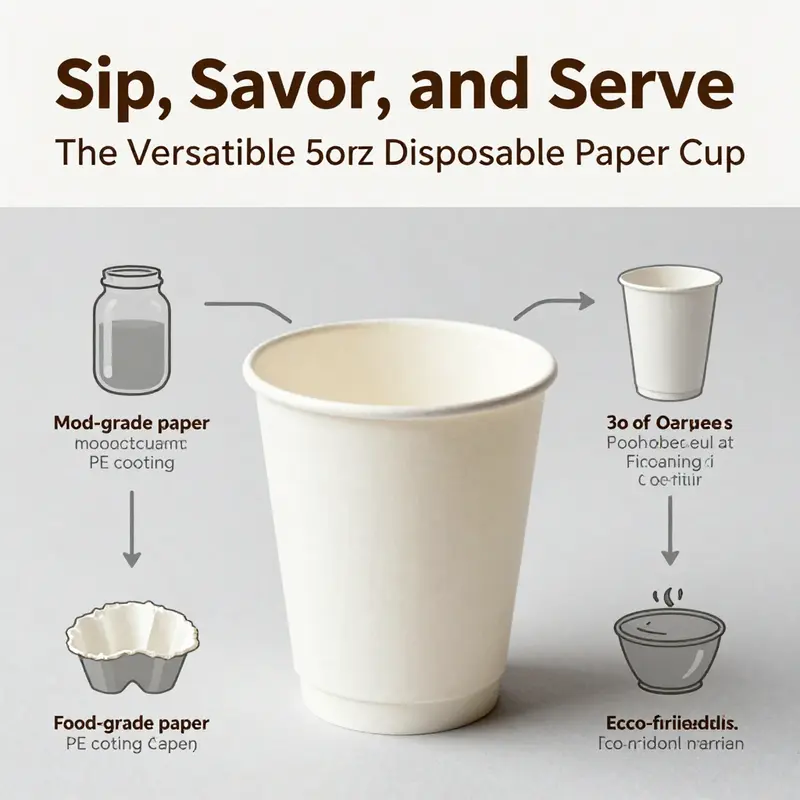
The 5oz disposable paper cup is more than a convenient vessel for a morning rush or a quick afternoon pick-me-up. It is the product of a tightly choreographed sequence of choices that balance safety, performance, cost, and sustainability. In a market saturated with options for hot drinks, cold beverages, and even novelty flavors, the small cup that holds the first sip can carry a surprisingly heavy load of technical decisions. The conversation starts with material science and ends with the consumer’s sensory experience, but the thread that binds them is the cup’s ability to protect its contents without compromising the user’s safety or the planet’s health. When viewed through this lens, the 5oz cup becomes a compact case study in how industrial design translates into everyday practicality, brand impression, and environmental responsibility. As such, the chapter that follows threads together material selection, manufacturing processes, and the evolving expectations around sustainability, all while acknowledging the real-world constraints of mass production and high-volume demand.
Material selection sits at the center of performance. The structural backbone of a 5oz disposable cup is a food-grade paperboard. This substrate must meet regulatory standards that govern safe direct contact with beverages—especially hot ones, where a momentary lapse could transfer heat or impart unwanted flavors or chemicals. The primary role of the paperboard is to provide stiffness, insulating properties, and a predictable surface finish. It must resist deformation and maintain a neat, sanitary appearance in the hand and upon the table. To prevent liquid seepage and to preserve integrity during use, a thin inner coating is typically applied—most commonly a polyethylene (PE) layer. This moisture barrier acts as a shield, ensuring that hot liquids do not wick through the cup’s wall and that the cup remains structurally sound during the shuttling from bar to mouth. In practice, manufacturers offer options across coating weight and layering, from single PE coatings to double coatings. Each variation has its rationale: a thicker or dual-layer coating translates to greater resistance to leaks and higher heat stability, but it also adds material cost and can slightly alter the cup’s surface feel.
The thickness and weight of the paperboard play a parallel role. A heavier stock provides rigidity and better heat retention, which is desirable for hot beverages. It resists crushing in the cupholder and stands sturdily on the counter between sips. Lighter stock, on the other hand, reduces cost and may be appropriate for cold drinks or promotional events where premium heft is less critical. The trade-off comes into sharp relief in a high-volume setting: even small differences in board weight or coating can scale to meaningful cost and waste implications when tens or hundreds of thousands of cups flow through a single day. In many offerings, this is where the conversation between supplier and buyer centers on the balance of performance versus cost, with the coating configuration acting as a key lever. The material choice is not purely about containment; it also shapes the cup’s feel, its heat transfer behavior, and its perceived value in the consumer’s hand.
Printing and customization add another dimension to material and manufacturing decisions. A cup that carries a brand’s logo or a seasonal design must be compatible with a reliable printing process, often flexo printing, which can apply designs to the cup surface in a way that adheres to the substrate and endures through typical handling and use. However, printing introduces a set of constraints. The printing ink must be compatible with the internal PE or other barrier layer to avoid migration or delamination. Additionally, there are minimum order quantities (MOQs) tied to print complexity and color count. These MOQs—commonly in the range of ten thousand to a hundred thousand units—drive a portion of the decision-making process for a new campaign or a seasonal promo. The economics of customization can thus push buyers toward standard, off-the-shelf designs during periods of uncertainty, or conversely, unlock the potential for brand differentiation when a marketing push justifies the investment.
For many operators, the choice to print also intersects with the environmental story told by the cup. A growing segment of suppliers now foreground eco-friendly materials, blending performance with sustainability. A notable shift is toward cups made from 100% recyclable kraft paper, designed to be biodegradable and compostable under industrial conditions. These options are positioned as sustainable alternatives to more traditional plastic-lined varieties, appealing to consumers who want to see tangible environmental responsibility in the products they choose. Certifications such as SGS or CIQ help substantiate these claims, signaling adherence to international safety and quality standards for food contact. Yet even as this green narrative gains traction, there is a practical caveat: the end-of-life story of a single-use cup depends not only on the cup’s own materials but also on the local waste stream, composting infrastructure, and consumer behavior. In other words, a cup can be designed for recyclability or compostability, but its actual ecological impact hinges on the broader systems that handle it after its brief moment of use.
From a sourcing perspective, China has emerged as a dominant hub for disposable paper cup production. The strength of this position rests on a combination of manufacturing know-how, scale, and supply-chain efficiency. Suppliers can provide precise specifications for every cup dimension and material property, including details such as diameter, height, and capacity, along with material certifications that reassure buyers about safety and compliance. For the 5oz cup, typical dimensions might be around a 3-inch diameter with a 1.6-inch height, which translates into a compact, portable footprint that stacks efficiently in storage and fits neatly into takeaway workflows. It is also here that price—and by extension, the feasibility of large-scale deployment—becomes a critical factor. In bulk scenarios, the unit price can vary significantly depending on whether the coating is PE-based or degradable, the degree of printing, and the packaging method.
Yet the story does not end with material choices and manufacturing lines. The equipment and processes that transform raw paperboard into a finished cup play an equally vital role. Modern cup production blends a sequence of automated steps: forming the cup shape from a web of coated paperboard, applying the inner barrier layer with precision, and then curing or drying the coating to achieve a stable surface ready for printing and assembly. When a double coating is chosen, the additional layer adds another stage to the line, with added quality checks to ensure there are no pinholes or delamination that could compromise leak resistance. The precision of this sequence matters not just for leakage performance but also for consumer perception. A cup that feels sturdy, resists heat transfer effectively, and maintains a clean, glossy or matte print finish contributes to a positive experience, shaping the association between the beverage and the brand in the consumer’s memory.
The environmental dimension adds another layer of complexity to manufacturing. The shift toward recyclable or compostable options requires careful consideration of adhesive systems, lamination chemistry, and barrier technologies that can meet safety and performance requirements without undermining recyclability. In some configurations, the inner PE is reduced or replaced with barrier coatings that facilitate recycling streams or industrial composting. These changes must be evaluated in terms of end-of-life performance: can the cup be efficiently separated from other materials in a recycling facility? Will industrial composting processes yield a predictable and timely degradation without leaving behind microplastics or other residues? Each question has a practical answer that guides product development and procurement. The growing demand for environmentally responsible options has also created opportunities for suppliers to demonstrate compliance through certifications, independent testing, and transparent material disclosures. In this domain, the alignment between product design and environmental promises becomes a core buyer consideration, one that can influence supplier selection and long-term partnerships.
In the spectrum of cost, 5oz cups sit near the low end of the price ladder in disposable packaging, yet the price range reflects the material choices and service terms that accompany bulk orders. Pricing and shipping costs typically depend on the finishing, the number of printing colors, and whether the cups are delivered in bulk or in a value pack configuration. Reports and listings show a wide variance in unit price, with bulk orders offering substantial savings per unit as quantities rise into tens of thousands or more. The economics of these decisions are not merely about per-unit cost; they must also account for the entire lifecycle of the product—from raw material procurement and manufacturing energy use to distribution, usage, and end-of-life processing. The interplay between cost and sustainability is a moving target as consumer expectations shift and as technologies improve in barrier performance, recyclability, and compostability.
To ground this discussion in practical terms, consider the typical data buyers use when evaluating options. The material composition is often summarized in a cascade: the paperboard grade and weight, the presence and type of inner coating, the possibility of a double-wall or double-coated configuration, and the kind of printability achieved through flexo printing. Documentation may also include dimensional specifications, such as the height and diameter that determine whether a cup can hold hot liquids effectively while still fitting standard cup sleeves and lids. For hot beverages, the choice between single and double coating becomes a central safety consideration, as the barrier must prevent not only leaks but also the sensation of heat transfer through the cup wall. In a bustling café or a fast-cood environment, the cup’s performance translates directly into service speed and customer comfort, underscoring why these seemingly small cups are engineered with such care and intention.
A further layer of realism emerges when one considers the role of samples and trials. Suppliers often offer free samples to test performance in real-world settings, with buyers covering postage. This pragmatic step allows operators to assess leakage resistance, heat retention, and the feel of the cup in hand before committing to a large order. It also presents an opportunity to assess compatibility with existing lids, straws, and sleeve systems, ensuring a seamless consumer experience across the entire beverage presentation. The interaction of the cup with a lid and with straw access points compounds the design considerations. A cup with a tight seal and precise edge geometry can reduce spill risk, while a lid that complements the cup’s coating and surface finish contributes to a cohesive brand experience. It is in this pragmatic testing space that the theoretical benefits of a given material choice meet the realities of everyday service.
The market footprint of the 5oz disposable cup is inseparable from the broader supply-chain ecosystem that supports global foodservice operations. China’s manufacturing prowess, combined with the demand signals from cafes, quick-service restaurants, and promotional events, fuels the iterative improvements in cup design and material science. This is not a static story. Materials evolve, barrier technologies advance, and consumer expectations shift toward greater environmental accountability. The 5oz cup remains a flexible, adaptable format because it can be tuned along multiple axes: paperboard weight, coating type, printability, and even post-consumer processing. For buyers planning campaigns, this translates into a choice matrix: maintain consistency and cost efficiency with a dependable standard, or invest in a more elaborate cup that communicates a brand’s sustainability or premium positioning through visible design cues and robust performance.
In sum, the 5oz disposable cup sits at the intersection of material science, manufacturing engineering, and consumer expectations. Its success relies on a careful balancing act among barrier integrity, heat management, printability, and end-of-life considerations. The choice of paperboard grade, the layering of coatings, and the feasibility of branding through flexo printing all contribute to a product that not only holds a beverage but also carries a brand story from the moment a customer lifts it to their lips. The cup, in this light, is a small, efficient ambassador—one that communicates safety, reliability, and responsibility in a single, well-engineered package. For operators who want to optimize both operational efficiency and environmental performance, the roadmap is clear: invest in material science that respects the beverage’s temperature and the consumer’s experience, adopt manufacturing practices that scale reliably, and align with end-of-life pathways that reflect a company’s commitment to sustainability. And as the market continues to evolve, the 5oz cup will remain a focal point for how foodservice can deliver a practical, well-designed product that answers the demands of volume, speed, and responsibility.
Internal link example excerpt (for context only): You can explore a related discussion on cost-effective cup options with a compact, single-wall design at the following resource: best-price-8oz-double-plastic-free-single-wall-paper-cup. This link illustrates how suppliers segment performance features like wall thickness and barrier layers while maintaining price competitiveness for take-away programs. While the 8oz size differs, the underlying considerations—printing feasibility, material compatibility, and MOQs—echo across sizes and formats, including the 5oz family discussed here.
External resource for further reading: Materials and certification frameworks for disposable paper cups, including safety and recyclability assessments, can be explored here: https://www.foodbizsupply.com/brown-kraft-recyclable-paper-cup-5oz
The Small Cup Economy: Market Currents, Pricing, and Sustainability of 5oz Disposable Paper Cups
The 5oz disposable paper cup sits at a quiet crossroads of everyday life and global supply chains. It is a modest vessel, yet its economics ripple through cafés, fast-food counters, and promotional events around the world. In a single, unassuming cylinder of paper, a complex system unfolds: raw materials sourced from forests and mills, coatings selected for barrier performance, printing processes that translate a brand’s identity onto a cup sleeve of mere inches, and logistics networks that deliver millions of units to customers who expect convenience on demand. This 5oz standard, compact enough to be tucked into a middle shelf of a beverage station, embodies a broader shift toward single-use packaging that prioritizes speed, hygiene, and recognizable branding. To understand its market today is to follow a thread that links consumer behavior, design constraints, and the economics of scale.
Market dynamics around 5oz disposable cups reveal a sector that is not merely surviving, but expanding with vigor. Market analyses point to a substantial value placed on single-use packaging within the food service and beverage industries. The sector reached a sizable magnitude in the mid-to-late decade, and recent projections place growth on a steep trajectory. One widely cited forecast estimates the overall disposable paper cup market at several billions of dollars, with a compound annual growth rate that hovers well above typical consumer-packaging norms. This growth is not an accident. It is driven by a combination of factors that together define the consumer experience: speed, predictability, and the ability to tailor a product to a moment or a promotion. In many settings, a 5oz cup is the most practical size for a quick sip, an after-dinner sample, or a small test portion at a promotional event, making it an enduring anchor in a crowded category.
The numbers tell a story of expansion and opportunity. A recent snapshot places the value of a broad disposable cup market in the billions of dollars, with projections suggesting a near-double-digit to low-teens percentage CAGR across the next several years. While the aggregate figure captures a family of sizes and configurations, the 5oz segment occupies a steady niche within that growth. It is the scale of use, rather than sheer novelty, that keeps demand resilient: it is a standard that fits many beverages—hot and cold alike—and it aligns with the workflow of busy service points. The size is small enough to minimize waste in some settings, yet large enough to accommodate a practical serving volume for many customers who want a quick, familiar experience. In the context of a modern café or fast-service shop, the 5oz cup is less a luxury than a workflow element, a portable portion capable of turning a visit into a smooth, repeatable ritual.
Pricing in this space tends to follow a simple, scalable rule: the larger the order, the lower the unit cost, with a spectrum shaped by material choices, coating technologies, and the degree of customization. Volume remains the primary driver of price, but the material and process specifics can steer the curve in meaningful ways. The base materials of a typical 5oz single-wall cup often involve food-grade paper and a barrier coating that prevents liquid penetration. The coating choice—whether a polyethylene–based barrier or a biodegradable alternative—can sway both performance and end-of-life considerations. Printing adds another layer of cost, especially when brands seek multi-color logos, promotional artwork, or event-specific designs. The manufacturing decision set expands as suppliers offer options such as heat-sealed seams and reinforcing features to ensure reliability across a busy service cycle. In practice, the economics of a bulk purchase look very favorable for the buyer who can commit to tens or hundreds of thousands of units. A representative example from a bulk-quantity scenario shows per-unit pricing in the low cents for large runs, with the unit cost dipping into a fraction of a cent in some configurations when economies of scale and favorable materials align. By contrast, smaller purchases tend to sit at a higher per-unit price, underscoring how much of the cup’s price is tied to volume and the fixed costs embedded in production lines. For instance, a 540-pack of 5oz cups might fetch around the mid-range of a few dollars per hundred cups in a one-off purchase, translating to roughly a few cents per cup. This contrast is not merely academic: it explains why many buyers plan purchases around seasonal demand, promotional campaigns, and long-term branding strategies that rely on consistent packaging across a network of stores.
An important, practical dimension of pricing revolves around the specific material and coating chosen by a manufacturer. PE coatings deliver a dependable moisture barrier, and in many markets, they remain the industry standard for hot beverages where insulation and leak prevention are crucial. Yet, demand for sustainability and regulatory scrutiny has pushed several buyers toward alternative, more environmentally friendly coatings. Biodegradable or compostable barrier materials may command a modest premium, but they can also unlock favorable positioning for brands that emphasize eco-conscious practices. For buyers who print logos or messages on cups, the ability to execute high-quality print runs at scale also shapes the price landscape. In some supplier catalogs, high-volume printed cups with water-based inks demonstrate how design and branding quality can be achieved without sacrificing too much in production efficiency. Suppliers frequently offer a range of customization levels, from minimal branding to full-color campaigns, with corresponding price adjustments that buyers must weigh against marketing objectives.
The supplier landscape for 5oz cups is heavily oriented toward the Asia-Pacific region, with numerous manufacturers in China and neighboring economies playing a central role. The scale and precision of this production ecosystem enable the offered tolerances that matter in practice. Buyers are advised to seek suppliers who demonstrate a disciplined approach to manufacturing—dimensional accuracy within tight tolerances and robust sealing integrity that can withstand the stresses of transport, refills, and varying temperatures. The practical implications are clear: a cup that leaks or loses its seal during delivery damages the brand experience and can inflate costs through returns, waste, or lost beverages. In busy operations, such reliability translates into measurable savings in waste reduction and improved customer satisfaction, reinforcing the value of selecting partners who prioritize quality control.
Sustainability and compliance have become non-negotiable considerations for many buyers. The modern consumer looks beyond mere price and convenience to the life cycle implications of packaging. As a result, buyers increasingly favor products that align with sustainable material choices and safer, non-toxic inks. The coatings, inks, and overall composition of a cup influence both recycling and disposal options. In some markets, circular economy principles are shaping procurement criteria, prompting buyers to favor offerings that can be more readily recycled or composted within local municipal programs. While regulatory environments vary, the trend is clear: sustainability isn’t a niche concern but a central criterion in supplier selection. In this context, the 5oz cup is not simply a passive container; it is a small platform for a brand’s environmental stance, a signal to customers that a business acknowledges waste, resource use, and post-consumer care.
From a design and branding perspective, the 5oz cup offers a compact canvas that aligns with the human scale of taste and memory. A compact surface area challenges the branding team to think strategically about color, typography, and messaging. Yet the constraints also spur creativity: bold color blocks, concise copy, and high-contrast visuals can yield a strong impact even on a small surface. In promotional contexts, this becomes a practical advantage, allowing campaigns to weave in event-specific logos, seasonal themes, and co-branding efforts without overwhelming the cup’s structural integrity. Because the cup is familiar, it can serve as a trusted ambassador for a brand’s broader packaging ecosystem, tying together cups, lids, sleeves, and ancillary products into a coherent customer journey.
The practical realities of procurement shape a buyer’s decision process as well. When a cafe or retail chain contemplates a 5oz cup, the priorities often center on production reliability, supply chain resilience, and total cost of ownership across a promotional cycle. Buyers assess whether a supplier can guarantee dimensional accuracy within a narrow tolerance and maintain a cap on deviations that could compromise sealing performance. A clean, uniform seam is more than cosmetic; it reduces the risk of leakage and ensures consistent customer experiences across multiple service points. The broader supply chain considerations—lead times, freight costs, and the ability to scale up during peak demand—also come into play. Suppliers who can demonstrate robust production planning and dependable lead times become especially valuable partners in a market characterized by seasonal flurries and promotional bursts.
Looking forward, the 5oz cup market will likely continue to navigate a tension between speed, cost, and sustainability. The competitive landscape rewards efficiency and reliability, yet sustainability goals are pushing for innovations that reduce environmental impact without compromising performance. In practice, this means ongoing exploration of alternative barrier coatings, more efficient ink formulations, and smarter packaging that reduces waste while preserving the customer experience. It also means that buyers will increasingly factor in end-of-life considerations when negotiating terms with suppliers. Some buyers may gravitate toward suppliers that provide transparent lifecycle data, third-party certifications, or clear declarations of compliance with environmental standards. As the sector matures, the ability to demonstrate a credible sustainability profile may become as important as the ability to deliver high-quality cups on time at scale.
Within this evolving landscape, a representative glimpse of how buyers compare options can be seen in how they manage print and customization. The choice between a simple, clean finish and a high-visibility, full-color branding option often pivots on the intended application and the promotional value attached to the cup. For some clients, the branding payoff justifies a higher unit cost and longer lead times; for others, maintaining consistency with a broader, cost-conscious procurement strategy is paramount. The 5oz cup becomes a link in a chain of decisions—how often customers drink, where they drink, what the cup communicates, and how well the cup performs in a retail environment that demands rapid service and compact, elegant packaging. In short, the cup is not a standalone item but a component of a curated customer journey that includes lids, sleeves, straws, and the broader ecosystem of takeaway packaging.
To illustrate how this ecosystem translates into practical buying behavior, consider the role of customization and branding. The ability to imprint logos or promotional artwork on a cup is often a differentiator for retailers and event organizers. When combined with a reliable barrier and a stable supply chain, branded cups can become mobile billboards that reinforce a brand’s identity during brief customer interactions. The economics of such branding depend on the scale of production and the chosen printing method. In high-volume programs, the incremental cost of providing a branded cup can be effectively absorbed into the overall marketing budget, generating value in the form of increased recall and customer engagement. In smaller deployments, it may be more prudent to favor simpler designs or embrace co-branding strategies that share branding costs across a wider portfolio of packaging. The decision, again, rests on scale, expected return, and the alignment of the cup with the brand’s broader packaging narrative.
As a practical note for readers who are scanning supplier catalogs or market reports, the specificity of data matters. For buyers planning large-scale investments, the precise printing capabilities, coating choices, and tolerance levels matter. Suppliers frequently advertise tolerances within fractions of a millimeter, reflecting the precision demanded by modern production lines. Maintaining the integrity of the seam, ensuring a uniform lip, and guaranteeing that the cup maintains its shape across a hot beverage cycle are all essential tests that determine whether a cup will perform as expected in the field. These technical details—though perhaps less glamorous than branding—are the conditions that determine whether a cup will contribute to a positive customer experience or become a source of dissatisfaction that undermines a brand’s promise.
In closing the current snapshot of the market, it is worth returning to the fundamental tension at the heart of the 5oz cup economy: speed and simplicity versus sustainability and customization. The data and stakeholder perspectives suggest a sector that is robust, with room to grow, but also one that must continually refine its materials, processes, and messaging to remain aligned with evolving consumer expectations and regulatory realities. For buyers, this means balancing short-term cost considerations with longer-term strategic goals—brand consistency, waste reduction, and the ability to deliver consistent customer experiences across multiple touchpoints. For suppliers, it means investing in precision manufacturing, durable barrier performance, and transparency around environmental impacts. The 5oz disposable paper cup, in this sense, becomes more than a disposable item. It is a component of a broader system that shapes how people enjoy beverages on the go, how retailers communicate with customers, and how companies navigate the ongoing conversation about sustainability in everyday packaging.
Internal reference for further context on cup options and packaging configurations can be found through a catalog that highlights a notable price point for a compact, insulation-focused cup variant. This example illustrates how a single SKU can embody efficiency, design flexibility, and a practical approach to scale, which in turn reflects broader market dynamics and the pricing logic discussed above. best-price-8oz-double-plastic-free-single-wall-paper-cup.
For those seeking a wider view of how these products fit into the global supply chain and pricing frameworks, external industry resources provide additional context on manufacturer practices, regional variations, and regulatory considerations. A comprehensive external resource offers a broader lens on supplier practices, pricing structures, and compliance expectations that influence decisions across markets. External resource: https://www.alibaba.com
Final thoughts
In summary, the 5oz disposable paper cup is not just a functional item for serving beverages; it represents a blend of convenience, safety, and branding potential that can elevate a business’s offerings. As trends shift towards sustainability and consumer demand for quality experiences continue to rise, investing in these cups can provide essential returns for beverage shops, restaurants, and event services alike. The insights shared in this article aim to empower decision-makers in choosing the right products to meet their operational needs and customer expectations effectively.