
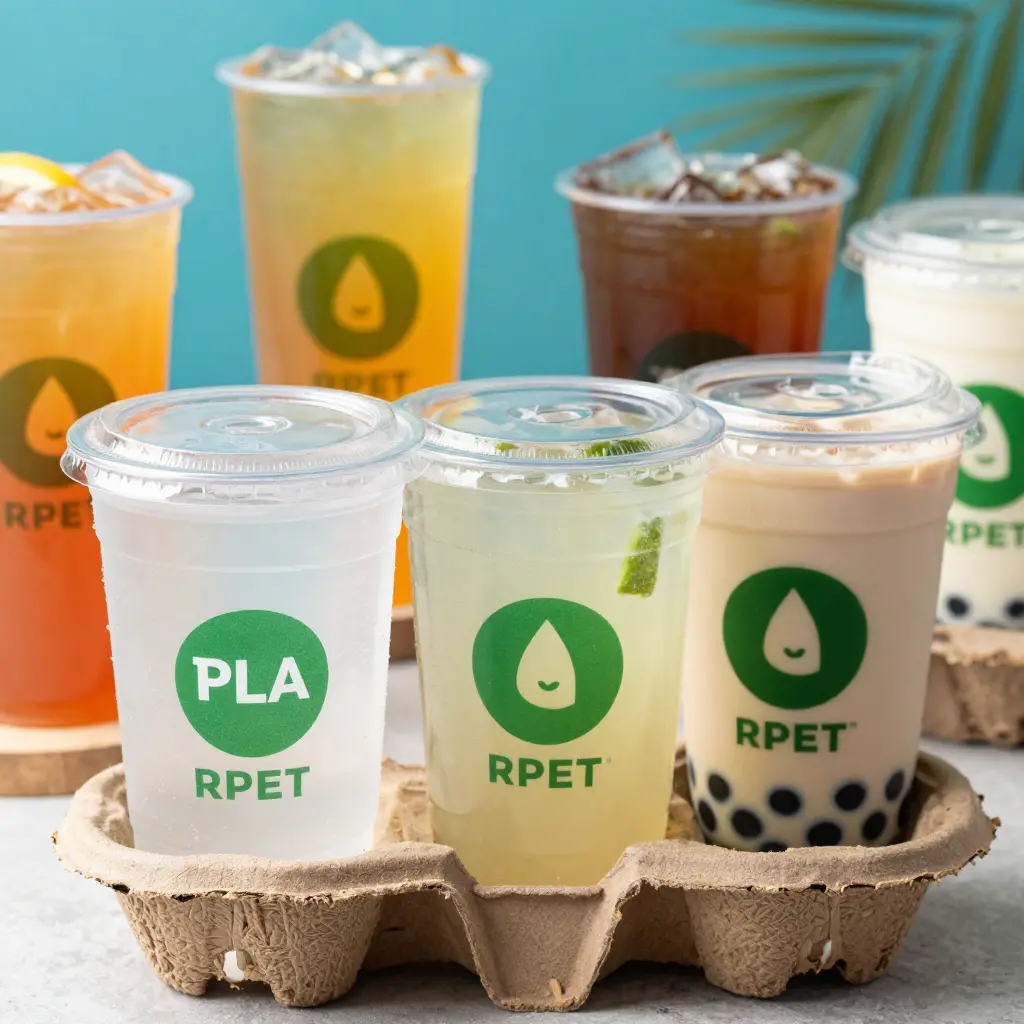
If you serve iced drinks, the cup in your customer’s hand is a decision you make every day, though most operators make it once and then live with it for a season. This comparison is for the teams that actually have to make the call: bubble tea shops, beverage chains, restaurants, food trucks, caterers, event procurement departments. The question is narrow. PLA or rPET for cold service? Both get sold as eco friendly clear plastic cups, but the two labels describe different things, which is why a supplier sheet rarely settles it.
Five factors decide the comparison in practice: where the resin comes from (plant starch or recycled bottles), how the cup behaves in cold service (clarity, cracking, condensation), what it costs per unit at your order volume, whether your local waste system will take it, and whether the supplier can keep you stocked through a full season. Lids and accessories belong in the same calculation, including paper straws for cold drinks. The goal is to end up with a cup whose sustainability claim survives a customer asking a follow-up question, not the one with the prettiest icon.
PLA and rPET in plain terms
Most clear cold-cup programs come down to two resins. The table further down is easier to read once you know where each one starts and how it is processed.
What PLA cups are made from
PLA, or polylactic acid, starts with plant starch, usually corn and sometimes sugarcane or cassava. The starch is fermented into lactic acid, polymerized into resin pellets, and converters thermoform those pellets into cups.
The polymer is glossy and transparent: thin walls nearly disappear against the drink, heavier walls pick up a faint haze. Layered boba, fruit teas and iced coffee look good in it because the drink does the showing. Heat is the limit. Standard PLA softens well below boiling point, so these cups belong behind an iced counter and nowhere near a hot fill.
What “compostable” means in practice:
- It names a disposal route, not a property of the material by itself: industrial composting at roughly 55-60 °C, with managed moisture and active microbes.
- It should be certified and printed on the cup: EN 13432, ASTM D6400 or a BPI mark. A green leaf on the sleeve proves nothing.
- It does not mean home composting, landfill or a general waste bin. Without a commercial facility nearby, a compostable cup ends up wherever any other plastic cup ends up.
- Collection comes first. Compostable cups only close the loop where the hauler accepts food-contact ware.
What rPET cups are made from
rPET is recycled polyethylene terephthalate. The feedstock is post-consumer PET bottles, baled and sorted, then washed, decontaminated and repelletized into food-grade resin. That resin is extruded into sheet and thermoformed into cups; buyers usually call them recycled PET cups, and the material is the same family as the bottle.
Clarity depends on what went in. Well-sorted, high-viscosity rPET gets close to virgin PET, while lower grades can carry a grey or yellow cast. Ask for samples and look at them under your own shop lighting, not in a brochure.
“Recycled content” is a claim about the input, not the output. It is a percentage by weight, commonly 30, 50 or 100, and it should come with documentation such as GRS certification or a mass-balance statement.
The two labels sit at different points in a product’s life. Compostable says how a cup is designed to break down; recycled content says what it was made from. Neither claim collects litter, and both depend on local infrastructure. Shops that also run hot drinks usually keep a paper cup range beside the clear cold cups so lids, sleeves and staff habits stay consistent across the menu.
PLA vs rPET at a glance
| Attribute | PLA | rPET |
|---|---|---|
| Feedstock source | Plant-based: corn starch or sugarcane | Recycled post-consumer PET bottles |
| Typical clarity | Clear and glossy; heavier walls pick up a slight haze | Clear to near-virgin quality; depends on input grade |
| Heat tolerance in cold service | Fine for iced drinks; wall softens around 40-45 °C | Stable in cold service; tolerates brief contact with heat |
| Compostability conditions | Industrial composting only, 55-60 °C | Not compostable, but recyclable as PET |
| Recyclability in standard streams | Rarely accepted, can contaminate PET bales | Accepted wherever PET is collected |
| Typical unit cost positioning | Premium, usually above rPET | Mid-range, close to virgin PET |
| Best-fit use cases | Events, eco-led branding, closed-loop compost programs | High-volume chains, deposit-return markets |
| Sourcing considerations for beverage chains | Confirm compost partners and shelf-life limits | Verify food-grade certification and supply stability |
Pick the two or three rows that match how your operation buys, stores and disposes of cups; averaging all eight tells you nothing. If the deciding row is temperature or freight, the answer is usually visible already. Teams still weighing formats can also benchmark paper cup options for cold drinks as a third path.
Performance behind the counter
Both cups are built for chilled drinks, but they part company once the drink leaves the counter. PLA has a practical ceiling of roughly 40-45 °C before the wall starts to soften, which rules it out of hot fills, warming cabinets and a delivery bag left in the sun. Cold is not automatically safe either: in freezer storage and slushy-ice programs PLA turns brittle. rPET tolerates a much wider window, taking freezer temperatures and brief contact with warm syrup without deforming, although neither material is a hot-beverage cup.
Condensation is the wildcard nobody plans for. Both materials sweat in a humid room, but how the water behaves depends on wall finish, wall thickness and drink temperature, so test both cups with your own drink on your own tray before committing to a pallet. A slick tray and a fast hand-off will tell you more than a spec sheet.
What staff notice during a rush is rim geometry and how the wall takes a knock. PLA is the stiffer material: it holds a rolled rim precisely, so a lid seats with a repeatable click, which matters when cups are lidded fast and stacked high. The price of that stiffness is brittleness. A dropped cup, an over-squeezed stack or a hard shake can open a hairline crack that weeps onto the counter. rPET has more give, absorbs bumps from couriers, cup holders and crowded prep tables, and forgives small rim tolerances; what it does not forgive is repeated re-lidding, which leaves stress marks. Side by side, rPET reads closer to glass, PLA slightly warmer and softer, and PLA scuffs more visibly under hard handling.
- rPET for travel-heavy programs: delivery, third-party couriers, shaken boba and catered drops, where impact resistance outranks everything else.
- PLA for short hand-over service: dine-in, events and pick-up counters where the drink is served within minutes and compostability is part of the message, with fills kept cool and cups kept out of the freezer.
- Sweat planning for both: a snug lid, a sleeve and an absorbent tray liner cover most slips, and cup wall thickness should match how long the drink sits before it is drunk.
A menu that mixes iced espresso, smoothies and dessert drinks rarely suits one universal cup; two or three sizes sharing a single lid footprint usually work harder than one cup bought in bulk, and you can explore plant-based cup alternatives alongside either material. PLA rewards speed and compostability claims, rPET rewards durability and shelf appeal, and which one you need depends on how far your drinks travel.
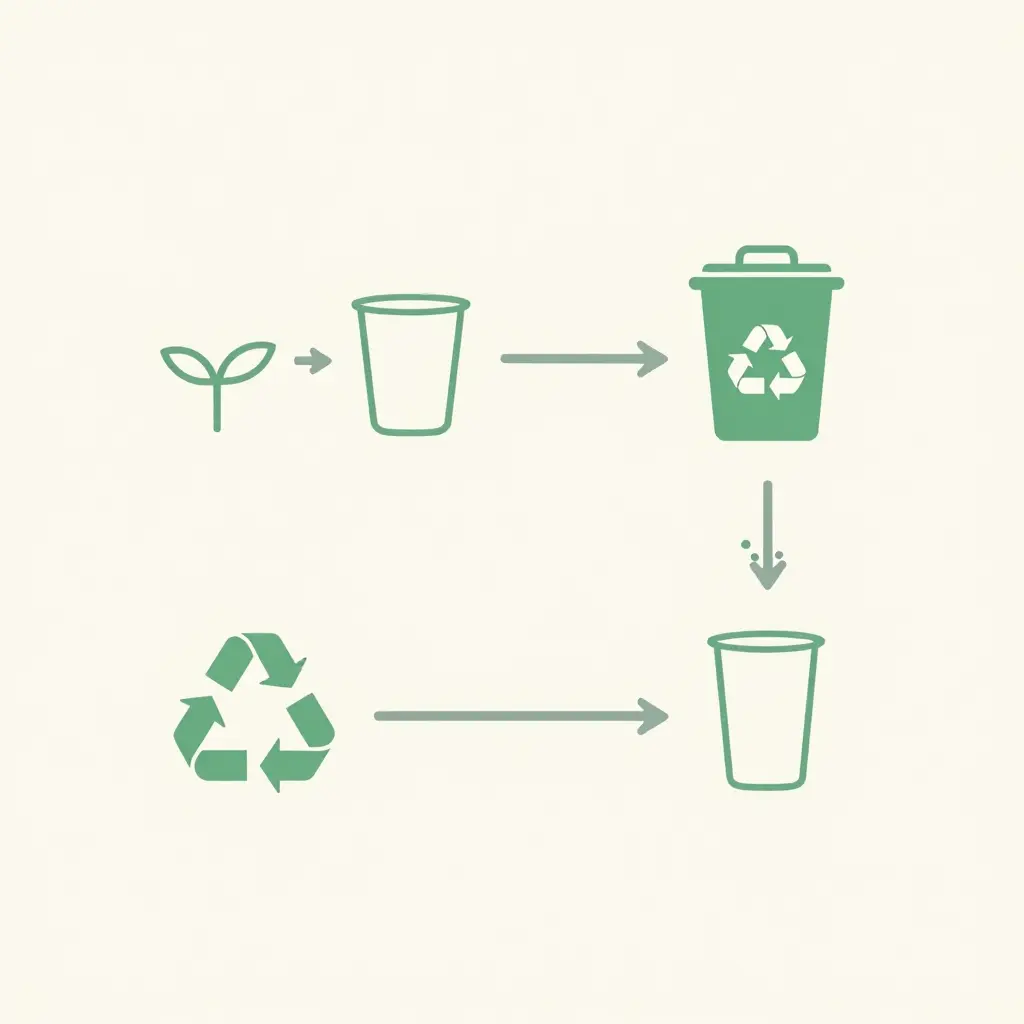
Left: plant-based feedstock becomes a cup and, where collection exists, returns to soil through industrial composting. Right: collected bottles become flake, then a new cup, then feedstock again. Teams weighing plant-fiber formats alongside clear plastic can put these plant-based cups through the same test.
Six criteria for choosing eco friendly clear plastic cups
A comparison table is easy to agree with on a Tuesday morning and hard to apply at two o’clock on a Saturday. Whether you run boba shops doing 400 drinks a day, a food truck with tight storage or a catering team quoting a 600-guest gala, six questions decide whether a cup works for you. Answer them in order before the first pallet order; the answers normally point to one material fast.
- Beverage temperature profile. List every drink you serve, because these cups are not interchangeable across heat and ice. PLA suits cold and iced builds and softens with hot liquid; rPET handles chilled and lightly warm service with more tolerance.
- Cup clarity and branding visibility. Judge clarity against your own logo artwork, since printed cups live or die on whether the sidewall stays clear. rPET usually gives sharp, high-gloss visibility for latte layers and boba pearls; PLA reads slightly softer and warmer.
- End-of-life infrastructure available to the business. Check what your region can process before anything goes on a menu board. PLA needs industrial composting, rPET flows into existing PET streams, and a shop with no compost pickup should weigh that gap honestly.
- Lid and accessory compatibility. Test lids, dome covers, paper straws and sleeves on the exact rim spec, because a millimeter of mismatch means leaks, re-dos and wasted inventory at peak volume.
- Landed cost per unit at volume. Calculate delivered cost per cup at your real annual quantity, including freight, pallet configuration, breakage and any recycling or compost surcharge. The cheaper quote often loses once landed cost is on the table.
- Supplier consistency and lead time. Check wall thickness, rim diameter and color batch to batch, plus a lead time that survives your busiest season. A material you like is still the wrong choice if restocks land after the rush.
Where the trade-off actually sits
Neither material wins across the board. The chart below puts the trade-off in a single picture. All four indicators are relative indices on a 0-100 scale rather than grams or dollars, so read them as positions, not measurements; wall thickness, supplier and country all shift the real numbers.
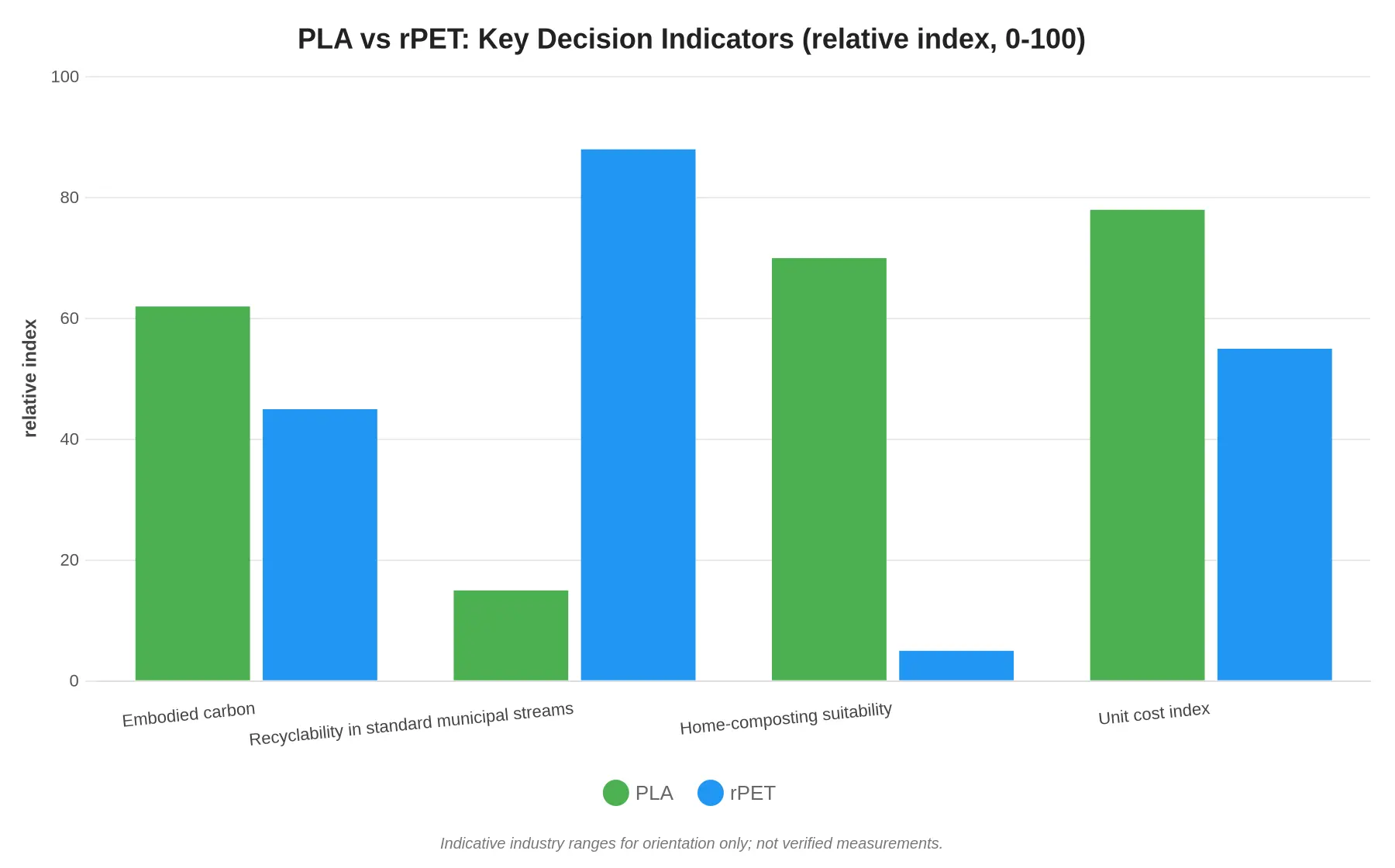
Each cluster is one indicator: green is PLA, blue is rPET. PLA’s bars run longer on embodied carbon and on compostability; rPET’s run longer on recyclability and on the cost index, where a longer bar means a higher price per cup.
Source and assumption note: these are indicative industry ranges used for orientation, not verified measurements. Your cup specification, local waste infrastructure and current pricing will move them. Confirm with your supplier and your municipal recycling program before switching.
Reading the four clusters
| Indicator (relative index) | PLA | rPET | Practical reading |
|---|---|---|---|
| Relative embodied carbon | 62 | 45 | PLA carries the lighter footprint, and plant-based sourcing is easy to explain to customers |
| Recyclability in standard municipal streams | 15 | 88 | rPET drops into existing PET streams; PLA generally does not |
| Compostability in a managed facility | 70 | 5 | PLA needs a managed facility at 55-60 °C; the chart’s home-composting label overstates that, and rPET does not compost at all |
| Unit cost index | 78 | 55 | PLA usually costs more per cup; rPET is the budget-friendlier route |
Most beverage chains end up pairing the two rather than crowning one: rPET for high-volume everyday service where curbside collection exists, PLA for brand launches, closed-loop events or venues with commercial composting. Whichever way you lean, wall quality and lid fit matter as much as the resin, and it is worth seeing how a mixed paper and plastic lineup is built around your service style in our paper cup range.
Cost, volume and supply planning
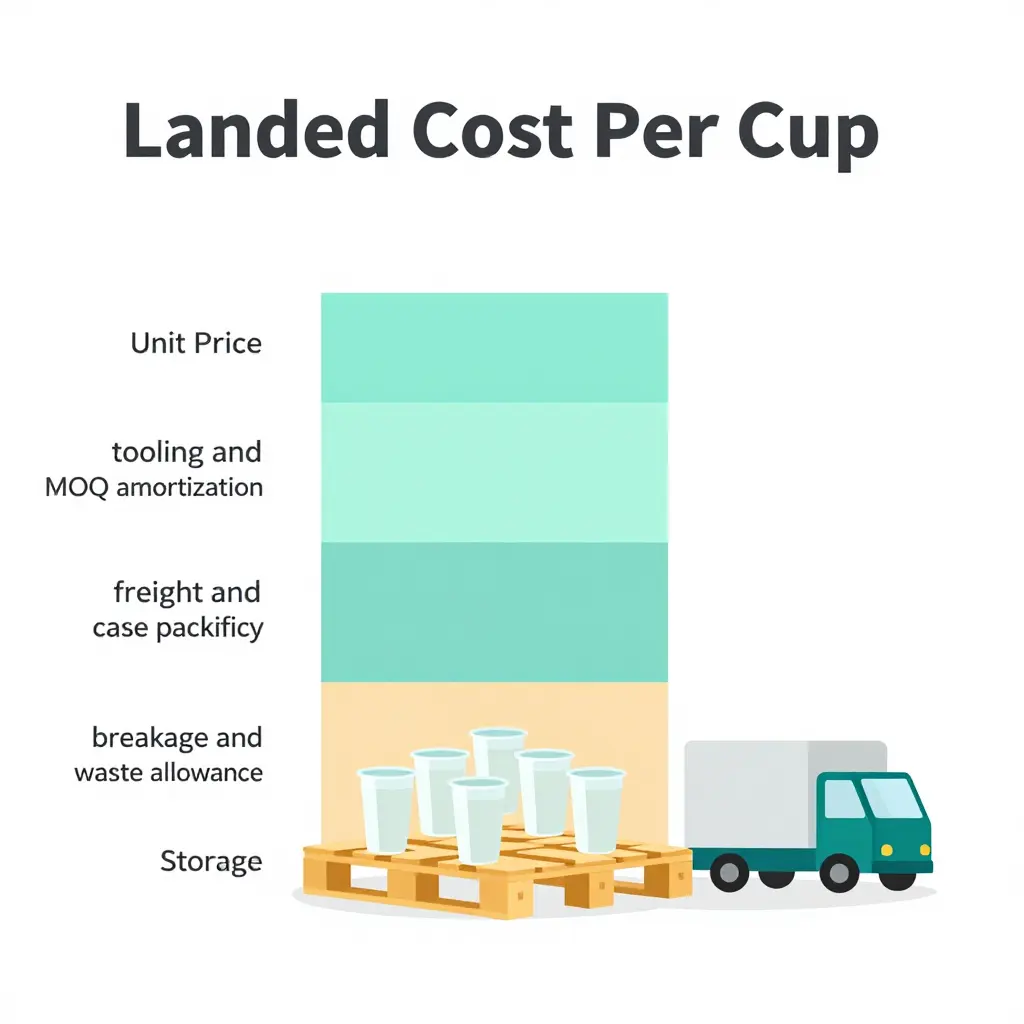
The price on a quote sheet is not the price you pay per cup. Between the invoice and the bin, a dozen small costs stack up: tooling, setup, pallet configuration, freight, breakage, and the staff time spent re-ordering. The number worth comparing is landed cost per unit, meaning what one cup costs once it sits in your stockroom ready to serve. Here is the worksheet we would run before comparing suppliers.
| Landed cost line | What it includes |
|---|---|
| Base unit price | Quoted price per cup at your order tier |
| Tooling and setup | Mold or print plates, amortized across the order |
| Freight | Inbound shipping, fuel, and accessorial fees |
| Case pack efficiency | Cups per case, per pallet, per container |
| Breakage and waste | Damage, culls, and over-pour allowance |
| Carrying cost | Storage space, working capital, obsolescence |
Tooling and minimum order quantities
Custom printing or a new size usually means a one-time tooling charge plus an MOQ. Spread the charge across realistic annual volume, not your first order: a $600 plate is trivial across 200,000 cups and painful across 20,000. If a supplier’s PLA MOQ ties up nine months of stock, that is not a saving, it is warehouse rent plus working capital.
Case pack and freight efficiency
Cups are mostly air, so you pay for geometry. A case pack that nests into a tidier pallet can cut freight per cup by double digits, and a slightly different diameter can fit more units per container. Ask for cases per pallet, pallets per truck and cube per shipment. Between 28 and 34 cases per pallet, the difference compounds on every delivery.
Breakage and waste allowance
Clear cups crack, scuff and get dropped during a rush. Plan a 2-5% waste allowance, higher for events where staff hand cups across a crowded bar. Thinner walls lower the unit price and raise the breakage rate, which is worth testing with a trial case rather than assuming.
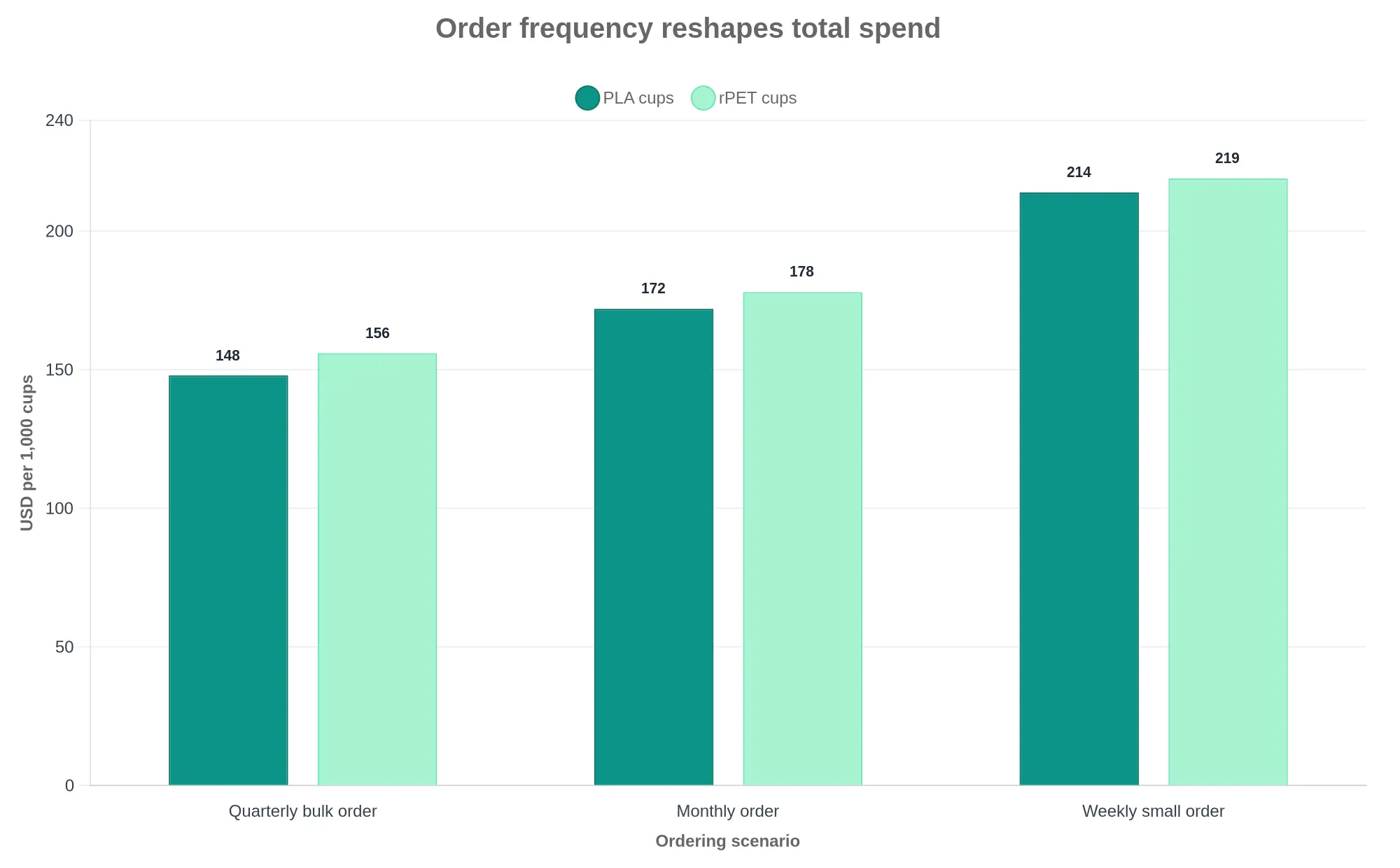
How order frequency changes total spend
Weekly ordering feels safe and multiplies freight, admin time and the risk of running dry mid-service. Quarterly bulk orders lower the rate per cup and tie up cash and storage. Event teams should treat it as a seasonal forecast: one signature event may justify a bulk buy, while a rolling schedule of small activations usually suits a monthly cadence with a safety buffer.
Re-check quotes every season
PLA and rPET are priced off upstream markets, not a fixed catalog. PLA follows lactic acid and corn feedstock; rPET follows recycled flake and bottle-bale pricing, which moves with collection rates and virgin resin. A quote that was sharp in January can look expensive by July. Ask for pricing validity windows and re-benchmark once a quarter, and compare cup formats and case packs while you rebuild the spreadsheet.
Takeaway: compare materials on landed cost per cup, not sticker price. The cheapest quote on paper often loses once tooling, freight, breakage and order frequency are counted, and a price rechecked each season reflects the feedstock and recycling markets instead of last year’s numbers.
Cup, lid, sleeve, straw, carrier
A cold drink cup is a five-part system: the body that holds the drink, the lid that keeps it in, the sleeve that protects fingers, the straw that delivers the first sip, and the carrier that gets it out the door. Miss one and the other four stop working.
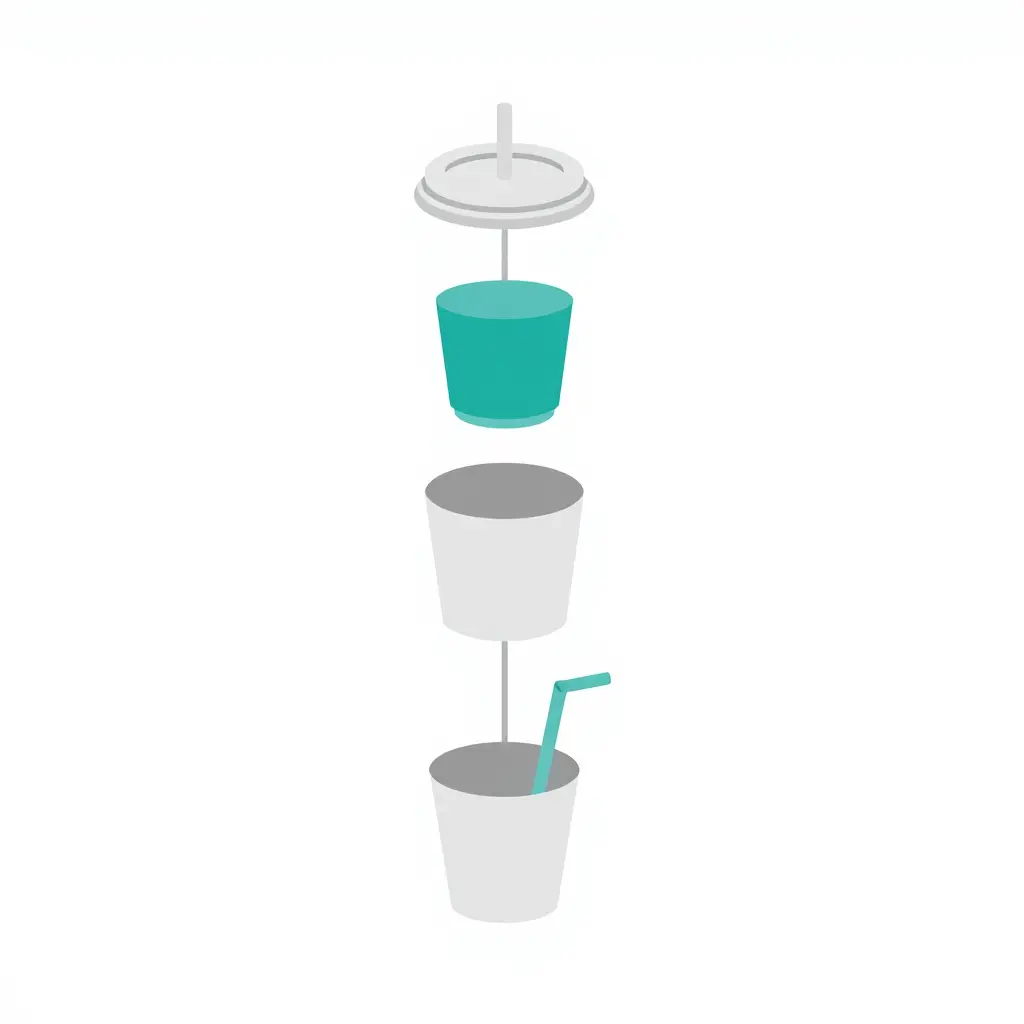
The exploded view is deliberately plain. Change one element, say moving from PLA to rPET, and lid fit, sleeve diameter, straw gauge and carrier slot all shift with it. A 16 oz cup that pairs cleanly with one lid may sit loose under another, and a sleeve sized for a 12 oz body will not hug a wider rim.
That is why the cup is the anchor of the purchase rather than the whole purchase. Get the anchor right and the accessories fall into place, including sturdy sugarcane cup holders for multi-drink orders.
Pairing cups with lids, sleeves, straws and holders
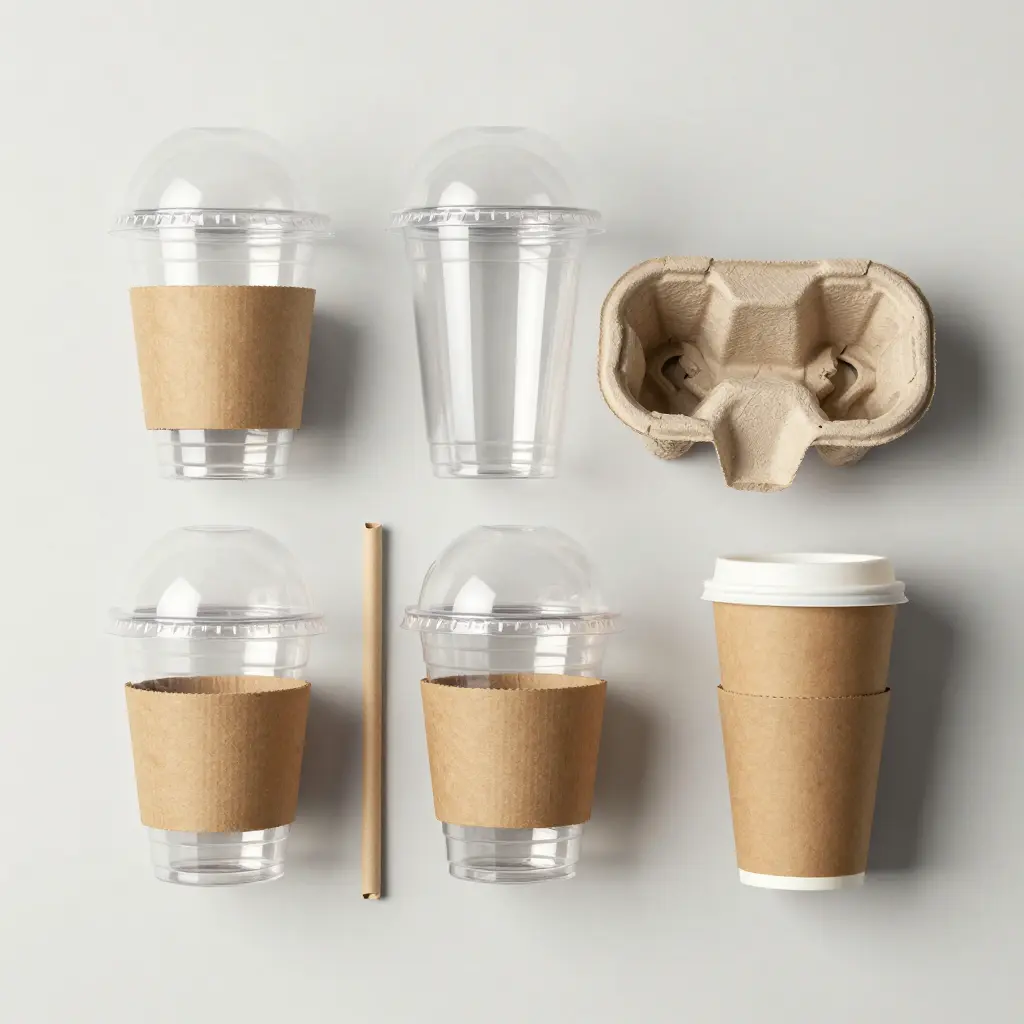
A cold cup performs only as well as the parts around it. Whichever material you standardize on, the goal is one closed loop: cup, lid, sleeve, straw and carrier that fit together, store together, and leave through the same end-of-life channel.
Start with lid fit and leak control
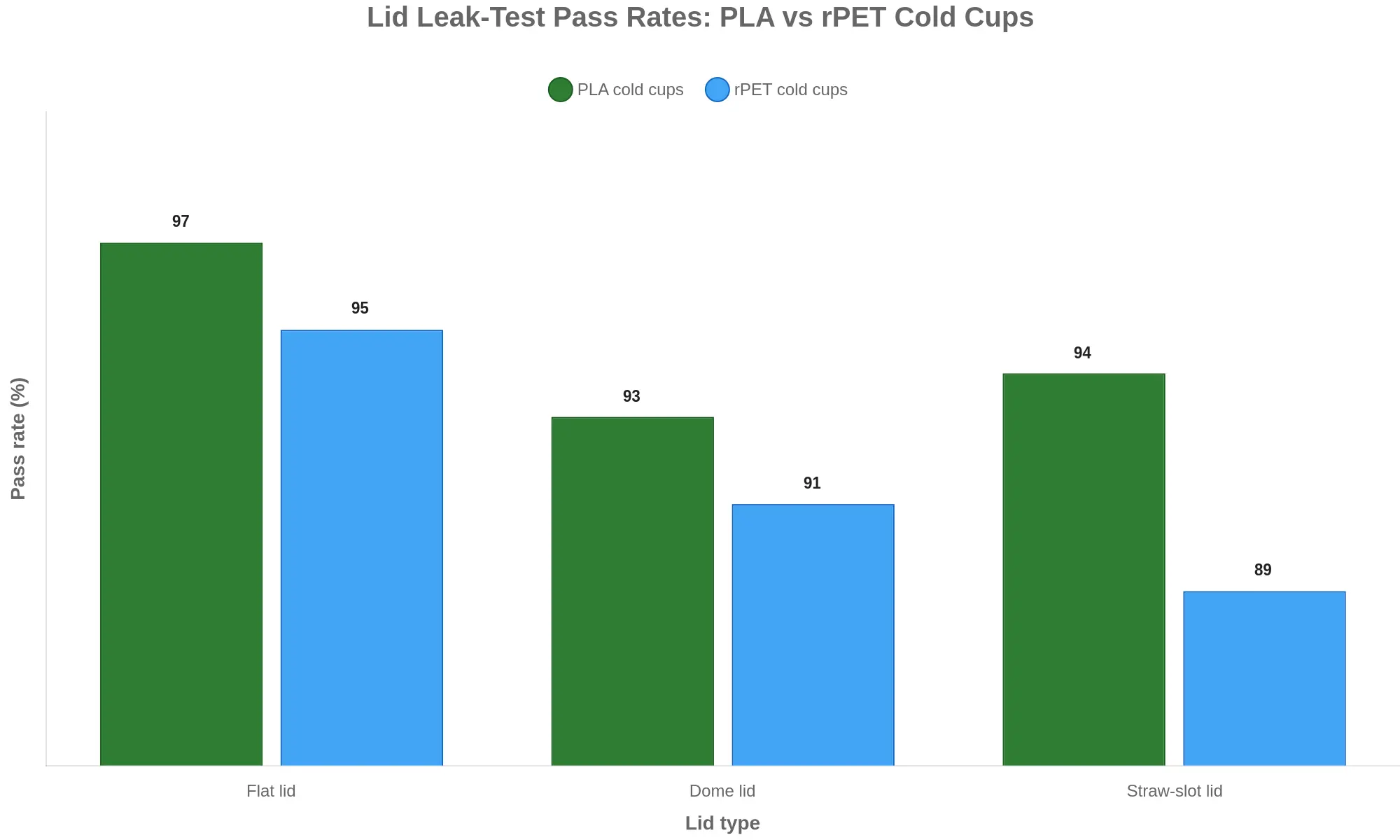
Match lids to the exact rim diameter and wall thickness. A 98 mm lid on a 98 mm cup from a different supplier is not automatically a seal. Push-test a full case before committing: fill to the rim line, cap, invert for 30 seconds, then check the rim seam. PLA is slightly stiffer and holds a snap-fit lid more firmly; rPET flexes more, which makes a dome easier to seat and easier to seat unevenly.
Straw-slot and strawless lids trade convenience against leak risk, so decide per drink. Shaken boba under sealed film needs a different lid from an iced Americano. If you also serve hot drinks, one lid and sleeve system across paper cup formats keeps storage and staff training simple, and matching paper lids hold rim tolerances better than mixing vendors.
Use sleeves for condensation and grip
Condensation is the usual reason cups end up on the floor. A kraft or corrugated sleeve insulates the palm, keeps the printable area dry and gives branding space that does not touch the lid seal. Size sleeves to the cup body, not the rim, and check that staff can slide one on with one hand during a rush. Paper sleeves come in flat and ripple styles, so insulation can follow drink temperature and holding time.
Choose straw material by disposal stream
This is where eco programs quietly break. A PLA cup with a paper straw belongs in commercial composting. An rPET cup with a paper straw belongs in recycling, but only if the straw is pulled out and binned separately, because paper fiber contaminates PET bales.
| Program type | Cup | Recommended straw | Why |
|---|---|---|---|
| Commercial composting | PLA | Paper or PLA | Breaks down with the cup in one stream |
| Mechanical recycling | rPET | PP or reusable | Paper fiber contaminates PET bales |
| Mixed / no infrastructure | Either | Paper | Lowest litter impact, no sorting needed |
Our paper straws use thicker wall constructions for boba and long iced drinks; test soak time against your slowest-selling drink rather than the fastest.
Select holders for multi-cup orders
Carriers fail at the weakest joint, usually the base rather than the handle. For two- and four-cup orders, molded sugarcane cup holders handle condensation and stack compactly, while paper cup holders suit lower-cost, high-volume delivery runs. Test one carrier with four full cups at a 15-degree tilt before approving a pallet; that single check prevents most delivery spills.
GreenDispopack supplies disposable tableware, packaging paper and boxes, with safety, durability and eco-friendly practice listed as priorities across the range, so cup, lid, sleeve, straw and carrier can arrive as one coordinated set instead of five separate negotiations.
Labels, claims and customer communication
Getting the words right protects the brand. For PLA cups, “plant-based feedstock” and “industrially compostable in commercial facilities” are claims you can defend, as long as the cups actually reach that stream. For rPET, state the recycled content precisely, as in “made with 30% post-consumer recycled PET”, and note that recyclability depends on local collection. What you should not claim: “biodegradable”, “plastic-free”, “home compostable”, or a blanket “100% recyclable” for PLA. Those words invite greenwashing complaints and confuse the bin. Describe the cup by material and end-of-life path instead.
Bin signage and staff scripts carry as much weight as the printed claim. Use one plain sentence and one icon per bin, keep the colors identical at every location, and put the compost bin where cups are actually emptied, usually by the exit rather than at the condiment stand. Give staff a 20-second script and a short FAQ so they can answer “is this compostable?” without improvising. For events, get the hauler’s requirements in writing before the first delivery, and pair the buffet setup with sturdy cup holders so clearing stations keep moving.
- Do keep every claim short and specific: “PLA, composts in commercial facilities only” and “rPET, 40% recycled content, recyclable where facilities exist”, with certification or supplier details in small print.
- Don’t call PLA “plastic-free” or “biodegradable”, and never print “eco friendly” on its own without saying why. Staff will repeat it and customers will screenshot it.
- Do brief catering crews and corporate procurement contacts on one sorting line per material: plant-based cups to compost, recycled PET to recycling, lids and straws checked separately, nothing “wish-cycled” into general waste.
Frequently asked questions: PLA vs rPET cups
These are the questions we hear most often from bubble tea shops, restaurants, food trucks and event teams comparing cups.
Are PLA cups recyclable?
Not in standard curbside recycling. PLA is built for industrial composting, where certified facilities hold it at 55-60 °C with managed moisture; EN 13432 requires 90% disintegration within 12 weeks. Check whether your local hauler accepts PLA before planning collection routes, because the cup only closes the loop if it reaches that stream.
Do rPET cups contain BPA?
PET is not made with bisphenol A, so BPA is not part of the resin, and food-grade rPET is used for cold drink service. Whether the cup gets recycled still depends on local collection.
Can PLA cups hold cold drinks with ice for hours?
Yes, through a normal service window. PLA is rigid enough for iced drinks and holds up for several hours, though prolonged contact with ice and condensation softens the wall. For all-day events or slow sipping, choose a thicker-walled cup and serve closer to the time of drinking.
Which option suits high-volume beverage chains?
Usually rPET. It is durable, crack resistant, fits existing PET supply and collection systems, and needs no workflow change. PLA stays the stronger choice for brands with reliable access to commercial composting.
How should used cups be handled at events?
Set labeled bins beside every drink station: one for rPET, one for compostable items, one for general waste. Brief staff on sorting, keep bins clean, and book pickup with a hauler licensed for the stream. Matching eco friendly straws cut contamination, provided the straw goes into the same bin as the cup.
A practical recommendation
The decision comes down to what your local waste system can handle. Choose PLA where industrial composting collection genuinely exists at the point of service, and where plant-based positioning matters to your customers; a compostable cup that reaches a commercial facility supports a claim you can stand behind. Choose rPET where PET recycling already exists in your market, and where a recycled-content figure strengthens sustainability reporting. Both are defensible eco friendly clear plastic cups. The better one is the cup that matches real infrastructure rather than the more attractive label.
Before committing to volume, request samples and full spec sheets for both materials. Check wall thickness, rim fit, lid compatibility, cold-hold performance and clarity under your own filling and sealing routine: a cup that cracks at the sealer or clouds over with condensation is no bargain at any price. Pair the choice with matching paper straws so the whole serve stays consistent.
GreenDispopack works as a disposable tableware and packaging supplier with safety, durability and eco-friendly practice listed as priorities, so the cup decision sits inside a supply program rather than a one-off purchase.
Request a PLA and rPET sample kit with spec sheets from our team, then run both through a week of real service before placing the first full order.