
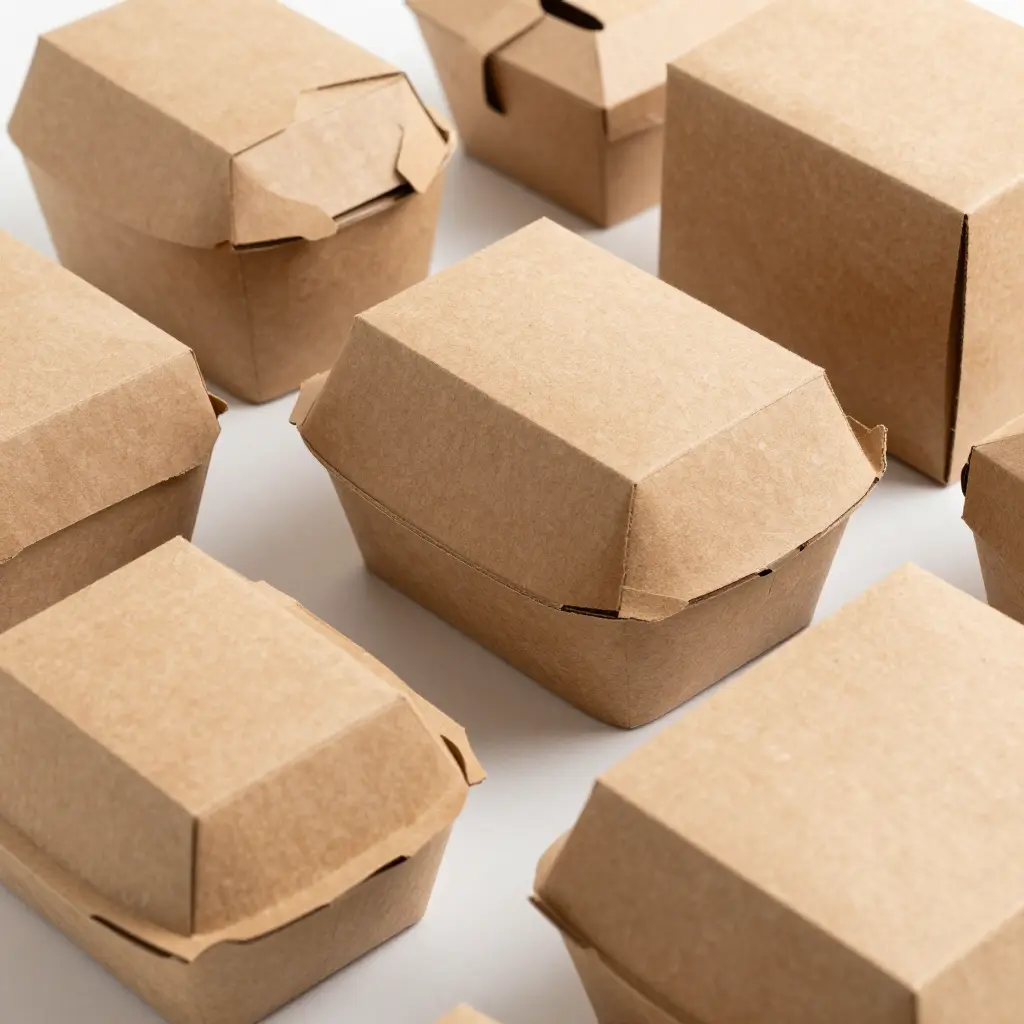
Recycled Kraft Paper Food Boxes vs. Corrugated Boxes for Hot Takeout
Recycled kraft paper food boxes are made from solid paperboard: one homogeneous sheet of reclaimed kraft fiber, typically 200-400 gsm, calendered smooth and coated on one or both faces for direct food contact. Corrugated boxes are made from fluted board, with a corrugated medium bonded between two liner facings. The flute buys bending stiffness and gives up surface density, and in recycled liner grades it adds variability that shows up at the seal line and the score line.
Two measurements decide the choice for hot takeout: grease resistance at the food-contact surface, and stacking strength once heat and moisture reach a sealed, loaded box. Both figures move as holding time and condensation rise. The comparison below checks each format on barrier type, kit rating, edge crush, board weight, coating compatibility and recyclability, because those are the numbers a buyer can request and verify before committing to an order.
Grease Resistance: Fiber Chemistry, Sizing Agents, and Barrier Coatings
Grease resistance in paperboard comes out of fiber chemistry, sheet structure and surface treatment working together. Hot takeout oil arrives warm and thin, so it spreads and wicks much faster than it would at room temperature. The barrier has to be built into the sheet, not just laid on the surface.
Why recycled kraft fiber needs a barrier
Recycled kraft fiber has been shortened by repeated pulping, and it carries more fines and broken fiber fragments than virgin stock. Short fibers pack less efficiently, so the sheet has higher porosity and a more open pore network. Oil moves through that network by capillary action, wicking along fiber surfaces and through connected voids until it reaches the outside of the box.
Sizing agents and barrier coatings
Sizing agents interrupt the capillary path chemically. Fluorine-free AKD (alkyl ketene dimer) reacts with the hydroxyl groups on cellulose and lowers the surface energy of the fiber, so oil beads instead of spreading. Starch-based treatments work more physically: they fill pores and form a film across the surface that slows wicking at the entry point.
Coatings add a second line of defence. A dispersion coating lays down an aqueous polymer layer that fuses into a continuous film as it dries, while a film coating applies a pre-formed barrier that is essentially pinhole-free. Coverage has to be continuous. One uncoated break in the layer is enough to give hot oil a path through.
How grease resistance is measured
The standard method is the kit test. Solutions with progressively lower surface tension are dropped onto the board, and the reported rating is the highest-numbered solution that does not visibly penetrate the sheet within the observation window (15 seconds in TAPPI T559, with ratings running from 1 to 12). A high kit number means the sheet held off a more aggressive, lower-surface-tension liquid, which in practice buys hold time against hot fatty food before staining or soak-through appears. Buyers evaluating recycled kraft paper food boxes should read the rating as a buffer measured in time and temperature, not as an absolute guarantee.
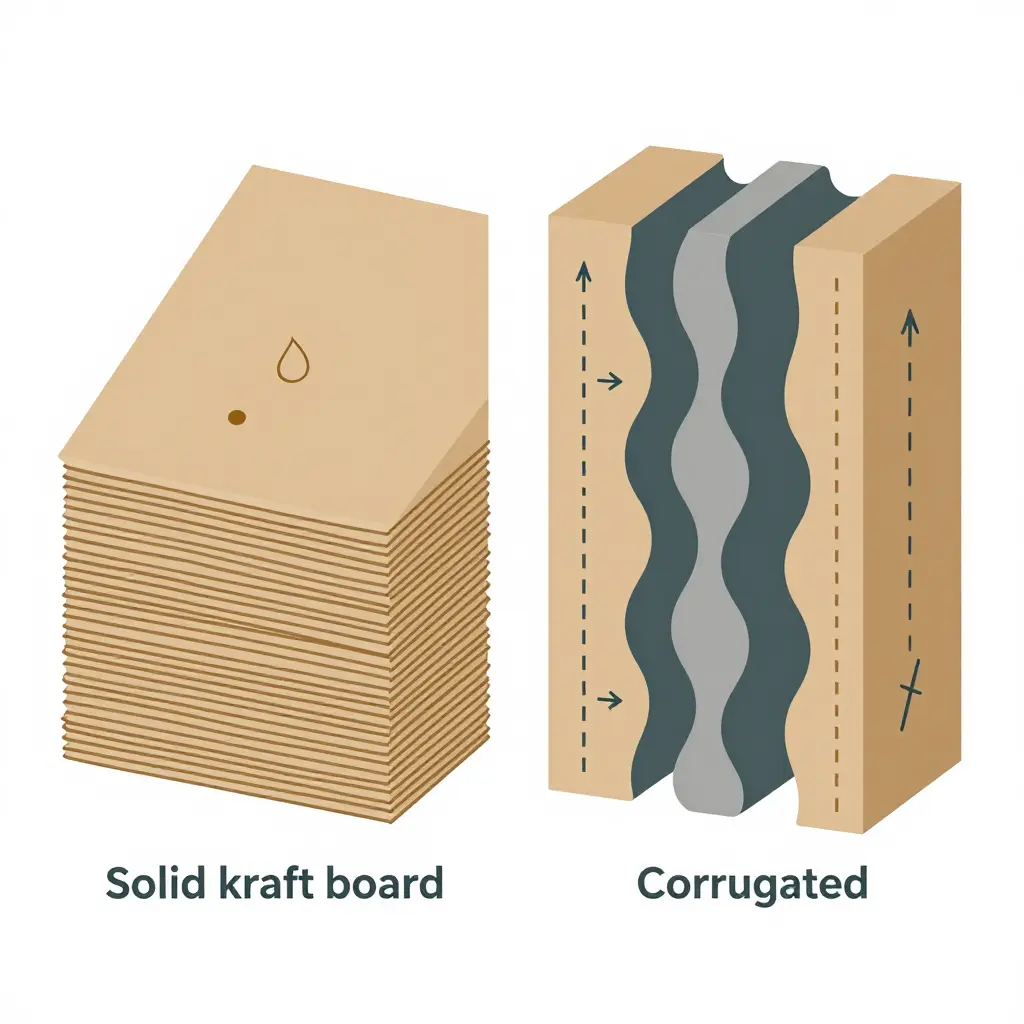
Solid kraft board versus corrugated
Solid kraft board starts with an advantage in geometry. It is dense, single-ply, uniform in thickness, and flat and tight enough for a coating to be applied continuously, so oil has only a short, direct path to travel before it meets a barrier or an edge.
Corrugated board fights the same battle with a structural handicap. The flutes leave large internal voids, and those voids work as channels where oil wicks sideways along the liners and through the flute tips. Coating a fluted surface continuously is harder, and score lines, cut edges and glued joints expose open fiber that a surface barrier never reaches.
The net effect: a dense single-ply sheet has no flute channels for oil to run along, so sizing and a dispersion or film coating can hold an unbroken barrier across the face.
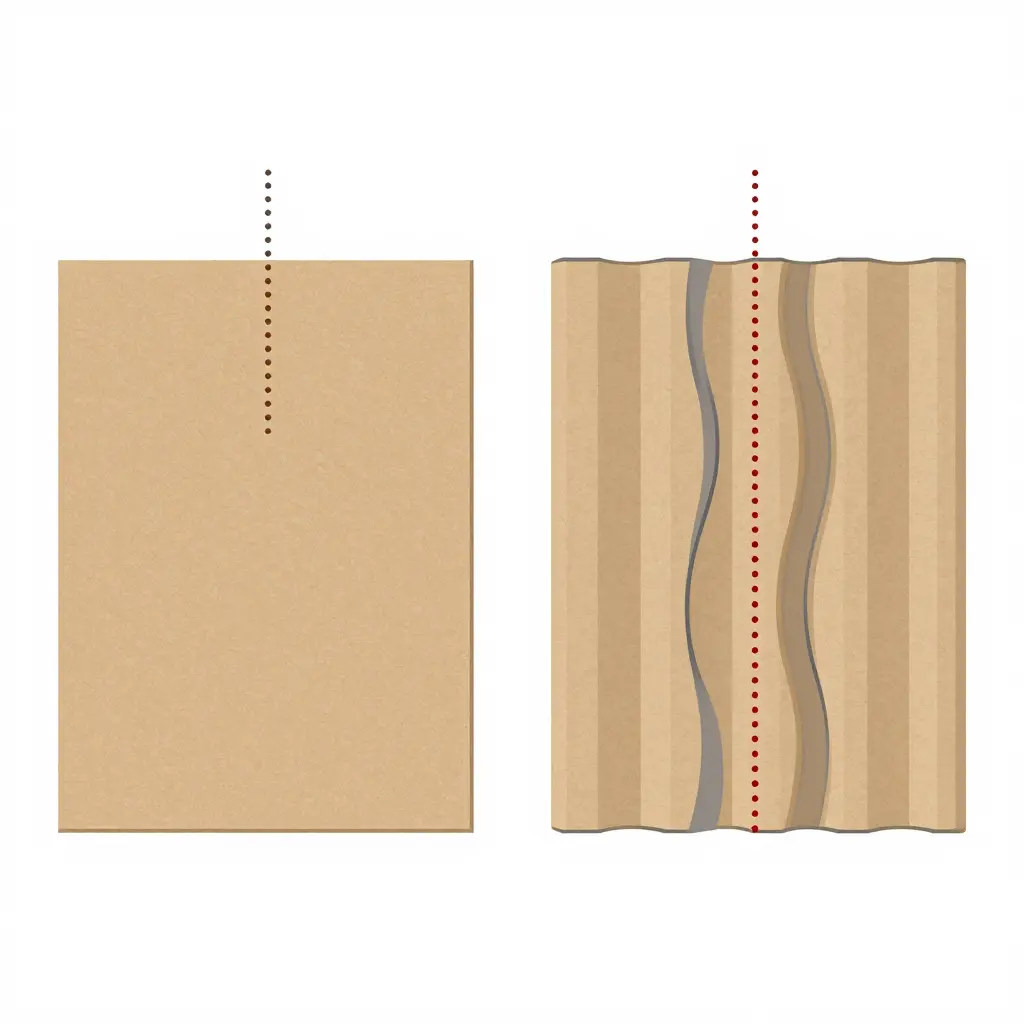
Schematic: solid single-ply kraft wall (left) versus single-wall corrugated board (right), with dotted arrows tracing the penetration path in each.
Grease barrier options for hot takeout boxes step from uncoated fiber through coatings to film lamination. Each step trades grease resistance, heat tolerance, cost and end-of-life pathway.
-
Uncoated dense kraft board – High fibre density and calendering slow oil wicking, delivering short-contact grease resistance for dry or low-fat menus in recycled kraft paper food boxes.
-
Limitation: Not greaseproof under sustained hot grease; heavier grammage improves performance but adds cost and weight.
-
Starch-based grease-resistant treatment – A starch or starch-composite surface layer forms a grease-repellent film while keeping the board compostable in industrial systems.
-
Limitation: Heat and moisture stability are the weak points; steam from hot takeout softens the film faster than synthetic coatings.
-
Water-based dispersion coating – An acrylic or styrene-butadiene dispersion at low coat weight creates a continuous film with reliable grease resistance and repulpable fibre recovery.
-
Limitation: Coat weight cost runs above untreated board, and hot-fill resistance varies with formulation and curing.
-
PE film lamination – Extruded LDPE gives the highest barrier against hot oil, sauce, and steam migration, protecting both the surface and stacking strength.
-
Limitation: Polyethylene blocks repulping and is not compostable, so the box becomes a residue stream in fibre recycling.
-
PLA or other compostable film – A PLA or PBS laminate provides a sealed greaseproof surface while satisfying industrial compostability requirements.
-
Limitation: Low heat deflection shortens hot-hold tolerance, and film cost plus limited composting infrastructure raise landed cost.
-
Corrugated board with liner treatment – A coated liner carries the grease resistance while the fluted medium supplies the stacking strength needed for heavy, hot loads.
-
Limitation: Uncoated flutes, score lines, and cut edges wick oil, and saturated board loses compression strength quickly.
Confirm coat weight, contact temperature and end-of-life claim in writing before locking a specification.
Recycled Kraft vs. Corrugated: A Procurement Screening Table
Before you line up samples, it is worth restating the barrier routes that actually drive the grease conversation for recycled kraft food boxes. Each one changes both the cost per unit and how the box behaves under a hot, oily load:
- Clay or kaolin dispersion coatings applied at the paper mill
- Water-based acrylic or bio-based emulsion barrier layers
- PE or PLA extrusion laminations for heavy-oil menu items
- Fluorochemical-free grease repellent surface treatments
- Film liners or bagged inserts for curries, sauces and fried foods
Treat the table below as a screening tool for shortlisting, not as a final specification. Verify any format you shortlist against our recycled kraft paper takeout boxes range with live samples and hot-hold testing.
| Performance Attribute | Recycled Kraft Paper Food Box | Corrugated Box |
|---|---|---|
| Board construction | Single-ply solid kraft board, coated one face | Fluted medium laminated between two linerboards |
| Typical board weight or caliper | Lighter caliper, matched to dish weight | Heavier, bulkier board graded by flute height |
| Grease resistance mechanism | Dispersion coating or film resists oil migration | Relies on liners; flutes remain uncoated, porous |
| Grease barrier durability, hot foods | Holds longer under hot, oily takeout loads | Wicking at seams and score lines appears sooner |
| Stacking strength source | Board stiffness plus tight box geometry | Flute columns distribute load vertically through walls |
| Moisture sensitivity | Picks up moisture at cut edges, softens faster | Highly moisture sensitive; flutes soften and crush |
| Print surface quality | Smooth coated face prints crisp logos and copy | Textured fluted surface favors bold, simple graphics |
| Pack-out space efficiency | Stacks flat and nests tightly before use | Bulky walls and air gaps cut trailer fill |
| Recyclability | Widely accepted when clean with low residue | Broadly recyclable, but greasy liners often rejected |
| Relative unit cost | Higher unit cost, offset by lighter freight | Lower unit cost, heavier freight can erase savings |
Read the table across rather than down. Kraft tends to win on print, freight and space; corrugated tends to win on board cost and on vertical crush resistance at large footprints. Where hot greasy food is the dominant load case, the barrier row and the moisture row usually settle the shortlist before price comes into it.
Stacking Strength: How Corrugated and Solid Kraft Board Carry Load
Stacking strength decides whether a pallet arrives intact or arrives leaning. The packaging trade describes it with two linked measurements.
The first is the edge crush test (ECT), which clamps a strip of board on edge and compresses it until the flutes or the fiber collapse. The second is box compression strength (BCT), measured on an assembled box or predicted from ECT for a given perimeter, height and style. ECT describes the material; BCT describes what the finished carton can hold.
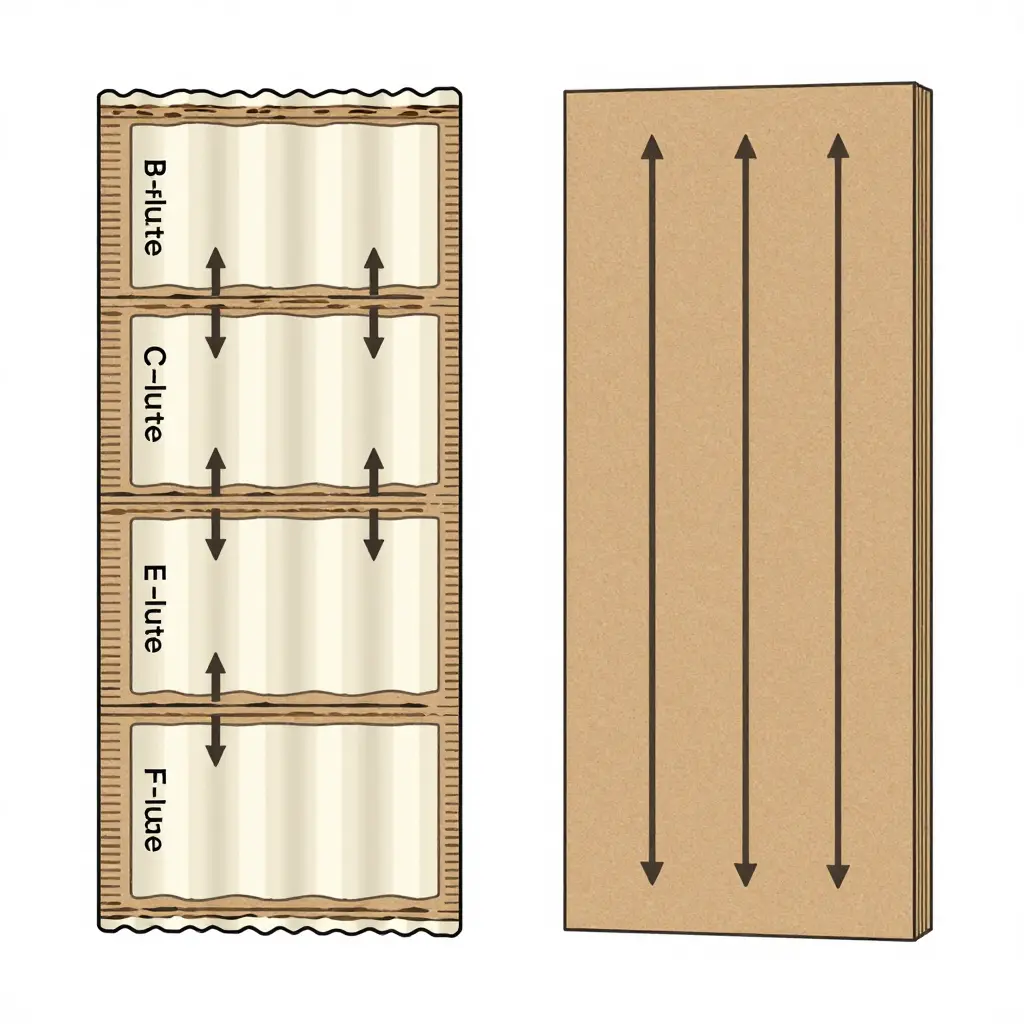
Flute profile and board grade set the ceiling
In corrugated, the flute profile does most of the work. Taller, coarser flutes such as B and C give more caliper and more vertical wall to resist buckling, while finer E and F flutes trade some raw compression for printability, foldability and a cleaner finish. Board grade, meaning the liner weights and the medium, sets the upper limit on what a given flute can deliver. Change the grade and the ceiling changes, even when the flute stays the same.
Solid kraft board is a different load path
Solid kraft board carries load through caliper and fiber density rather than through flutes. There is no air gap to buckle and no flute wall to tip sideways, so the sheet behaves as a continuous stack of bonded fiber. Absolute compression values are usually lower than a well-specified corrugated board would give, but they are more consistent: less variability from scoring, converting and handling, and more predictable deflection under load.
Heat and moisture: the decisive variable for hot takeout
Moisture and heat from steam soften fiber bonds and reduce compression strength. A box that tests comfortably at ambient conditions can lose a large share of its load capacity once it is full of hot food and sealed. Fluted structures lose capacity faster because the flutes expose more surface area to humidity: steam migrates into the open flute channels and into the medium, which is the very component carrying the vertical load.
| Attribute | Corrugated | Solid kraft board |
|---|---|---|
| Load path | Flute walls in compression | Caliper and fiber density |
| Peak compression | Higher when grade is specified well | Lower, but more consistent |
| Moisture sensitivity | High – flute walls expose more surface area | Moderate – dense bonded fiber |
| Strength consistency | Variable across score lines and handling | Predictable, uniform deflection |
| Typical role in hot takeout | Outer shipper, high-stack cases | Primary food contact box |
What this means in practice
Maximum stack height has to be set on the wet-strength case, not the dry spec sheet. Pallet configuration should keep corrugated-heavy loads from carrying the full weight of upper tiers for long periods. Transit duration matters because strength loss accumulates with time in a humid trailer or a steamed delivery bag. Where the stacking load is genuinely high, in bulk catering or multi-tier distribution, the sensible engineering answer is a corrugated outer shipper around the primary pack: the grease-resistant recycled kraft paper food boxes stay as the food-contact layer and corrugated takes the dead load.
Buyers sourcing the food-contact box itself can start from kraft paper takeout boxes built on consistent solid board, then pair them with a corrugated case wherever the pallet plan demands it.
Solid kraft board meets the load requirement at moderate stack heights, where consistency matters more than peak compression. Corrugated, or a corrugated outer shipper, is the right call where stacking loads are high and the full weight of a pallet has to be carried through heat and humidity.
Which board format holds its stack when things get hot and humid?
Before comparing quotes, look at how each format behaves after it leaves the dry warehouse. The chart below normalizes every board to a dry baseline index of 100, then shows where that index lands once the material has been exposed to heat and steam, which is the everyday condition of a delivery bag on a 40-minute run.
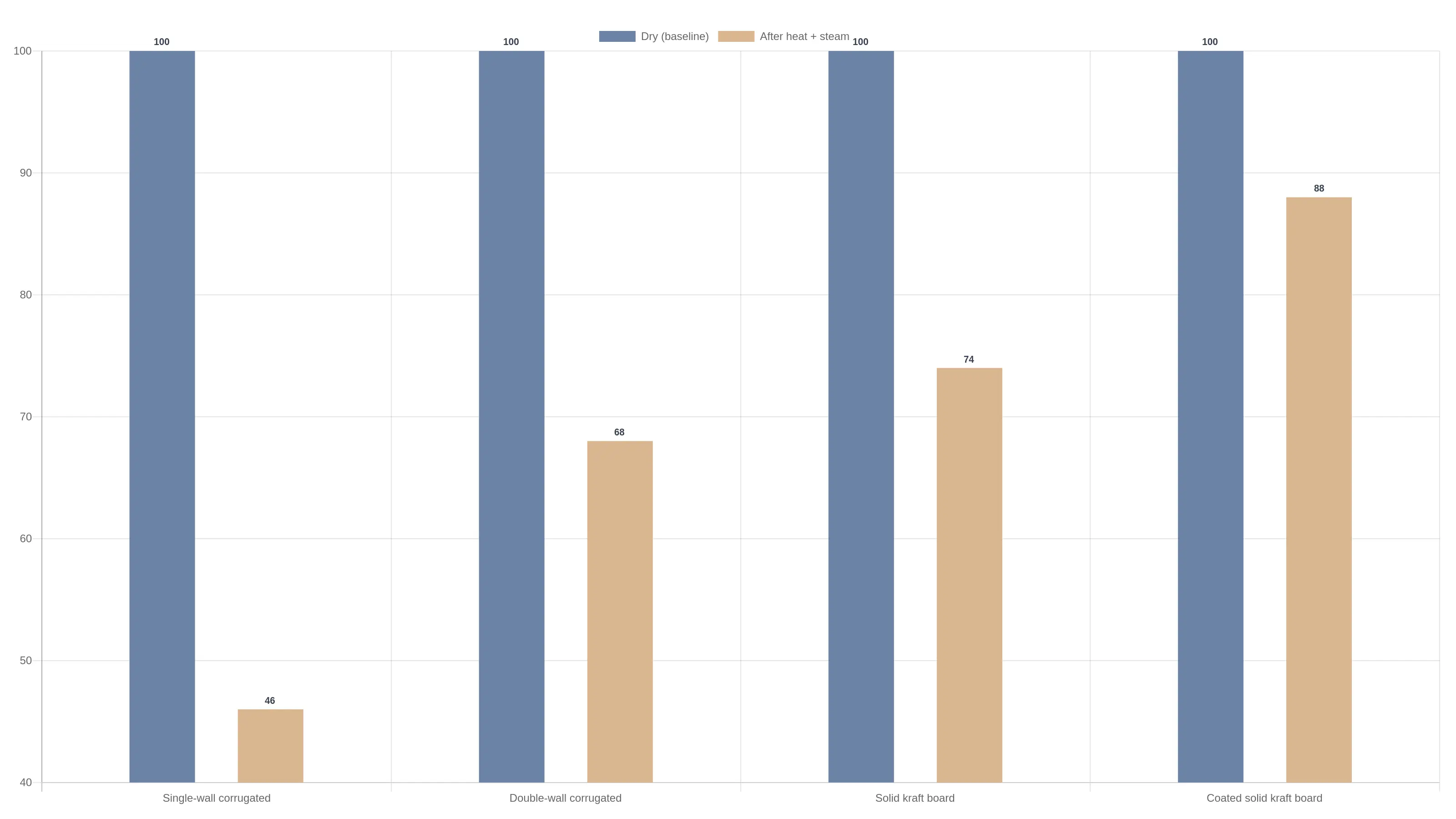
Takeaway: single-wall flute loses more than half its stacking index once steam hits, double-wall loses about a third, while coated solid kraft board keeps roughly 88%. Fiber structure, not wall count, is what carries a hot-takeout specification. Index values are normalized for comparison, not absolute load measurements.
Corrugated earns its reputation in dry storage, where a fluted structure is genuinely efficient. Add moisture and radiant heat, and the same flutes that resist vertical load begin to soften in the medium, so a single-wall box that passed a dry compression test can arrive visibly bowed, or collapse in a stacked delivery bag. Double-wall buys back some margin. Solid kraft board is dense and unfluted, so it holds its geometry better, and a functional coating gives the flattest line in the chart.
That has a commercial consequence: over-specifying wall count does not buy stack integrity in a hot channel. If the menu runs saucy, steamed or fried items, it is worth pairing this retention data with the kraft paper box format that matches the load and venting profile you actually ship.
Procurement and Cost-per-Performance
For hot takeout, the buying question is not which substrate costs less per piece, but which format delivers the required grease resistance and stacking strength at the lowest total cost per order. Compare barrier performance per unit area, board weight, pack-out cube, secondary materials and handling labor in the same model.
Solid recycled kraft paper food boxes usually cost more per unit area of barrier quality, because the base sheet and the treatment are engineered as one system. That premium buys a tighter surface for grease resistance and usually reduces board weight and pack-out volume. The constraint is compression: solid board performs well in shallow or moderate stacks, while tall dense loads need tighter limits and careful case packing.
Corrugated is cheaper per unit of compression strength, since the fluted medium adds depth and stiffness with less fiber. It does not provide grease resistance by default. A separate liner, coating or inner bag may be needed, and tall stacks often need an outer shipper or divider system. Those additions belong in landed cost.
| Procurement variable | Solid kraft format | Corrugated format |
|---|---|---|
| Barrier cost per unit area | Higher; barrier built into the sheet | Lower base cost; separate barrier may be needed |
| Board weight per package | Generally lower | Generally higher for comparable compression |
| Pack-out volume | Lower; more units per case or pallet | Higher; flutes consume cube |
| Compression strength per unit cost | Lower; stack limits need review | Higher; fluted medium adds stiffness |
| Secondary packaging | Often minimal for moderate stacks | Outer shipper or dividers may be required for tall stacks |
| Best-fit use | Low-load, short-hold hot menus | High-load or long-transit programs |
Format choice also changes the handling model. Paper buckets can make a closed, cylindrical package with good barrier coverage, but lid fit and seam integrity are part of the grease-control specification. Paper lids should be evaluated for fit, coating and rim resistance, not diameter alone. Paper sleeves can add insulation and branding, but they are not structural support.
For food packaging distributors and multi-unit buyers, quote by case, cube and compression target rather than piece count. Ask for barrier test data, board grade and a stack simulation that reflects the actual menu, holding time and transit profile.
Low-load hot menus. For a program with short holding times, moderate stack heights and limited transit, specify a solid recycled kraft format with verified grease resistance, and add a separate barrier only where the fat or moisture load requires it.
High-load or long-transit programs. Where stacking loads are high, transit is long, or a mixed menu carries sustained heat and grease, specify a corrugated format with a qualified grease barrier plus an outer shipper or divider plan, and validate the whole system through compression and leakage testing before approval.
Strength Retention Under Heat and Moisture: The Decay Curves
Grease resistance gets most of the attention, but humidity is what flattens a stack inside a delivery bag. The chart below plots relative compression strength retention against cumulative exposure to 40 °C / 85% RH, with every sample indexed to 100 at hour zero, so the comparison rests on the shape of the decline rather than on absolute load figures.
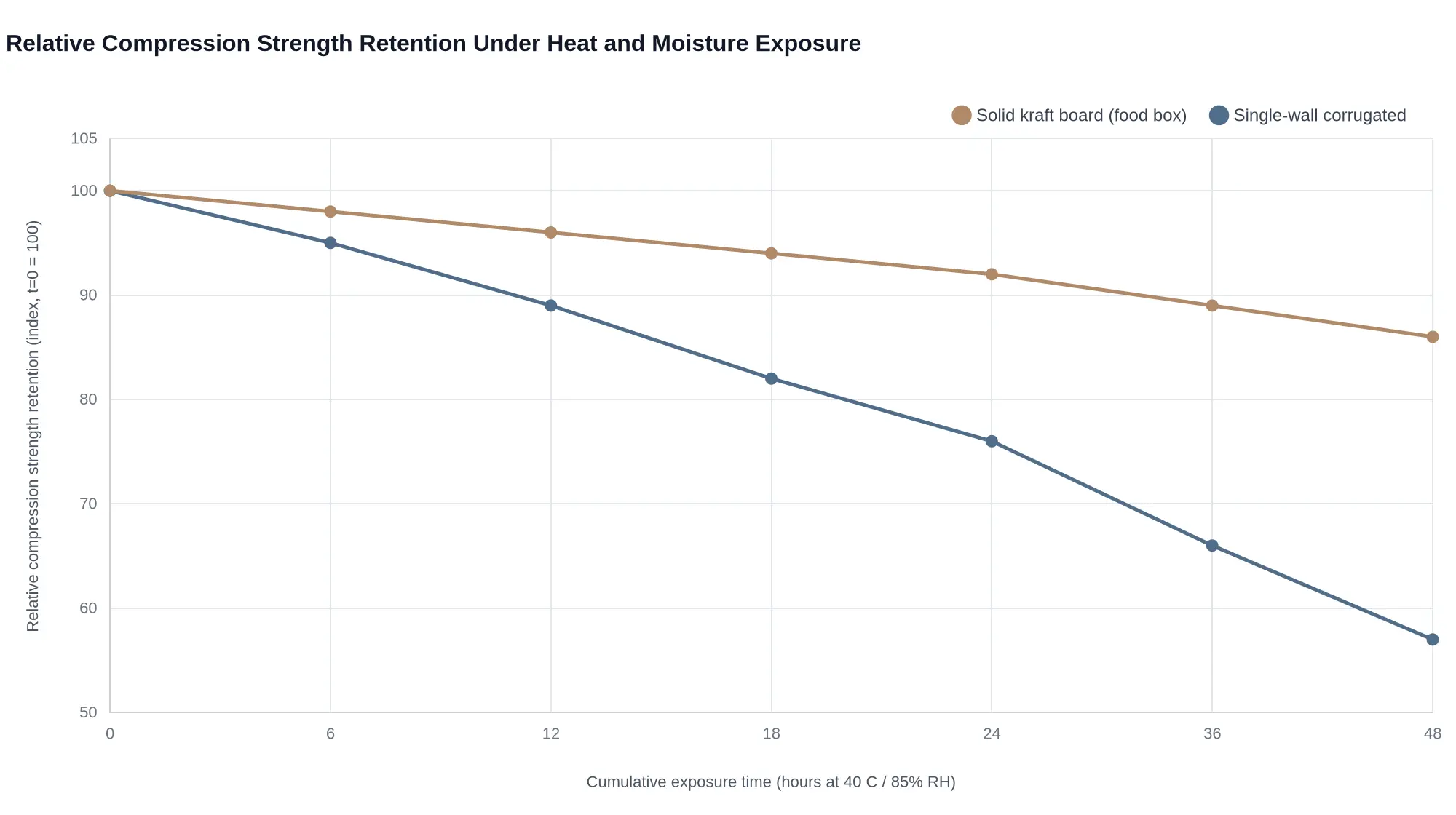
Figure 2. Relative compression strength retention (index, t = 0 → 100) for solid kraft board food boxes versus single-wall corrugated, plotted against cumulative heat-and-moisture exposure at 40 °C / 85% RH.
The gap opens early. At 24 hours the two materials sit about 16 index points apart; by 48 hours that spread has stretched to 29 points, with corrugated down to 57% of its starting strength and solid kraft board still above 85. The mechanics are simple: corrugated’s fluted medium exposes far more open fibre surface to ambient moisture, so the board softens along the flutes first and buckles under vertical load. Solid kraft board is denser and slower to absorb, which is why buyers specifying kraft paper boxes for hot takeout should read a stacked-height spec as a humidity-adjusted figure, not a dry-lab one. If a storage or transit window runs past 24 hours of warm, humid air, plan the pallet pattern on the corrugated curve rather than the kraft one.
Handling, Storage, and Product-Fit Guidance for Hot Takeout
Recycled kraft paper food boxes deliver their rated grease resistance and stacking strength only when the chain from packing line to dispatch supports them. Treat the points below as operating rules.
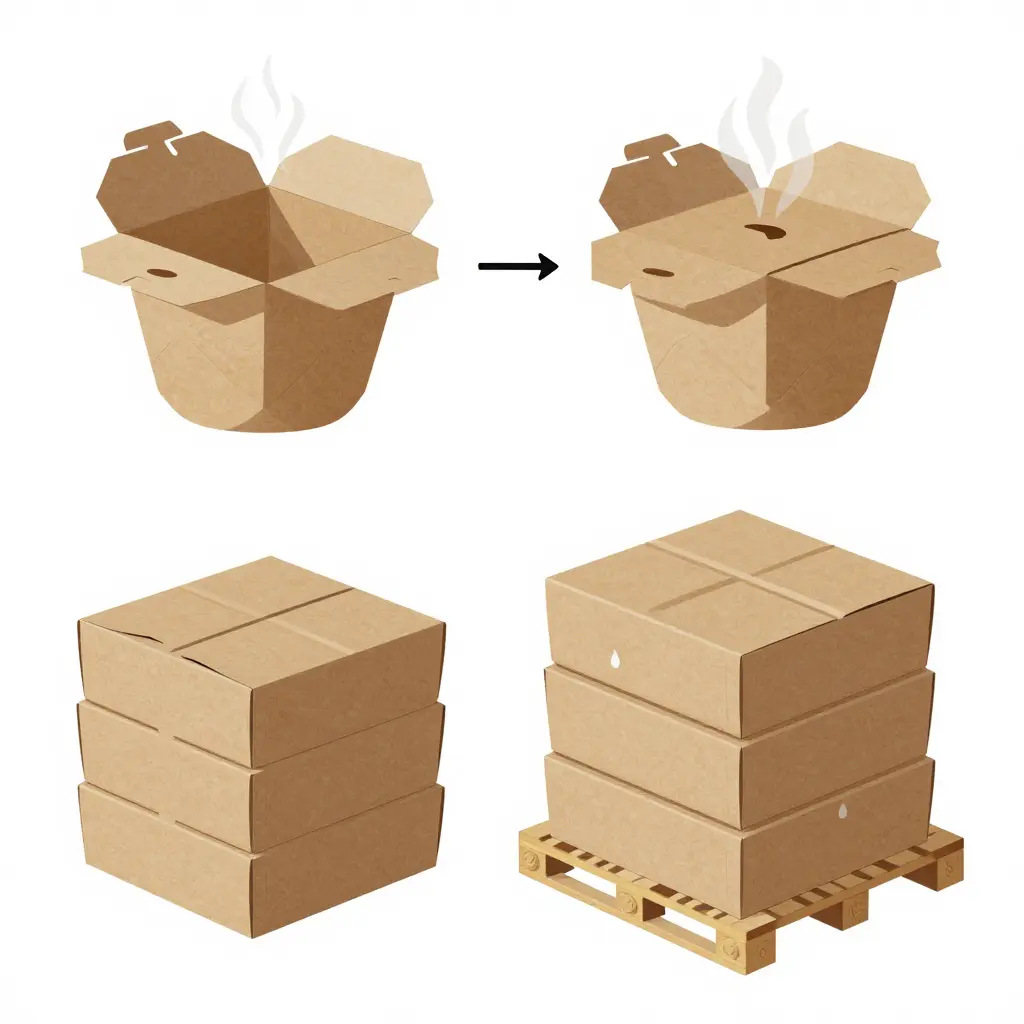
Vent the box before you close it
Steam is the fastest way to lose grease resistance. Trapped vapour softens the barrier layer and lets fat migrate into the fibre, so keep every factory-punched vent clear. Do not tape over vents to stop leaks, and do not seal a box while the food is still visibly steaming.
For lidded formats, use vented paper lids that release vapour sideways instead of letting it drip back onto the board.
Stop condensation from pooling on lids
Condensation damages stacking strength faster than grease does. A wet lid loses compression capacity, and the moisture then transfers into the side walls, which is exactly where a stack buckles. Where the format uses a paper lid, a clear window or a paper box with a clear lid, leave a small offset gap during transport or specify a lid with discrete vent holes.
Keep board stock dry and off the floor
Recycled kraft board is hygroscopic, so it takes on ambient moisture before it ever meets food. Store stock flat on pallets at least 100 mm clear of the floor and away from exterior walls, at roughly 35-60% relative humidity. Rotate first in, first out, and keep pallets away from steam tables, dishwashers and doorways that cycle between hot and cold air.
Shorten the packing-to-dispatch window
Every minute a closed hot takeout box sits, vapour condenses and the board softens. Pack to order rather than ahead of the peak, and keep the interval between filling and dispatch as short as the kitchen flow allows.
Match the box format to the food type
Fat load, free liquid and surface area all vary by dish. Use the format that manages the specific load rather than one box for everything.
| Food type | Recommended format | Why it holds up |
|---|---|---|
| Fried and breaded items | Vented kraft box | Vents release steam; ventilated walls limit fat wicking |
| Saucy noodles and rice | Noodle paper box with folded closure | Tall side walls contain liquid; fewer seams to soak |
| Greasy handhelds and snacks | Boat tray | Wide shallow profile spreads oil over an even surface |
| Dry bakes and pastries | Paper box with window | Low moisture load means windows stay clear |
| Mixed plates | Multi-compartment container | Separates wet and dry components to protect the base |
Supporting components decide the outcome as much as the box. Sleeves add hoop rigidity and stop the side walls from bowing under load. Cup holders isolate drinks so a spill does not soften the base of a stacked box. Lids, closures and box formats have to be specified together, because a rigid box with a poorly vented lid still fails in transit.
A four-step handling sequence
- Assess the load. Classify each dish by moisture and fat content, then assign the box format and vent configuration that suits it.
- Fill within capacity. Keep food below the sidewall fold line so the lid seats flat and the base carries load evenly.
- Close without trapping steam. Leave vents open, offset lidded formats slightly, and never tape over punched holes.
- Stack to tested height and dispatch. Respect the rated stack count, keep drinks isolated in holders, and move hot takeout to the loading area immediately after closing.
Frequently Asked Questions: Grease Resistance and Stacking Strength
Can recycled kraft paper food boxes hold greasy hot foods without a coating?
No. Uncoated fiber wicks free oil straight into the sheet, so a hot fried item or a saucy noodle dish will saturate the board within 10 to 20 minutes of contact, leaving translucent patches and softening the walls where they flex. That saturation is also the moment structural stiffness collapses, which is why bare recycled kraft paper food boxes are specified with a barrier layer rather than sold as a grease-ready format. Reliable grease resistance on recycled fiber comes from a water-based dispersion coating at roughly 3 to 8 gsm, or from a PLA layer applied by extrusion at a heavier coat weight. Either one holds oil out for the full 40 to 60 minute takeout window.
Is corrugated stronger than solid kraft board for stacking?
In dry conditions, usually yes. The medium in a B-flute or E-flute board acts as a series of vertical columns that carry load in compression, so corrugated typically posts a higher edge crush test value per gram of fiber than a solid kraft sheet of similar basis weight. Solid kraft board’s advantages lie elsewhere: puncture resistance, a smoother print surface and thinner walls. The ranking flips once the stack sits in heat and steam, because the fluted medium picks up moisture and softens faster, so specify corrugated for high dry stacks and coated solid kraft where the load has to survive a hot, humid channel.
How does moisture from steam affect grease resistance?
Steam condenses on the lid and inner walls, raising the board’s moisture content and opening the fiber network, and a wet fiber matrix lets hot oil through faster than dry fiber does. That is why a box can pass a dry grease test and still show wicking on a 30 minute delivery of steamed rice or curry: grease resistance is not a fixed number, it drops as the sheet gains moisture. Vented lids, a tight-fitting closure and a dispersion coating keep internal humidity low enough to hold the barrier for the full transit window.
Which barrier option is recyclable in standard paper streams?
Water-based dispersion coatings, clay-based coatings and PVOH coatings all repulp in standard paper streams because they disperse into the fiber furnish instead of forming a plastic film. Polyethylene extrusion does not: the PE layer has to be screened out, so an extruded-laminated box is a mixed-material item, not a paper one. Ask the supplier for a repulpability statement or a mill test result before you commit a barrier to your waste stream.
How to choose between the two formats for a mixed hot menu?
Run the load first: add the weight of every item in the box, multiply by the number of tiers you stack, and compare the result against the compression value of the candidate board. Solid kraft handles single-item, low-stack orders; corrugated handles heavy multi-item loads and long stacking columns. Then match the barrier to the wettest item on the menu, because one greasy dish sets the specification for the whole format. A mixed hot menu usually lands on corrugated with a dispersion coating, with solid kraft kept for the lighter, lower-stack items.
Conclusion: Matching the Format to the Load
The verdict is split. Solid recycled kraft paper food boxes lead on grease resistance and on stack consistency per unit weight: dense, unfluted walls accept a barrier coating evenly and hold their footprint when nesting pressure varies, so performance stays predictable from box to box. Corrugated leads on absolute compression strength and on cost per unit of load capacity, because fluted walls buy height and rigidity at a low material cost. Neither advantage cancels the other; they answer different questions.
Two questions decide between them: how well the wall resists fat and moisture migration, which determines whether a container keeps its geometry and its printed surface through a delivery window; and how much sustained vertical pressure it carries, which sets how high a pallet, rack or warming shelf can be built before the lowest layer deforms. Test both against your fill weight and dwell time, and the material choice usually makes itself.
Kraft is the right choice when the menu runs fatty or sauce-heavy, holding times are short to moderate, and unit-weight efficiency matters across transport and storage. Corrugated is the right choice when the load is heavy, orders are multi-item and bulky, and containers sit stacked for long periods in a warehouse or under a warming lamp. Blended programs, with kraft for the food-contact vessel and corrugated for the outer shipper, cover most mixed requirements without giving up either property.
Greendispopack.com supplies both formats from a single source, alongside disposable tableware, packaging paper and boxes, together with the kraft paper takeout boxes, lids, sleeves and carriers that complete a finished order. Buying both formats from one supplier keeps tolerances, board grades and coating specifications consistent, and leaves one point of contact for repeat orders.