
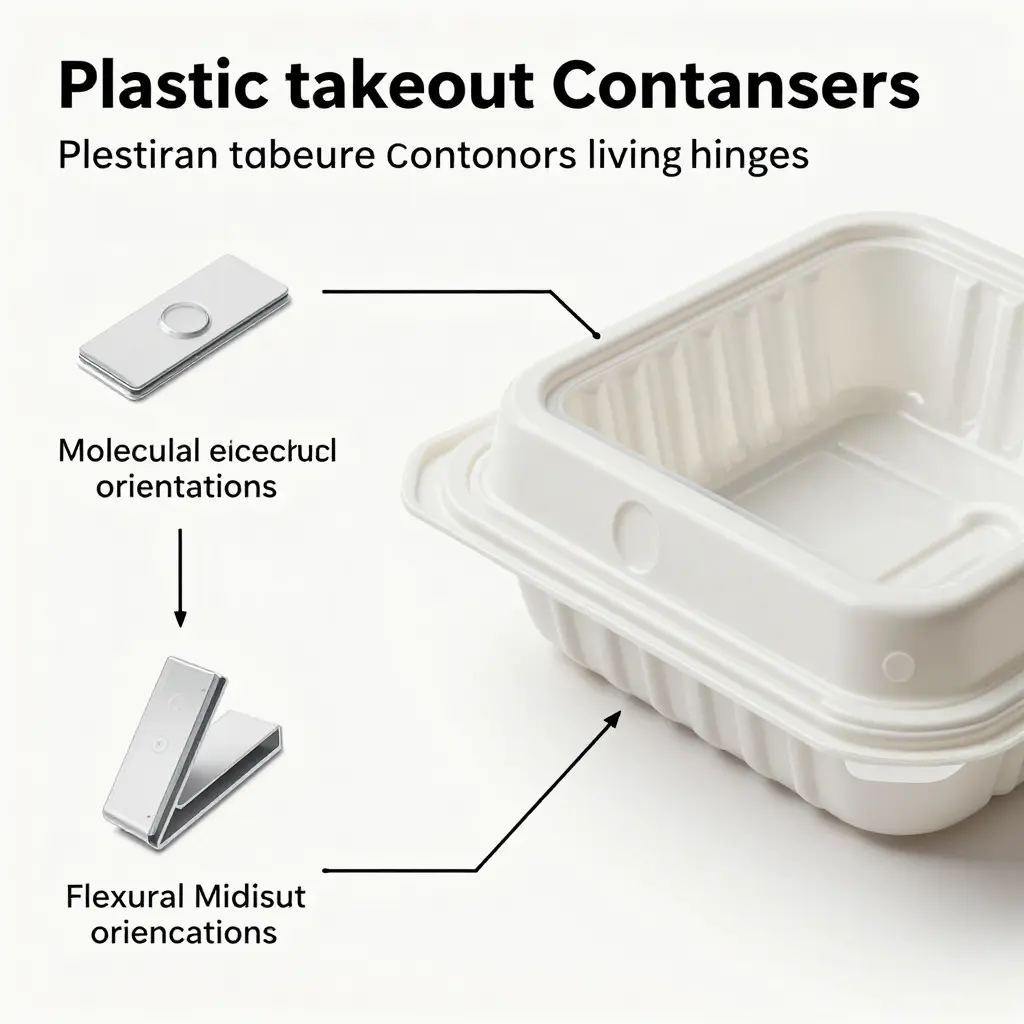
Living Hinge Mechanics and Molecular Orientation
A living hinge has no pins, barrels, or separate parts. It is a thin strip of the container’s own polymer bridging the lid and the base, narrow enough to bend through a tight radius every time the lid moves. A clamshell that gets opened and closed a few hundred times in service puts that strip through a few hundred flexural cycles, so the hinge is a fatigue detail rather than a part sized for one static load. In most failed clamshells the crack was growing for a long time before anyone could see it.
Molecular Orientation: The Hidden Requirement
The web only holds up if the molder gets the polymer chains lined up across it. As the melt accelerates into the thin hinge section, the chains stretch and align with the flow. That alignment is what makes the hinge work: it raises the flexural modulus and tensile strength across the fold and leaves a microstructure that resists the slow crack growth behind most hinge cracking in PP clamshells. If the melt arrives cold, stalls, or flows along the hinge line instead of across it, the web stays close to isotropic and cracks much sooner. Molded fiber formats such as molded fiber clamshell packaging avoid the mechanism altogether, because there is no polymer hinge to fatigue.
Balancing Stiffness and Toughness
A durable hinge has to satisfy two demands that pull in opposite directions. The web needs enough stiffness to hold the lid at its detent angle and to give a clean snap, and enough toughness to take the strain of every cycle without starting a crack.
| Design Goal | Governing Property | Trade-off |
|---|---|---|
| Hold lid position | High flexural modulus | Stiffer webs resist bending but strain more sharply |
| Resist crack initiation | High toughness / elongation | Tougher blends flex further but may creep |
| Long fatigue life | Balanced orientation | Over-orientation can embrittle across the fold |
The Three Stages of Hinge Cracking in PP Clamshells
Fatigue damage in a hinge follows the same sequence as any fatigue failure:
- Initiation – a micro-crack opens at a surface defect, weld line, or notch, where tensile strain concentrates.
- Propagation – the crack advances through the web with each flexural cycle, often following weak or transverse orientation.
- Rupture – the remaining ligament can no longer carry the load, and the hinge separates completely.
Why Cracks Start on the Outer Surface
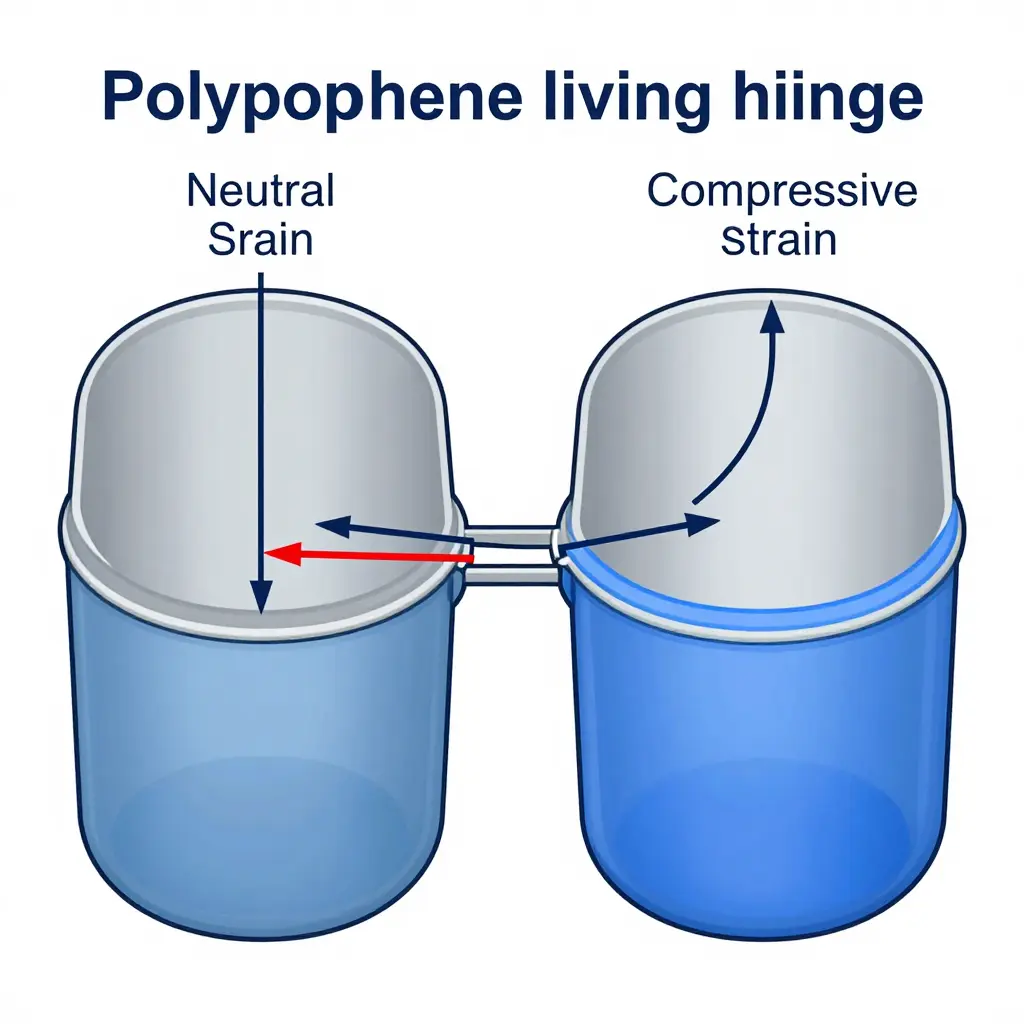
Cracks usually begin on the outside face of the hinge because that is where tensile strain peaks. During bending the neutral axis stays near the middle of the section while the outer fibers stretch the most. Any stress concentration at that surface, whether a molding defect, an abrupt thickness change, or a sharp corner, multiplies the local strain and gives a fatigue crack a place to start. Holding the radius, the thickness uniformity, and the gate location under control is what keeps outer-surface strain below the level where a hinge begins to fail.
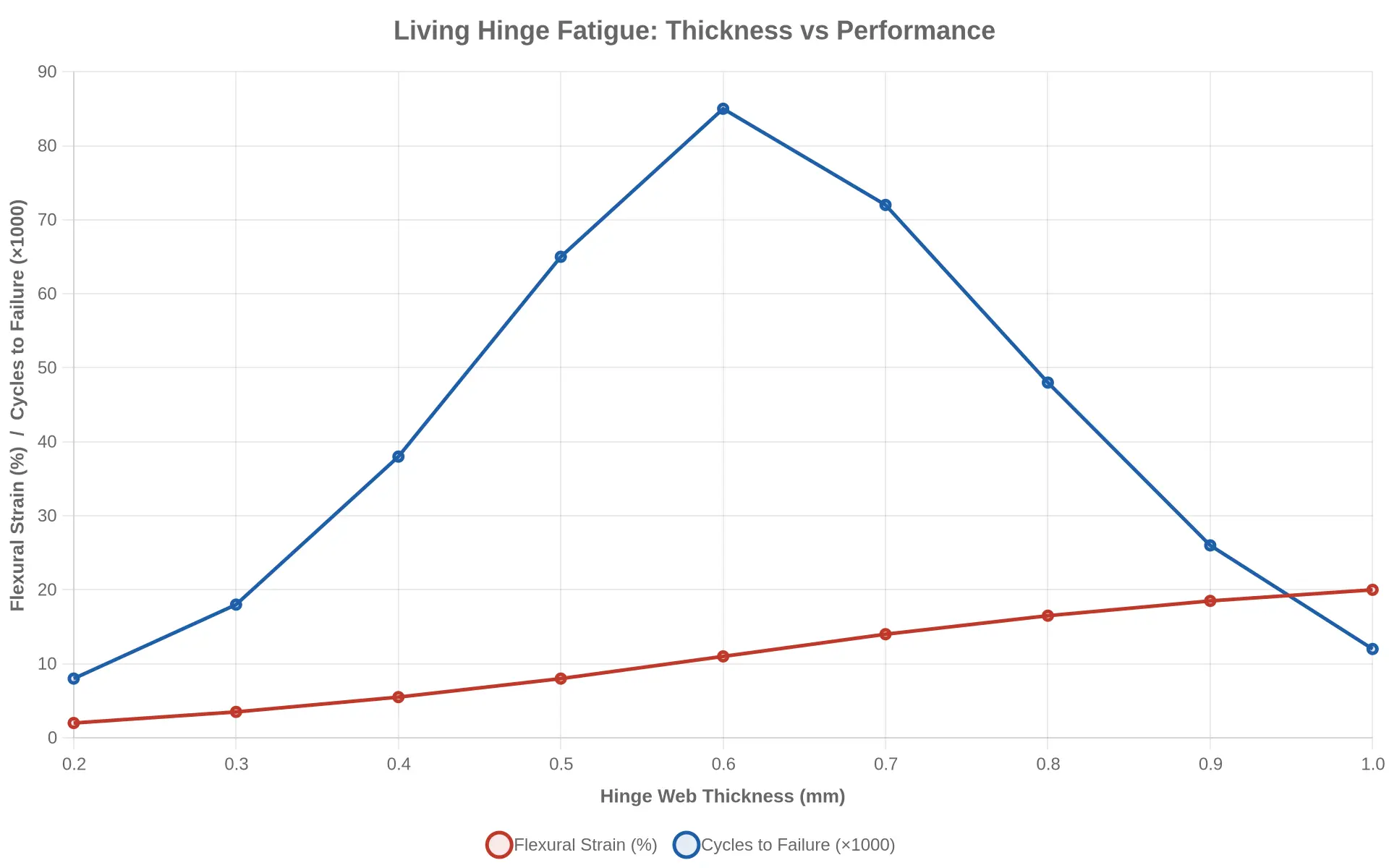
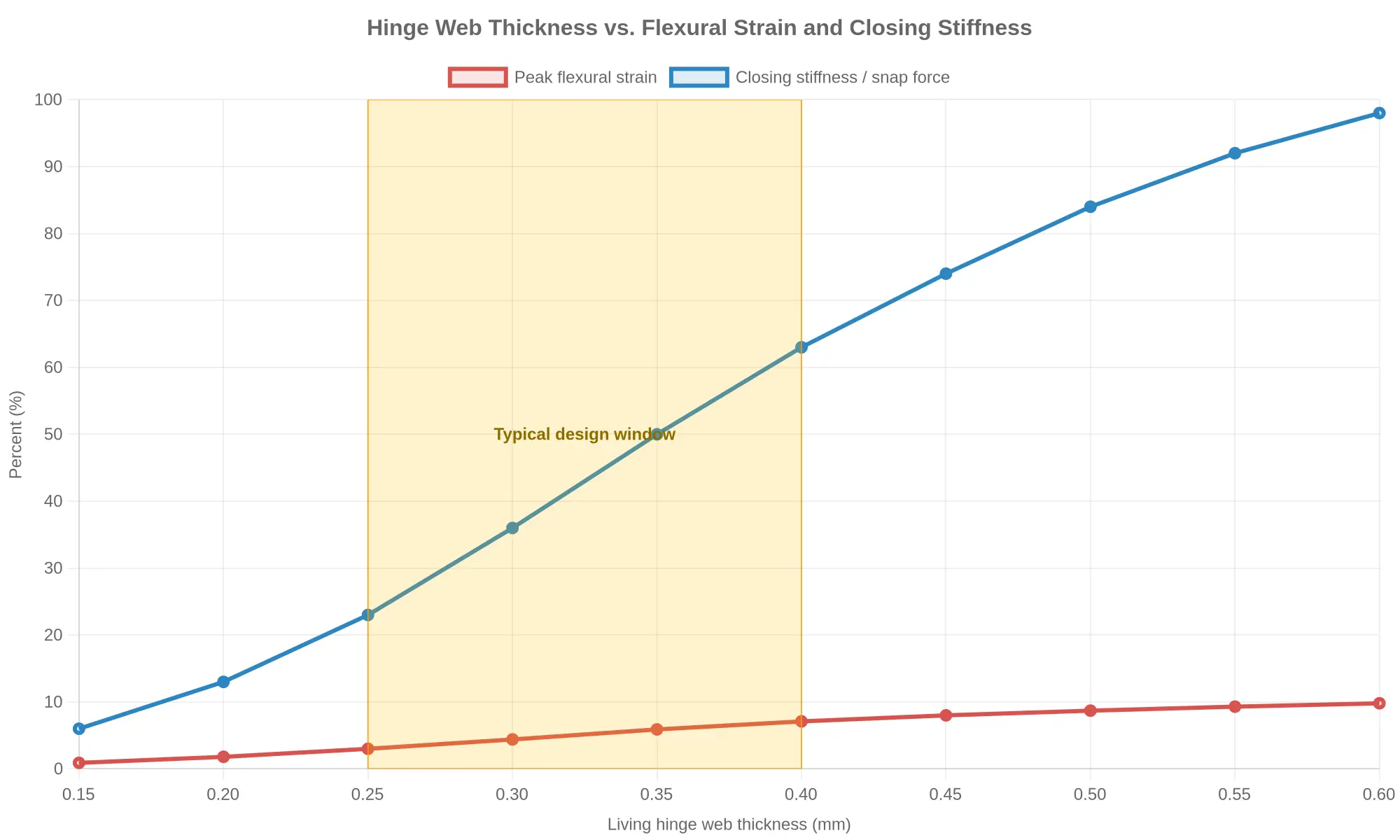
The chart above shows the trade-off in more detail. Thicker webs give a stronger snap but raise flexural strain, while cycles to failure peak at a mid-range thickness before falling off. Matching the PP grade to the hinge geometry is what keeps outer-surface strain in the safe zone.
PP Resin Grade Selection vs Living Hinge Performance
Grade choice is the first lever for stopping a takeout clamshell from cracking at the hinge. The table below lines up the four PP families most often used in packaging with their mechanical numbers and their flex-fatigue behavior, so the stiffness-versus-toughness trade-off is visible before you start sizing the web.
| PP Resin Grade | Typical Flexural Modulus | Notched Izod Impact Strength (23 deg C) | Hinge Flex Life Tendency | Key Pros | Key Cons | Recommended for Living Hinge? |
|---|---|---|---|---|---|---|
| Homopolymer PP | ~1,400-1,800 MPa (high) | ~20-40 J/m (low) | Usually the longest flex life of the four | Highest stiffness, best creep and chemical resistance, lowest cost, develops the strongest flow orientation | Brittle at low temperature, low notched impact | Yes – the default for hinges that flex at room temperature |
| Random Copolymer PP | ~900-1,200 MPa (medium) | ~40-90 J/m (medium) | Good – close to homopolymer, with a small drop in fatigue life | Better toughness and clarity, lower melting point, balanced properties | Lower stiffness than homopolymer | Yes – where clarity or a softer feel matters |
| Impact (Block) Copolymer PP | ~900-1,400 MPa (medium) | ~60-250 J/m (medium-high) | Moderate – the EPR domains interrupt orientation and shorten flex life | High toughness with retained stiffness, good low-temperature impact | Opaque, stress whitening, shorter hinge fatigue life | Only when cold-temperature impact is the priority |
| High-EPR Impact Copolymer PP | ~700-1,100 MPa (low) | ~250-600+ J/m (high) | Lowest – the shortest hinge fatigue life of the four | Outstanding impact toughness, superior low-temperature performance | Lowest stiffness, higher cost, stress whitening, reduced flow, poorest hinge fatigue | Not for high-cycle hinges – specify for impact and cold-chain protection, not flex life |
Two trends run side by side as EPR content rises: notched impact strength climbs and flexural modulus falls, but hinge flex life falls as well. The rubber domains that absorb impact energy also interrupt the chain orientation the hinge depends on, which is why grade and web thickness have to be specified together. A homopolymer or random copolymer keeps a thin web alive through a long cycle count; an impact copolymer buys low-temperature toughness by giving some of that life back.
For room-temperature food service the durable choice is usually a homopolymer or a random copolymer, with the impact grades reserved for cold-chain and rough-handling applications. Lids and rigid trays that never flex can use any of them. Where the hinge itself is the weak point, you can compare our sugarcane clamshell containers as a like-for-like alternative that removes the flexing part.
Grade Selection: Random vs Impact Copolymer and EPR Content
The choice between the two copolymer families comes down to molecular architecture. The table below compares them side by side for designers and packaging buyers who need the trade-offs before committing to a PP copolymer grade.
| Property | Random Copolymer | Impact (Block) Copolymer |
|---|---|---|
| Ethylene placement | Randomly distributed along the chain | Discrete EPR domains in a PP matrix |
| Clarity / optics | High transparency | Opaque, low clarity |
| Flexural modulus | Lower (softer) | Higher, tunable |
| Low-temperature impact | Moderate | High |
| Living hinge flex life | Good – retains orientation | Reduced – EPR domains disrupt orientation |
| Typical application | Thin-wall clarity parts and moderate-cycle hinges | Cold-chain and impact-resistant containers, crates |
Random copolymer: clarity and a hinge that holds up
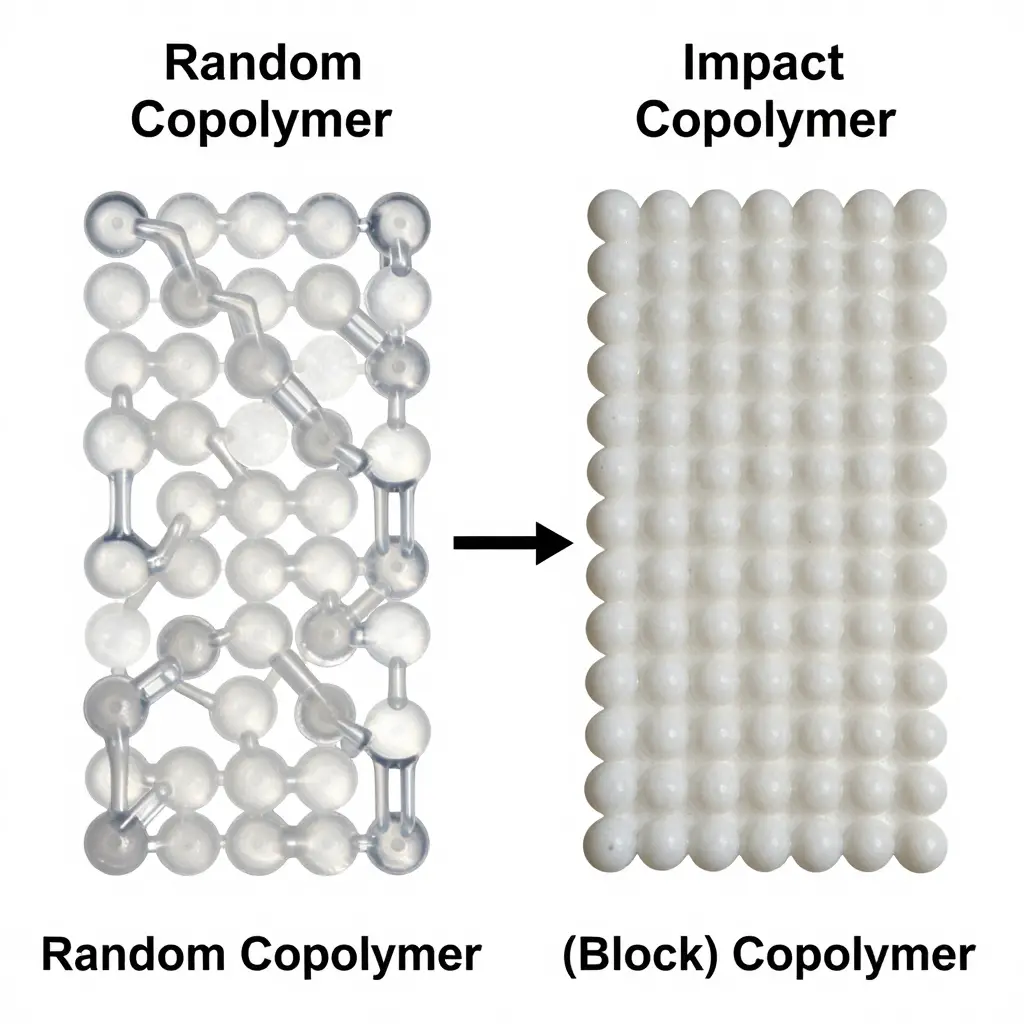
Random copolymer scatters ethylene comonomer units along the polymer backbone. Those interruptions lower crystallinity, which delivers two useful properties at once: high transparency for display containers, and a lower flexural modulus for a softer feel. The same structural disorder costs a little fatigue performance relative to homopolymer, because the less crystalline matrix concentrates stress, but random copolymer remains one of the better choices for a living hinge.
Impact copolymer: the EPR phase buys impact, not flex life
An impact copolymer is polymerized in stages, so the finished resin carries a dispersed ethylene-propylene rubber phase, soft elastomeric domains suspended in a rigid polypropylene matrix. The rubber absorbs impact energy and blunts crack propagation, which is what gives the grade its low-temperature toughness. The same domains break up the flow-induced orientation through the hinge, so repeated flexing shortens life compared with homopolymer or random copolymer.
The EPR content trade-off
The chart below quantifies the compromise. As EPR content rises, notched Izod impact strength climbs sharply while flexural modulus drops. Flex-fatigue life in the hinge drops with them.
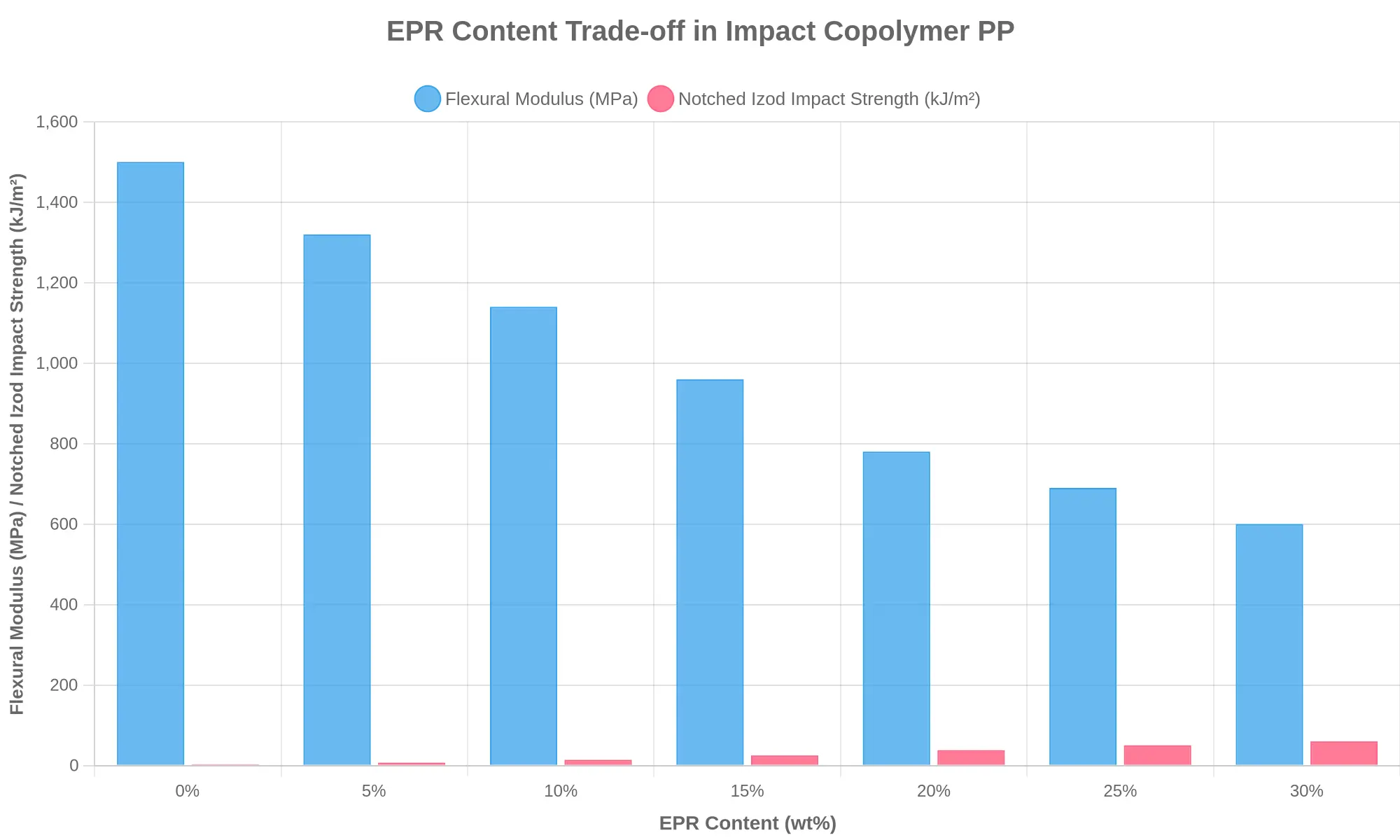
That combination decides how rigid the container is and how well it stacks. A high-EPR grade tolerates drops and cold temperatures but produces a floppier wall that can bow under a stacked load, while a low-EPR grade holds its shape and stack height but risks brittle fracture instead of a slower crack. For living-hinge clamshell containers that have to stack and flex, the choice is a balance between hinge fatigue life and load-bearing stiffness.
Grade-selection rules of thumb
- Choose homopolymer or random copolymer when the hinge has to survive many cycles at room temperature.
- Choose random copolymer when clarity or a soft feel matters, and accept a modest drop in fatigue life.
- Reach for impact copolymer when cold-chain storage or drop performance is the priority, and accept the shorter hinge life.
- Raise EPR content for low-temperature or high-drop applications, and expect both lower stiffness and shorter hinge life.
- Lower EPR content for tall stacks or heavy top loads, then compensate with hinge thickness.
- Validate the final combination with a hinge-cycle test; thickness and gate location can move the result.
How Hinge Thickness Governs Stress and Flex Life
The hinge is the most stressed feature on a clamshell and the least forgiving. Its thickness sets the mechanical budget for the joint: how far the polymer has to stretch on each cycle and how much strain the chain network can absorb before it fatigues. Miss in either direction and the lid either cracks early or refuses to stay shut.
The Strain-Stiffness Trade-Off
Flexural performance in a living hinge is a balance, not a quantity you can maximize on one axis. The governing variable is flexural strain at the outer fiber of the web, which scales with web thickness.
- Thin hinges bend around a tight radius with less material stretch, so each cycle imposes lower strain and fatigue life improves. The penalty is stiffness: a thin web provides little snap force, so the lid may not latch closed or hold its seal.
- Thick hinges resist deformation and deliver a confident snap, but they push the outer fiber further from the neutral axis. Tensile strain rises, crazes grow faster, and the fold line eventually cracks.
The chart below shows the relationship qualitatively: strain climbs steadily with web thickness, while closing stiffness falls as the web thins. The workable design window is the band where both curves stay acceptable.
Geometry Beyond Raw Thickness
Thickness alone does not decide the outcome. Three features shape how strain is distributed:
- Hinge gap and land radius. A correctly sized gap and a generous land radius let the web fold without pinching. A tight radius spikes local strain even at moderate thickness.
- Wall-thickness transitions. Abrupt steps from a heavy wall into a thin web create stress risers. Gradual tapers let material flow smoothly and spread the flex across a broader zone.
- Gate placement. Gates sited away from the hinge let melt fill the web under balanced pressure. Gating directly into the hinge produces high orientation and weld-line weakness right where stress peaks.
Typical Design Ranges
A well-designed living hinge web is noticeably thinner than the adjacent wall. The table below outlines common starting points before grade-specific tuning.
| Feature | Typical Range | Design Intent |
|---|---|---|
| Hinge web thickness | 0.25 – 0.40 mm | Balance strain vs. snap force |
| Web to wall ratio | 1:3 to 1:5 | Keep the fold thin, the body rigid |
| Land radius | 0.25 – 0.50 mm | Avoid pinch-point strain |
| Transition taper | Gradual, no sharp step | Reduce stress risers |
| Gate distance from hinge | Offset from the web | Even fill, orientation across the hinge |
The Grade Dependency
There is no single optimum thickness. A stiffer grade reaches its snap force with less material, so the web can be thinner and the strain lower; a compliant impact grade needs more thickness for the same snap, which raises strain at the fold. Thickness and resin selection therefore have to be tuned as a pair. Teams refining this balance across molded formats can benchmark geometry against proven sugarcane clamshell box construction.
Match the web thickness to the strain capacity of the material, then support it with clean radii, gradual transitions, and disciplined gating. A hinge designed that way snaps firmly and survives its cycle count.
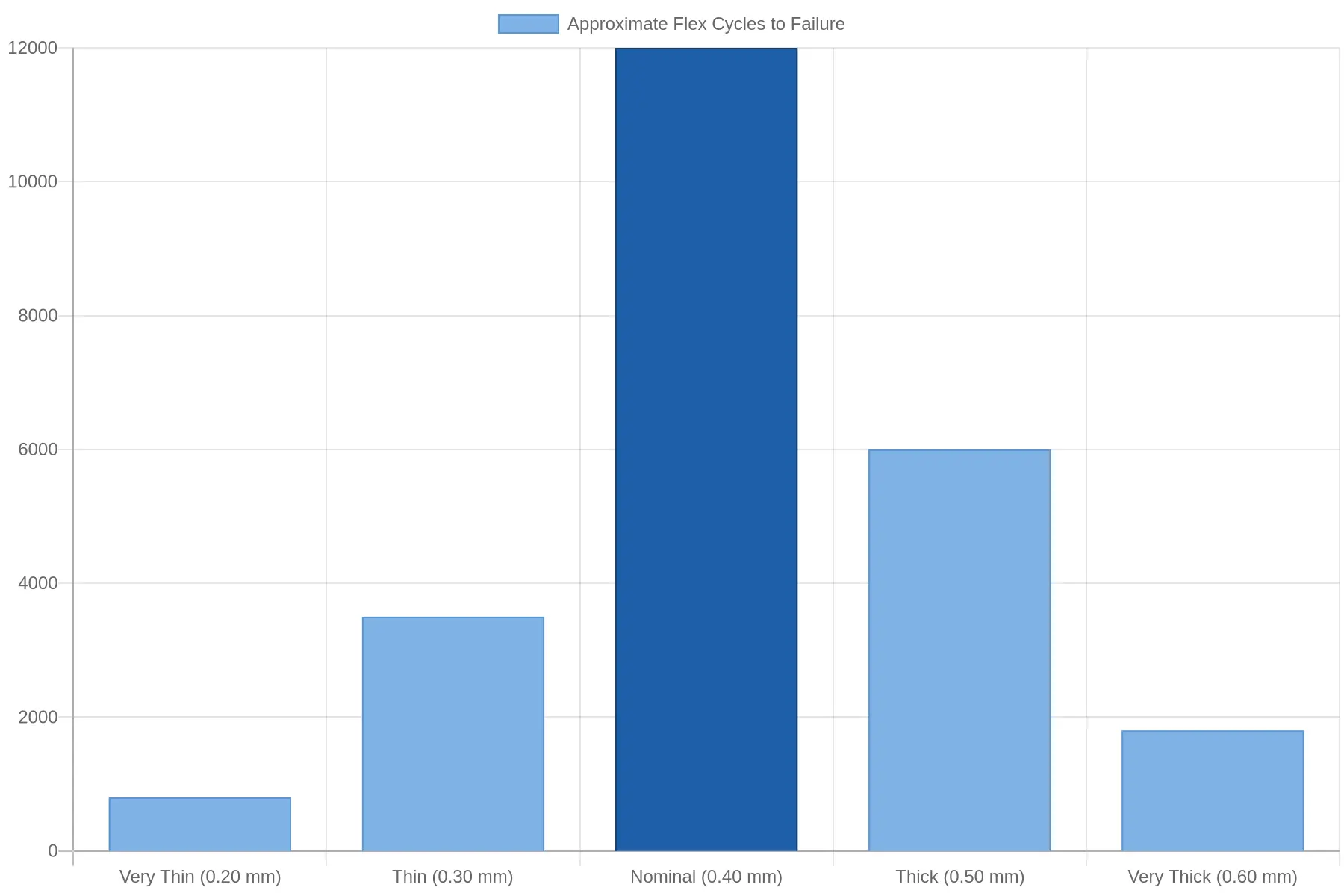
This chart plots approximate flex cycles to failure against hinge web thickness for one fixed PP impact copolymer grade, and the shape is the whole message: life peaks at the 0.40 mm nominal web and falls away on both sides. At 0.20 mm the cavity is difficult to fill, so the melt can freeze before the chains orient and the web never develops the alignment that carries the fatigue load. At 0.60 mm the web fills and orients well but sits far from the neutral axis, and the resulting surface strain exceeds what the copolymer tolerates across repeated flexing. The practical lesson is that a target window exists near nominal, and that adding material to a hinge does not automatically add life.
Reading the Data
| Hinge Web Thickness | Approximate Flex Cycles to Failure |
|---|---|
| Very Thin (0.20 mm) | 800 |
| Thin (0.30 mm) | 3,500 |
| Nominal (0.40 mm) | 12,000 |
| Thick (0.50 mm) | 6,000 |
| Very Thick (0.60 mm) | 1,800 |
The curve is parabolic rather than linear, so tooling changes that push thickness in either direction tend to cost hinge life. For a manufacturer running living-hinge clamshells, the design conversation should stay focused on holding the web at nominal and on controlling regrind and mold wear, both of which quietly move the actual wall thickness off target.
From Bar Chart to Design Decisions
The bar chart maps each PP grade to the hinge thickness it can survive at a full opening angle. Read it as a decision map, not a fixed spec sheet.
Optimum thickness is not an absolute number. It depends on the selected PP grade, the geometry around the web, and the opening angle the container has to handle. Change one and the safe thickness moves.
Impact grades absorb more impact energy and tolerate cold, but they lose orientation through the web, so a long flex life usually comes from the stiffer grades with a thinner hinge. High-MFI grades fill thin sections more easily but develop less orientation. That is why PP copolymer grade vs hinge thickness is always read together, never separately.
Design Rules
- Keep the hinge web substantially thinner than the adjacent walls.
- Use smooth thickness transitions to avoid stress risers.
- Place gates so flow orients across the hinge, in the bending direction.
- Validate with repeated open-close cycling before release.
Size the web for the flex strain your grade can tolerate, then confirm it on the line. For formats built for repeated flexing, review sugarcane clamshell containers engineered for the job.
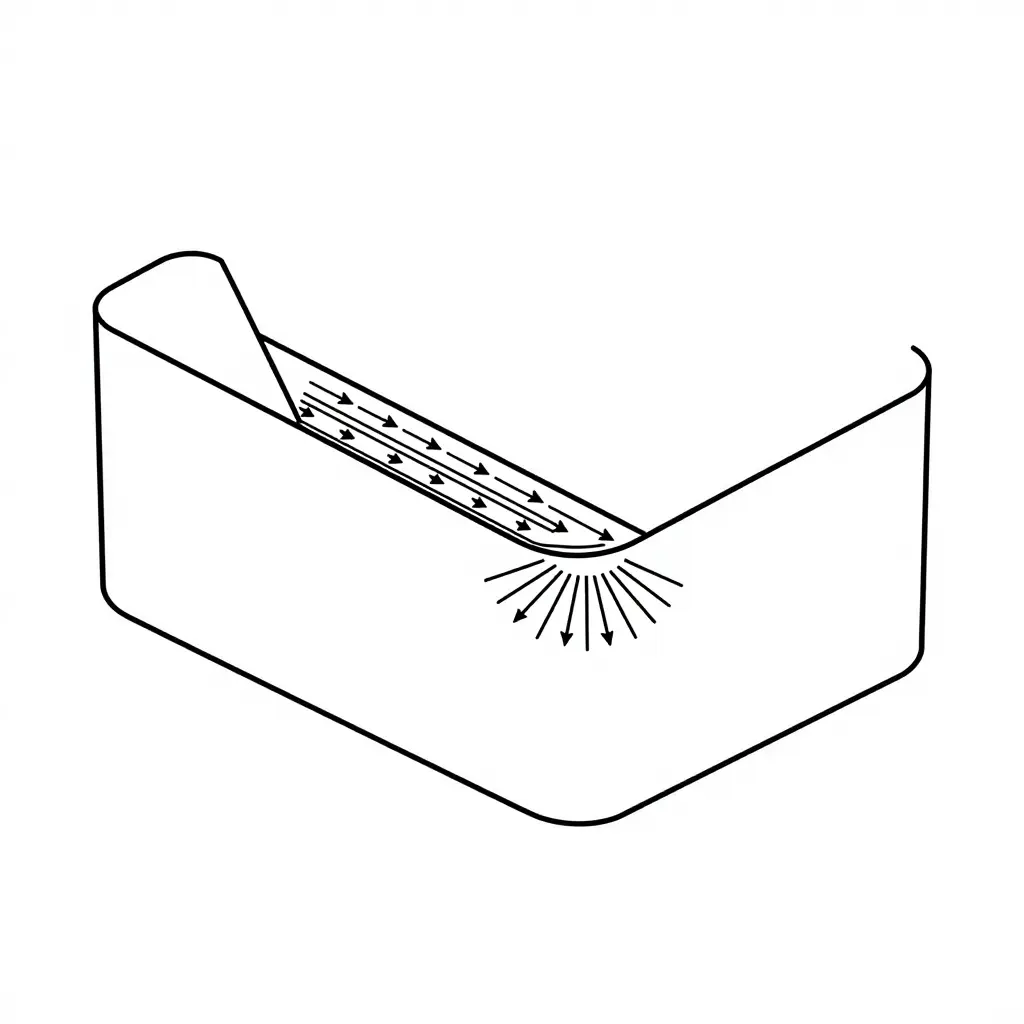
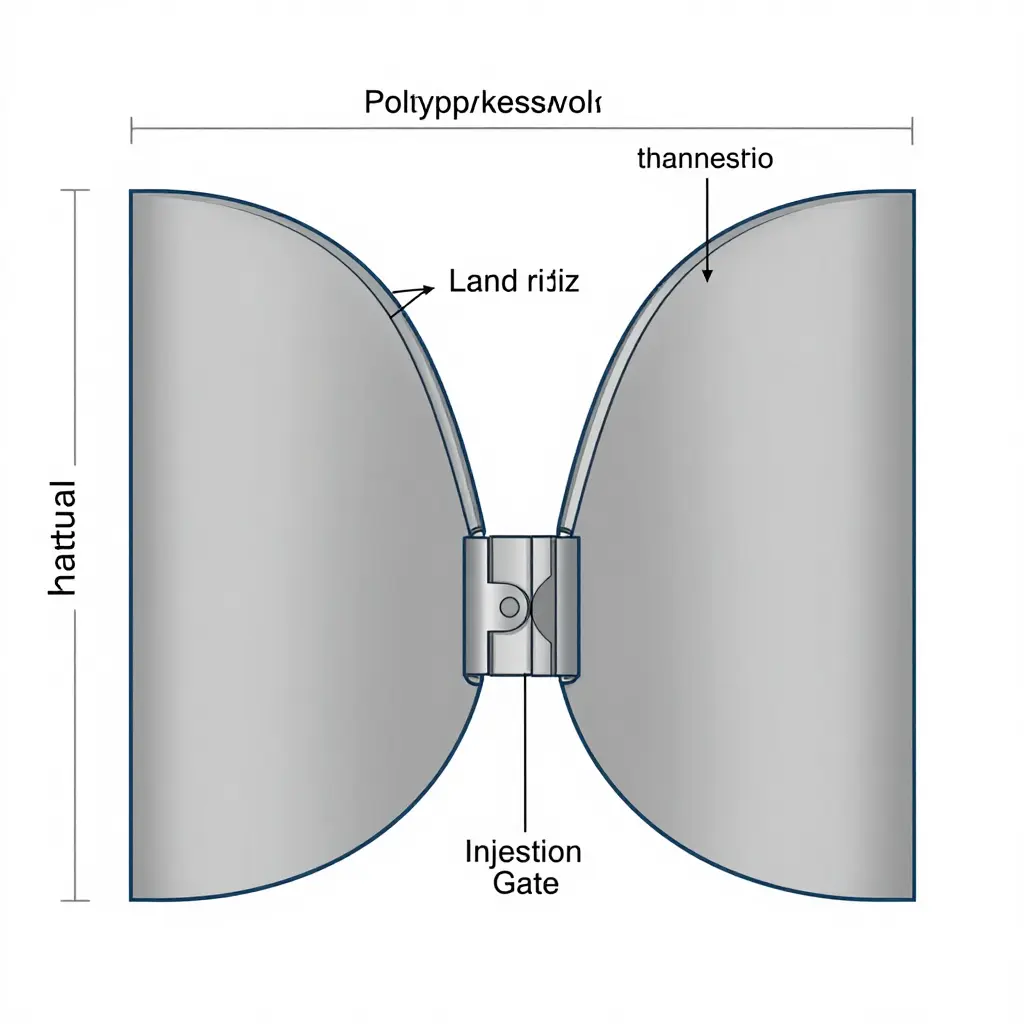
The schematic isolates the geometry that decides whether a clamshell hinge lasts thousands of cycles or cracks early in service. Two thick wall sections, the lid wall and the base wall, are bridged by a deliberately thin, tapered web that lets the polymer flex without yielding.
The first set of arrows traces flow-induced molecular orientation. As molten polymer moves through the narrowed hinge section, the chains stretch and line up with the flow path. That alignment is an asset when it runs across the web, because oriented chains resist bending fatigue far better than randomly coiled ones. If the fill is too slow or the melt front stalls, orientation becomes inconsistent and the hinge loses the toughness it was supposed to have.
The second set of arrows converges on the outer surface of the web, where flexing generates peak tensile strain. Every time the lid closes, that outer skin is pulled into tension while the inner surface is compressed. Because the web is thin, the strain is confined to a small volume of material, so any surface defect, weld line, or under-oriented resin there becomes a crack initiation site.
Three variables have to be balanced in practice: the hinge thickness (thin enough to flex, thick enough to survive fatigue), the web profile (a gentle taper distributes strain better than an abrupt step), and the resin grade. The stiffer grades, homopolymer in particular, hold orientation best through the fold, while impact copolymers trade some of that performance for low-temperature toughness. Get the geometry and grade right and the hinge outlives the container; get either wrong and the failure starts where those strain arrows point.
Living Hinge Failure Mode Quick-Reference Checklist
Living hinges in PP takeout clamshells concentrate a large stress into a very thin web, and most failures trace back to the grade and the thickness. Use this checklist to match a symptom you see on the line to its likely root cause.
-
Brittle snap on first opening. Probable cause: the PP grade is too stiff for the service temperature (low EPR content), or the web is molded over-thick so the chains cannot reorient. Corrective action: move to a grade with more EPR if the container sees low temperatures, and bring the hinge zone to a controlled 0.25-0.35 mm web so it flexes instead of shattering.
-
Progressive cracking after repeated open-close cycles. Probable cause: not enough toughness in the grade, combined with fatigue as the web cycles past its elastic recovery limit. Corrective action: specify a grade with a higher Izod impact rating and confirm the web is thin enough to bend without accumulating fatigue damage.
-
Whitening or stress marks radiating from the hinge. Probable cause: poor molecular orientation from weak melt flow or a cold melt that freezes before the chains align. Corrective action: raise melt and nozzle temperatures and tune injection speed to promote orientation; verify that the grade’s MFR suits the thin-wall hinge section.
-
Short shots or a visibly weak, under-filled web. Probable cause: mold temperature or injection speed too low, so the thin hinge fills too slowly and solidifies early. Corrective action: increase mold temperature and injection speed, and check that the web is not so thin it starves the cavity.
-
Warped lid that will not align with the base. Probable cause: uneven cooling across the two halves, or a stiffness mismatch between lid and base. Corrective action: balance cooling circuits and re-check the grade’s shrinkage so lid and base cool symmetrically.
-
Premature rupture at one spot on the hinge. Probable cause: gate position drives melt orientation the wrong way across the web, thinning or over-stressing the flow front. Corrective action: relocate the gate so flow crosses the hinge in the bending direction, and confirm the web thickness is uniform along its full length.
Matching each symptom to a grade or thickness change keeps troubleshooting fast and repeatable for QC teams and molding engineers. A well-specified material paired with a good sugarcane clamshell box design is what turns a fragile hinge into a durable one.
Protecting the Living Hinge: Injection Molding Process Parameters and QC
A living hinge only performs as designed when the injection molding process reproduces the intended molecular orientation and uniform cooling on every shot. A good grade and a correct web thickness are necessary but rarely sufficient, because process drift can ruin both.
Key Process Parameters That Safeguard the Hinge
- Melt temperature: run in the mid-to-upper range the grade datasheet specifies so the polymer flows freely and orientation forms cleanly at the thin web. Too cold and the fill hesitates; too hot and the resin degrades at the hinge line.
- Mold temperature: keep it moderate and, critically, uniform across both hinge faces. Cold, uneven molds freeze the web prematurely and lock in built-in stress.
- Injection speed: use a relatively fast, repeatable fill so the polymer chains align across the hinge axis, the orientation that gives the living hinge its flex life.
- Packing pressure: apply enough hold pressure to collapse internal voids, but not so much that it over-packs the thin web and creates residual stress.
- Cooling uniformity: balance both mold halves and cooling channels so the hinge solidifies evenly; uneven cooling warps the web and shortens fatigue life.
| Parameter | Goal | Failure mode if drifted |
|---|---|---|
| Melt temperature | Clean flow, proper orientation | Short shots or degraded resin |
| Mold temperature | Uniform and moderate | Premature freeze, frozen-in stress |
| Injection speed | Fast, repeatable fill | Poor orientation, weak hinge |
| Packing pressure | Fill voids, avoid over-pack | Internal voids or residual stress |
| Cooling uniformity | Even solidification | Warpage, reduced flex life |
Why Process Drift Punishes a Correct Part
Even a well-chosen grade and web thickness fail if the press drifts. A few degrees of mold-temperature creep, a slower fill, or a fluctuating hold pressure shifts the orientation and stress pattern inside the injection molding cycle. The hinge then cracks at the fold line during normal handling, and return rates climb.
Simple Incoming Inspection Routine
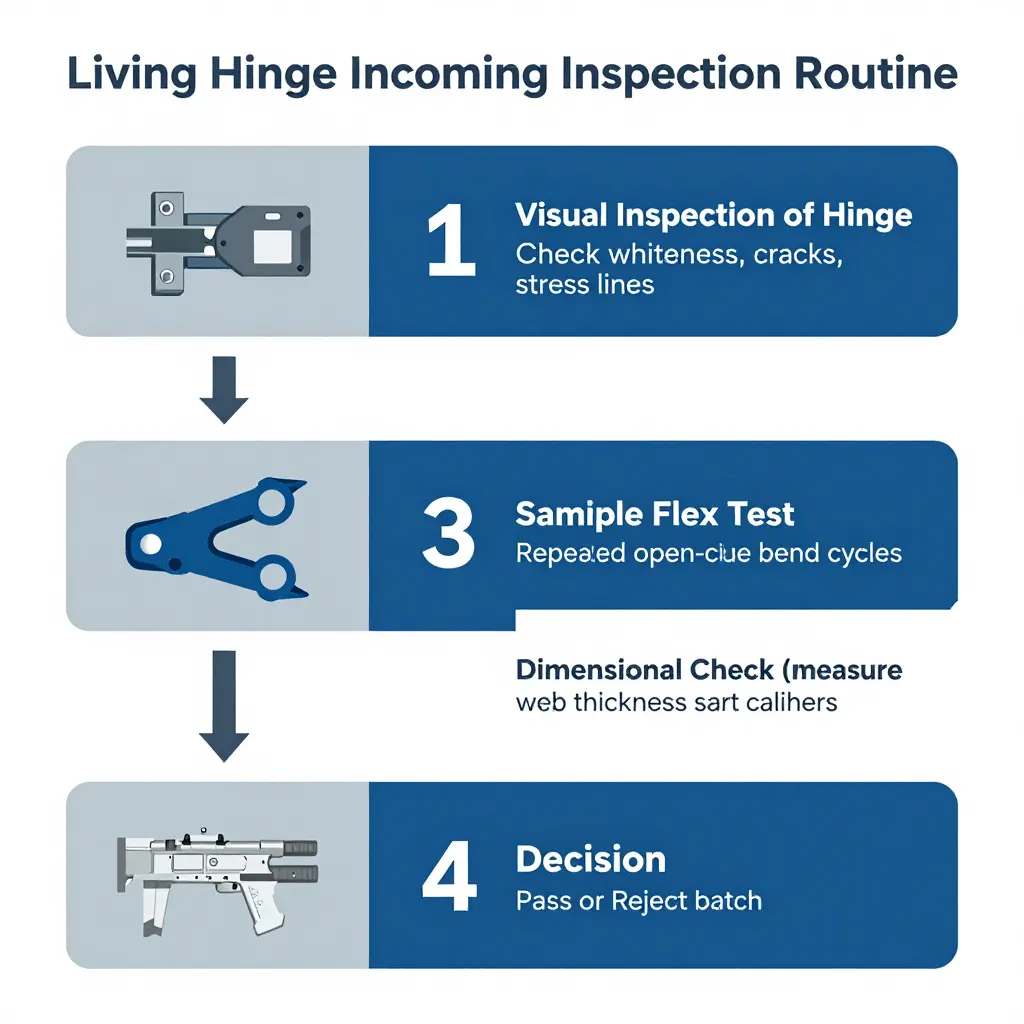
A short, repeatable routine catches drift before it reaches customers:
- Visual inspection: look for whitening, fine stress lines, or cracks along the hinge line before the container is ever used.
- Sample flex test: bend a sample hinge through repeated open-close cycles and watch for early cracking, stiffening, or noise.
- Dimensional check: measure web thickness with calipers at several points. Thin spots fail first and are a reliable drift indicator.
Buyers sourcing finished packaging should confirm that these checks apply to the parts they order. Comparing clamshell container designs that specify grade, web thickness, and flex targets helps align supplier output with real hinge performance.
Frequently Asked Questions: PP Copolymer Grade vs Hinge Thickness
Why do PP clamshells crack at the living hinge?
A living hinge fails when repeated flexing exceeds the fatigue limit of the material at the fold, and the crack usually starts as a stress-whitening line that opens into a full split. The hinge is the thinnest, most highly oriented section of the container, so it concentrates stress and becomes the first point of failure. The combination of PP copolymer grade and hinge thickness decides how many open-close cycles it survives. When plastic takeout containers cracking at the living hinge becomes a recurring pattern, the cause is usually a mismatch between the two rather than either one alone.
Does a higher copolymer grade always improve hinge life?
No. Raising the ethylene content improves impact toughness, but it also disrupts orientation through the web and reduces stiffness, which can promote lid droop. A thicker, more impact-resistant grade helps primarily at low temperature; at room temperature it can shorten flex life rather than extend it. Overspecifying the resin without adjusting geometry tends to shift the failure from cracking to sagging instead of removing it.
What hinge thickness should a takeout container hinge have?
Most polypropylene clamshell hinges are engineered between roughly 0.25 mm and 0.50 mm, or about 20-40% of the adjacent wall thickness. A thinner hinge flexes more freely and lasts longer, provided the cavity fills completely; a thicker hinge demands higher closing force, and because strain rises with thickness it stops helping past a certain point. The best hinge thickness depends on the selected PP copolymer grade and on the number of open-close cycles the container has to endure in service.
Can an impact copolymer grade cause lid droop?
Yes. Impact copolymer grades contain a rubbery ethylene-propylene phase that raises toughness but lowers flexural modulus, so a lid molded from a very high-impact grade can sag slowly under its own weight. Droop is a stiffness problem, not a cracking problem, and thin lid walls make it worse. It is usually resolved by balancing the grade against hinge thickness and adding lid ribbing rather than by changing resin alone.
Is cracking a material problem or a molding problem?
Usually both, and the two are hard to separate in practice. A tough, well-oriented grade can still crack if the hinge is molded with poor molecular orientation, low melt temperature, or excessive gate shear. Good molding cannot rescue a grade that lacks flex-fatigue resistance either. This is why plastic takeout containers cracking at the living hinge are best diagnosed with a joint review of resin specification and process parameters.
How can I reduce hinge-related returns on clamshell containers?
Start by qualifying hinge thickness against the flex-fatigue data of the specific PP copolymer grade, then validate with real-world cycle testing rather than short bench trials. Standardize the grade and thickness combination across your SKUs so returns can be traced to a known baseline. Many buyers also evaluate alternative formats to remove single-point hinge failures; for example, a sugarcane clamshell box lowers the risk where repeated flexing is unavoidable. Documenting the grade-versus-thickness trade-off for each product keeps quality teams ahead of field failures.
Buyer and Food-Service Perspective: Specify the Grade and the Hinge, Not Just the Box
Packaging buyers, food-service operators, and QC teams usually stop the purchasing checklist at overall dimensions: length, width, depth, and lid clearance. That leaves out the two variables that decide whether the hinge fails, and neither one appears on a standard dimensional drawing.
Grade choice matters, but not in the direction most buyers assume. Homopolymer and random copolymer PP hold molecular orientation through the web, which is what gives a living hinge its fatigue life; impact copolymers add low-temperature toughness but shorten hinge life at the same thickness. Thickness matters just as much: too thin and the web may not fill or may lack snap force, too thick and the outer-fiber strain climbs. Specify both, with a nominal thickness and a tolerance, so the supplier can hold a repeatable process window instead of guessing.
The practical fix is documentation plus verification. Before approving a purchase order, ask suppliers for the PP grade designation and melt flow rate and for the hinge-thickness specification with tolerance, then validate with sample flex testing: cycle the hinge an agreed number of open-close repetitions and inspect for cracks, whitening, or partial tearing. A container that passes dimensional checks but fails flex testing will still generate returns.
| Parameter | What to Request | Why It Matters |
|---|---|---|
| PP copolymer grade | Grade designation and melt flow rate | Determines hinge ductility and flex life |
| Hinge thickness | Nominal value plus tolerance | Controls stress distribution during flexing |
| Flex-test standard | Agreed cycle count and pass/fail criteria | Confirms real-world hinge durability |
Where hinge reliability or material availability is a concern, alternative formats deserve a place in the sourcing plan. A sugarcane clamshell box removes the living-hinge variable entirely with a separate-lid design, while a take-away kraft paper box suits dry or wrapped items where structural rigidity matters more than moisture resistance. For high-turnover menus, standard fast-food packaging can complement molded clamshells and reduce dependence on a single hinge-critical SKU.