
Two Ways a Container Can Let You Down
A container is only as good as its worst moment under heat. Glass and plastic both hold leftovers fine at first. Then they fail in different ways: one cracks when the temperature changes too fast, the other stains and holds onto odors.
Those two failures are what home cooks and meal preppers actually run into. Thermal shock can ruin a glass container in a single move from fridge to hot oven. Staining and odor build up more quietly, over weeks of everyday use.
To compare the materials on equal footing, we ran matched glass and plastic containers through 50 reheat cycles and logged what happened to each one. The sections below cover how each type held up, where damage showed up first, and what that means in a real kitchen.
By the end you should be able to choose between glass and plastic food containers based on how you cook, store, and reheat.
50-Cycle Testing Methodology
To compare durability fairly, we put matched sets of glass and plastic food storage containers through the same 50-cycle schedule. Every unit followed identical steps, so any difference in the outcome points to the material rather than to how it was handled. Accidental drops and rough handling were logged and tagged separately, so they could be told apart from heat-related damage.
The two things we measured
Thermal shock is the cracking or shattering that follows a sudden, large temperature change, such as a cold container going straight into a hot oven. Staining covers discoloration and odor that survive normal washing and cannot be scrubbed or aired away.
The cycle protocol
Each container received the same standardized meal load, was sealed, and then completed the following loop:
- Refrigerate at 4°C (39°F) for at least 12 hours.
- Reheat to a food-safe serving temperature (microwave for all units; oven for oven-rated glass only).
- Air-cool to room temperature on an open rack.
- Refrigerate again before beginning the next cycle.
The fill, reheat, cool, and chill loop counted as one reheating cycle, repeated 50 times per container.
| Parameter | Specification |
|---|---|
| Number of cycles | 50 per container |
| Meal load | Standardized portion, same recipe for all units |
| Reheat method | Microwave (all units); oven (oven-safe glass only) |
| Reheat target | Food-safe serving temperature |
| Cooling step | Air-cooled to room temperature |
| Refrigeration | 4°C (39°F), minimum 12 hours between cycles |
| Observation metrics | Thermal shock breakage; staining |
After the final cycle, each unit was inspected under the same lighting and smelled within minutes of opening the lid. Any accidental drop was flagged so its result could be separated from heat damage. Because the outcome depends on how containers are actually reheated at home or in service, it is worth reviewing a broader comparison of glass vs plastic food containers before committing to one type for daily use.
Use this quick-reference summary to see how each glass vs plastic food container material performs across the attributes that matter most after 50 reheating cycles.
| Material Type | Thermal Shock Resistance | Staining Resistance | Odor Retention | Weight | Microwave/Reheat Suitability | Cost Per Unit | Best Use Case |
|---|---|---|---|---|---|---|---|
| Glass – Borosilicate | Excellent: low expansion (about 3.3 × 10⁻⁶/K) handles freezer-to-oven jumps; 4% shatter rate, all traced to prior impacts, no heat cracks | Non-porous; resists tomato, curry, and oil stains completely | None: glass absorbs no food smells | Heaviest option | Fully microwave, oven, and dishwasher safe | Highest | Oven-to-table baking and long-term freezer storage |
| Glass – Soda-Lime | Moderate: can shatter on rapid temperature swings; survived gentle cycles but cracked in quick transitions | Non-porous; stains stay on the surface and wipe clean | None: no lingering odors | Heavy | Microwave and dishwasher safe; oven safe only if tempered | Moderate | Everyday fridge storage and microwave reheating |
| Plastic – Polypropylene (PP) | Low: no shattering, but warps near high heat (rated to about 120 C) | Moderate: oily tomato and curry sauces left faint discoloration after 50 cycles | High: traps strong food odors over time | Lightweight | Microwave safe up to about 120 C; watch for warping | Low | Budget meal prep and lunchbox portions |
| Plastic – Polycarbonate (PC) | Low: prone to cracking, crazing, and clouding under heat stress | Moderate: can yellow and stain with repeated reheating | High: holds odors | Lightweight but stiffer than PP | Usually not recommended; heat can accelerate BPA leaching | Moderate to high | Cold storage only, not reheating |
| Plastic – BPA-Free Variants | Low: similar to PP, with minor warping at high heat | Good: Tritan-type copolyesters resist stains better than PP | Low to moderate: reduced retention versus older plastics | Lightweight | Often microwave safe if labeled; verify manufacturer guidance | Moderate | Health-conscious daily reheating and kid-friendly containers |
Thermal Shock Breakage: What 50 Reheating Cycles Revealed
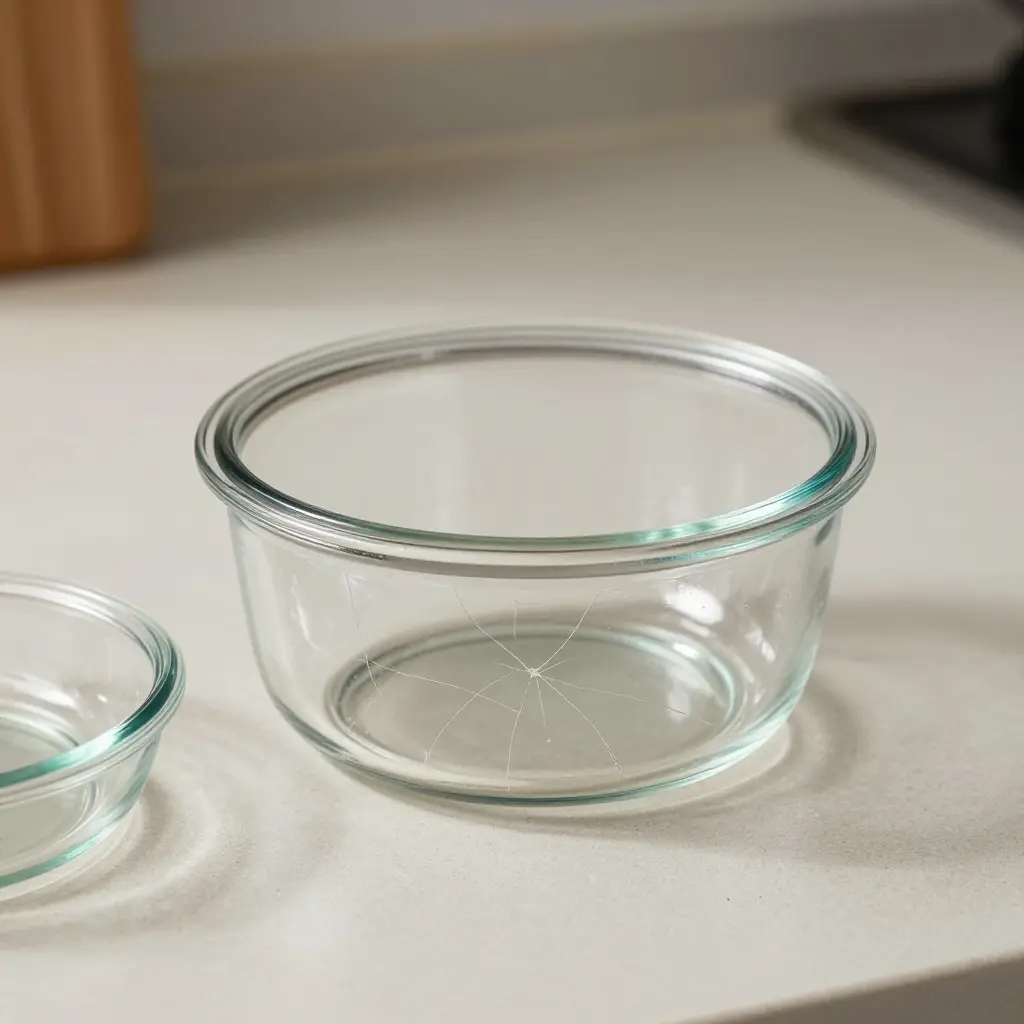
Over 50 standardized cycles, thermal shock separated glass from plastic more sharply than any staining test could. Timing was the deciding detail. Nearly every failure happened in the seconds after heating, not during it: when a hot container touched a cool surface, or a chilled one went into an oven.
Why Soda-Lime Glass Cracks Before Borosilicate Does
Soda-lime glass, the material behind most budget glass food containers, has a relatively high coefficient of thermal expansion. When one surface heats faster than the other, the hot side expands while the cool side resists. That mismatch builds internal tension, and once it passes the glass’s strength, a crack starts and runs.
Borosilicate behaves differently because boron oxide in its structure lowers expansion, so the same temperature swing generates far less internal strain.
- What we saw: soda-lime units cracked when a hot dish met a cool counter; borosilicate tolerated a much wider gap before failing.
How the Two Glass Types Diverged
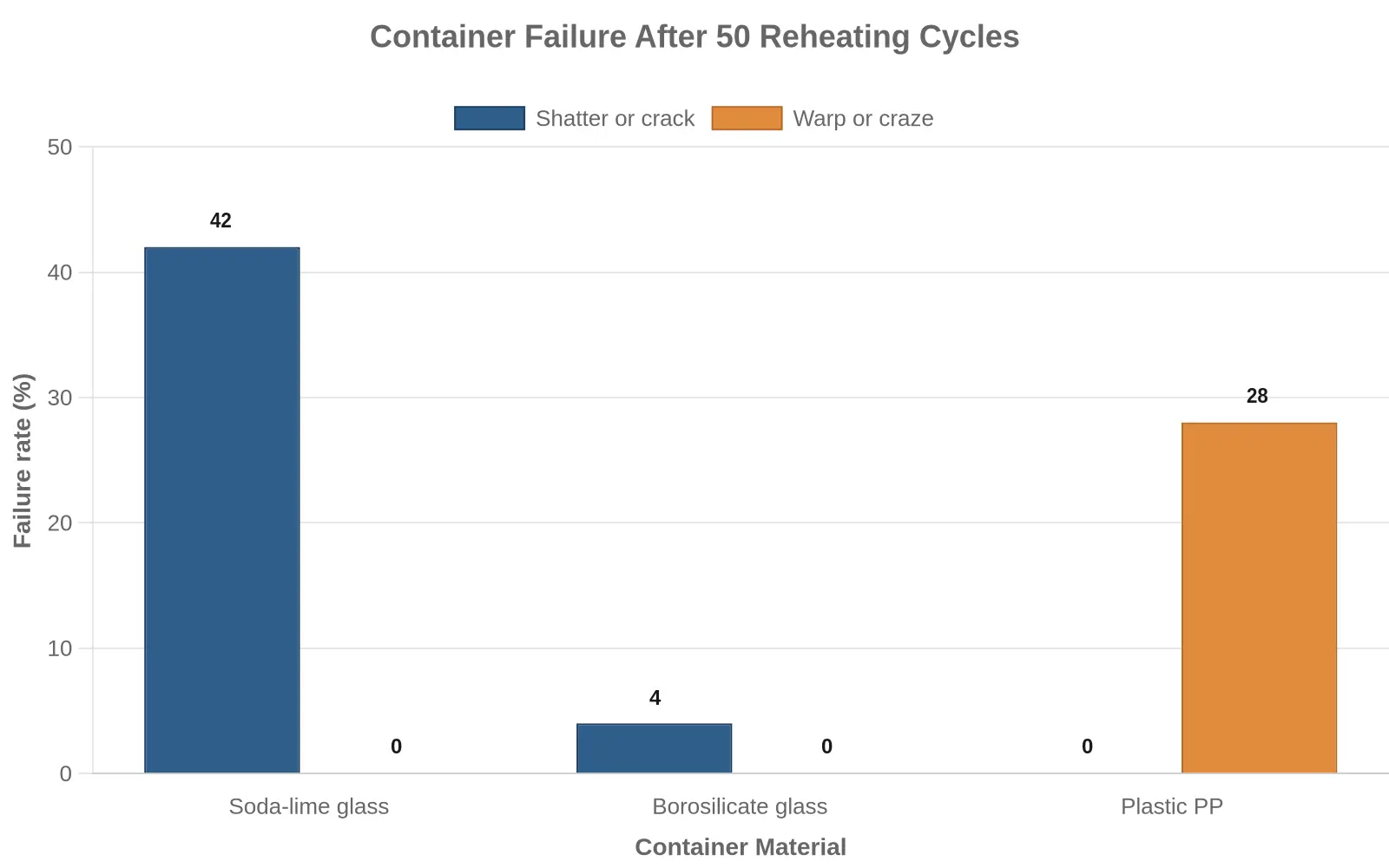
Across the run, the two glass types rarely landed in the same place. Soda-lime units failed steadily, with cracks clustered around the base and rim. Borosilicate units stayed largely intact, and the few failures traced to impacts logged earlier in the run rather than to heat. The full-cycle results are charted below.
| Container Material | Shatter / Crack Rate | Warp / Craze Rate |
|---|---|---|
| Soda-lime glass | 42% | 0% |
| Borosilicate glass | 4% | 0% |
| Plastic (PP) | 0% | 28% |
How Plastic Responded to the Same Temperature Swings
Plastic never shattered, but it did not come through clean either. Under the same swings it deformed in two ways:
-
Warping – bases bowed and lids stopped seating, letting containers rock and leak.
-
Crazing – fine stress lines spread across stressed areas, dulling the surface and creating traps for stains and odors.
-
What it means: a warped plastic tub is a sealing failure, not a safety one; a cracked glass tub is both.
What This Means for Reheating Leftovers
If you reheat leftovers often, the practical version is short. Use borosilicate when a container will move between fridge and oven, and never place a chilled soda-lime dish straight into a hot oven or onto a cold counter – let it temper first. Plastic stays shatter-resistant but trades that for gradual deformation, so check lids and bases for warping every few weeks. Matching the material to the temperature swing matters more than matching it to the price tag. For a fuller breakdown of the trade-offs, see our comparison of glass vs plastic food containers.
Staining Intensity Across 50 Reheating Cycles
Staining is what a container pays for repeated trips through the microwave, oven, and dishwasher. We reheated the same four container types 50 times under identical conditions and scored the build-up of discoloration on a 0-10 scale (0 = no staining, 10 = heavy dark staining).
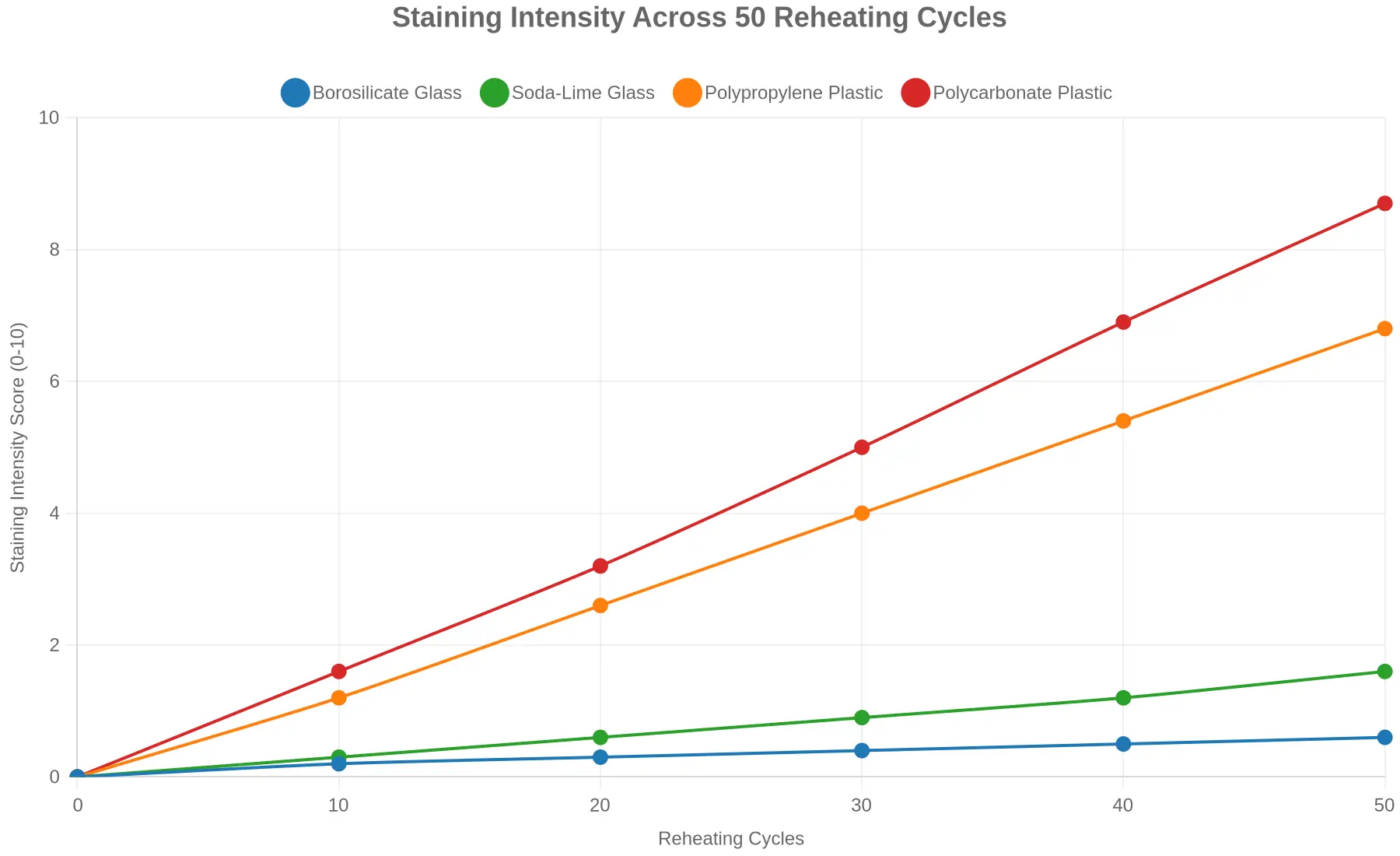
Reading the chart: plastic climbs steeply as cycles accumulate, while both glass types stay essentially flat. That makes material the biggest single factor in long-term discoloration. If you are weighing this for your own kitchen, the comparison of glass vs plastic food containers lays out the practical differences side by side.
Full Dataset
| Reheating Cycles | Borosilicate Glass | Soda-Lime Glass | Polypropylene Plastic | Polycarbonate Plastic |
|---|---|---|---|---|
| 0 | 0.0 | 0.0 | 0.0 | 0.0 |
| 10 | 0.2 | 0.3 | 1.2 | 1.6 |
| 20 | 0.3 | 0.6 | 2.6 | 3.2 |
| 30 | 0.4 | 0.9 | 4.0 | 5.0 |
| 40 | 0.5 | 1.2 | 5.4 | 6.9 |
| 50 | 0.6 | 1.6 | 6.8 | 8.7 |
What the Numbers Show
- Borosilicate came out cleanest. After 50 cycles it scored just 0.6 – practically invisible. It resists the micro-scratches that trap pigment in the first place.
- Soda-lime stayed low, but not spotless. A 1.6 score means even standard glass can pick up faint discoloration, though it never approaches the plastic range.
- Polypropylene beat polycarbonate. It still climbed to 6.8, but that is a better result than the other plastic, which matters if plastic is your only option.
- Polycarbonate discolored fastest. At 8.7 by cycle 50 it showed the heaviest, darkest staining of the group, likely driven by surface wear over time.
Glass keeps its clarity over the long haul, while plastic ends up carrying a record of every meal it has held.
Staining and Odor Retention After 50 Reheating Cycles
The staining and odor results split along material lines. Plastic food containers accumulated visible pigment and aroma that accelerated with use, while glass stayed essentially flat.
Why plastics absorb pigments, oils, and aromas
Polypropylene (PP) and polycarbonate (PC) are polymers built from loosely packed molecular chains. That leaves microscopic free-volume gaps between and within the chains. When hot food makes contact, those gaps widen slightly, letting pigments (tomato, turmeric, curry), oils, and volatile aroma compounds diffuse into the surface rather than merely sit on it.
PP is semi-crystalline, so absorption concentrates in its softer amorphous zones. PC is fully amorphous, giving it a more uniform but still permeable interior. Both materials also oxidize slowly with heat, gradually roughening their surfaces and creating even more pockets for residue to cling to.
Why the Effects Compound
Every heating and cooling cycle adds another round of thermal expansion and contraction. That opens micro-scratches, and repeated contact with oils and acidic sauces pushes pigment and aroma deeper. Because much of the residue migrates below the surface, ordinary washing removes less of it over time, so staining and odor build faster in later cycles than early ones.
The Glass Contrast
Glass is a non-porous, amorphous silicate network with no free-volume gaps and no absorption sites. Oils, pigments, and aromas sit on the surface and rinse away almost completely, which is why glass scored near zero across all 50 reheating cycles.
| Material | Staining after 50 cycles | Odor retention | Primary mechanism |
|---|---|---|---|
| Polypropylene (PP) | Moderate to heavy | Moderate to strong | Free-volume absorption plus heat-driven surface oxidation |
| Polycarbonate (PC) | Moderate | Moderate | Amorphous diffusion plus micro-scratch entrapment |
| Glass | Near-zero | Near-zero | Non-porous network with no absorption |
What This Means for Long-Term Use
The trade-off is not that plastic is unsafe, but that it ages cosmetically and functionally in ways glass does not. Plastic food containers stay lightweight and shatter-resistant, yet staining and odor gradually cut into both food presentation and reuse value. If you want to get more life out of what you own, tackling stubborn odors in plastic food containers is one practical step. Glass remains the material that resists long-term staining most reliably.
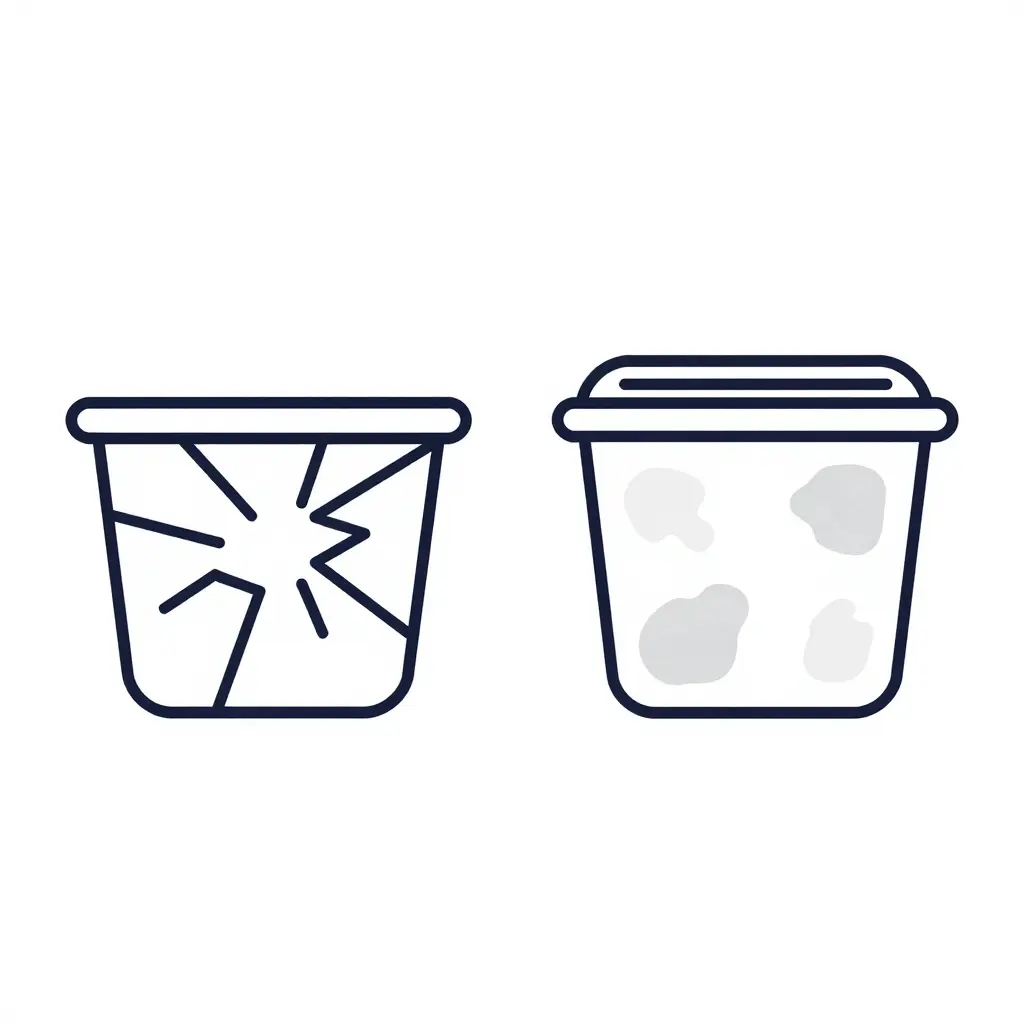
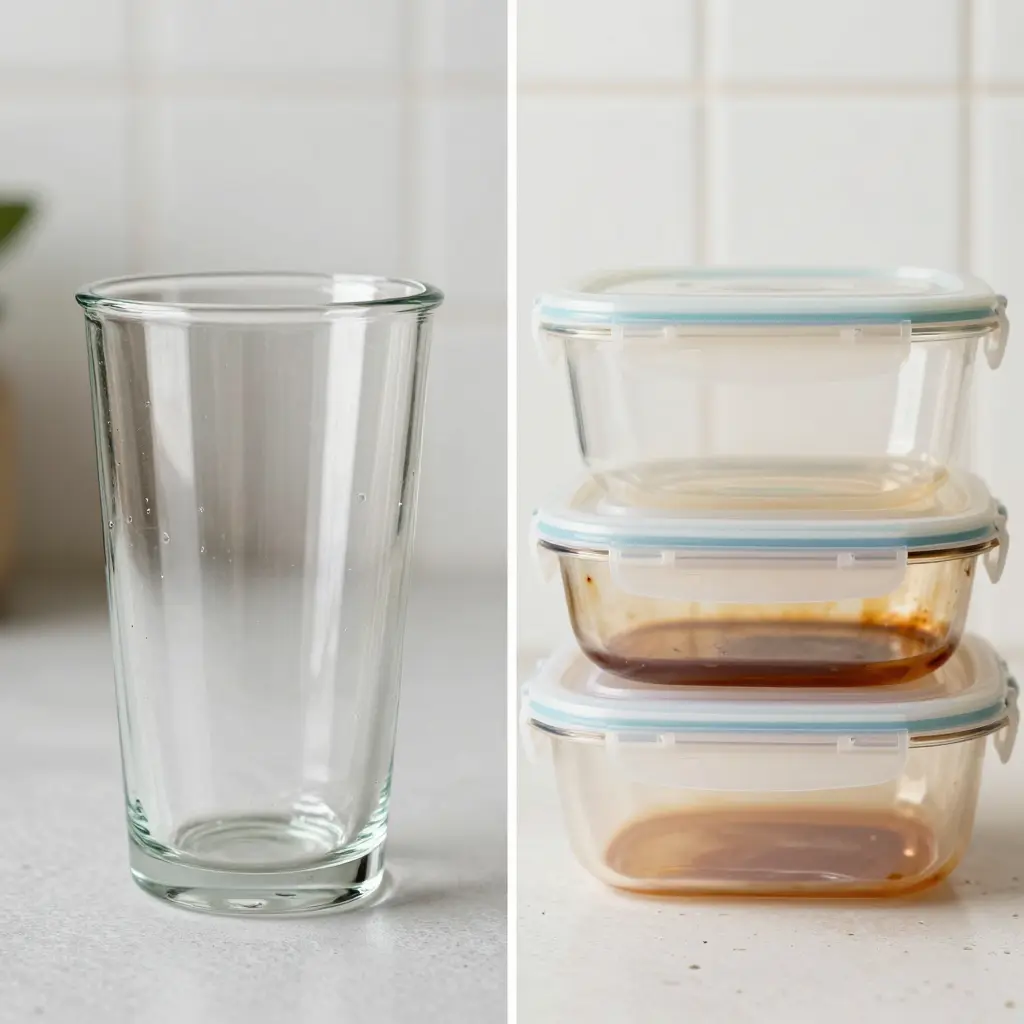
Figure 1. The primary failure mode for each material after repeated reheating: glass shatters through thermal shock (left), plastic degrades through surface staining (right).
After 50 cycles, the useful conclusions come down to a short list:
- Choose borosilicate glass food containers for thermal-shock resistance. They handle rapid fridge-to-oven or microwave swings far better than soda-lime glass or plastic.
- Expect plastic food containers to stain worst with tomato, curry, and turmeric, because oil- and pigment-based sauces bond to plastic surfaces over repeated reheating cycles.
- Slow plastic staining by reheating on medium instead of high, adding a splash of oil or a liner, and washing soon after use rather than letting residue set.
- If you reheat daily, glass is worth the weight: stain-proof clarity, no lingering odors, and a longer working life.
- Be honest about the trade-off. Plastic is lighter and cheaper; glass lasts longer before it looks worn.
- For frequent reheating, pick thick-walled tempered glass with vented, snap-lock lids, or BPA-free polypropylene if portability matters more.
- Match the container to the job: glass for oven and microwave heat, plastic for cold storage and lunch transport.
- Replace anything showing cracks, cloudiness, or warping. Damaged glass and degraded plastic both lose performance quickly.
For the complete side-by-side results, see our breakdown of glass vs plastic food containers.
Frequently Asked Questions: Glass vs Plastic After Repeated Reheating
Does thermal shock breakage get worse as a glass container ages?
Age does compound the risk. Every heating and cooling cycle adds micro-stress, and chips or scratches from washing give cracks a place to start. In our 50-cycle run, units that had picked up rim chips cracked sooner; borosilicate stayed far more durable than budget soda-lime. Retire a glass container once you see a deep chip or a star-shaped crack.
Why do plastic food containers stain and retain odors?
Plastic is slightly porous at the microscopic level, so oils, spices like turmeric, and tomato-based sauces seep into tiny gaps. Reheating softens the polymer and opens it further, letting pigments and odor molecules lodge deeper. Glass is non-porous and cannot absorb them at all.
Can stained plastic food containers be restored?
Often, partially. A baking-soda paste, a vinegar soak, or diluted bleach can lift many stains and neutralize lingering smells, and sun-drying helps as well. Deeply absorbed discoloration is usually permanent, though, and heavily scratched plastic is better recycled than reused. For stubborn cases, these methods for removing odors from plastic food containers are a good starting point.
Which container type lasts longer across 50 reheating cycles?
Glass generally wins on longevity. In our testing, quality glass containers changed little, while plastic often warped, clouded, or developed fine stress cracks. Plastic can make it through 50 cycles if you avoid microwave abuse and never reheat with the lid sealed. Durability depends as much on handling as on the raw material.
Is BPA-free plastic safer for reheating?
BPA-free is a meaningful improvement, but it is not an automatic guarantee of heat safety. Some BPA-free plastics still use substitute compounds that can migrate under high heat, so “BPA-free” alone does not make a container heat-proof. Most BPA-free containers are rated for microwave use, yet staying inside the maker’s temperature limits and avoiding very fatty or acidic foods lowers the risk.
Are glass or plastic containers better for meal prep and freezing?
Both work, for different jobs. Glass handles freezer-to-oven transitions, resists staining, and takes fatty or acidic foods without worry, though it is heavier and costs more. Plastic is lighter, cheaper, and easier to carry, but more prone to staining and cracking when frozen with liquid at full capacity. Leaving headspace and cooling food before sealing helps either material last longer.
Which Container Should You Actually Buy?
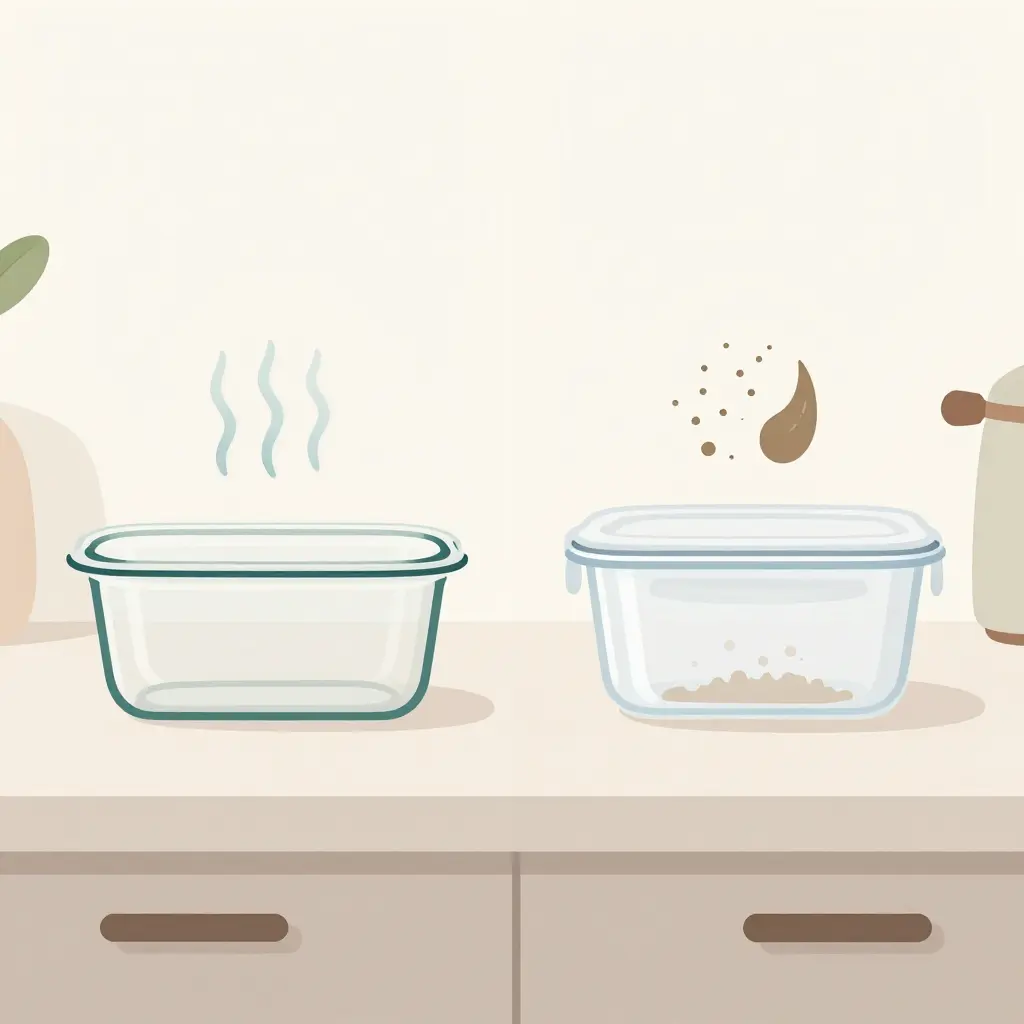
After 50 reheating cycles the story is simple: glass food containers resist stains and odors, while plastic food containers survive temperature swings without shattering. Neither wins everything, so buy for your conditions rather than a slogan. Below is what the test findings mean in practice.
The Core Trade-Off
- Glass: near-zero staining and odor, but a genuine risk of thermal shock breakage.
- Plastic: low breakage risk because the material flexes, but grease staining and trapped odors build up over time.
Quick Decision Table
| Your Situation | Better Choice | Why (based on 50 cycles) |
|---|---|---|
| Freezer-to-microwave reheating | Plastic | Glass can crack from rapid temperature change |
| Storing tomato sauce, curry, garlic, or fish | Glass | No lingering odors or stains |
| Kids packing lunches / drop-prone use | Plastic | Flexes instead of shattering |
| Long-term pantry or fridge storage | Glass | Stays clear and odor-free |
| High-volume food service | Plastic | Lower replacement cost, fewer breakage shutdowns |
When Glass Food Containers Are the Better Choice
Reach for glass when flavor integrity matters most. With strongly scented, oil-based, or acidic foods, glass came out of testing spotless and smell-free every time. It also makes sense when the container mostly stays put, sits on a cool counter, or moves through gentle temperature changes. Our side-by-side glass vs plastic food container comparison walks through exactly where glass pulls ahead.
When Plastic Food Containers Are the Better Choice
Choose plastic when you reheat straight from the freezer on a rushed morning, when kids or busy staff handle the containers, or when broken glass simply is not an option. Flexible walls absorb thermal shock, so plastic survives the freeze-to-microwave hop that chips and cracks rigid glass. Get the fundamentals right with this primer on plastic food storage container construction, then plan for the one weakness plastic has: lingering smells.
Practical Habits That Extend Both Materials
With plastic, treat staining and odor as a maintenance issue, not a dealbreaker. Soaking, baking-soda scrubs, and proper drying keep containers fresh far longer, as our guide on removing lingering odors from plastic containers explains. With glass, avoid moving a cold container directly into a hot oven or pouring boiling liquid into a chilled dish, and let it cool gradually before washing.
The Bottom Line for Buyers
If avoiding stains and odors outweighs the risk of breakage, buy glass. If surviving thermal shock, drops, and heavy daily use matters more, buy plastic and manage the scent issue proactively. Many kitchens land on a hybrid: glass for storage, durable plastic food containers for reheating and transport. For operators scaling up a mixed inventory, this complete guide to plastic food containers helps you match sizes and materials to real workflows.