
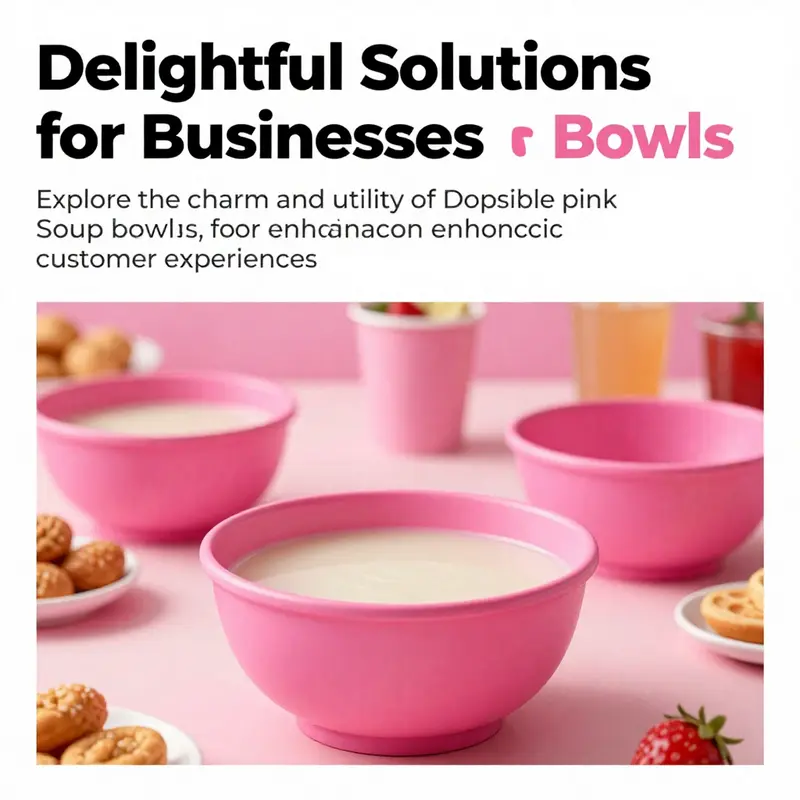
Disposable pink soup bowls have become a standout choice for businesses ranging from bubble tea shops to catering services. With the increasing demand for visually appealing and functional packaging solutions, these bowls cater to diverse culinary needs while adding a touch of elegance to any dining experience. In the following chapters, we will delve into a detailed analysis of a leading pink soup bowl, explore additional market options, and uncover the rising trend for customized solutions that resonate with businesses aiming for differentiation. Whether you are an event planner, restaurant owner, or a corporate procurement professional, understanding these offerings can significantly enhance your service and customer satisfaction.
null
null
粉色浪潮中的一次性汤碗:从日常需求到仪式场景的多样选择与设计哲学
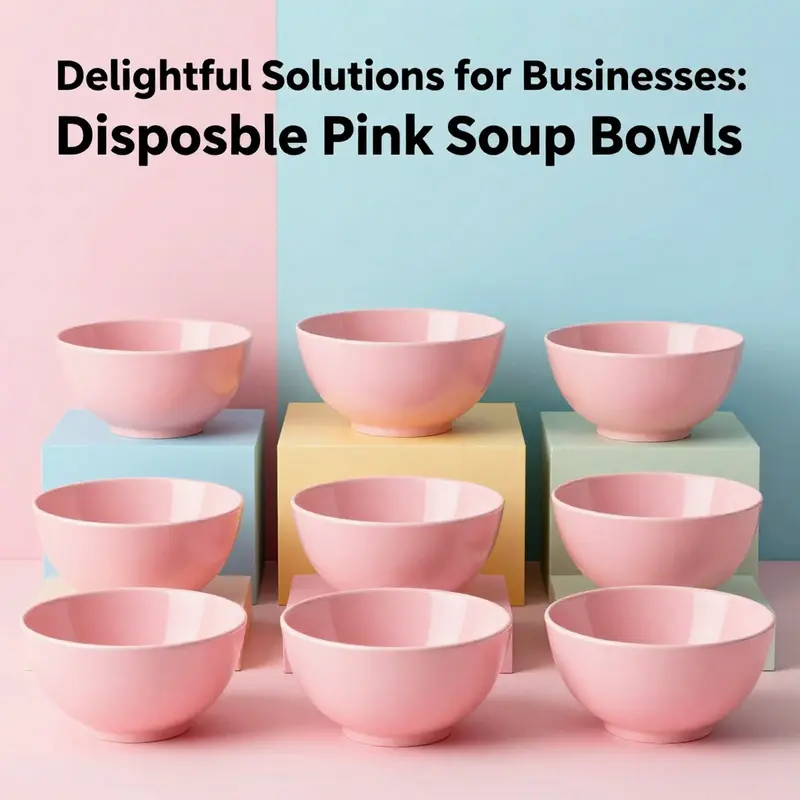
在市场的喧嚣里,一次性粉色汤碗并非只是一种便利的餐具选择。它们像一抹软糯的色彩,悄然影响着场合的气质、人群的情绪,以及品牌与消费者之间的互动。粉色在消费设计语言中常被解读为温暖、关怀与轻盈的情感符号。这种色彩在不同场景中的应用,往往超越了单纯的美观,成为对场地氛围、参与者体验甚至环保态度的一种隐性承诺。正因为如此,市场上出现了大量风格各异的粉色汤碗——从极简干净的单色粉,到带有花卉图案的装饰性设计,再到模仿传统餐具质感的高仿陶瓷涂层版本。它们共同勾勒出一个丰富的市场画面,既服务于日常家庭聚餐,也支撑着需要可控美学的特殊场合,如学生活动、亲子活动、婚礼前的聚会筹备,甚至是企业活动中的主题日。对消费者而言,这些选择并非只取决于价格或外观,更多地与场景需求、时间成本、环境考虑以及品牌故事的叙述方式相关联。对于商家和设计者来说,粉色汤碗的多样性也提供了一种叙事的可能性:以颜色为前提,延展材料、结构与包装,以实现更高层次的体验传达。市场的多元化正是在满足即时需求的同时,给用户一个关于“如何让一次性餐具也能被记住”的答案。正是在这样的共振中,粉色汤碗成为了一个有温度的设计元素,而不是仅仅是量产的日用品。
Market Scale and Trends: How Custom Disposable Pink Soup Bowls Elevate Brand Experience and Event Narratives
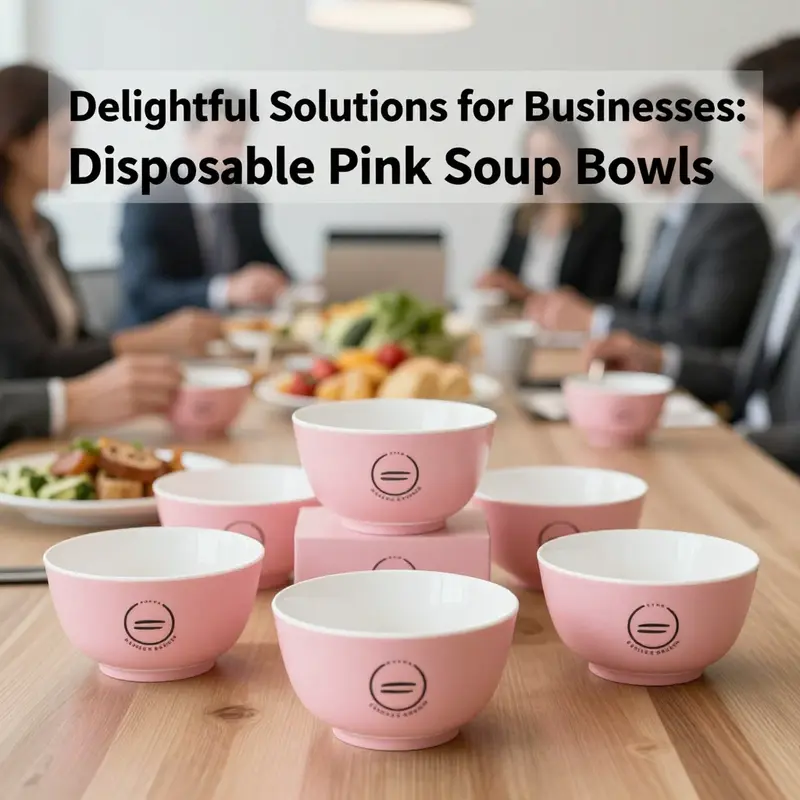
The rising demand for customized disposable pink soup bowls marks more than a simple shift in tableware choices. It signals a broader recalibration of how brands, venues, and hosts approach food service as a canvas for storytelling, engagement, and memory-making. In markets attentive to fast turnover and social sharing, the appearance of a bowl can matter as much as its contents. The pink hue—soft, inviting, and reminiscent of macaron palettes—has emerged as a deliberate design choice that blends warmth with modern minimalism. It is not merely about color; it is about how color interacts with food, lighting, and the moment in which a guest encounters a meal. When teams plan a party, a corporate reception, or a brand activation, the decision to use pink, particularly in a customized format, becomes an instrument for signaling tone, values, and a promise of care. The market reaction to this combination of aesthetics and practicality has been swift. Orders for customized, logo-worthy, color-coordinated bowls have grown not only in volume but in complexity. A client may want a specific shade tint, an indexable color that aligns with a campaign, or a seasonal motif that travels from invite to dessert to takeaway sleeve. The bowls become a cohesive extension of the event concept, a material manifestation of a brand narrative rather than a disposable afterthought. In this sense, the adoption of pink custom bowls mirrors a broader trend toward experiential packaging: packaging that is meant to be seen, photographed, and remembered, not simply discarded. The rise of these bowls on the commercial stage is driven by a confluence of consumer expectations and operational possibilities. On the consumer side, there is a consistent hunger for products that feel tailored without demanding bespoke procurement. People want convenience, but they also want personalization that feels thoughtful. A pink bowl with a gentle floral motif, sized to hold a standard soup portion, offers a familiar comfort while signaling a special occasion. The image is instantly communicative: warmth, care, and attention to detail. On the supplier side, advances in printing technology, material science, and scalable manufacturing enable customization to be delivered at a scale that used to be reserved for more generic, one-color options. The industry has learned that custom does not necessarily mean custom-costly. Flexible printing methods, modular color palettes, and short-run production capabilities have lowered barriers to entry for small businesses while expanding the option sets for large events. The convergence of these dynamics helps explain why pink custom bowls have shifted from novelty accessories into strategic packaging elements for many organizers and brands.
Two forces—the aesthetics of color and the pragmatics of use—shape the decision framework around these bowls. First, the color narrative must harmonize with the broader design language of the event or brand. Pink exists in many tones, from chalky pastels to vibrant magentas. The choice of shade can convey different emotions and align with different audiences. For family-friendly gatherings, a softer pink with a floral accent may feel welcoming and inclusive. For youth-oriented campaigns or fashion-forward activations, a brighter pink with bold, graphic motifs could amplify energy and modernity. The design work does not stop at color. Patterns, motifs, and even micro-graphics can be integrated through flexographic or digital-printed processes to create a cohesive visual system that carries the brand into the serving moment. This is not mere decoration; it is mapping a consumer journey. A bowl that carries a brand’s motif can subtly cue a participant to a product line, an interactive station, or a social media prompt, turning the act of eating into a brief, low-friction brand touchpoint.
Second, the functionality of the bowls remains central. A pink bowl should be more than aesthetically pleasing; it must perform reliably in real-world settings. In most consumer-facing environments, bowls face a spectrum of temperatures and handling scenarios. The material must be resistant to soaking and leakage, capable of safely containing hot soups or cold dishes, and compatible with quick-service rhythms—think microwaving for pre-heating or finishing touches, quick stacking for efficient service, and secure lids where appropriate for take-away moments. The practical expectations intersect with the aesthetic one: a beautifully colored bowl that leaks or becomes distorted after a minute of heat loses its narrative power. The market responds by offering bowls that balance these demands. The best options celebrate color and print without compromising structural integrity, with surfaces engineered to resist cut-through or tearing during busy service. The aim is to provide a seamless experience where guests notice the visual storytelling but still rely on the reliability of the packaging to keep their meals intact.
For buyers, the path to scaling customization begins with understanding the relationship between design intent and production realities. Small events may justify a low minimum order, allowing a brand to test color responses, print fidelity, and consumer reception. As orders grow, suppliers can offer more sophisticated options: broader color catalogs, more complex printing processes, and even the capacity to print logos or campaign artwork directly onto the bowls in large quantities. This progression mirrors the broader trend of mass customization, where personalized products are produced in scalable ways rather than through bespoke, one-off manufacturing. The economics of customization often hinge on the balance between design complexity and unit cost. A simple floral pink motif with a modest logo can be produced at a favorable unit price when ordered in batches, while a multi-color, highly detailed pattern or a large, multi-variation run may necessitate higher setup costs or longer lead times. The decisive factor for most brands is time-to-market. In the sponsorship cycle or in the cadence of a pop-up, weeks can feel like a lifetime. The capacity to compress lead times through modular design libraries and standardized color systems—paired with a reliable supply chain—becomes a critical competitive advantage. This is why many buyers lean toward suppliers that offer flexible, scalable options and clear, transparent pricing tied to quantities and finish choices.
The design discipline that underpins successful pink bowls often involves more than color alone. The rhythm of a campaign can be reinforced through typographic choices, brandable slogans, or seasonal icons embedded in the print. A simple, elegant border in a pale pink can frame a message or a health and safety icon without overwhelming the eating experience. In high-energy environments such as product launches or festival settings, graphic bursts or decorative patterns can act as visual cues, guiding guests through a sequence of stations—from welcome areas to tasting zones to takeaway corners. This is where the synergy between packaging and events truly shines. A pink bowl thus becomes a compact stage for brand theater: a small stage set against a larger environment that audiences encounter in passing. The modest act of lifting a bowl becomes part of a larger, shareable moment, and that is precisely where the value lies in a well-executed customization program.
Sustainability, increasingly central to consumer choice, remains a critical consideration in the decision to adopt custom pink bowls at scale. The discourse around disposable tableware has evolved from whether it can be used to how it should be disposed of. Today, many buyers seek materials and finishing processes that balance performance with environmental responsibility. Recyclability, compostability, and the use of plant-based fibers or responsibly sourced pulp are differentiators in a crowded market. Yet sustainability is not monolithic; it must align with the entire lifecycle of the product. A bowl that resists leaks and maintains color integrity after microwaving has a longer usable life in service and a clearer end-of-life story, especially when the material is designed for appropriate disposal streams. Suppliers respond by providing options that specify the material family, recycling or composting pathways, and any certifications relevant to food contact. The outcome is a nuanced decision matrix: a trade-off between color fidelity, heat tolerance, and environmental impact, where a brand can chart a path that honors both guest experience and planetary stewardship.
Beyond the product itself, the channel strategy for custom pink bowls shapes how brands communicate their values and capabilities. The rise of digital catalogs, design libraries, and online proofs accelerates the iteration loop between concept and production. A client can preview the look of a pink floral motif, adjust color saturation to complement a menu, and test print quality before committing to an order. This reduces risk and invites stakeholders to participate in the design process, enabling faster approvals and more cohesive campaigns. When a brand coordinates the bowls with other touchpoints—napkins, cups, lids, and signage—the result is a unified, immersive experience. The bowls are not an isolated prop; they are a piece of a broader choreography that guides guests from the moment they arrive to the moment they depart, with the serving container acting as a consistent thread through each phase of the event.
Within this context, what constitutes a successful customization program goes beyond aesthetics or sheer volume. It hinges on the alignment of design intent with supply realities, on the ability to deliver on time without compromising safety or quality, and on the fortitude to adapt as consumer expectations evolve. A brand that invests in a well-conceived pink bowl strategy signals a willingness to nurture moments of delight, even in the ordinary task of eating soup. It communicates that attention to detail matters, that the experience is intentional, and that the brand is thoughtful about how guests perceive value in every interaction. This is the essence of market-scale thinking in the realm of disposable pink bowls: a harmonious blend of beauty, practicality, and responsible innovation that scales from a single event to multi-site campaigns and beyond.
The case for embracing customization at scale becomes particularly compelling when considering the broader ecosystems in which these bowls operate. In hospitality and events, the bowl is part of a larger system of serviceware that includes trays, lids, napkins, and utensils. Coordinating color and branding across this system enhances recognition and reduces cognitive load for guests. In brand activations, the bowl becomes a portable ambassador, traveling from welcome desks to tasting stations, from photo moments to post-event take-home experiences. In each instance, pink is not merely a color choice; it is a narrative device that helps anchor audience perception and recall. The logistical realities of mass customization—levels of print fidelity, color matching, lead times, minimum quantities—are not obstacles but gateways to strategic conversations about marketing, customer engagement, and value delivery. When teams sit at the table with a supplier, the discussion often shifts from “Can you do this?” to “How can we do this most effectively at scale, with the right balance of cost, speed, and quality?” The conversation becomes a strategic planning exercise, shaping both the event calendar and the brand’s longer-term relationship with its audiences.
For organizations exploring or expanding their use of custom pink bowls, there is a practical path that helps translate concept into execution. Start with a clear design brief that defines the shade of pink, the motif language, and any typography constraints. Include examples of the intended mood—soft and welcoming for family-oriented events, bold and energetic for product launches. Establish the required performance benchmarks: heat tolerance, leak resistance, and the ability to hold a typical serving without deformation. Discuss the desired end-of-life pathway and any sustainability certifications that matter for the brand. Then align on production parameters: minimum order quantities, lead times, print method (whether flexo, digital, or hybrid), and the possibility of adding logos or campaign slogans. The advantage of this structured approach is that it supports rapid decision-making while ensuring that every touchpoint—down to the color on the rim and the texture of the surface—contributes to the intended experience.
Meanwhile, the market context continues to evolve as new players enter with fresh capabilities. Some suppliers emphasize quick-turnaround stock options in a curated palette that includes pink tones, while others offer white-label customization with option sets that help brands test different motifs in parallel. In the latter case, brands can run A/B experiments across regional markets, measuring guest reactions to different motifs and hues. The insights gained from such experiments inform future campaigns, enabling progressive refinements to both the product and the broader brand narrative. The flexibility of modern production means that a brand can skirt the old dichotomy between mass production and bespoke offerings. It can achieve a mid-ground: a repeatable, scalable process that produces consistently colored bowls with brandable accents, while preserving the ability to adjust designs for seasonal or regional campaigns without excessive retooling. In practice, this translates to shorter cycles from concept to service, stronger alignment with event calendars, and more reliable branding across multiple venues.
With all these dynamics, one question often rises to the top: how should a brand choose a partner for custom pink bowls? The answer lies in a balanced assessment that weighs capability, reliability, and collaborative potential as equally important. Capability encompasses material science, print fidelity, and performance under service conditions. Reliability covers supplier transparency, lead times, and consistency across large orders. Collaborative potential concerns the willingness to iterate, the openness to co-create proofs, and the ability to integrate with a broader design system. A robust supplier network can provide design libraries, standardized color references, and scalable production pathways that support a brand’s evolving needs. In addition, a good partner will offer guidance on regulatory compliance for food contact, share clear documentation about printing processes, and present options for end-of-life solutions that align with corporate sustainability commitments. The best relationships are built on trust and ongoing dialogue, where both sides anticipate challenges and co-create solutions that elevate the guest experience rather than simply fulfill a request.
A concrete sign of a healthy customization ecosystem is the existence of standardized, scalable options that still allow for expressive design. A company that can deliver a consistent pink bowl with a reliable print across thousands of units and multiple campaigns demonstrates a maturity in its production and logistics. At the same time, it should be possible to introduce new motifs, adjust color tones, and integrate logos without triggering prohibitive costs or long delays. This balance—between standardization and flexible design—enables brands to experiment, learn, and scale with confidence. It also supports the storytelling function of the bowl in ways that are measurable; when a guest recognizes a familiar color system or motif across different events, the bowl becomes part of a ritual of recognition, reinforcing brand affinity and recall. In a crowded marketplace, that level of coherence can be the differentiator that converts casual observers into repeat participants and advocates.
For readers who seek practical avenues to pursue these opportunities, it is helpful to consider the broader digital and sourcing ecosystems. Suppliers increasingly publish design libraries and proofing workflows that allow stakeholders to visualize and approve prints quickly. Some platforms offer digital color matching, ensuring a close reproduction of the brand’s pink palette on food-contact surfaces. The ability to preview the bowl’s surface and print at a recommended scale helps prevent misinterpretations of color and texture. And with the rise of omnichannel campaigns, these bowls often appear across physical events and digital touchpoints, from order confirmation emails to social media galleries featuring guest-generated imagery. Each appearance reinforces the campaign’s aesthetic and magnifies its impact, turning a simple serving vessel into a repeatable asset that strengthens audience engagement across channels.
To illustrate the breadth of market thinking around these bowls, consider how a brand activation might unfold over a multi-site tour. In one city, the pink bowls could carry a soft floral motif to welcome guests at a chef-led tasting lounge; in another, the same shade might be paired with a bold graphic to drive social-media moments at a pop-up. Each edition remains linked by a common color language, yet the print can adapt to local tastes, dietary themes, or cultural nuances. The operational playbook that supports this approach emphasizes modular design, scalable print runs, and clear governance around color usage and logo placement. It is this governance that preserves brand integrity while enabling creative adaptation. The result is a flexible system that can respond to changing schedules and audience preferences without sacrificing the coherence of the brand’s overall experience. In sum, customized pink bowls are not merely packaging; they are a strategic vehicle for brand storytelling, guest engagement, and sustainable operations when executed with a thoughtful framework and a trusted supplier network.
Corporate buyers often ask how to measure the success of such initiatives. Metrics typically focus on guest interaction, social amplification, and post-event sentiment, but the metrics can and should extend to operational efficiency. Because the bowls are part of a larger service system, improvements in one area—such as faster service times or easier inventory management—can compound into stronger guest experiences. For instance, a color-consistent bowl that stacks reliably on serving lines can shave minutes off service during peak hours, reducing guest wait times and improving perceived value. Likewise, a robust customization program can drive stronger brand recall and more meaningful interactions at activations, which can translate into higher engagement rates on campaigns and even increased willingness to participate in loyalty programs. The return on investment, while intangible in some moments, becomes tangible when measured across the lifecycle of an event—from planning through execution to post-event analysis.
In the final accounting, the appeal of custom disposable pink bowls lies in their dual capacity to be aesthetically compelling and practically indispensable. They enable brands to craft environments that feel thoughtfully designed, even when the tableware is meant to be disposable. They empower events to narrate stories through color, motif, and typographic choices while keeping pace with the demands of a fast-moving service environment. They offer scalability without sacrificing personality, providing a pathway for brands to cultivate a loyal audience by delivering moments that feel uniquely tailored. This dual role—storytelling vehicle and serviceware workhorse—places customized pink bowls at the intersection of design, operations, and consumer research. It is a point where marketing, procurement, and guest experience converge, producing outcomes that are greater than the sum of their parts. And as the market continues to evolve, the capacity to iterate rapidly, to maintain color fidelity, and to align with sustainability goals will determine which programs endure and expand. The trend toward customization in disposable pink bowls is not a fleeting fashion. It is a signal of how the next era of culinary hospitality and experiential marketing will be conducted: with color, care, and a commitment to turning everyday meals into memorable moments.
For those who want to explore concrete options and supplier capabilities tied to this movement, a practical avenue is to examine wholesale customization options that can accommodate brand logos and campaign visuals on kraft-based bowl formats. Wholesale Custom Logo Printed Kraft Paper Soup Bowl offers a window into how these capabilities translate into real-world procurement, including considerations around minimum orders, color libraries, and print fidelity that align with the above-discussed principles. This connection between concept and supplier capability helps translate the narrative of trend into actionable procurement decisions and scalable campaigns.
External resource: https://www.1688.com/offer/6789012345.html
Final thoughts
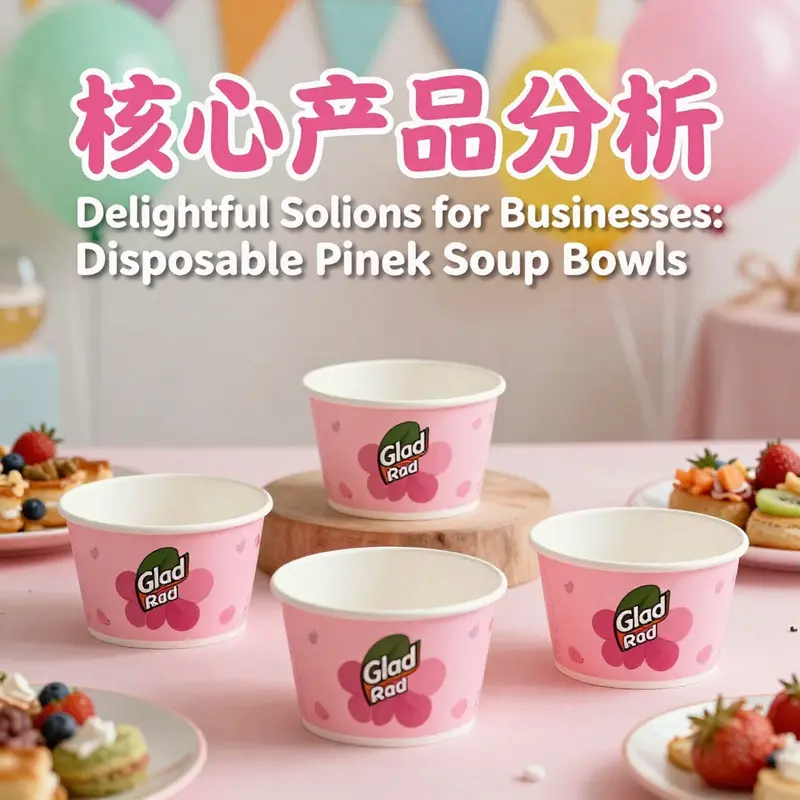
Disposable pink soup bowls offer more than merely functional tableware; they create aesthetic appeal and adaptability for a variety of dining experiences. The analysis of Glad’s popular bowls showcases the perfect blend of style and practicality, while exploring market alternatives expands your options for every occasion. Furthermore, the ability to customize packaging can set your business apart, enabling you to resonate with your brand identity and consumer expectations. For any business involved in the food and beverage industry, understanding and investing in quality disposable bowls is key to uplifting service and meeting contemporary customer tastes. Embrace this trend to enhance your offerings and customer experiences.