
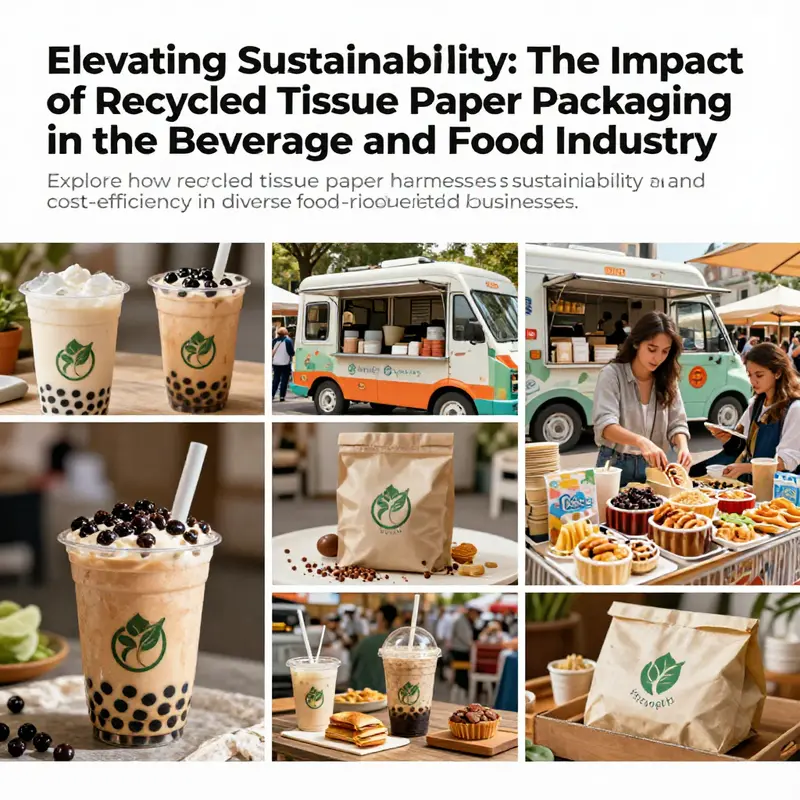
Recycled tissue paper packaging is more than just an eco-friendly choice; it’s a strategic asset for businesses in the food and beverage sector. As more consumers opt to support environmentally-conscious brands, the demand for sustainable packaging alternatives is accelerating. This evolution is especially significant for bubble tea shops, restaurants, food trucks, catering services, and corporate procurement teams that wish to enhance their brand image while contributing to a healthier planet. In the chapters below, we will delve into the role of recycled tissue paper in promoting sustainable consumer practices and outline the economic benefits associated with its use, providing insights into how these practices can be integrated for maximum impact.
null
null
From Waste to Wallet: The Economic Logic of Recycled Tissue Paper Packaging
When a brand considers its packaging, a ledger of costs often dominates the conversation: material price, production time, waste disposal, energy use, and labor. Yet the economics of recycled tissue paper packaging reach beyond simple price-per-square-foot. They hinge on a broader equation that weighs immediate cost savings against long-term value, risk, and resilience. In this chapter, the focus is not only on what recycled tissue paper costs in dollars, but on how adopting it can recalibrate a company’s financial trajectory across the entire supply chain. The shift from virgin pulp to post-consumer content usually lowers raw material costs because recycled fibers are often less expensive to source and can be secured through stable, bulk arrangements. This is particularly true in markets with robust recycling streams and established reclamation networks, where the flow of recycled pulp into packaging grades has become more efficient and predictable. The cost advantage widens when one considers the downstream effects: recycled tissue paper typically requires less energy and water to process, translating into notable reductions in energy bills and water usage in production facilities. Each kilowatt-hour saved, each liter of water conserved, compounds into lower operating expenses, and the savings accumulate over time as production lines run more efficiently and with fewer interruptions tied to raw material shortages. In industries that pack high volumes—where even a fraction of a cent per unit matters—the cumulative effect can shift a marginal operation into a more sustainable, higher-margin model. The fundamental economics are reinforced by the fact that recycled content can often be procured through bulk channels that favor long-term contracts and predictable pricing. In many cases, suppliers are able to offer favorable terms for large-volume buyers who commit to recycled tissue paper on a recurring schedule. The predictability of demand helps stabilize raw material costs, reduces the volatility that can plague virgin pulp markets, and minimizes the need for buffer stock designed to guard against supply disruptions. When a company can forecast its packaging input costs with greater certainty, it gains the room to optimize other parts of the value chain, from product design to logistics planning. The practical implication is that packaging decisions ripple outward, shaping everything from the unit economics of a product to the carbon accounting that is increasingly demanded by investors and customers. The energy and water savings in production, though sometimes modest on a per-unit basis, accumulate impressively for large-scale operations. If a factory processes millions of sheets or rolls per year, even small efficiency gains compound into substantial reductions in utility spend. This is especially true in facilities designed to handle high-volume, high-speed converting lines where incremental improvements in fiber handling, moisture management, or drying cycles can yield meaningful throughput improvements. Moreover, the lighter weight of many recycled tissue grades can translate into lower shipping costs, better storage efficiency, and reduced warehousing expenses. In distribution, every gram saved on packaging translates into more efficient palletization and routing, potentially lowering freight costs and reducing the total landed cost of goods. The economic case strengthens further when one weighs the lifecycle benefits of a more sustainable packaging choice. Recycled tissue paper is biodegradable and compostable, offering end-of-life pathways that help minimize landfill burden and potential disposal costs. While some critics point to color saturation or texture variations as tradeoffs, the market often accepts these characteristics when matched with clear branding and a coherent sustainability narrative. For brands committed to responsible practices, the financial payoff is not solely about the discount on raw materials. It also comes in the form of enhanced brand equity, customer loyalty, and the ability to articulate a tangible commitment to the circular economy. Consumers who align their purchases with environmental values tend to gravitate toward brands that demonstrate integrity across the entire packaging lifecycle. In surveys and behavioral studies, these shoppers repeatedly express willingness to pay a premium or maintain loyalty when a brand consistently demonstrates sustainable sourcing, responsible production, and transparent end-of-life outcomes. This premium is not a mere whim; it translates into steady demand, improved hit rates in competitive markets, and a resilience dividend during economic downturns. Eco-conscious consumers often become brand ambassadors, choosing to share their experiences and influence others through word-of-mouth and social channels. The reputational uplift associated with sustainable packaging can, in turn, support broader pricing power, enabling businesses to reinvest in better materials, advanced printing capabilities, or more sophisticated brand storytelling that reinforces trust. In practical terms, companies that embrace recycled tissue paper packaging can leverage customization as a differentiator without inflating costs. The ability to print logos, seasonal motifs, or brand colors on recycled stock enables a cohesive brand presentation that honors sustainability while preserving aesthetic appeal. The production technology behind many recycled tissue papers is compatible with modern printing processes, which means that decorative elements, interior patterns, and unboxing experiences can be executed with the same precision and impact as virgin-based options. In some cases, color saturation is slightly reduced when compared with virgin pulp, and texture variations may occur from batch to batch. Rather than viewing these as impediments, many brands treat them as opportunities to craft a distinctive tactile experience that signals authenticity. The story conveyed through packaging—its texture, its feel, its unboxing ritual—becomes part of the product’s identity, a sensory cue that reinforces the sustainability narrative. The marketing payoff stems from the synergy between responsible sourcing and purposeful presentation. In the modern retail environment, packaging is not a mere container; it is a communications channel, a first point of contact, and in many cases, a reusable or compostable asset that reinforces the value proposition. The economic rationale, therefore, extends beyond the balance sheet. It touches brand differentiation, consumer trust, and the long-term viability of the business model in a world that increasingly questions the environmental footprint of everyday operations. The supply chain dynamics around recycled tissue paper also contribute to financial resilience. Because recycling streams are often anchored by municipalities or regional networks, buyers can offset risk associated with supply shocks in virgin pulp markets. When a company commits to recycled content, it signals to suppliers and investors a readiness to navigate a resource-constrained future with a more diverse set of inputs. This diversification reduces exposure to price spikes, demand swings, and geopolitical disruptions that can affect traditional paper pulp supply. The resulting stability benefits procurement planning, supplier collaboration, and inventory management. In many regions, policy instruments further enhance the economics of recycled tissue packaging. Governments frequently offer tax incentives, subsidies, or regulatory preferences for companies that adopt eco-friendly packaging solutions. These programs reduce the net cost of switching to recycled content, speeding up the return on investment for capital expenditures tied to new converting lines, storage spaces, or printing capabilities tailored to recycled stock. The economic case is not merely theoretical. Real-world evidence from across sectors suggests that a thoughtful shift to recycled tissue paper packaging can align with profitable growth trajectories. Brands that place sustainability at the core of their packaging strategy report improvements in customer retention, higher perceived value, and a more compelling value proposition for channel partners who are searching for more responsible packaging options. The net effect is a more resilient business model capable of weathering shifts in consumer taste, raw material markets, and regulatory landscapes. Importantly, the economics of recycled tissue paper packaging rely on meticulous execution. Bulk procurement, stable supplier relationships, and careful quality control are essential to capture the anticipated savings. Organizations must manage color consistency, printability, and surface texture to ensure that the packaging remains visually compelling while staying true to its recycled roots. In practice, this means establishing specifications that balance the practicalities of production with the consumer-facing expectations of a brand. For instance, a brand might work with suppliers to standardize a color palette and texture range that minimizes batch-to-batch variation while preserving the tactile cues that signal sustainability. The associated procurement strategy should include clear service-level agreements, robust QA testing, and continuous improvement loops that feed back into design and development. The result is a packaging solution that not only protects goods and facilitates efficient handling but also reinforces a brand’s economic and environmental commitments in a coherent, repeatable way. When considering the broader ecosystem, recycled tissue paper packaging dovetails with other sustainable packaging options to form a comprehensive, cost-conscious approach to packaging design. Brands can combine recycled tissue with other recyclable or compostable materials to create layered protection without compromising end-of-life outcomes. This holistic approach allows retailers to present a consistent sustainability story across channels, from in-store displays to online fulfillment. The financial implications of such a strategy extend to inventory turnover and working capital. As packaging waste reductions flow through the system, waste disposal costs decline and the need for capital tied up in landfill levies or disposal fees narrows. In markets where circular economy practices are gaining traction, tangible metrics—waste diversion rates, recycling percentages, and material recovery costs—can be tracked and reported, further strengthening the business case to investors and lenders who increasingly prioritize environmental performance as a component of risk assessment and value creation. In sum, the economic benefits of utilizing recycled tissue paper packaging are multi-dimensional. They arise from lower raw material costs, energy and water savings in production, clearer branding opportunities, consumer loyalty, and regulatory incentives that collectively support stronger profit margins and long-term viability. The narrative is reinforced by a practical recognition of minor tradeoffs—such as color saturation or texture variability—that can be managed through design and process control. The balance favors a forward-looking strategy in which sustainability is not merely a compliance obligation but a core driver of cost efficiency, brand equity, and market differentiation. For organizations aiming to strengthen their brand image while improving profitability, recycled tissue paper packaging offers a compelling combination of lower input costs, operational efficiencies, and enduring consumer goodwill. As markets evolve, the ability to align cost discipline with credible environmental performance will increasingly distinguish leaders from followers. A careful, well-executed shift toward recycled content can therefore illuminate a path toward sustainable profitability. For those seeking broad context on waste reduction and recycling impacts for businesses, the EPA provides resources that illuminate the strategic value of reducing waste and increasing recycling across the supply chain. https://www.epa.gov/sustainable-management-waste/reducing-waste-and-increasing-recycling-impact-businesses
In addition to the financial calculus, there is a practical dimension to this shift that resonates with decision-makers across functions. Packaging teams must consider the compatibility of recycled tissue with existing product formats, the demands of fulfillment operations, and the expectations of consumers who anticipate a premium unboxing experience. The unboxing moment matters primarily because it is a moment of trust. When a customer sees that a brand has chosen a material that aligns with broader environmental commitments, that moment reinforces the belief that the company will follow through on its promises in other areas—from sourcing to production to post-consumer recycling. This alignment has tangible monetary value. It can influence conversion rates, repeat purchases, and the likelihood that customers will accredit a brand with social responsibility. The economic advantages also extend to corporate risk management. By diversifying input materials toward recycled content, a company reduces exposure to price volatility in traditional pulp markets. This resilience can reduce the need for speculative hedging, ease budgeting, and stabilize cash flow across quarters and fiscal years. In a time when investors increasingly evaluate environmental, social, and governance (ESG) performance, a credible commitment to recycled tissue packaging can improve a company’s profile, potentially lowering the cost of capital and broadening access to favorable financing terms. Yet, the path to realizing these benefits is not a straight line. It requires a thoughtful approach to supplier selection, contract negotiation, and quality assurance. The supply chain for recycled tissue paper must be robust enough to deliver consistent stocks that meet brand requirements for color and texture. Some batches may exhibit slight shade differences or surface variations, but with careful specification and testing, these can be integrated into a controlled design language rather than treated as defects. Brands that recognize this as an opportunity rather than a constraint often craft packaging aesthetics that leverage the natural character of recycled stock. A palm-sized patina of variation can become a feature that signals authenticity and environmental stewardship. The enterprise-level decision to switch to recycled tissue packaging also needs alignment with logistics and fulfillment workflows. The lighter weight and compact form of tissue-based packaging can enable denser packing, streamlined returns processing, and more efficient pallet configurations. These logistics advantages contribute to lower freight costs and faster throughput. In e-commerce and omnichannel fulfillment, where speed and efficiency drive margins, such improvements can noticeably tilt the economic balance in favor of recycled packaging. The customer experience, of course, remains central. The tactile impression of recycled tissue—its softness, its crinkle, its natural fibers—can elevate the unboxing ritual in a way that plastic-based alternatives often cannot replicate. The sensory element reinforces the sustainability message and helps justify any incremental costs associated with higher-quality branding or seasonal design work. At the same time, brands should recognize that recycled tissue may not be a perfect one-size-fits-all solution. There are contexts in which high color saturation is essential, or where specialized textures are required for delicate items. In those cases, the market offers a range of recycled tissue options with varying fiber contents, densities, and finishes. Strategic selection and testing can ensure that the chosen stock delivers the protective performance needed for the item, while still aligning with the company’s sustainability objectives. The practical takeaway is clear: the economic case for recycled tissue packaging is strongest when it is integrated into a holistic approach to product design, materials science, and brand storytelling. Rather than treating packaging as a passive recipient of goods, it becomes an active contributor to cost containment, risk management, and customer engagement. This integrated perspective helps executives justify capital investments in equipment, printing capabilities, and supplier partnerships that support high-volume, consistent production on recycled stock. It also provides a framework for measuring impact—tracking supplier performance, material savings, energy and water use, and the effect on waste streams. In this sense, recycled tissue packaging becomes a lever for both financial performance and sustainability reporting, offering a credible story to stakeholders who want to see tangible outcomes rather than aspirational commitments. Finally, the economic logic of recycled tissue paper packaging is not static. As recycling programs mature, as consumer demand for sustainable goods strengthens, and as technology enables more efficient processing and better printability on recycled stock, the cost benefits are likely to widen. The industry can anticipate further convergence between waste streams and supply chains, with better materials, improved processing methods, and more sophisticated customization options. This momentum will help ensure that the economics of recycled tissue packaging remain favorable, even as broader market conditions shift. Brands prepared to embrace this evolution will find opportunities to reduce costs, strengthen margins, and deliver a packaging experience that resonates with conscious consumers. For those curious about related packaging solutions and supplier options, the contextual landscape continues to expand, offering multiple avenues to maintain consistent branding while honoring environmental commitments. For example, a related resource in the packaging ecosystem highlights accessible options for recyclable stock and related forms of sustainable containment, which can be explored here: eco-friendly-recyclable-pulp-2-4-cups-coffee-take-away-cup-holder.
Final thoughts
The integration of recycled tissue paper packaging is proving to be not only a responsible choice but a savvy business strategy for food and beverage businesses. By embracing this eco-friendly option, shops and services can align themselves with consumer values that prioritize sustainability without sacrificing aesthetic or functional quality. Ultimately, opting for recycled tissue paper packaging reinforces a brand’s commitment to the planet, allowing businesses to stand out in a competitive marketplace while enjoying the economic advantages of bulk purchasing and customization. Making the switch to recycled materials today can pave the way for a greener tomorrow, helping brands connect with their customers on a deeper level.