
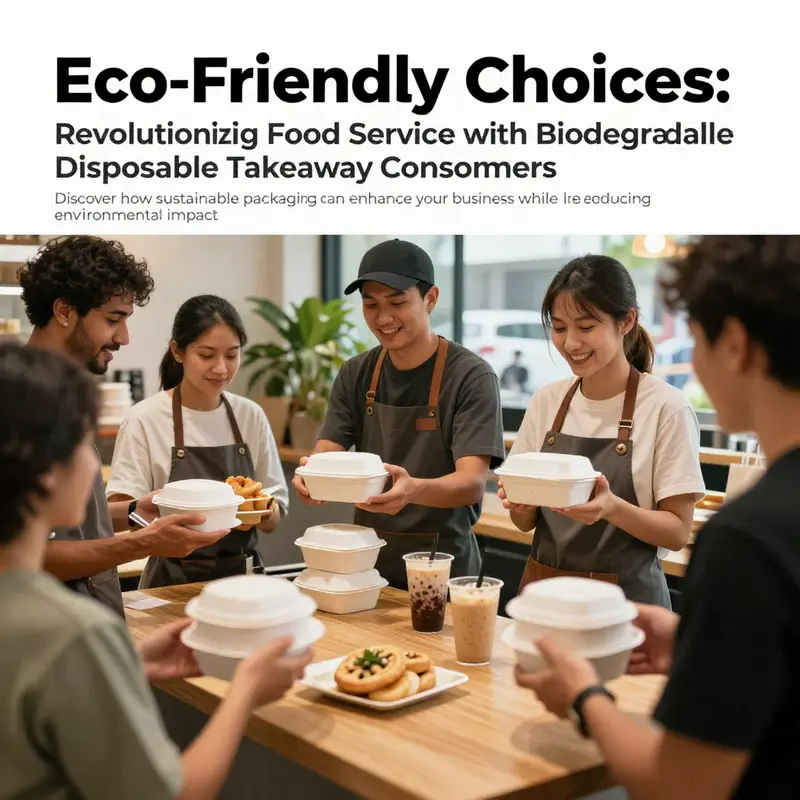
In today’s environmentally focused world, businesses in the food and beverage industry are actively seeking sustainable alternatives to traditional packaging. Biodegradable disposable takeaway containers are becoming increasingly popular, catering to the eco-conscious consumer and helping businesses like bubble tea shops, restaurants, food trucks, catering services, and corporate procurement teams to reduce their environmental footprint. This article delves into the sustainable materials used in production, evaluates the environmental impact of these containers, analyzes market trends and economic implications, and outlines the regulatory frameworks and certifications that guide their use. By exploring these aspects holistically, we provide a thorough understanding of biodegradable takeaway containers and how they can significantly benefit your business.
From Renewable Fibers to Responsible Packaging: The Material Science Behind Biodegradable Takeaway Containers
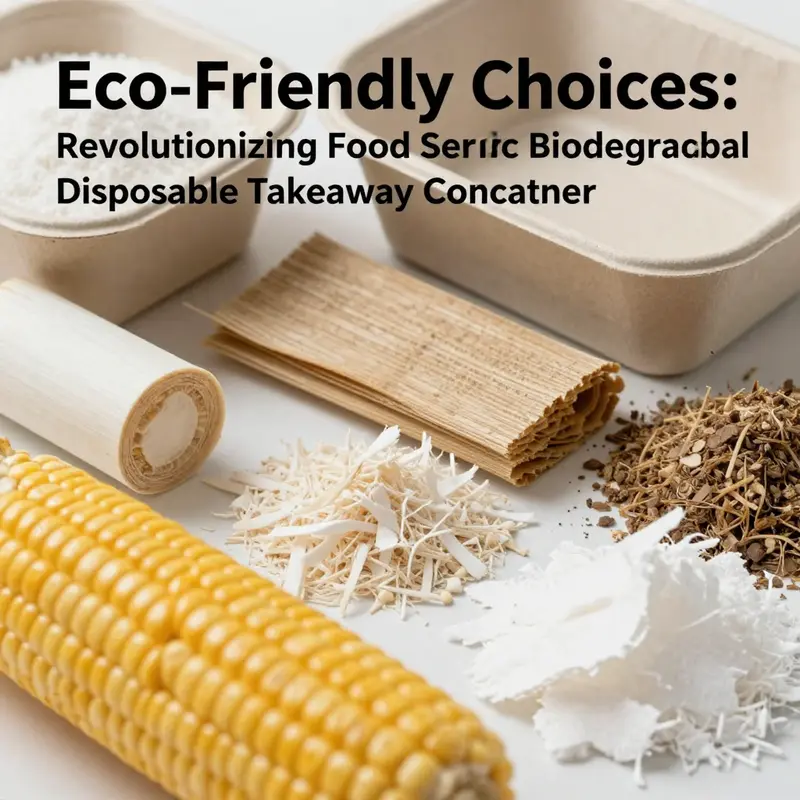
Biodegradable disposable take-away containers are not merely wrappers for meals; they are tangible expressions of material science, supply chains, and evolving policy landscapes all converging in a single consumer touchpoint. The chapter of materials that underpins these containers reveals a quiet revolution. It is a shift away from fossil-based plastics toward renewable fibers and fibers’ byproducts that can be sourced, processed, and returned to the earth with minimal residual impact. When we speak of the material backbone of these containers, we are talking about four families that currently dominate the field: bamboo fiber, sugarcane bagasse, wheat straw, and recycled paper. Each brings a distinctive combination of renewable origin, mechanical strength, barrier properties, and end-of-life pathways that inform how a container performs in a kitchen, stores a hot curry, or travels through a delivery network.
Bamboo fiber stands out for its speed of renewability and its intrinsic robustness. Bamboo grows quickly, often without intensive chemical inputs, and its fibers can be fashioned into molded forms that are both sturdy and light. For food-contact applications, bamboo-derived materials offer a natural alignment with consumer expectations for clean labeling and safety, and they carry potential antimicrobial properties attributed to certain bamboo constituents. While the antimicrobial claim is nuanced and depends on processing, the core point remains: bamboo-based containers can withstand the everyday rigors of kitchen use, including handling in busy take-out environments where heat and moisture can challenge other materials. This makes bamboo fiber a compelling option for bowls, clamshells, and close-fitting lids that are meant to travel from restaurant to table or doorstep with confidence.
Sugarcane bagasse, the fibrous residue left after extracting juice from sugarcane, represents a quintessential example of upcycling agricultural byproducts. In a sustainability sense, bagasse embodies the circular economy: it uses waste material that would otherwise require disposal, and it can be transformed into molded shapes with heat and pressure rather than harsh chemical processes. The heat resistance and sturdiness typical of bagasse-based containers suit hot foods and oils, where a rigid form helps protect the contents and maintain structural integrity during transit. This material also benefits from a growing infrastructure that supports composting in many regions, helping to close the loop when the container’s useful life ends. The bagasse route often involves a combination of pulping, forming, and sometimes light surface coatings that balance moisture resistance with compostability, all while keeping a footprint smaller than traditional plastics.
Wheat straw, another agricultural byproduct, contributes to waste reduction within farming systems already in use. In the production line for take-away packaging, wheat straw fibers can be blended with other fibers to tune stiffness, flexibility, and barrier properties. The material’s relatively high yield and compatibility with existing pulping technologies make it a practical option for customers seeking a balance between cost, performance, and end-of-life outcomes. Wheat straw-based designs can be molded into various shapes—from simple rectangular takeaway boxes to more complex, branded forms—without sacrificing recyclability or compostability when properly processed. The broader message is clear: agricultural residues, when thoughtfully integrated into packaging streams, unlock value that would otherwise be wasted.
Recycled paper completes the quartet, grounding the material strategy in a proven recycling loop. Using post-consumer or post-industrial paper fibers reduces virgin resource depletion and can offer reliable dimensional stability, printability, and barrier performance when paired with appropriate coatings or treatments. The recycled paper route often enables a wide range of form factors—from simple lids to multi-compartment boxes—while maintaining compatibility with standard waste-management systems in many communities. Importantly, the use of recycled fibers does not automatically guarantee compostability; it highlights a different end-of-life pathway that, in many jurisdictions, includes recycling streams alongside composting. The choice between compostable and recyclable design reflects a local infrastructure assessment as much as a product spec sheet.
The environmental benefits of these materials extend beyond end-of-life outcomes. Each material aligns with circular economy principles by reducing dependence on fossil fuels, cutting greenhouse gas emissions during decomposition relative to conventional plastics, and enabling more resilient supply chains that can weather disruptions in petrochemical markets. The lifecycle logic is pragmatic: renewable inputs, efficient conversion processes, and end-of-life options that are accessible to users and waste-management systems. In practice, this means that a container made from bamboo fiber or bagasse, or one derived from recycled paper, can contribute to lower overall environmental impact when compared with traditional plastic packaging. Yet the story is not purely about the raw materials; it also hinges on how these materials perform during use and how they align with public policy, consumer expectations, and industry certifications.
Certifications and safety standards play a crucial role in bridging material science with market confidence. Food-contact safety remains non-negotiable for take-away packaging. Reputable specifications ensure that containers meet food-grade standards, do not leach undesirable substances, and maintain performance across temperature ranges. Common evaluative frameworks consider microwave safety, freezer resilience, and resistance to oil and moisture, all while guaranteeing that any coatings or additives used to achieve barrier properties remain compliant and non-toxic. The complexity of these requirements means that material selection is rarely a binary choice between “biodegradable” and “strong enough.” Instead, it is a careful balancing act, aligning the inherent properties of the chosen renewable fibers with the manufacturing realities and the practical needs of kitchens, delivery fleets, and event venues.
In practice, manufacturers often pursue a layered approach to performance. A bagasse-based clamshell, for example, may achieve the necessary rigidity through a design that leverages its natural fiber structure, while a thin, food-safe coating or a compatible bioplastic can supply a moisture barrier without compromising compostability. Similarly, a bamboo fiber container might use a molded-in strength geometry to support heavier meals, with minimal coatings to preserve the environmental credentials. These design choices are not arbitrary; they are guided by testing regimes that simulate real-world use, including repeated heating and cooling cycles, humidity exposure, and stacking during transport. The result is a family of products that can tolerate microwave reheating, refrigeration, and short-term heat exposure in a way that aligns with consumer expectations for convenience and safety.
From a market perspective, the availability of these materials has expanded significantly. Suppliers now offer a spectrum of options, with varying degrees of customization, from sizes and shapes to branding and moisture management features. The cost dynamics of sustainable materials have improved as well, driven by increased production scales and growing demand from forward-looking operators who want to differentiate on environmental criteria. The economics are not purely about price per unit; they also involve total cost of ownership across the lifecycle. If a container can perform reliably in a busy kitchen, withstand delivery conditions, and depart with a compostable footprint, it can reduce waste handling costs and support brand narratives around corporate responsibility.
The design choices are deeply informed by practical constraints. For many operators, the ability to microwave food in the same container used for serving and storing leftovers is a critical feature. A material system that can withstand repeated microwave exposure without warping or releasing undesirable compounds supports a seamless consumer experience. Refrigeration compatibility is another non-negotiable in take-away logistics, ensuring that cold or prepared meals retain quality from pickup to plate. These performance criteria do not exist in a vacuum; they are shaped by consumer behavior, kitchen workflows, and the logistics environment that takes meals from door to dining room. In this sense, the material science of sustainable take-away containers is as much about human factors as it is about chemistry and engineering.
One practical implication of embracing sustainable materials is a reimagining of end-of-life logistics. With compostable or biodegradable options, municipalities and waste-management systems face new opportunities and responsibilities. Industrial composting facilities, in particular, can convert these materials into useful compost within defined timeframes, typically 90 to 180 days, under conditions that support complete degradation without harmful residues. Home composting remains more variable, and thus many manufacturers emphasize industrial compostability to ensure predictable outcomes. The choice between compostable and recyclable pathways often depends on local infrastructure, regulation, and consumer participation rates. In some regions, dual pathways exist, enabling households to divert these containers toward composting while preserving recyclability for other streams. The bottom line is that the environmental benefit of sustainable materials multiplies when end-of-life systems are designed to handle them as intended.
The narrative around materials also intersects with design for branding and consumer perception. The visual and tactile cues of a container—its color, texture, and surface finish—convey a message about environmental commitment even before a consumer reads the fine print. Designers can leverage the natural aesthetics of bamboo fiber, bagasse, or recycled paper to reinforce a brand story about sustainability, while maintaining legibility for recycling or composting instructions. This is where the interplay of form and function becomes especially important. A well-designed container can reduce improper disposal and improve user trust, which in turn supports broader adoption of sustainable packaging practices. The market has moved beyond simply offering a “green option.” It now emphasizes coherent packaging ecosystems where materials, processes, labeling, and end-of-life stewardship work in concert with the customer’s experience.
For businesses exploring these pathways, the materials described here are not a single solution but a toolkit. Each material brings a different set of trade-offs in cost, performance, and end-of-life outcomes. A shop that specializes in hot-wrap meals may lean toward bagasse for its heat tolerance, while a café with a high share of cold or room-temperature salads might favor recycled paper with a suitable protective coating. A fast-casual restaurant aiming for a bold, natural brand identity could lean toward bamboo fiber for its perceived premium appeal and strength. Importantly, these choices must also align with relevant certifications and regulatory expectations, ensuring that the final packaging does not compromise safety or environment credits. In practice, this means engaging with suppliers who can provide documentation about compostability standards, food-contact safety, and the absence of problematic additives such as PFAS or certain plasticizers, especially when coatings are involved.
The materials narrative also feeds into the broader conversation about supply chain resilience. The reliance on agricultural byproducts, like bagasse and wheat straw, offers a way to diversify feedstocks and reduce dependence on petrochemical inputs. It can also stabilize prices and supply by leveraging existing agricultural processes and waste streams. At the same time, it requires attention to harvest cycles, regional availability, and seasonality. Sustainable packaging leadership, therefore, depends on partnerships across farming, forestry, pulping, molding, and waste-management ecosystems. When these partnerships mature, they enable a more robust and transparent supply chain, one that can demonstrate cradle-to-cradle thinking and measurable environmental performance.
As this material-centered chapter intersects with the broader themes of the article, it is worth noting how consumer expectations are evolving. People increasingly seek packaging that is not only functional and safe but also clearly aligned with values around sustainability. The rise of compostable and recyclable take-away containers reflects a cultural shift in which packaging choices become a visible extension of a business’s environmental commitments. Yet this shift also invites ongoing scrutiny: are end-of-life systems in place to handle these materials? Are coatings and additives truly compostable in practice, or do they hinder recycling streams? Answering these questions requires ongoing collaboration among designers, manufacturers, waste-management operators, and regulators. It also calls for transparent communication with customers about how to dispose of containers properly and what to expect at the end of a product’s life.
In sum, the sustainable material landscape for biodegradable take-away containers is a dynamic intersection of renewable resources, processing technologies, regulatory frameworks, and consumer behavior. Bamboo fiber, sugarcane bagasse, wheat straw, and recycled paper each contribute unique strengths to the mix. They offer viable pathways to reduce fossil-fuel dependence, lower environmental footprints, and support circular economy objectives while maintaining the practical performance demanded by modern food-service operations. The challenge and opportunity lie in balancing these materials’ intrinsic qualities with the realities of kitchen use, supply chain logistics, and end-of-life infrastructure. When done thoughtfully, this balance yields containers that perform as reliably as their plastic predecessors, yet tread far lighter on the planet and on future generations of diners and business operators alike. To explore a practical example that aligns with these principles, one can consider designs that integrate bamboo or bagasse with compatible barrier layers and branding-ready surfaces, such as a round kraft paper bowl intended for hot and cold foods alike. See the following resource for a real-world view into durable, compostable options that blend sustainability with market demand: biodegradable-eco-friendly-take-away-odm-oem-round-kraft-paper-bowl. This reference illustrates how the concepts discussed here translate into tangible packaging choices that support eco-conscious food-service operations.
For readers seeking a broader market overview and material specifications, a supplier listing provides detailed data on the range of biodegradable, plant-based take-away containers available today, including temperature tolerance, compostability criteria, and certifications. This external resource offers practical guidance for procurement teams evaluating material options and aligns with the end-to-end narrative of sustainable packaging—from renewable feedstocks to responsible disposal. External resource: https://www.alibaba.com/product-detail/Disposable-Takeaway-Biodegradable-Printed-Paper-Fast_1600542985328.html?spm=a2700.191319.0.0
Measuring Real Impact: How Biodegradable Takeaway Containers Change Waste, Emissions, and Systems
Measuring Real Impact: How Biodegradable Takeaway Containers Change Waste, Emissions, and Systems
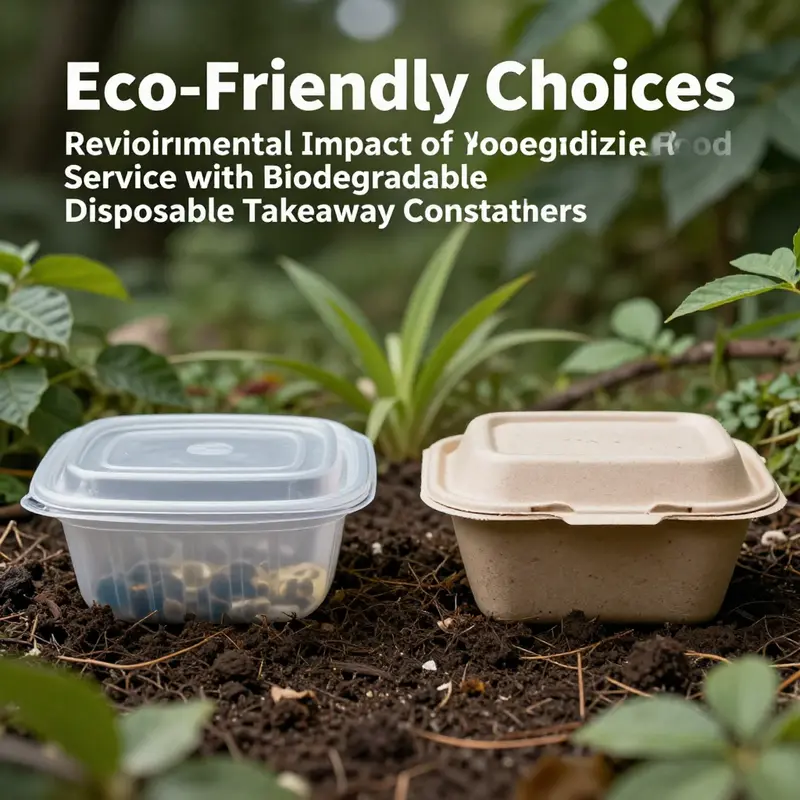
Biodegradable disposable takeaway containers promise a cleaner alternative to conventional single-use plastics. Materials such as sugarcane bagasse, bamboo fiber, and polylactic acid (PLA) are renewable and designed to break down under suitable conditions. Yet their environmental benefit is not automatic. The real-world impact of these containers depends on choices made across design, supply chains, consumer behavior, and waste management systems. This chapter examines how material properties, production footprints, and end-of-life pathways interact, and how food-service operators and municipalities can turn potential into measurable gains.
Materials shape both benefits and trade-offs. Sugarcane bagasse is an agricultural residue repurposed into sturdy packaging. Its embodied carbon is often lower than new plastic, because it uses a waste stream rather than virgin feedstock. Bagasse products are compostable in industrial facilities and return organic matter to soil. Bamboo fiber offers rapid renewability and strong fibers, creating attractive, durable containers. PLA, derived from corn starch, reduces reliance on fossil feedstocks and can lower greenhouse gas intensity during production. Each material, however, requires specific processing. Chemical binders or thermal treatments may be used with bamboo. PLA and some bagasse products need high-temperature industrial composting to break down. Those processing steps incur energy use, water consumption, and sometimes chemicals that alter net environmental benefits. Understanding these upstream inputs is essential when comparing materials.
Life cycle assessments show that material choice alone does not determine sustainability. Manufacturing energy, transport distances, and production efficiency influence total environmental costs. A lightweight plastic container produced with low energy can, in some analyses, have a lower global warming potential than a heavier biodegradable option made far from its market. Conversely, converting agricultural byproducts like sugarcane bagasse into packaging typically yields low feedstock impacts. But long transport or energy-intensive finishing processes can erode that advantage. For businesses, the practical implication is to evaluate not just the material, but the entire supply chain, including local sourcing, manufacturing emissions, and packaging design.
End-of-life management is the decisive factor. Compostable materials perform well only when they enter composting systems. When these containers go to industrial composting, they often degrade within 90 to 180 days, returning carbon and nutrients to soils. However, if they are placed in landfills, the result can be slow anaerobic decomposition and methane generation. Methane is a potent greenhouse gas, so landfill disposal can negate climate benefits. If compostable containers contaminate recycling streams, they can also reduce recycling quality and increase sorting costs. Thus, the existence and accessibility of appropriate waste infrastructure determine whether biodegradable trays are an improvement over plastics.
The gap between material capability and practical outcome is visible in many urban systems. Municipalities that invest in commercial-scale composting facilities create a favorable environment for compostable packaging. Businesses operating in those areas can reliably divert waste and realize circular benefits. In contrast, regions lacking composting capacity may effectively treat biodegradable packaging like conventional waste. For food-service operators expanding across different cities, this variation complicates procurement and operational strategies. A container that is ecologically preferable in one location can become problematic in another.
Consumer behavior and on-site practices play an outsize role. Clear labeling and staff training are simple, high-impact measures. Containers marked with decomposition conditions and disposal instructions reduce contamination. Training staff to separate food-soiled compostables from recyclables prevents cross-contamination. Providing visible, labeled bins for customers encourages correct disposal. Packaging design that integrates lids and reduces loose components also cuts the likelihood of mis-sorting. These measures are inexpensive and immediate. When combined with an available composting route, they significantly improve diversion rates and environmental outcomes.
Policy and incentives can accelerate system-level shifts. Procurement policies that prioritize compostable materials encourage investment in composting infrastructure. Fee structures that charge for landfill disposal while subsidizing composting collection create financial motivation for both businesses and waste haulers. Regulatory clarity on labeling, standards, and certification reduces confusion. When municipalities require source separation of organic waste, the supply of compostable feedstock grows, improving economies of scale and lowering processing costs. Such policy levers transform biodegradable packaging from an individual product choice into a scalable circular solution.
Design decisions amplify benefits. Lightweighting reduces material use and transport emissions. Mono-material designs simplify compostability and sorting. Avoiding non-compostable coatings, such as certain plastic or fluorinated barriers, ensures the entire product can biodegrade. When moisture or grease protection is needed, selecting water-based or plant-derived coatings that meet composting standards preserves functionality. Thoughtful compartmentalization minimizes excess material without sacrificing food safety. Designing packaging to nest or stack efficiently reduces shipping volume and associated emissions. In short, better design lowers both upstream and downstream impacts.
Supply chain transparency helps businesses make credible claims and avoid unintended harm. Procuring from manufacturers that disclose energy use, water consumption, and chemical inputs makes comparative assessment possible. Third-party verification of compostability and food safety adds trust. Companies should request evidence of industrial composting compatibility, and understand whether a product will decompose only in specialized facilities. When possible, prioritizing locally produced items reduces transportation emissions and supports regional circular systems. Transparency also enables monitoring and reporting that demonstrates actual environmental performance.
Quantifying impact requires measurement across the value chain. Trackable metrics include diversion rates, contamination percentages, and greenhouse gas emissions from collection and processing. For food-service operations, measuring the proportion of packaging that reaches composting facilities versus landfill illuminates the gap between intent and outcome. Monitoring the amount of organic material returned to soils through composting programs quantifies benefits like improved soil carbon and reduced fertilizer needs. Regular audits, paired with operational changes, yield continuous improvement.
There are trade-offs and practical limits. Industrial composting facilities require capital investment and operational capacity. Certain rural or low-density regions may not sustain cost-effective composting. Some biodegradable materials are less durable in wet or greasy conditions unless treated, and those treatments can complicate compostability. PLA contamination of recycling streams is another challenge, as PLA can be mistaken for conventional plastics. These limits emphasize that biodegradable packaging is one tool, not a universal solution.
Still, when systems align, the gains are tangible. Diverting food-soiled packaging to composting reduces landfill volume and generates a valuable soil amendment. It diminishes microplastic pollution risks in the environment. It can also lower the social cost of waste management by reducing odors and leachate from landfills. For businesses, adopting compostable containers can support brand values, meet regulatory requirements, and appeal to customers seeking sustainable options. But these benefits only materialize with coordinated action across design, procurement, operations, and municipal services.
Practical steps for immediate improvement are straightforward. First, choose materials with proven industrial compostability where such facilities exist. Second, standardize packaging designs to simplify sorting and reduce contamination. Third, implement clear, consistent labeling and staff training at points of sale. Fourth, partner with local composting providers or waste haulers to secure reliable collection. Fifth, measure results and iterate. These steps convert the theoretical promise of biodegradable containers into concrete environmental outcomes.
Long-term solutions require systems thinking. Municipalities, waste firms, and food-service operators should plan together. Investments in composting and anaerobic digestion expand end-of-life capacity. Standardized certification and labeling reduce confusion. Financial mechanisms that align cost signals with environmental outcomes, such as landfill taxes or composting credits, help scale circular infrastructure. Research into low-impact processing methods and alternative coatings can further reduce upstream impacts. Over time, these changes shift the baseline, enabling biodegradable packaging to deliver consistent, verified benefits.
One practical product category that aligns with this approach is compostable kraft paper take-away bowls. These bowls are often designed to be functional and compatible with industrial composting, while reducing reliance on fossil-based plastics. For businesses looking to adopt compostable bowls with reliable disposal outcomes, sourcing locally and confirming compostability claims helps close the loop. For example, consider options such as the biodegradable eco-friendly take-away round kraft paper bowl when evaluating materials and compatibility with local composting services.
Measuring the true environmental impact of biodegradable takeaway containers means moving beyond material labels. It requires scrutiny of manufacturing, evaluation of local waste infrastructure, attention to design choices, and investment in clear collection systems. With these elements in place, biodegradable containers can reduce plastic pollution, cut greenhouse gas emissions, and contribute organic matter back to the land. Without them, these items risk becoming another stream of problematic waste. Real, lasting benefit emerges when product design and public systems work together.
For deeper analysis of lifecycle impacts and comparative studies, see the ScienceDirect review on environmental impacts of takeaway food containers: https://www.sciencedirect.com/science/article/pii/S0959652618314756
How Market Forces and Economics Are Shaping Biodegradable Takeaway Containers
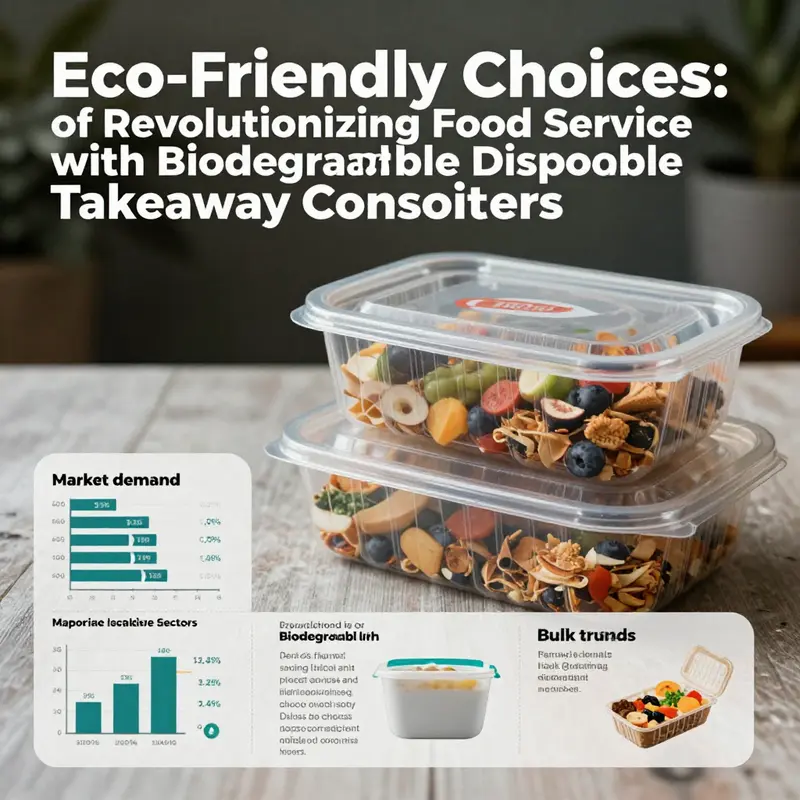
The market for biodegradable disposable take away containers is no longer a niche. Growing environmental priorities, tightening regulation on single-use plastics, and rapid improvements in manufacturing have combined to create a dynamic economic landscape. Demand now spans independent cafes, large catering operations, food delivery platforms, and event planners. This chapter examines the economic drivers, pricing mechanics, adoption patterns, and strategic implications for businesses that choose biodegradable containers over conventional plastics.
Cost dynamics are central to adoption. A decade ago, biodegradable options often carried a clear price penalty versus petroleum-based plastics. Today that gap has narrowed substantially. Advances in material science, process automation, and higher production volumes have driven per-unit costs down. At large order volumes, unit prices can fall to a few cents each. This creates a tipping point where the environmental advantage is accompanied by compelling economics. For small operators, mid-sized businesses, and national chains, the total cost of ownership increasingly favors biodegradable choices, especially when downstream savings are factored in.
Downstream savings are often overlooked in simple price comparisons. Biodegradable containers can reduce long-term disposal costs in jurisdictions that enforce landfill surcharges or banned materials. They can also lower reputational risk, which translates into measurable revenue benefits for businesses that promote sustainable practices. For many restaurants and caterers, the value of an environmentally responsible brand identity can offset modest cost differentials. This is particularly true for venues focused on events and hospitality, where sustainability is a selling point that commands higher margins.
Supply-side economics matter as well. Sugarcane bagasse, cornstarch derivatives, and molded paper pulp are the primary feedstocks for these containers. The relative availability and price stability of these feedstocks influence manufacturing costs. Agricultural byproducts such as bagasse benefit from steady supplies tied to sugar production cycles, which can stabilize prices. Cornstarch depends on grain markets and bio-based demand, which may be more volatile. Manufacturers that diversify supply and invest in vertical integration achieve better margin control. These companies can offer more competitive pricing to large-volume buyers and secure consistent product availability during peak seasons.
Manufacturers have also expanded the portfolio of functional features without compromising biodegradability, and those features affect market pricing. Microwave-safe, leak-resistant coatings, hinged lids, and compartmentalized designs add value. When these features are essential to customers, they justify higher unit costs. The economics of customization are significant: branding, custom printing, and tailored shapes enable foodservice businesses to differentiate their offering. For many buyers, marketing value from a branded, compostable container offsets additional per-unit costs. Bulk orders with standard designs remain the cheapest option, while bespoke runs carry premium pricing but deliver stronger brand impact at events or in high-touch dining experiences.
Certification and regulatory compliance play a dual role in market growth and economic calculation. Certifications from recognized bodies signal that a product meets compostability or biodegradability standards and is safe for food contact. This assurance reduces buyer risk and often enables access to markets where proof of compliance is mandatory. Obtaining certifications requires investment by manufacturers, but once secured, they open higher-value sales channels such as institutional procurement and government contracts. For buyers, choosing certified products can be a condition for participating in public tenders and corporate sustainability programs, which makes the initial price premium a strategic investment.
Policy and legislation exert major influence. Bans or levies on single-use plastics create immediate demand for alternatives. Many municipalities and countries have enacted restrictions that either outlaw certain plastics or impose taxes on their use. These measures alter the comparative economics. When plastic surcharges or disposal restrictions are applied, biodegradable containers become cost-competitive or even cheaper on a lifecycle basis. Businesses operating across multiple jurisdictions must track local rules and adapt procurement strategies accordingly. Proactive adoption ahead of regulation can also provide first-mover advantages and smooth supply transitions.
Market segmentation is evolving. The foodservice industry is not homogeneous, and economics differ by segment. Quick-service restaurants prioritize low unit costs and high throughput. They gravitate toward simple, stackable designs that minimize labor time and storage space. Catering and events place higher value on presentation and customization, so they tolerate higher per-unit costs for premium-looking, compostable options. Delivery platforms care about containment and leak resistance, so they favor containers that combine sturdiness with temperature tolerance. Understanding these segment-specific needs allows suppliers to tailor offerings and price points effectively.
Logistics and total landed cost are pivotal. Bulk pricing looks attractive until transport, tariffs, and warehousing are included. For international purchases, duties and freight can add materially to unit cost. Suppliers that offer terms like Delivered Duty Paid or that maintain regional distribution centers make it easier for buyers to predict final costs. Inventory planning becomes more important as businesses scale biodegradable usage. Facilities that lack onsite composting must coordinate with municipal composting or waste services; where such services are limited, the end-of-life handling can affect the perceived value of the product.
Financing and procurement strategies can smooth the transition. Long-term contracts, forecasted volume commitments, and cooperative purchasing arrangements reduce unit prices through guaranteed demand. Group purchasing organizations and industry associations can negotiate favorable rates. Some manufacturers offer tiered pricing that rewards larger commitments, while others include marketing support or design services as part of volume deals. Such structures lower upfront risk and enable smaller operators to benefit from economies of scale normally reserved for larger buyers.
Lifecycle economics are increasingly central to procurement decisions. Total cost of ownership models incorporate raw material cost, production energy, transport, disposal fees, and environmental externalities. When calculated correctly, these models often show biodegradable options outperforming plastics over a three- to five-year horizon. Externalities such as lower greenhouse gas emissions and reduced microplastic pollution may not show immediately on balance sheets, but they do influence stakeholder expectations and regulatory direction. Investors, insurers, and customers increasingly expect businesses to account for these factors.
Innovation continues to force down costs. Process improvements in pulping, molding, and coating application increase yields and reduce waste. Automation lowers labor costs and improves consistency. New barrier technologies that are compostable enhance shelf life and broaden use cases. When such innovations scale, they reduce the need for expensive additive treatments, enabling manufacturers to preserve compostability while delivering performance parity with conventional packaging.
Market signals point to sustained growth. Forecasts project strong compound annual growth as more regions tighten plastic regulations and consumers maintain preference for sustainable choices. This creates opportunities for established manufacturers and new entrants alike. However, competition encourages consolidation; efficient producers with scale, certification, and supply-chain resilience will capture a significant share of large institutional contracts. Smaller manufacturers can succeed by specializing in niche designs or offering exceptional service and rapid customization.
For buyers, the economic message is clear: evaluate beyond per-unit price. Consider certification, functional features, logistics, and lifecycle costs. Leverage collective purchasing and long-term agreements to reduce price volatility. Factor in brand value from sustainability and the potential savings from reduced regulatory compliance costs. Investing in supplier relationships that prioritize transparency across the supply chain yields predictable quality and more reliable pricing.
The shift toward biodegradable take away containers is more than an ethical choice. It is a response to shifting economics driven by policy, consumer preferences, and manufacturing innovation. Businesses that integrate these factors into procurement and pricing strategies will capture both environmental and commercial benefits. For practical product selection and customization ideas, suppliers now offer a wide range of compostable bowls and containers that combine functional performance with eco-credentials. One such example of the category is the biodegradable eco-friendly take-away kraft paper bowl, which illustrates how design, material choice, and certification can be bundled for specific use cases.
To explore supplier marketplaces and compare pricing and certification details, businesses often consult major trade platforms and verified supplier catalogs for up-to-date offers and MOQ options. These resources help buyers assess whether a switch to biodegradable containers will meet cost, functional, and sustainability goals and confirm timelines for rollout and supply continuity. For general supplier search and sourcing, a commonly used marketplace is https://www.alibaba.com.
Adoption of biodegradable disposable take away containers is not a single decision. It is an operational transition that touches procurement, operations, branding, and waste management. The economic case grows stronger each year. As markets mature, the combination of lower manufacturing costs, wider certification acceptance, and clearer regulatory signals will make biodegradable containers a standard choice rather than an optional upgrade.
Verified Compostability: Navigating Regulations and Certifications for Biodegradable Takeaway Containers
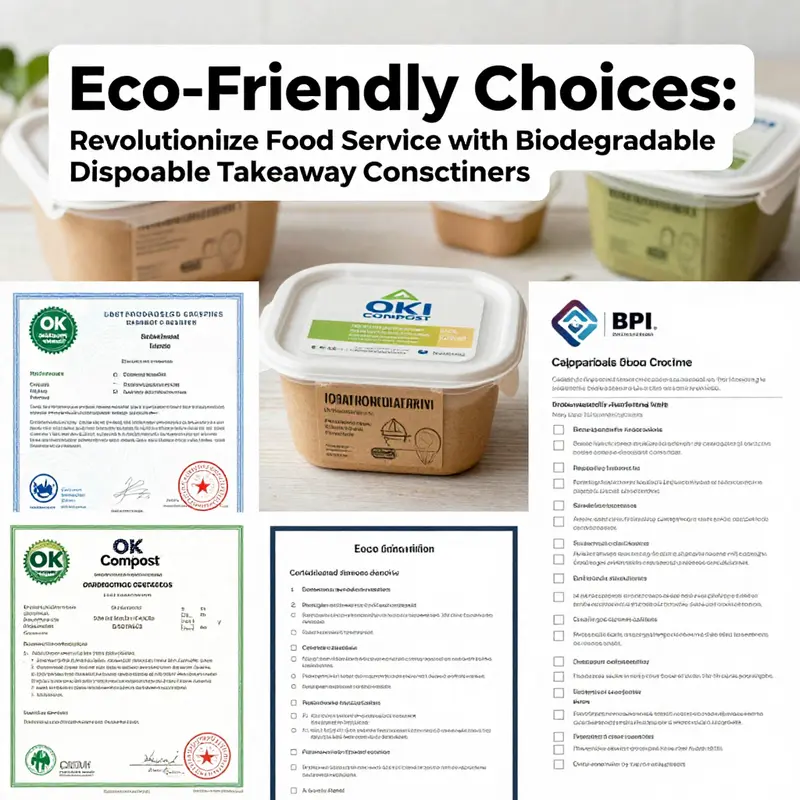
Regulatory Landscape and What Certification Means in Practice
Selecting biodegradable disposable take-away containers requires more than trusting a label. It requires understanding the regulatory landscape that turns environmental claims into verifiable facts. Certification is the bridge between marketing and measurable performance: it tells restaurants, caterers, retailers, and consumers whether a container will actually break down in a composting system without leaving harmful residues. This chapter explains the rules behind the claims, what tests and audits establish credibility, and how those requirements shape purchasing, waste handling, and communication strategies.
At the center of credibility are established standards and certification bodies. In North America and Europe, recognized specifications define what compostable means in measurable terms. Two widely used standards are the European EN13432 and the U.S. ASTM D6400. Both require a product to biodegrade into carbon dioxide, water, and biomass within a specified timeframe under controlled composting conditions. They also require physical disintegration so the material does not remain as visible fragments in finished compost, and they include ecotoxicity limits to protect soil health. Certification bodies evaluate products against these criteria using third-party laboratory tests and ongoing oversight.
One widely referenced certifier develops and verifies products specifically for commercial composting streams. Its certification process relies on independent lab testing and continued supply-chain audits to ensure manufacturing matches the tested formulation. This layered approach prevents a one-time test from becoming a permanent claim when raw materials or production methods change. Certified items appear in public registries, allowing purchasers to verify status and check the testing basis. When buying at scale, requesting registration proof is a standard due diligence step.
Testing protocols go beyond a single measurement. Biodegradation tests measure the conversion of organic carbon to carbon dioxide under aerobic conditions. Disintegration testing simulates the mechanical and biological breakdown that occurs in industrial composters. Ecotoxicity assays verify that compost containing the degraded material does not harm plant growth or soil organisms. Some standards also include limits for heavy metals and other contaminants. A product that passes these tests under lab conditions and in actual composting trials can be certified for commercial composting facilities, typically with an expected decomposition window expressed in days.
It is important to recognize the boundary between industrial and home compostability. Many certifications address industrial composting: facilities that maintain high temperatures for sustained periods and manage aeration and moisture. Containers certified to industrial standards will not necessarily degrade in a backyard pile or a curbside organics bin not managed as a hot compost system. For operations that expect returned containers to be composted by consumers at home, seeking products certified specifically for home composting is necessary. Otherwise, clarify to customers and staff that acceptable disposal is in industrial composting streams.
Food contact safety is a related concern. Regulatory frameworks often require materials intended for food packaging to comply with food safety rules, such as migration limits for substances that can transfer into food. Compliance with food-contact regulations ensures a container is safe to use with hot or cold foods and during reheating in common appliances. Verification may come from separate laboratory tests or declarations of compliance with appropriate food safety regulations. Suppliers should provide documentation that materials are safe for intended use conditions.
Beyond compostability and food safety, environmental and health considerations increasingly include chemical content restrictions. Per- and polyfluoroalkyl substances (PFAS) have been used to impart grease resistance to take-away packaging. Because PFAS are persistent and can be toxic, many procurement policies now demand PFAS-free certification or testing evidence. When evaluating suppliers, request explicit statements and test reports demonstrating the absence of PFAS or other restricted substances. This reduces the risk that packaging contaminates compost or introduces persistent chemicals into soils.
Certification is not a one-off stamp. Reputable programs require ongoing surveillance. Periodic audits verify that the manufacturer continues to use the same formulations and processes as those tested. Random product sampling and repeat laboratory testing guard against drift in ingredient sourcing. For large buyers, asking for the certifying body’s audit frequency and the last audit date clarifies how fresh the certification is. Public listings on certifier websites allow buyers to confirm current status and see associated test reports.
Labels and logos are useful shorthand, but they need context. A recognized compostability logo indicates compliance with a standard and usually links to a public registry. Buyers should verify that the logo is not used incorrectly or misleadingly. Look for accompanying statements that specify whether the certification applies to industrial or home composting. Also check what the certification excludes: some logos certify only the fiberboard or paper component and not an applied coating. Clarify coverage by requesting the full certificate and the lab report showing which elements of a multi-component product were tested.
Regulatory approaches vary across regions, which affects import and export decisions. European standards and certifiers may be the default for EU markets, while North American purchasers often expect North American compliance marks. Some global buyers prefer dual certification to ease movement across jurisdictions, or they select products verified by internationally recognized laboratories. Logistic planning should include documentation checks for customs and municipal acceptance. Municipal organics programs differ in what they accept; even certified compostable items may be rejected if local facilities lack appropriate processing capabilities.
Procurement teams and small business owners can apply some practical rules when choosing certified containers. First, request the exact standard cited on the certificate and the associated test report. Second, verify the certificate against the certifier’s public database. Third, confirm the certificate scope: which product SKUs and components are covered. Fourth, confirm food-contact compliance with appropriate documentation. Fifth, demand evidence of PFAS-free status if grease resistance is involved. Finally, ask about audit frequency and supply-chain traceability.
Waste handling and consumer communication are part of regulatory performance in the field. A certified compostable container only delivers its environmental benefit if it enters a composting stream. That requires clear signage, staff training, and convenient collection points. For businesses that provide take-away containers, include disposal instructions on packaging and at pick-up counters. Help customers understand whether the container goes into curbside organics, an on-site compost program, or a designated drop-off. If facilities accept only certain types of compostables, state that clearly to avoid contamination.
Certifications also influence branding and marketing claims. Accurate phrasing avoids legal and reputational risks. Use precise terms such as certified compostable in industrial facilities rather than ambiguous words like eco-friendly or broad claims of biodegradability without qualification. Transparency reduces accusations of misleading claims and builds trust with environmentally conscious customers. For bulk buyers, listing certified packaging options and linking to certificate pages signals due diligence and helps partners verify claims.
Manufacturers and suppliers play a role by keeping documentation accessible and up to date. Provide certificates, test reports, and product-specific disposal guidance with shipments. Maintain product listings that clearly indicate the standard met and whether the item is suitable for microwave, freezer, or reheating use. This information helps food-service operators match container performance with menu items and storage needs.
Finally, certification is one piece of a broader systems approach. Even fully certified containers have better environmental outcomes when paired with strong collection infrastructure, municipal acceptance, and consumer education. Buyers who invest in certified containers should also engage with local composting facilities to confirm acceptance, support collection systems, and communicate accurate disposal options to customers.
For a practical example of a product listing that emphasizes eco-friendly, biodegradable take-away packaging with details on design and material, see this biodegradable eco-friendly take-away round kraft paper bowl. For authoritative certification details and the public registry of certified products, consult the Biodegradable Products Institute: https://www.bpiworld.org/.
Final thoughts
Biodegradable disposable takeaway containers are a significant step forward in creating a more sustainable food service industry. Their production using renewable materials, combined with their positive environmental impact and growing market demand, highlights the importance of adapting to changing consumer preferences. Understanding the regulatory landscape and certifications further empowers food service providers to make informed choices. By embracing these eco-friendly alternatives, your business can not only enhance its reputation among environmentally conscious customers but also be a part of the solution to reducing plastic waste.