
Disposable paper coffee cups may seem like a green option, but the reality of their recyclability is more complex than it appears. As Bubble Tea Shops, Beverage Chains, Restaurants, Food Trucks & Catering Services, and Event Planners grapple with making sustainable choices, understanding the recycling issues surrounding these cups is vital. In the first chapter, we will dive into the inherent challenges faced in recycling disposable paper coffee cups and discuss practical solutions. The second chapter will explore cutting-edge technological innovations in recycling processes that provide hope for better outcomes. Finally, we will evaluate the economic implications of establishing effective recycling programs, with insights tailored for larger operations like corporate procurement teams. Together, these insights will help your business make informed decisions when it comes to waste management and sustainability efforts.
null
null
Breaching the Barrier: How Technology Is Redefining Recycling for Disposable Paper Coffee Cups
The disposable paper coffee cup stands as a paradox in modern waste discourse. It appears simple, familiar, and almost innocent in its daily use. Yet its end-of-life fate is a mirror of the larger inefficiencies that plague single-use packaging in a linear economy. The cup’s paperboard shell seems recyclable at first glance, but the reality underneath the lid is more complex. Most cups carry a thin plastic lining—typically a polyethylene barrier—that prevents leaks and keeps liquids from soaking through the paper. This laminate, designed to be waterproof, creates a stubborn composite that standard municipal recycling streams struggle to separate. In practice, the combination of paper and plastic forms a material that behaves like a trap rather than a straightforward feedstock. Contamination from the liquid contents alone can ruin batches of recyclables; add the plastic barrier, and the challenge multiplies. As a result, many disposable cups never become new paper fibers. They end up in landfills where the small, stubborn waste streams persist for decades, or in incinerators where energy recovery becomes the primary path. The widely cited takeaway is not that recycling is impossible, but that it remains highly constrained by material design, collection practices, and processing capacity. The question, then, is not merely whether recycling exists in theory, but whether it can function in practice at scale and with minimal environmental trade-offs.
Technological innovation in this space is not a single breakthrough but a constellation of advances that redefine what recyclable could mean for a cup. The most visible trend centers on materials science: the development of barrier systems and whole-cup constructions that either reduce the need for a plastic liner or make the liner easier to separate from the paper substrate in downstream streams. Biodegradable and compostable materials, for instance, aim to favor end-of-life destinations beyond landfill. Some cups are being designed to be compatible with specific composting infrastructures, especially industrial facilities that can reach the higher temperatures and longer residence times required to break down complex polymers. Even when compostability is not the default end-of-life option, innovations in barrier chemistry explore alternatives to conventional polyethylene that either disassemble cleanly or leave a minimal, non-contaminating footprint. The long-term vision is, in part, to reframe the cup not as a disposable nuisance but as a feedstock that can re-enter value chains with predictable outcomes.
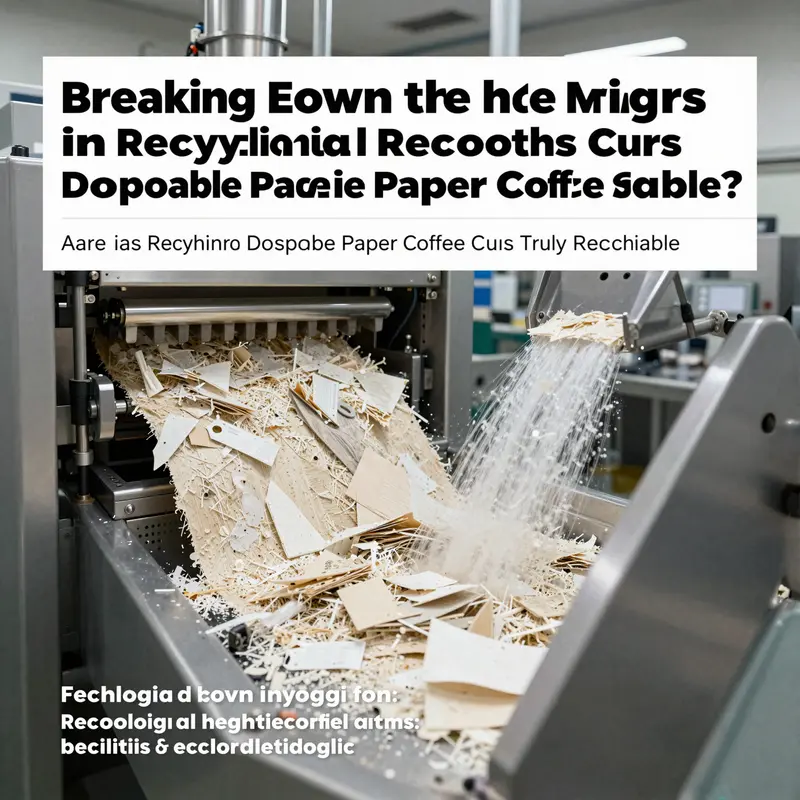
Parallel to material innovations, the evolution of recycling facilities themselves marks a meaningful leap forward. The old model—where a mixed stream of paper, plastics, and other residues was baled and shipped to faraway mills—has begun to give way to more specialized processing lines. Modern facilities are experimenting with technologies that can physically separate the paper from the polymer lining and then selectively refurbish the paper fibers. The separation step is critical; if the paper fibers can be recovered cleanly, they can re-enter papermaking loops, reducing virgin material demand and lowering the energy intensity of new cups. These processes may involve breaking the laminate under controlled conditions, using mechanical, thermal, or chemical methods to detach the layers without crippling the fiber. What makes these developments particularly promising is not just the ability to salvage fibers but the opportunity to reclaim the plastic components as separate streams that can be recycled or repurposed in ways that minimize waste. In short, the ecosystem begins to treat the cup as a modular system rather than a single, irredeemable object. The success of this approach relies on a precise choreography among design, collection, sorting, and reprocessing, a choreography that is progressively becoming achievable as throughput and accuracy in separation technologies improve.
A third pillar centers on the biochemical and chemical pathways that can unlock composites once viewed as intractable. Enzymatic deconstruction, for example, uses specialized enzymes to tease apart complex molecules in layered materials, stripping away the barriers that make conventional recycling impractical. The promise here is twofold. First, enzymatic processes can operate under milder conditions than some traditional chemical treatments, potentially reducing energy inputs and environmental footprints. Second, by breaking materials down into their basic building blocks, these methods can enable the recovery of high-purity feedstocks that are suitable for reuse in new cups or other products. Chemical recycling approaches push the envelope even further by converting mixed or contaminated streams back into monomers or other valuable chemical precursors. Rather than downgrading plastics into lower-value applications, chemical recycling aspires to reconstitute them into virgin-grade materials that meet performance standards for new packaging. Taken together, enzymatic and chemical routes widen the set of possible end-of-life trajectories, transforming a disposable object into a loop-ready resource when paired with appropriate collection systems and market incentives.
The convergence of these technological threads—material design, advanced separation, and targeted recycling processes—moves the discourse beyond a binary question of recyclable versus non-recyclable. It shifts toward a nuanced framework in which recyclability becomes contingent on a network of conditions: the cup’s construction, the capacity of local and regional facilities to process it, the clarity of labeling for downstream streams, and the economic viability of recovering and reusing the components. When these conditions align, what once appeared to be an unsalvageable item can re-enter the circular economy as a resource rather than waste. Yet alignment is not guaranteed. Real-world recyclability hinges on the interplay between innovation and infrastructure, policy and consumer behavior, and the willingness of industries to invest in new processing lines and feedstock markets. The narrative is not a triumphal parade of technologically possible outcomes, but a careful accounting of where innovation meets practical constraints and how those constraints can be surmounted with coordinated strategy.
In discussing the practical implications of these developments, it is essential to acknowledge the situational nature of recyclability. Innovations do not automatically translate into universal outcomes. A cup engineered for a particular brand’s supply chain or designed to fit the operational logic of a specialized in-store recycling program can perform exceptionally well within that constrained environment. For the average consumer relying on curbside collection, however, the odds remain heavily dependent on whether local facilities can accommodate the material in a separate stream or whether consumer labeling makes the intended end-of-life pathway clear enough to avoid improper disposal. The same technology that enables a plant-based barrier or enzymatic breakdown might not apply to every recycling plant, every automation line, or every municipal program. These gaps reveal a crucial truth: the journey from laboratory success to municipal-scale recycling is long and context-dependent. It requires not just clever chemistry or clever machinery, but a framework of standards, incentives, and education that incentivizes correct sorting and supports the logistics needed to keep streams clean and feedstocks abundant.
Within this broader context, the shift toward more recyclable cup designs often intersects with broader packaging goals. Some producers are experimenting with cup systems that minimize or even omit expensive barriers altogether, relying on durable, naturally water-resistant papers or coatings that can be separated more readily in recycling facilities. Others pursue hybrid approaches that optimize performance while maintaining recyclability in specific infrastructures. The aim is to reduce contamination risk and improve the viability of fiber recovery, while also preserving the user experience: the seal must remain leak-proof, the cup must be comfortable to hold, and the beverage must stay hot. These design criteria frequently pull in opposite directions, making the engineering challenge both pragmatic and subtle. The most compelling outcomes thus far are those that demonstrate a credible pathway to higher recovery rates without compromising consumer convenience or product safety. To achieve this, manufacturers, recyclers, municipalities, and policymakers must collaborate to align design choices with processing realities and market demand.
The practical reality for most consumers remains that a disposable paper cup is not yet a guaranteed recyclable item in daily life. The combination of a plastic lining and the lack of ubiquitous, specialized processing capabilities creates a stubborn barrier. Yet the trajectory is promising. Innovations in barrier materials and fiber-recovery technologies, combined with clearer labeling and enhanced collection practices, have the potential to move the needle meaningfully. The path forward is rarely a single miracle cure but a portfolio approach: adopting more recyclable materials where feasible, expanding dedicated recycling capacity, and embracing chemical and enzymatic recycling as complementary routes for materials that cannot be reclaimed through conventional means. When these elements coalesce, the cup becomes a signal of a more sophisticated, circular approach to packaging that treats waste as a resource rather than as a problem to be disposed of.
From a policy perspective, the emergence of these technologies often requires supportive infrastructure and clear standards. Without harmonized labeling, consistent collection streams, and predictable end-use markets for recovered fibers and polymers, even the best innovations may underperform. The tension between local capabilities and global ambitions is acute. Some regions may be able to integrate enzymatic recycling or advanced separation quickly, while others may rely on more traditional mechanical systems for longer. The challenge, then, is not only to fund and deploy new facilities but to synchronize supply chains and governance structures across jurisdictions. Harmonized definitions of recyclability, standardized testing methods, and transparent reporting on recovery rates are critical to ensuring that technological breakthroughs translate into tangible environmental benefits. Only through such alignment can the promise of these innovations be realized at scale, in diverse urban and rural contexts, and across different beverage cultures.
One practical illustration of how technology and practice intersect is the emergence of cups that are designed with recycling in mind, coupled with in-store and community recycling initiatives. In settings where cafes or retailers operate dedicated streams, the separation of water-resistant barriers from the paper can be accomplished with specialized equipment, enabling a higher-quality fiber recovery that more closely resembles virgin pulp. These pilots often hinge on straightforward operational changes, such as labeling cups with clear end-of-life instructions and providing standardized collection receptacles that keep cups segregated from mixed waste. The success of such pilots underscores an essential principle: the most transformative innovations are not only about new chemistry or new machines, but about how those tools are deployed in real-world systems that people interact with every day. Without thoughtful integration into the daily routines of consumers and waste workers, even the most elegant technologies struggle to achieve meaningful impact.
To connect these ideas to tangible choices for planners, designers, and manufacturers, consider the possibility of products engineered to accommodate a more robust value chain. Some concepts involve using barrier chemistries that can be de-laminated and recycled in standard fibers lines, while others explore wholly new pathways for the plastic component—recycling a waterproof film into high-value plastics or recovering monomers that can feed into other packaging applications. In this sense, the cup becomes a test bed for circular economy principles: it prompts designers to imagine closed-loop options and prompts recyclers to invest in capacity that makes those options practical. In practice, this means not only new materials and new processing technologies, but also new business models that reward recovery and ensure a reliable feedstock supply. It means public-private partnerships that fund pilot plants, test markets, and performance metrics that can convince investors and policymakers that these systems are viable and scalable.
The journey from today’s disposable cup to tomorrow’s circular solution is ongoing and iterative. It requires evaluating trade-offs—between barrier strength and recyclability, between consumer convenience and process efficiency, between industrial feasibility and environmental benefit. It also requires humility about what we can achieve with current technology, tempered by ambition about what is technically possible with continued investment and collaboration. The research ecosystem, including universities, industry labs, and scalable demonstration projects, is actively exploring how enzymatic and chemical recycling can complement mechanical separation to unlock the full value of cup materials. Early results suggest that a convergence of disciplines—material science, chemical engineering, waste management, and behavioral insights—will be necessary to translate promising laboratory concepts into durable, real-world systems. As researchers refine catalysts, enzymes, and reaction conditions, as facilities optimize separation lines, and as labeling and collection programs improve, the practical recyclability of disposable paper coffee cups moves from a theoretical concept into a regularly achievable outcome in a growing number of communities.
For readers who want to explore concrete examples of how these ideas are translating into real options, recent work in the field highlights the breadth of possibilities. The latest studies emphasize that even when cups are not currently widely recycled through conventional municipal programs, there are pathways—technological, logistical, and organizational—that can transform end-of-life handling in defined contexts. This is a developing story, and one that invites ongoing attention from policymakers, industry stakeholders, and everyday consumers. While the simple question—are disposable paper coffee cups recyclable?—is still answered differently depending on where you live and which facilities are available, the overarching trend is clear: technology is expanding the envelope of recyclability, and together with informed design and robust waste-management infrastructure, it is moving closer to a future where a used cup can indeed re-enter a value chain rather than become a footnote in a landfill.
As the field advances, a collaborative approach will be essential. Cup manufacturers, packaging engineers, municipal authorities, and recycling operators must share data and best practices, align on labeling and sorting criteria, and create incentives that encourage the adoption of more recyclable designs and more capable processing. The goal is not to produce an isolated success story but to establish durable, scalable pathways that reduce the environmental footprint of single-use cups across diverse contexts. In the meantime, consumers can contribute by supporting programs that clearly indicate end-of-life pathways, by choosing products designed with recyclability in mind, and by participating in collection streams that maintain material purity. Each of these actions reinforces the technology-driven trajectory and helps ensure that innovations translate into meaningful environmental benefits. The result, when achieved, is a more resilient material loop that respects the value of paper fibers while embracing the realities of modern waste management.
External resource: for a deeper dive into emerging recycling technologies and material innovations relevant to disposable paper cups, see the ongoing research summarized in the field, including work discussed in the article on advanced recycling technologies [external resource: https://www.sciencedirect.com/science/article/pii/S2352543125000278].
Internal reference (for readers seeking specific product-context examples): prospective readers may find related discussions about packaging with life-cycle considerations and design-for-recycling principles linked to industry examples such as eco-friendly, recyclable pulp-based cup holders, which illustrate how materials engineering and product design intersect in practical offerings. See https://greendispopack.com/product/eco-friendly-recyclable-pulp-2-4-cups-coffee-take-away-cup-holder/ for more on that approach.
Closing the Loop on Single-Use Cups: The Economic Reality of Recycling Disposable Paper Coffee Cups
The recyclable potential of disposable paper coffee cups is a topic that stubbornly resists neat conclusions. The marketing language around these cups often promises a simple, one-size-fits-all solution: paper cups, therefore recyclable; end of story. Yet the practice reveals a far more complex ledger, where material science, municipal logistics, and consumer behavior collide. At first glance, the cup appears to be an everyday, straightforward product: a sheet of paperboard, a modest lid, and a smooth exterior that can be printed with branding and messages. The reality, however, is shaped by a thin, crucial compromise: most cups are lined with a layer of polyethylene to keep liquids from seeping and to shield the paper from coffee stains. That plastic lining is the fulcrum of the recyclability question. In many municipal streams, the paper and plastic cannot be cleanly separated, and even when facilities claim to accept them, contamination and processing inefficiency gnaw away at any theoretical gains. The result is a paradox: a cup that is technically recyclable in some specialized contexts remains, in practice, far from a reliable recycling option for most consumers. The erosion of universal recyclability becomes most evident in in-between spaces—where cups are handled by typical curbside programs or by private waste haulers without access to advanced separation technologies. In those spaces, a significant share of disposable cups end up in landfills, where the material decomposes slowly and with nuanced environmental consequences. The simple, tidy arc: “recyclable” → “recycled” often bends into a more intricate route: “recyclable in-store or in specialized facilities,” or, more commonly, “not effectively recyclable in everyday settings.”
This ambiguity matters not only for environmental outcomes but for the economics of waste management and the business case for recycling programs. When cities and private operators commit to recycling disposable cups, they confront a balance sheet that reflects a blend of upfront costs, ongoing operating expenses, and uncertain material value. The upstream investments include improved collection systems that can capture cups at the source, and sorting facilities capable of recognizing and handling cups that have mixed fiber and plastic components. The downstream side must wrestle with market dynamics: the recovered materials from cups tend to have lower quality and higher contamination, diminishing the revenue potential and raising the perceived risk of the entire program. It is here that the EPA’s findings on contamination—where mixed waste streams can exhibit contamination rates exceeding 25%—become a sobering reality, not just a statistic. Contamination chips away at the efficiency and cost-effectiveness of recycling efforts, forcing operators to spend more on pre-sorting, cleaning, or even discarding materials that fail to meet quality thresholds. The economic calculus, thus, is not merely about whether the cup can be recycled in a vacuum; it is about whether the system in place can handle the material in a way that yields net environmental and financial benefits over time. Acknowledging this dynamic helps explain why some cafes and municipalities have experimented with in-store recycling and targeted labeling. In-store recycling systems can, in principle, separate the paper from the plastic lining through mechanical or chemical processes, enabling a closed loop that would be difficult to achieve in conventional curbside programs. Brands and operators have explored this path by establishing in-store collection points and partnering with specialized processors who have the technology to extract fiber from the plastic barrier. The practical examples of these efforts underscore a core point: the economics of cup recycling improve when the process is tightly controlled and when contamination is minimized at the source. A consciously designed system can deliver material streams of higher quality and more predictable value, though the tradeoffs are not trivial. The costs of such systems are substantial: there is the capital expenditure to set up in-store collection and separation, the operational costs of running dedicated lines, and the ongoing need for consumer education to ensure proper disposal. The benefits, in turn, include better waste diversion performance, potential savings in landfill tipping fees, and the creation of jobs across collection, sorting, and processing stages. This is where the broader macroeconomics of recycling intersect with the microeconomics of a single cup. If a city invests in the required infrastructure and fosters a culture of proper disposal, the public ecosystem can begin to capture real value from discarded cups. In some regions, this has translated into measurable job creation—an outcome supported by research indicating that recycling generates more employment per ton of material than landfilling. The social dimension—brand reputation and consumer trust—also weighs in. When a business aligns itself with responsible waste practices, it can strengthen its relationship with customers who are increasingly mindful of environmental credentials. A major coffee retailer’s promotions around reusable cup programs and recycling partnerships provide a case in point: customers respond positively to efforts that demonstrate tangible commitments to reducing waste, and those responses can manifest as loyalty and, potentially, increased market share. The link between environmental stewardship and consumer sentiment is not merely theoretical; it is a live business consideration that, in turn, feeds the economics of the recycling programs themselves.
Innovation in cup design offers a parallel thread in this economic tapestry. Designers and manufacturers have pursued fully compostable cups made from plant-based materials such as cornstarch or sugarcane. In theory, these materials can be processed in industrial composting facilities rather than in traditional recycling streams. The shift toward compostable cups represents a potential pathway to closing the loop, albeit one that comes with its own challenges. Costs rise as new materials and processes are adopted, and the success of compostable cups depends on the availability of industrial composting infrastructure and the presence of clear, effective labeling that helps consumers route cups correctly. The environmental and economic signals from these innovations are not uniform across regions. In places with robust composting networks and clear incentives for composting facilities, the transition can unlock value by aligning waste streams with appropriate end-of-life routes. In markets lacking such infrastructure, compostable cups may face the risk of ending up in landfills anyway, nullifying the intended environmental benefit and sometimes complicating municipal waste streams further if facilities misinterpret the material’s end-of-life needs. Regulatory environments also shape the economics. The European Union’s Single-Use Plastics Directive, enacted and enforced more recently, has accelerated the movement toward sustainable packaging and clearer expectations for packaging end-of-life processing. The directive has created new market opportunities for packaging manufacturers to develop materials and systems that integrate with higher-tier waste processing, such as composting and advanced recycling. While the directive is geographically specific, its ripple effects influence global suppliers, municipal operators, and national policy discussions, signaling a broader trend toward systems-level thinking about waste.
All of these strands—technological feasibility, infrastructure, contamination, consumer behavior, and regulatory context—collectively determine whether a disposable paper cup can truly participate in a circular economy. The current state is a mosaic rather than a single, unified pathway. In many everyday settings, the cup does not actually enter a recycling loop but instead becomes waste that is disposed of with mixed municipal waste. It is in this zone of practical limitation that the economics of recycling programs become most consequential. If a community lacks the necessary sorting capacity, if contaminants are not controlled at the source, or if the end-market for recovered materials is unstable, the economic case for investing in cup recycling weakens. Conversely, where a city or operator succeeds in implementing targeted programs—clear labeling, separate collection streams, and robust consumer education—the potential to extract value from recovered fibers grows. The value, however, remains conditional on the quality of the input streams and the certainty of end markets for recycled material. The EPA’s findings offer a sobering reminder that even well-intentioned programs can be undermined by contamination and logistical complexity. The numbers are not abstract: a 25% contamination rate can erode the revenue from recycled fiber, increase processing costs, and push programs toward higher tipping fees or subsidies from public budgets. In such an environment, the decision to invest in cup recycling becomes a political and administrative choice as much as an engineering one. It requires a deliberate calculation of tradeoffs: the environmental payoff of diverting cups from landfills, the financial outlay demanded by upgraded collection and sorting, and the social benefits of jobs and brand equity that can arise from a credible commitment to waste reduction. The interplay of these outcomes helps explain why many jurisdictions pursue a mixed strategy, encouraging reuse and promoting better labeling while maintaining recycling options for other components of the waste stream. The nuanced reality is that a disposable paper cup is not merely a piece of packaging; it is a node in a complex system where design, logistics, policy, and consumer habits converge to determine whether the material can truly be recaptured and reintegrated into new products.
If readers take away one practical takeaway from this examination, it is that the economic viability of recycling disposable cups hinges on the alignment of multiple components of the system. A successful program requires not just the existence of a recycling facility, but a suite of supportive conditions: source separation at the point of disposal, reliable labeling that reduces consumer confusion, adaptable collection routes that minimize transportation costs, and a consistent demand for recycled materials at competitive prices. In the absence of these conditions, the default outcome tends toward low recovery, with cups lagging behind other recyclables in terms of diversion and value. It is not sufficient to claim that cups are recyclable by label alone; the pathway to actual recycling must be demonstrated in practice, and that demonstration requires coordinated action among municipalities, waste haulers, facility operators, brands, and consumers. The promise of a closed-loop future remains alive where these actors invest in infrastructure, experiment with design, and communicate clearly about disposal. The economic case for doing so becomes more favorable as the market for recycled fiber stabilizes, as contaminants are reduced through better labeling and education, and as new materials promise to shrink the negative tradeoffs between performance and end-of-life handling. In the meantime, a practical approach for many regions is to recognize where recycling is feasible, and to invest strategically in the most impactful components of the system. For example, directing resources toward consumer education and labeling can reduce contamination more effectively and cost-efficiently than a blunt expansion of curbside programs that struggle to sort mixed streams. In-store recycling pilots, though not universally scalable, illustrate a potential model for targeted efficiency gains. These pilots show that when facilities can control the input stream and when consumers understand how to separate materials, the quality of recovered fiber increases and the economics of processing improve. The overarching narrative is thus not a simple declaration of victory or defeat for disposable paper cups; it is a recognition that true recyclability depends on a system that supports separation, processing, and markets for the recovered materials. In that sense, the cup becomes a test case for how communities translate the potential of a material into a durable environmental and economic outcome. Consumer awareness, policy signals, and corporate responsibility must co-evolve to move the needle meaningfully. If the public sees recycling as a shared responsibility rather than a passive end-stage activity, the chances of achieving real improvements grow. If businesses align product design with end-of-life realities and invest in credible collection and processing partnerships, the path toward a circular economy for single-use cup waste becomes more than an aspirational vision. It becomes a measurable objective with tangible implications for job creation, material stewardship, and the overall sustainability of our consumption system. For readers who want a point of reference beyond general discussion, consider exploring practical options that bridge everyday use with responsible disposal. The idea is not to demonize single-use cups, but to illuminate how their fate is decided by a confluence of design choices, logistics, policy, and behavior. When these elements align, recyclable in-store or specialized facility pathways can demonstrate legitimate pathways for recovery, while keeping in mind that uniform, curbside recyclability remains a work in progress in many places. To further explore practical iterations of this alignment and to see examples of how a company has approached the issue through packaging design and waste partnerships, a detailed resource on sustainable packaging and recycling progress provides broader context and data. For readers seeking a concrete example tied to the idea of improved end-of-life handling, the concept of a dedicated cup holder that prioritizes recyclability and downstream separation offers a useful model to study. Such models emphasize the importance of design for recyclability, clear labeling, and a connected network of collection and processing—an ecosystem in which the economics of cup recycling can begin to show a favorable balance between costs and benefits. In short, the economic viability of cup recycling is not a fixed property of the cup itself but a reflection of the entire system that surrounds it. Investments in infrastructure, the adoption of clearer labeling, strategic consumer education, and the development of compatible end-of-life facilities collectively determine whether disposable paper cups can move from being a potential resource to becoming a reliable contributor to a circular economy. Without these coordinated efforts, the truth remains stubbornly mundane: many disposable cups end up as waste rather than as feedstock for new products. And in that outcome lies the central economic tension of this chapter: the value of recycling is real, but it requires an ecosystem that is coordinated, adequately funded, and aligned with the material realities of the cups themselves.
For readers who wish to delve into further context on how policy and practice intersect in this space, a key external resource documents progress in recycling and composting efforts across the broader waste-management landscape. This reference helps situate the cup recycling question within the larger conversation about how communities manage materials and shape markets for recycled content. It underscores that improvements in recycling rates depend not only on technology but also on regulation, funding, and public engagement—the same forces that must converge to make paper cup recycling more than a theoretical possibility. Meanwhile, if you want a glimpse of how packaging and waste-management thinking is evolving in practical terms, exploring the linked materials about cup-related products and packaging options can be informative. A relevant internal example that captures the broader shift toward recyclable packaging, while remaining mindful of the need for appropriate end-of-life systems, is the concept of eco-friendly, recyclable cup holders designed to support better material separation at the point of use. These innovations illustrate how design decisions can complement policy and consumer behavior to improve outcomes in the near term, even as the long-term vision of a fully circular cup economy remains a work in progress. eco-friendly recyclable pulp coffee take-away cup holder
External resource: Progress in recycling and composting provides a comprehensive overview of current trends, challenges, and opportunities in waste management, including but not limited to paper-based packaging. For a concise synthesis of policy developments and practical outcomes, refer to the Environmental Protection Agency’s summary of progress in recycling and composting. This external link remains a valuable touchstone for readers seeking to connect the cup-specific discussion to the broader recycling landscape. https://www.epa.gov/sustainable-management-waste/progress-recycling-and-composting
Final thoughts
As the discussion about sustainability takes center stage in the beverage industry, understanding the limitations and possibilities surrounding disposable paper coffee cups is essential for businesses large and small. While substantial challenges exist regarding their recyclability, advancements in technology and thoughtful economic strategies can pave the way for better practices. By aligning your operations with these insights, you can contribute to a more sustainable future while also enhancing your brand reputation. Making informed choices today creates a ripple effect that benefits both the environment and your bottom line.