
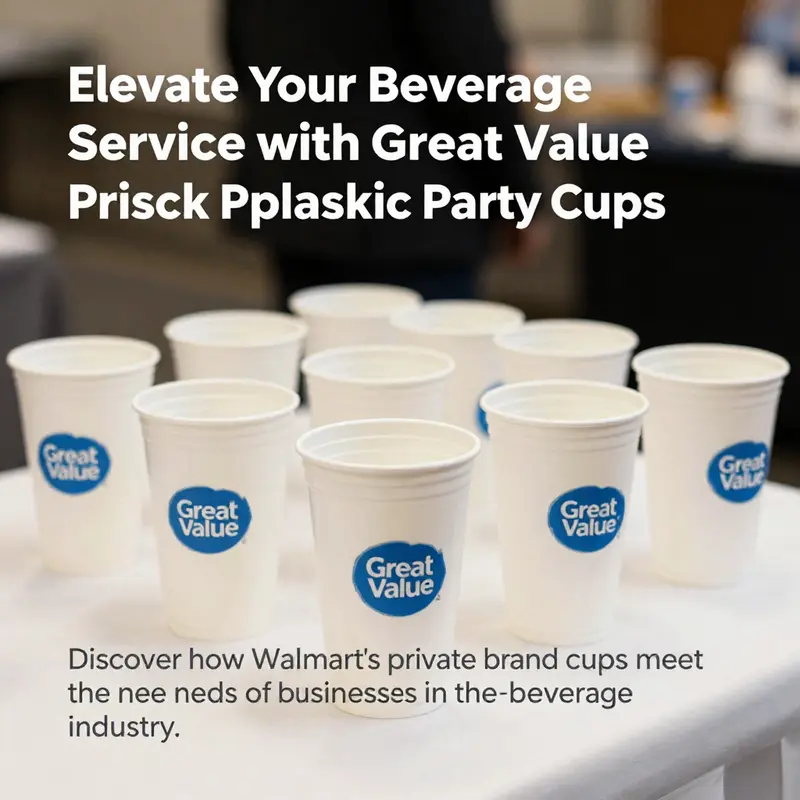
In today’s competitive beverage service landscape, providing quality products that enhance customer experience is essential. For bubble tea shops, restaurants, food trucks, catering services, event planners, and corporate procurement teams, choosing the right disposable tableware can deeply impact service efficiency and branding. Walmart’s private brand, Great Value, offers a standout selection of disposable plastic party cups tailored for various occasions and consumer preferences. This article explores the diverse product varieties available, the affordability and reliability that Great Value is known for, and the evolving consumer trends influencing disposable plastic cup choices, ensuring your establishment remains at the forefront of customer satisfaction.
Beyond the Aisle: The Private-Label Cup Palette and Its Quiet Orchestration of Everyday Celebrations

A party is more than the sum of its guests; it is a choreography of choices that begin long before the first toast and end long after the last napkin is disposed. In the retail landscape, a big-name retailer’s private-label line of disposable party cups operates as a backstage liaison between planning and performance. It does not merely supply cups; it frames the tone of an event, influences guest experience, and shapes the budgetary calculus hosts carry from the invite to the after-party cleanup. The private-brand collection sits at the intersection of practicality and presentation, offering a spectrum that spans sizes, colors, and features designed to meet a variety of casual and semi-formal occasions. In this sense, the cup chapter of a party is not a footnote but a recurring motif in how hosts translate intention into use, how hosts translate the look of an event into the feel of the beverages poured, and how a vast retail ecosystem can quietly steer cultural habits around shared moments.
What makes a private-label line particularly potent for planning is its breadth without sacrificing consistency. The line is built to cover the trajectory of everyday celebrations—from backyard barbecues and birthday gatherings to picnics and small ceremonies. A host can select among multiple sizes without leaving the aisle, and the choices are not merely about capacity. The sizes correspond to distinct serving contexts: a smaller size for tasting flights or layered mixers, a midrange cup for daily beverages, and a larger option for juice, punch, cocktails, or beer at more festive gatherings. The 8.79-ounce and 9-ounce configurations, for instance, speak to a standard of everyday utility—compact enough to discourage over-serving while robust enough to hold a generous pour. The 16- and 18-ounce variants meet the needs of extended socializing, where guests linger, refill, and share, and where the pacing of a party influences how much material is required and how quickly it disappears from the table.
Color and theme matter, not as mere decoration but as signals that help people navigate the evening. A private-brand line often includes a range of hues, from classic transparent to celebratory reds, and sometimes even seasonal or event-oriented palettes. The effect is subtle but real: color guides behavior, cues guests about the formality of the event, and helps ties the visual language of the cups to the music, lighting, tableware, and décor. A host organizing a family gathering can lean toward a bright, approachable palette that invites interaction, while the same retailer’s line can offer more restrained or metallic tones for a wedding or anniversary toast. The result is a toolkit that supports planning rather than constraining it, enabling hosts to curate a consistent vibe across beverages, seating, and keepsakes.
The practical anatomy of these cups is equally important as their aesthetic. A private-brand range typically features a variety of grip textures, which serve both ergonomic and social functions. A cup with built-in grips helps guests carry drinks without slipping on wet hands or crowded tabletops, a small but meaningful improvement in guest comfort. In more festive or late-evening events, features such as glow-in-the-dark prints or metallic rims introduce a playful or formal flair that aligns with the tone of the occasion. The concept of a silver-rimmed cup, for example, hints at a celebratory mood without the cost and fragility of fine glass, delivering a moment of refinement that is still practical for a party setting. The glow-in-the-dark option, meanwhile, can transform the night-time ambience of an outdoor gathering or a dimly lit venue, providing a touch of whimsy while maintaining ease of use and disposability. These design motifs—grips, finishes, light-emitting accents—illustrate how a single product category can carry multiple layers of meaning, from everyday utility to special-event signaling.
Packaging and quantity are not afterthoughts but core to how hosts plan around a guest list. The breadth of packaging counts—from compact 50-count bundles to substantial 2,000-count bulk options—mirrors the scale of modern celebrations. A household party may require a modest assortment of cups for a few dozen attendees, while a larger community event or a multi-family gathering can justify bulk purchases that reduce per-unit cost and simplify logistics. The private-brand strategy often mirrors the consumer’s rhythm: casual gatherings benefit from value-driven, medium-sized packs, while larger events gain choice flexibility and predictable pricing through bulk quantities. The ability to mix and match sizes and colors within the same retailer’s private-brand line also simplifies procurement. It lowers the cognitive load for hosts who would otherwise browse multiple brands or set up a separate shopping list for cups, ice buckets, napkins, and utensils.
One consequence of this breadth is the ease with which hosts can manage the presentation of beverages across different drink stations. In a single shopping trip, a host can balance a set of red cups for festive punch, a clear option for water and soda, and perhaps a specialty cup for a signature mocktail or a seasonal twist. This versatility is not merely about aesthetics; it accelerates decision-making under time pressure, a frequent reality for planners who juggle RSVPs, menus, and timeline coordination. The private-brand line, by placing a carefully curated spectrum in one place, reduces the friction that often accompanies event preparation. It becomes a practical partner that understands the psychology of hosting: when supplies are predictable, the mind can focus on guest experience, timing, and the micro-mcripts of hospitality—how long to let guests mingle, when to restock, and how to cue the moment at which the toast occurs.
A key dimension of these offerings is exclusivity, which translates into reliability for the consumer and steady demand for the retailer. The cups remain available under the retailer’s own private label, which means consistent quality across stores and a predictable supply chain. The advantage for hosts is twofold: cost predictability and assurance that replacements will be easy to source if a party runs longer than anticipated or if additional guests RSVP at the last minute. For planners who organize events for communities, schools, or clubs, this level of reliability matters. It reduces the risk that a party stalls at the moment when a fresh set of beverages is needed or when a last-minute refill becomes essential to keep the conversation flowing. This reliability extends to branding opportunities as well. Private-brand cups provide a cohesive surface for messaging that ties the event’s theme, sponsor logos, or family monograms into the social fabric of the gathering, a subtle but meaningful form of social signaling at scale.
Of course, the value proposition of a private-brand cup line is inseparable from the broader economic logic of mass retail. When a retailer owns the line, it can harmonize pricing across the product family, leverage vendor relationships for consistent production schedules, and align packaging with shelf space strategies that maximize visibility. Consumers often perceive such lines as reliable choices: a known quantity within a trusted store, with consistent quality and a straightforward procurement process. The buy-in is not only monetary but psychological. Hosts feel confident buying from a single source, confident that replacements will be available without hunting through multiple aisles or making a special trip to a specialty shop. The effect on planning is to streamline, not to overspecify; it preserves room in the budget and schedule for other party essentials—catering, entertainment, and décor—while ensuring that basic party infrastructure remains robust.
The conversation about disposables often intersects with broader questions of sustainability, consumer behavior, and the evolving expectations of hosts. The private-brand approach can incorporate sustainability narratives in several ways. It may emphasize recyclable materials, avoid unnecessary packaging, or offer limited-variation options that reduce waste. Even when the core product is a single-use plastic item, the line can reflect a sensitivity to the realities of modern consumption: finished products that are affordable, easy to dispose of, and compatible with recycling streams where local systems permit. This is not a sermon on single-use culture, but an acknowledgment that many hosts want practical solutions that do not complicate cleanup or post-event logistics. In this sense, the private-brand cup line becomes part of a larger conversation about how households balance convenience with responsibility during celebrations. It invites hosts to make deliberate choices about quantity, usage patterns, and aftercare—questions that often determine the environmental footprint of a party just as decisively as menu planning or guest lists do.
The elegance of this private-brand strategy lies in its adaptability. A host can plan a party with unwavering alignment between invitation design, table settings, and beverage presentation. The cups act as a unifying element that reinforces the event’s character while remaining pragmatic: they are easy to store, easy to transport, and compatible with a wide range of beverages. The color and finish choices function as a palette that elevates the overall aesthetic, while the functional features—grip textures, clear sides for visibility of the drink, and sturdy construction for stacking and transport—support the practical realities of hosting. The result is a consumer experience that feels curated without feeling exclusive; a sense that the host had a thoughtful plan, even as the reality of planning remains a busy, iterative process.
In the broader ecosystem of home entertaining, these cups also illuminate a cultural pattern: the democratization of celebratory rituals. Private-label lines at large retailers make it possible for communities to mark milestones, seasonal gatherings, and ordinary weekends with the same essential kit that once required a trip to specialty stores. The quantity ranges respond to varying scales of social life—small gatherings with intimate circles and large community events that demand bulk quantities—without forcing hosts into trade-offs between cost and quality. The result is a practical equality: people with different budgets can achieve a similar level of presentation, and hosts can tailor the level of formality to the occasion without sacrificing convenience.
Yet the private-brand cup line does more than accommodate existing practices. It also shapes expectations and habits. When a host repeatedly encounters an affordable, dependable option that looks polished on the table, it normalizes the idea that a party can be both economical and visually cohesive. It fosters a sense of agency in the planning process—an implicit assurance that the details will hold together, from the first beverage pour to the last cleanup. This is subtle influence, not a marketing push. It operates in the hours spent comparing shopping lists, in the quiet conversations about guest comfort, and in the small rituals of party preparation: the moment a stack of cups is chosen as a signal that the event is about to begin, or the decision to select a specific color to align with a birthday theme. In a way, the private-brand line becomes a quiet conductor, guiding the tempo of preparation and the mood of the gathering without shouting above the music.
For organizers who want to explore branding and material options in one place, there are also related products in the ecosystem of disposable tableware. The choice to branch into eco-friendly, branded paper cups with lids—though a different material category—reveals a broader trend: retailers are recognizing that events often demand multiple layers of identity, from the practicality of disposables to the branding potential of on-site customization. For those intrigued by this broader palette, there is a dedicated ecosystem of paper-based options designed for logo printing and branding. Visit the eco-friendly, printed-logo, cold-beverage paper-cup-with-lid product page to see how branding can translate from the table to the moment guests arrive. eco-friendly-printed-logo-cold-beverage-cup-paper-cup-with-lid
As hosts weigh the merits of a private-brand line, the final measure often comes down to timing, rehearsal, and the cadence of a particular event. The decision to choose a specific size, color, or finish is guided by anticipated guest behavior: how many rounds of drinks are likely, how long the gathering will last, and whether the space encourages lingering interactions or quick transitions between activities. The strength of a robust private-brand lineup is that it makes these judgments easier to calibrate. The same retailer that supplies the cups also supplies the rest of the party infrastructure—together creating a coherent ecosystem where the look, feel, and function of disposables align with the host’s ambitions. When a host can align tableware with decor, lighting, and menu flow, the party begins to take on a life of its own, one that is cohesive yet flexible enough to accommodate surprises, changes, or unplanned moments of joy.
For readers crafting their own event playbooks, the private-brand disposable cup family offers a blueprint for how to approach supply selection with confidence. Start by mapping the guest count against the expected duration of the event to identify a base range of cup sizes and counts. Consider the mix of beverages and the serving contexts: do you need a smaller option for tasting stations, a standard size for soft drinks, and a larger option for punch bowls or beer? Then turn to color and finish as a way to anchor the event’s theme. Is the vibe energetic and festive, or refined and understated? The hues and textures should echo that mood, helping guests navigate the space without overt instructions. Finally, factor in the pragmatic realities of storage, transport, and cleanup. A line designed for ease in stacking, secure lids for transport, and compatibility with common beverage types reduces friction and helps the event arrive at its natural moments—when to refill, when to transition from one activity to another, and when to toast the collective experience.
What emerges from this integration of design, function, and scale is a picture of how a single product category within a retailer’s private-label universe can influence the texture of everyday celebrations. It is not about a single moment of choice; it is about a continuum of decisions that runs from the initial shopping list to the last glass clink. It is about how hosts feel when they browse a familiar aisle and see a familiar line that promises dependable quality, predictable pricing, and a spectrum broad enough to accommodate both the simplest backyard barbecue and a modest milestone party. In that sense, the private-brand cup family is a quiet but consistent partner in the art of hosting—a reminder that great gatherings begin with small, sometimes invisible choices that set the stage for connection, conversation, and memory.
External reference for further exploration: https://www.walmart.com/browse/party-cups/204022040320404?icid=1437242:1155117
Value and Dependability in Private-Label Disposable Plastic Party Cups

When planning gatherings, from casual backyard barbecues to larger celebrations, the choice of disposable tableware can shape the budget and flow of the event. Private-label disposable plastic party cups sit at the intersection of practicality and price, offering a solution that is easy to procure and easy to use without demanding a premium. The appeal is simple: a product category that promises reliable performance at a cost that leaves room in the budget for food, drinks, and entertainment.
This is not merely about a single purchase; it is about a value proposition that retailers hope will translate into predictable consumer behavior across a wide range of occasions. In many households, these cups become a staple because they deliver what families and event planners need most: consistency, simplicity, and cost-effectiveness in one package. The result is a category that often functions as a backbone for everyday and celebratory use alike, a quiet yet crucial enabler of social gathering without the weight of a high price tag.
The most visible attributes in private-label disposable cups are their size options and bulk availability. The 18-ounce variant, available in both smaller 50-count and larger 100-count configurations, has become a versatile standard for serving a variety of beverages. Whether it is juice at a family brunch, soda at a picnic, or a casual cocktail hour, the 18-ounce format tends to balance guest satisfaction with refilling ease. The same family of products often includes a 9-ounce clear option that packs in bulk, sometimes delivered as a 2000-count bundle. This pairing mirrors real-world event dynamics: you want enough capacity to minimize refills, yet you also want options that can be deployed for different beverages, different guest groups, or different zones within the same venue.
In practice, the value proposition unfolds in several interconnected ways. First is price. The private-label cups are positioned to offer a favorable price-to-performance ratio when compared with premium alternatives. Manufacturing and packaging efficiencies translate into a lower per-cup cost that can be passed along to consumers. For households planning multiple events, even small differences in per-cup price can add up to meaningful savings. The second dimension is reliability. Reviews from many users highlight that these cups perform as expected: they hold liquids securely, resist leaking, and maintain their integrity during typical party activities. The cups’ construction—thin walls that still retain rigidity, with stable rims and solid bases—contributes to a dependable user experience and reduces the risk of spillage during transport or service.
Of course, no product is without caveats. Some consumers describe these cups as feeling slightly less sturdy than premium options. The practical impact varies with the drinking context. For water, juice, or sodas, the cups perform well; for thicker drinks or cocktails with ice, some hosts find the cups may flex more than desired when guests mix drinks aggressively or stack cups. Yet, for most everyday needs, the trade-off remains favorable: the price is lower, leaks are rare, and the cups deliver adequate performance for the majority of use cases.
Another important facet of value lies in usability and guest experience. Ergonomic grips on certain variants enhance the user experience, particularly in outdoor settings or busy events. Grips help guests keep a secure hold while walking, talking, or navigating a crowded table, reducing drops and spills and contributing to smoother event flow. The practical implications are real: less wasted drink, fewer cleanup interruptions, and more time for hosts to engage with guests.
The packaging and disposal pathways associated with private-label cups also contribute to their appeal. The ability to simplify cleanup is as important as the initial price. Disposables that are easy to dispose of align with the broader convenience narrative of disposable tableware and reduce post-event effort.
A crucial dimension of value is supply consistency. Private-label lines are designed to be readily available across retailers, helping prevent stockouts during peak seasons. The ability to rely on a vendor that delivers consistent product quality and quantity is a practical advantage when planning large gatherings on short notice or scheduling recurring events. This consistency reduces cognitive load for hosts who would otherwise check multiple sources for availability.
From a consumer psychology standpoint, affordability and reliability work together to shape purchasing decisions. When a household encounters a private-label option that delivers predictable quality at a predictable cost, perceived value grows. The decision calculus includes perceived risk of leaks or breakage and the relief of avoiding mishaps by choosing a known performer. The result is a low-stakes, high-utility choice that aligns with expectations about what a party should cost and how it should perform. The valley between price and performance becomes a strategic advantage for budget-conscious shoppers.
When hosts compare private-label cups with premium options, the conversation often shifts toward balance between budget and experience. Premium offerings may promise more sturdiness or finishes; private-label focuses on practicality: a solid, leak-resistant cup with appropriate capacity, reasonable rigidity, dependable containment, and straightforward disposal. Many families and planners favor the private-label option for value and reliability, recognizing that most guests want a comfortable drink experience and a smooth cleanup rather than a premium-brand ritual.
To meet diverse needs, there is a breadth of sizes, colors, and quantities commonly offered in private-label lines. The 18-ounce format is versatile, and color options—such as red and clear variants—provide flexibility in theming without elevating costs. The 50-count and 100-count bags are scalable for households hosting different event scales, while 2000-count bulk options appeal to organizations planning town events, schools, or clubs that require reliable supply over time. The practical takeaway is simple: match configuration to expected guest count, beverage variety, and event duration, knowing that consistency remains across the range.
In this landscape, the retailer-private strategy to offer affordable and reliable cups is part of a broader narrative about how households approach disposable tableware. The emphasis on value reflects a cultural tendency to seek practical solutions that maximize time and resources for social connection. The quiet efficiency of these cups—easy to stock, serve, and dispose of—resonates with consumers who prize straightforward, cost-conscious decision-making. The cups perform reliably across a broad spectrum of gatherings.
For organizers who host recurring gatherings, the private-label program offers a predictable supply line, a consistent user experience, and a manageable budget line. The ability to rely on a uniform product across multiple events reduces the need for repeated trials with different brands and appeals to community groups, schools, and small businesses operating on tight timeframes and procurement resources. The value proposition extends beyond the cup itself to the overall planning ecosystem it supports.
Finally, as sustainability and waste-management conversations evolve, private-label cups remain a practical choice in many contexts where budget and reliability trump sustainability concerns. While compostable or recyclable options gain attention, many households still rely on traditional disposables when budgets are tight or when cleanup resources are limited. A well-executed private-label program can contribute to a smoother event experience by aligning expectations with practical realities of hosting. It remains a pragmatic option that supports daily rhythms of social life: people want dependable servers, a price that makes sense, and a cleanup process that does not drain energy.
In sum, value for private-label disposable plastic party cups is a blend of price, performance, convenience, and reliability. When designed with practical features and offered in scalable formats, these cups become a dependable instrument in the host’s toolkit. They are a quiet workhorse of celebrations, supporting convivial moments without demanding the spotlight or a premium price tag.
Value, Convenience, and Sustainability in a Major Retailer’s Private-Label Disposable Cups

When planning gatherings, hosts often balance practicality with mood. A major retailer’s private-label disposable party cups have become a reliable option that offers durability, ease of use, and predictable pricing. The appeal lies in bulk availability, straightforward cleanup, and consistent performance across beverages, from juice to water to mixed drinks. This default choice reflects a broader shift toward convenience, where value is measured not only by unit price but by the overall purchasing experience. At the same time, rising environmental awareness is reshaping expectations: many shoppers seek recyclable or compostable options and materials with a smaller environmental footprint. The private-label line therefore faces a path that blends affordability with evolving sustainability, exploring incremental additions of greener materials and recycling-friendly options without eroding price advantages. Competition reinforces the idea that trust, reliability, and clear branding matter as much as cost. The future of these cups may hinge on thoughtful expansion into sustainable variants while maintaining the core strengths that make them a practical default for many events.
Final thoughts
Walmart’s Great Value disposable plastic party cups offer numerous benefits for businesses in the beverage industry. From their wide range of product varieties, designed for different occasions and preferences, to their affordability and reliability, these cups are a smart choice for caterers, event planners, and food service professionals. As consumer trends continue to evolve, embracing these products can enhance your service offering, ensure customer satisfaction, and maintain a competitive edge. By aligning your beverage presentation with the trusted quality of Great Value, you can better meet the diverse needs of your clientele.